
Look, throwing money at ads without a plan is a surefire way to get frustrated. For contractors, effective advertising isn’t about random spending; it’s about building a predictable system that brings in qualified leads.
It all starts with a little homework: identifying your most profitable customers, figuring out what your successful competitors are up to, and setting real, tangible goals. This groundwork is the difference between guessing and knowing your ad budget is set up for success from day one.
Build Your Advertising Foundation
Before you spend a single dollar on an ad, you need to lay a solid foundation. It’s tempting to jump straight into Google or Facebook, but I’ve seen too many contractors do this and end up with nothing but a lighter wallet. When the phone doesn’t ring, it’s usually because this crucial prep work was skipped.
Real success with contractor advertising starts with strategy, not spending. The goal here is to shift from a “spray and pray” approach to one that’s sharp and focused. That means knowing exactly who you serve, what they truly need, and where your competition is dropping the ball.
Before we dive into the nitty-gritty of platforms and budgets, let’s get these foundational pieces locked in. Skipping this is like trying to build a house on sand—it’s just not going to hold up.
Here’s a quick summary of the essentials you need to nail down before you even think about launching a campaign.
Key Foundational Elements for Contractor Ads
| Element | Why It’s Critical | Actionable Step |
|---|---|---|
| Ideal Customer Profile | Prevents wasting money on people who can’t afford you or don’t need your high-margin services. | Create a detailed buyer persona, including demographics, income, and specific service needs (e.g., “high-end kitchen remodel”). |
| Competitor Analysis | Shows you what’s already working in your market and, more importantly, reveals gaps you can exploit. | Manually search Google for your top services. Analyze the ads, offers, and landing pages of the top 3-5 competitors. |
| Clear Goals & Budget | Turns advertising from an expense into an investment with a measurable outcome. | Define a specific goal (e.g., “10 qualified bathroom remodel leads per month”) and set a starting budget you can track against it. |
Getting these elements right from the start is what separates the contractors who get a steady flow of leads from those who just burn through cash. It’s all about being intentional.
Pinpoint Your Ideal Customer
First things first: stop thinking of your target audience as just “homeowners.” That’s way too broad. You need to create a detailed buyer persona for your ideal client—the person who not only needs your services but is also happy to pay for your most profitable work.
Get specific by considering these factors:
- Specific Service Need: Are you after emergency plumbing calls, luxury kitchen remodels, or commercial roofing jobs? Each of these requires a completely different message and approach.
- Geographic Sweet Spot: Where do your best jobs come from? Pinpoint the exact neighborhoods, zip codes, or towns. There’s no point in running ads in an area you don’t want to drive to.
- Demographics: Think about home value, income level, and age. A client looking for a high-end deck build has different priorities and pain points than someone who just needs a quick fence repair.
When you get this granular, your ad copy and visuals suddenly become much more powerful. You’re no longer shouting into the void; you’re speaking directly to the people most likely to hire you.
Key Insight: Trying to advertise to everyone results in connecting with no one. A focused buyer persona ensures your marketing message resonates deeply with your most valuable potential clients, dramatically improving ad performance.
Analyze Your Competitors
Next up, it’s time to do a little recon. You don’t need fancy software for this—just some dedicated time to see what the top-performing contractors in your area are doing.
Hop on Google and search for your main services. What ads pop up? What offers are they promoting—”Free Estimates,” “10% Off,” “24/7 Service”? Pay attention to the language they use.
Then, click on their ads and check out their websites or landing pages. Are they heavy on testimonials? Do they have great before-and-after photos? Is their “Get a Quote” button front and center? Seeing their strengths tells you what the market expects, but finding their weaknesses shows you exactly where you can stand out.
The digital marketplace for contractors is buzzing. With an estimated 1.7 million online searches for independent contractors every single month, your online visibility is non-negotiable. This high search volume means there’s a massive pool of clients actively looking for your skills, and a well-planned ad campaign is essential to capture your share. For a broader look at growth, you can explore these effective small business marketing strategies.
Choosing Your Best Advertising Channels
Picking the right advertising channels is one of the most important calls you’ll make. So many contractors waste their budget on platforms where their ideal clients simply aren’t hanging out. It’s a common and expensive mistake. The best way to advertise isn’t about being everywhere; it’s about being in the right places with a message that actually connects.
Not every platform works for every trade. The channels that are a goldmine for an emergency plumber might be a complete bust for a custom home builder. Your goal is to build a smart, multi-channel strategy that snags leads at different stages of their journey—from “I need help now!” to “I’m dreaming about a future project.”
Matching Your Trade to the Platform
First things first, you need to understand the fundamental difference between the major ad platforms. Some are built to capture existing demand, while others are designed to create it.
- Demand Capture (High-Intent): This is where homeowners are actively searching for a solution to a problem. Think of a burst pipe or a broken AC unit on a hot day. The need is urgent, and they’re looking to hire someone right now.
- Demand Generation (Inspiration-Based): On these platforms, people aren’t necessarily looking for a contractor today. You’re planting a seed for future business by showing them what’s possible, inspiring them to start a project they hadn’t even considered.
A kitchen remodeler, for instance, thrives on demand generation. Jaw-dropping before-and-after photos on Facebook can spark the idea for a future renovation. On the flip side, an electrician specializing in emergency repairs needs to be on demand-capture platforms where clients are frantically searching for an “electrician near me” at 2 AM.
Google Ads vs. Local Service Ads
For most contractors, Google is the first stop. But it’s not just one thing—it offers two very different avenues: traditional Google Ads (PPC) and the newer Local Service Ads (LSAs).
Google Ads (PPC) run on a pay-per-click model. You bid on keywords like “roofing company dallas,” and you pay Google every time someone clicks your ad. This gives you a ton of control over your ad copy, the landing page you send them to, and your targeting. But it also requires active, hands-on management to be profitable.
Local Service Ads (LSAs) are much simpler. You’ve seen them—they’re the “Google Guaranteed” or “Google Screened” listings at the very top of the search results. Instead of paying per click, you pay per lead, which is a phone call or message from a real potential customer. LSAs build trust instantly with Google’s seal of approval but offer less control over how the ad looks.
Expert Takeaway: For emergency and needs-based trades (plumbing, HVAC, electrical), LSAs are often a fantastic starting point. The pay-per-lead model and top-of-page visibility are hard to beat. For project-based trades (remodeling, landscaping, custom building), a mix of traditional Google Ads and social media is usually more effective.
Leveraging Social Media for Visual Trades
Platforms like Facebook and Instagram are absolute powerhouses for contractors whose work is visual. If you’re a remodeler, landscaper, painter, or deck builder, these are your stages to shine. People scroll through these feeds looking for inspiration. A stunning kitchen transformation or a beautifully manicured backyard can literally stop them in their tracks.
Success here isn’t about the hard sell. It’s about showcasing your craftsmanship with high-quality photos and videos. If you want to dive deeper into getting set up, check out our guide on social media marketing for general contractors. This approach builds your brand and fills your pipeline with clients who are already sold on your quality before they even pick up the phone.
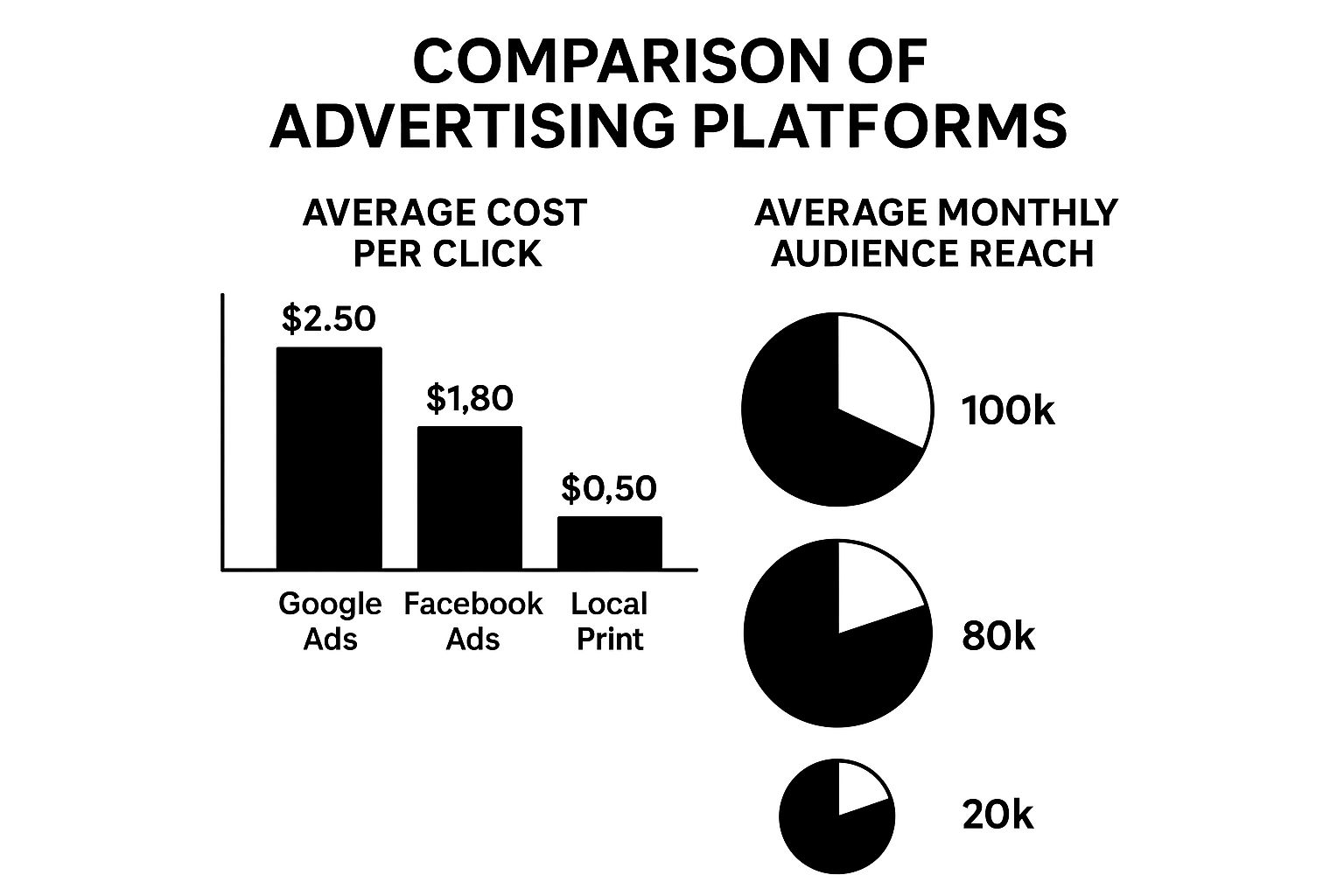
As you can see, while digital platforms like Google and Facebook offer a massive potential audience, don’t completely write off traditional methods. Print can sometimes offer a lower cost-per-impression, even if it reaches far fewer people.
The Untapped Power of Offline Advertising
Seriously, don’t sleep on old-school advertising methods. They can be incredibly effective when you do them right.
- Yard Signs: Simple. Cheap. Effective. A professionally designed yard sign at a current job site is a silent salesperson, generating super-local leads from neighbors who are seeing your quality work with their own eyes.
- Vehicle Wraps: Your truck is a mobile billboard. A clean, professional wrap with your name, what you do, and your phone number works for you 24/7, whether you’re driving down the highway or just parked at a supply house.
These offline methods create a powerful echo effect for your digital marketing. When a homeowner sees your truck in their neighborhood and then sees your ad on Facebook, it builds a sense of familiarity and trust. That makes them far more likely to call you when it’s time for their next project.
How to Set an Ad Budget That Actually Works

Let’s get right to it—the big question every contractor asks: “How much should I really be spending on ads?” Nailing this down is what separates a frustrating, money-draining expense from a predictable, job-generating investment.
A solid budget and a smart bidding plan are the fuel for everything. There’s no magic number here. Your ad spend needs to be directly tied to your growth goals and what your business can realistically handle. Just throwing money at ads without a plan is the fastest way to get nowhere.
Instead of guessing, let’s walk through a couple of practical ways to build a budget that makes sense for your trade and your ambitions.
Two Smart Ways to Set Your Budget
You can come at this from two different angles. One method is based on your overall revenue, and the other is more tactical, working backward from the specific results you want to see.
- The Percentage of Revenue Method: This is a common and solid benchmark. Most established contracting businesses will allocate 5-10% of their total revenue to their marketing and advertising efforts. If you’re a newer company or you’re in an aggressive growth phase, you might need to push that to 10-15% to really gain traction and build momentum in your market.
- The Goal-Based Budgeting Method: This approach is my personal favorite because it’s so tactical. You start with the end goal and work backward. Say you want five new kitchen remodel jobs next month. You know from experience that you close one out of every four qualified estimates, which means you need 20 qualified leads. If your average cost-per-lead on Google Ads is $75, your starting ad budget is $1,500 per month (20 leads x $75/lead).
See how that works? This method forces you to think about advertising in terms of outcomes, not just spending. It creates a direct line between the dollars you spend and the jobs you book.
Understanding Digital Bidding Strategies
Once you have a budget, you have to tell platforms like Google Ads how to spend it. This is where bidding strategies come in, and picking the right one is crucial for getting the most out of every dollar.
- Maximize Clicks: This strategy tells the ad platform to get you as many clicks as possible within your budget. It’s a decent starting point for brand new campaigns when you just need to drive traffic and gather some initial data. The downside? It doesn’t care about the quality of those clicks, so you might get a lot of tire-kickers who aren’t ready to buy.
- Maximize Conversions: Now this is a much smarter, more advanced strategy. It uses the platform’s machine learning to find people who are most likely to take a valuable action—like filling out your contact form or calling you. It requires you to have conversion tracking set up properly, but it almost always delivers a better return on your ad spend once the campaign has enough data to learn from.
For a roofer offering emergency leak repairs, a “Maximize Conversions” strategy focused on phone calls is a no-brainer. But for a high-end custom home builder looking to build their brand with a new portfolio, “Maximize Clicks” to a stunning project gallery could be a good way to start.
Expert Insight: Don’t go all-in right away. Start with a smaller test budget for 1-3 months. This lets you gather real-world data on what your actual cost-per-click and cost-per-lead are. Once you’ve proven what works, you can scale your spending with confidence.
A Quick Look at the Bigger Picture
It helps to know what you’re up against. In the United States, advertising spend makes up about 1.5% of the total GDP, which tells you it’s a very competitive space. And where is that money going? A massive 72% of it is spent on digital channels, which is exactly why your focus needs to be there. You can dig into more of these global advertising trends on Statista.com.
This digital competition means you can’t afford to waste money on the wrong clicks. You have to be precise with your targeting, and that includes using negative keywords to filter out irrelevant searches. To get a handle on this, you really need to learn all about negative keywords in PPC advertising—it’s one of the best ways to make sure your budget is only spent attracting your ideal customers.
Creating Ads That Actually Convert Homeowners
Let’s be honest: an ad that doesn’t get a click is just money down the drain. The real measure of your advertising isn’t just getting eyeballs on your brand, but inspiring homeowners to actually pick up the phone or fill out a form.
Crafting an ad that stops someone mid-scroll takes a smart mix of psychology, powerful visuals, and a message that’s impossible to ignore. It’s time to move past generic ad copy and focus on what really gets a response.
Write Headlines That Solve Problems
Your headline is your first—and maybe only—shot to grab a homeowner’s attention. Its one job? To connect with someone who has a specific problem right now. Forget vague phrases like “Your Trusted Local Roofer.” Instead, tap directly into their pain point.
Think about the conversation already happening in their head. They aren’t thinking, “I need a contractor.” They’re thinking, “This leaky roof is a disaster!” or “I can’t stand this outdated kitchen anymore.”
Here’s how to meet them where they are:
- For Urgent Needs: “Leaky Roof in Dallas? Get a Fast, Free Inspection Today.” This hits all the right notes: the problem (leaky roof), the location (Dallas), and a low-risk, immediate solution (free inspection).
- For Aspirational Projects: “Finally Get the Kitchen You’ve Always Dreamed Of.” This is perfect for visual platforms like Facebook because it speaks directly to emotion and desire, which drives big remodeling decisions.
Showcase Your Work with Powerful Visuals
In the contracting world, seeing is believing. Potential clients want proof you can deliver, and nothing builds that trust faster than showing them what you’ve done for others.
A stunning portfolio is your single greatest advertising asset. People are 90% more likely to trust and buy from a brand that’s been recommended—and your visuals are a powerful, silent recommendation of your skill.
Make these visuals the star of your ad campaigns:
- High-Quality Before-and-After Photos: This is the gold standard for remodelers, painters, and landscapers. It tells a dramatic story of transformation in an instant, saying more than a block of text ever could.
- Short, Authentic Video Testimonials: Ask a happy client to record a quick video on their phone talking about their experience. A genuine, unpolished testimonial often feels far more trustworthy than a big-budget, professionally shot video.
Create Urgency and a Clear Call to Action
Once you’ve grabbed their attention with a great headline and visual, you need to tell them exactly what to do next. This is where a clear Call to Action (CTA) and a touch of urgency come in.
Urgency isn’t about being pushy. It’s about giving homeowners a real reason to act now instead of putting it off and forgetting about you.
Combine that urgency with a clear CTA, leaving no room for confusion:
- HVAC Example: “Don’t Get Stuck in the Heat! Schedule Your AC Tune-Up Before Summer. Click to Book Now.“
- Remodeling Example: “Our Spring Calendar Is Filling Up Fast. Claim Your Free Design Consultation Before It’s Too Late. Get Your Free Quote.“
Your CTA needs to be direct and benefit-driven. Ditch “Contact Us” for action-packed phrases like “Get Your Free Estimate” or “Download Our Project Guide.” These tactics are part of a bigger picture when it comes to landing more jobs. For more ideas, you can explore our guide on how to get more clients for your home services business.
Once your ads are live, the work isn’t done. The next step is to constantly refine your campaigns using proven strategies to improve conversion rates. This ensures every dollar you spend is working as hard as possible to bring in qualified jobs.
Tracking Performance and Optimizing for Profit

Launching your ad campaigns is a huge milestone, but it’s genuinely just the start. The real profit in contractor advertising is unlocked through careful tracking, honest analysis, and constant optimization. Thinking you can “set it and forget it” is how budgets get drained with nothing to show for it.
The key is to treat your advertising like a science experiment. You have a hypothesis (this ad will get leads), you run the test (launch the campaign), and then you study the data to see what happened. This is how you turn a monthly expense into a powerful engine for business growth.
Mastering the Metrics That Matter
When you open up your Google Ads or Facebook Ads dashboard, you’ll see a dizzying amount of data. It’s easy to get overwhelmed. To stay focused, you only need to concentrate on a few key performance indicators (KPIs) at first.
These metrics tell the story of your campaign’s health:
- Click-Through Rate (CTR): This is the percentage of people who see your ad and actually click on it. A low CTR often means your ad copy or visual isn’t grabbing attention. It’s your first signal that your message might be off.
- Cost Per Click (CPC): This is simply how much you pay for each click. Your goal is to keep this as low as possible while still attracting quality traffic.
- Conversion Rate: This is the percentage of people who click your ad and then take the desired action, like filling out your “Request an Estimate” form. This metric tells you if your landing page is doing its job effectively.
- Cost Per Lead (CPL): This is the bottom-line metric for lead generation. It’s your total ad spend divided by the number of leads you received. Knowing your CPL is essential for budgeting.
While these are all important, there’s one metric that reigns supreme for any contractor.
The Ultimate Metric: Your most important number is your Cost Per Booked Job. This goes beyond just getting a lead; it tells you how much ad spend it takes to get a signed contract. It connects your advertising directly to your revenue.
This single data point helps you make smart decisions. If your cost per booked job for kitchen remodels is $500, but each job brings in $15,000 in revenue, you’d spend that $500 all day long.
Fine-Tuning with A/B Testing
Once you have baseline data, it’s time to start improving. The best way to do this is through A/B testing, also known as split testing. It sounds technical, but the concept is simple: you create two slightly different versions of an ad (Ad A and Ad B) to see which one performs better.
You only change one element at a time. For instance:
- Headline Test: Ad A might say “Expert Roof Repair,” while Ad B says “Stop Roof Leaks Fast.”
- Image Test: Ad A could feature a picture of your crew, while Ad B shows a stunning before-and-after shot.
- CTA Test: Ad A’s button might say “Learn More,” while Ad B’s says “Get Your Free Quote.”
By running these tests, you let the data tell you what your audience responds to. After a week or two, you pause the losing ad and create a new challenger to test against the winner. This cycle of continuous improvement is how you systematically lower your costs and increase your leads over time. For more on this, our guide on how marketing analytics and reporting can impact your campaign success offers deeper insights.
Calculating Your True Return on Investment
Ultimately, advertising for contractors is about one thing: Return on Investment (ROI). You need to know that for every dollar you put in, you’re getting more than a dollar back out.
To calculate your ROI, the formula is straightforward:
(Revenue from Ads - Cost of Ads) / Cost of Ads
For example, if you spent $2,000 on Google Ads in a month and booked $10,000 worth of jobs directly from those ads, your calculation would be: ($10,000 - $2,000) / $2,000 = 4. Multiply by 100 to get a percentage, giving you an ROI of 400%.
Tracking this is non-negotiable. To effectively optimize your advertising spend, robust tracking is essential. Learn how to implement effective social media campaign reporting strategies that truly drive results and give you the clarity needed to grow profitably.
Common Questions About Contractor Advertising
Even with a solid plan in hand, jumping into paid advertising can feel like a big leap. It’s completely normal to have questions, especially when your hard-earned money is on the line. We get it. Over the years, we’ve heard the same practical questions from contractors time and again.
Let’s cut through the noise and tackle some of the most common hurdles you’re likely to face. Getting straight answers will give you the confidence to move forward and make smarter decisions for your business.
How Much Should a Small Contractor Business Spend on Advertising?
There’s no single magic number here, but a good rule of thumb for established businesses is to put 5-10% of total revenue toward marketing and advertising. If you’re a newer contractor or you’re in an aggressive growth mode, you might need to push that to 10-15% to really gain traction and build momentum.
A more practical way to think about it is to work backward from your goals.
- First, decide how many new jobs you actually want to land each month.
- Then, look at your typical closing rate to figure out how many qualified leads you’ll need to hit that number.
- Finally, use the average cost-per-lead for the channels you’re targeting (e.g., $50–$150 on Google Ads) to set a realistic starting budget.
I always recommend starting with a smaller test budget for the first one to three months. This lets you gather real-world data on what your actual costs are before you commit to a bigger, ongoing ad spend.
Which Is Better for Contractors: Google Ads or Facebook Ads?
Honestly, this really depends on your trade and what you’re trying to achieve. The two platforms play very different roles when it comes to advertising for contractors.
Google Ads (and its cousin, Local Service Ads) are hands-down the best for capturing “high-intent” leads. These are the homeowners who are actively looking for your services right now. They’re typing things like “plumber near me” or “emergency roof repair” into the search bar. This makes Google the go-to platform for any needs-based or emergency service trade.
Facebook Ads, on the other hand, are all about “demand generation.” You’re showing your beautiful work to people who might not be looking for a contractor today but could be inspired to start a project. This works incredibly well for visual trades where a stunning photo can create instant desire. Think about:
- Kitchen & Bath Remodelers
- Landscapers & Hardscapers
- Custom Deck Builders
- High-End Painters
Often, the most powerful strategy is using both. You can use Google to grab the low-hanging fruit—the people who need you now—while using Facebook to build your brand, showcase your craftsmanship, and fill your pipeline for future projects.
What Is the Biggest Mistake Contractors Make with Online Ads?
By far, the most common and costly mistake is sending paid ad traffic to a generic homepage. It seems like a tiny detail, but it has a massive, negative impact on your results.
Your homepage is built to do a dozen different things. It has links to your “About Us” page, your full project gallery, your blog, and all your different service pages. A potential customer who clicked your ad for “Bathroom Remodeling” can easily get distracted, overwhelmed, and just click away.
A dedicated landing page is a standalone page built with one single, focused goal: to convert the visitor from that specific ad. It needs a headline that perfectly matches the ad, bullet points reinforcing the benefits, social proof like testimonials, and a big, obvious form or phone number to request an estimate.
Using landing pages dramatically boosts your conversion rates because you’re giving that person a clear, direct path to take the exact action you want them to. No distractions, no confusion.
How Long Does It Take to See Results from Advertising?
The timeline really depends on the channels you’re using. With pay-per-click (PPC) advertising like Google Ads, you can start seeing traffic, clicks, and even a few leads within days of launching your campaigns.
But seeing a positive return on investment (ROI)—that takes a bit more time. It usually takes one to three months to gather enough data to properly optimize your campaigns. This is the critical period for testing different keywords, ad copy, and targeting to figure out what really works. If you find your entire online strategy is lagging, it could be a sign you need help with your online presence. You can check out these 5 signs your contracting company needs help with its online presence.
For marketing efforts that are more about brand building, like organic social media or content marketing, the timeline is much longer. You might not see a significant, direct ROI for 6-12 months, because those channels work by building authority and trust over the long haul.
Ready to stop guessing and start growing with a predictable lead-generation system? The expert team at Core6 Marketing builds data-driven advertising campaigns exclusively for contractors like you. We handle the technical details so you can focus on the job site. Schedule your free strategy session today!