
Direct Answer: You own only what the agreement says you own. Your domain, website files, Google Business Profile, and Google Ads account are four separate assets, and each one needs your name on it.
I talk to contractors in Salinas, Seaside, and Watsonville who have paid for a website twice. Once to the guy who built it, and again to whoever had to rebuild it after that guy disappeared with the login.
The hard part is that ownership questions only show up when you want to leave. By then you are asking a company that just lost your business to hand over the thing that makes your phone ring.
So here are the five questions I wish every owner asked at signing instead of at the exit. Short answers, because you are probably skimming for the one that applies to you.
Who owns the contractor website and Google account after you fire the agency?
You own whatever the agreement says you own, and nothing else. That is the whole answer, and it is why the agreement matters more than the handshake.
When I look at how marketing companies serving the trades write their terms, ownership is usually the quietest part of the document. Some mention the website. Most say nothing at all about who holds the Google Business Profile or the ad account.
And I have read plenty of contractor complaints about national marketing companies that follow the same pattern: a contract that keeps renewing, a site the owner paid for but cannot move, and reports that never match the actual revenue on the books. That last one is its own problem, which is why cost per lead is the wrong number to judge marketing by.
There are four separate assets in play, and owners tend to treat them as one thing:
- The domain name
- The website itself, meaning the files, pages, and content
- The Google Business Profile that holds your reviews
- The Google Ads account and its performance history
You can own one and lose the other three. I have seen exactly that happen to a roofer who thought buying the domain meant he owned everything attached to it.
Isn’t my domain the same thing as my website?
No, and this is the mix-up I hear most often. The domain is the address. The website is the house sitting at that address.
You can own the address and still lose the house. You can also own the house and find out the address is registered to a web designer in Gilroy you have not spoken with since 2022.
Checking the domain takes about two minutes. Go to the ICANN domain lookup tool and type in your domain. It will show you the registrar, meaning the company where the name is actually registered, and when it expires.
If the registrar is a company you do not recognize, or the contact email is not yours, that is your first phone call this week.
Then ask for three things in writing, not over the phone:
- Administrative access to the domain registrar account, in your name and your email
- Admin login to the website itself
- A current full export or backup of the site, including pages, images, and content
We build on WordPress, and the clients we build for keep full ownership of the site, the content, and the data. The site is a one-time project, separate from the monthly work, and it stays theirs whether we keep working together or not.
What happens to my Google Business Profile and all my reviews?
This is the one that hurts most, because the profile carries your reviews. A contractor in Monterey County with eight years of five-star reviews has something a competitor cannot buy or copy.
There is a difference between being the primary owner of a profile and being a manager on it. The primary owner can add and remove everyone else. A manager can edit the listing and nothing more.
If someone else created your profile, you are probably a manager on your own business. Open your profile settings, look at the people and access list, and confirm which role sits next to your name before anything changes.
It matters more now than it did five years ago. Google’s own guidance for business owners is to keep profile information accurate and current, and that profile feeds both the map pack and the answers AI assistants give when a homeowner in Carmel asks who to call.
Lose control of the profile and you are not just losing a page. You are losing the evidence that makes you the recommended name, which is most of what happens when AI overviews name a contractor.
Four assets, who should hold them, and how to check today
Here is the quick version. Each check takes a few minutes and you can do all four before lunch.
| Asset | Who should hold it | How to verify |
|---|---|---|
| Domain name | You, as registrant, with your email on the account | Run a public domain lookup and read the registrar and contact email |
| Website files and content | You, outright, with admin access and a backup copy | Log in as admin and confirm you can download a full export |
| Google Business Profile | You, as primary owner | Open profile settings and check your role in the access list |
| Google Ads account | You, as owner, under your own billing profile | Check account access and whose payment method is on file |
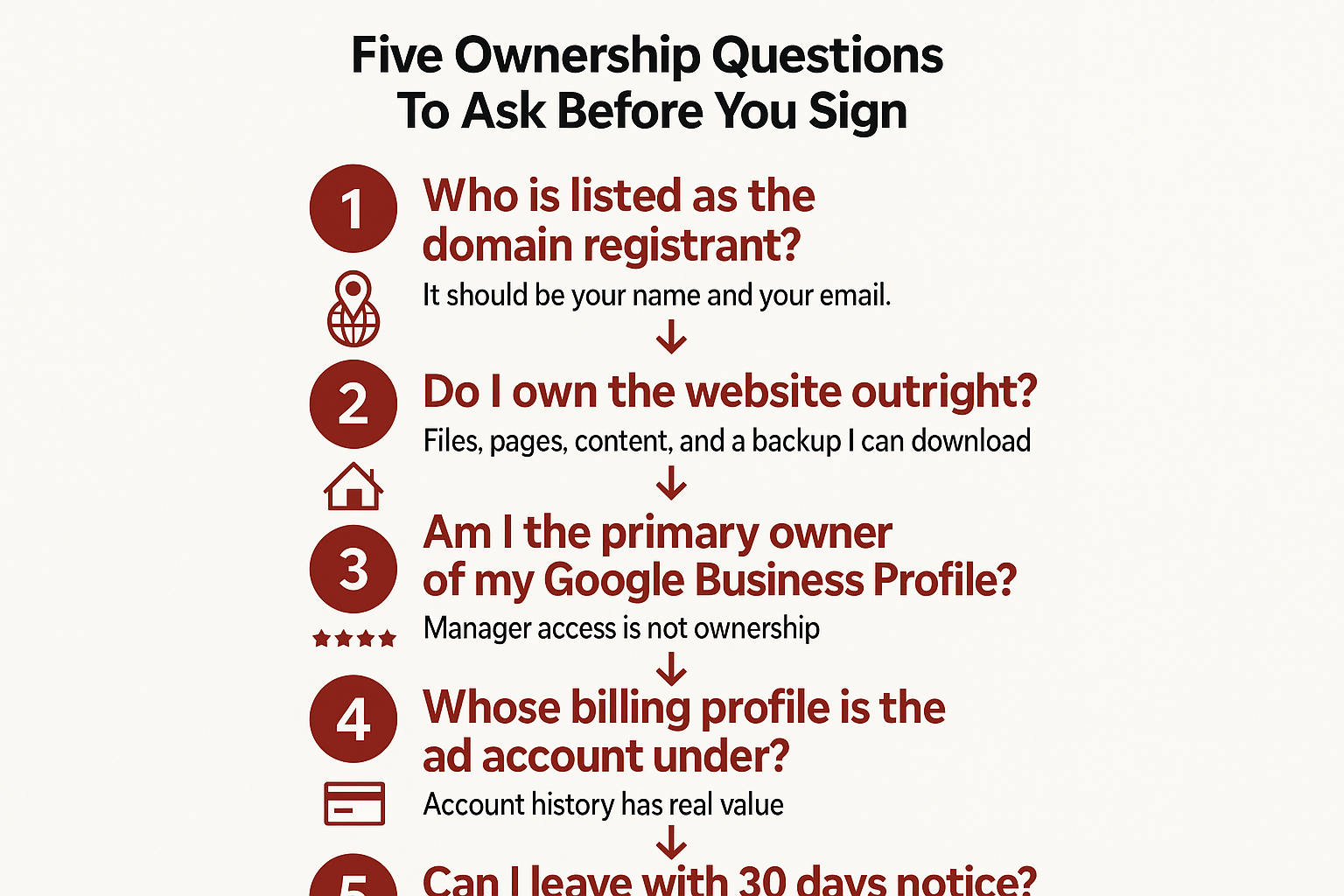
The five ownership questions to settle before the first invoice
Print this, or screenshot it and send it to whoever is pitching you next.
Can’t I just start a fresh Google Ads account?
You can. I would rather you did not, because the account you already have is carrying history, and history has value.
Inside that account sits your conversion data, your keyword performance over time, your lead records, and the signals the system uses to decide which searches to show you on. A brand new account starts with none of it.
Google also publishes a data retention policy that limits how long detailed account history is kept, so this is a practical deadline, not a legal technicality. Waiting six months to sort out access can mean the useful part is gone by the time you get in.
Two questions to ask today:
- Whose billing profile is the account under? If it is the agency’s, your payment history and spend records go with them.
- Can I be added as an owner right now? Not a manager, not read-only access. Owner.
If the answer involves a delay or a reason you cannot be added, you have learned something useful about the relationship.
What do good terms actually look like?
Not a comparison, just a checklist. Any marketing company worth hiring should be able to say yes to all of these without checking with legal.
- Month to month from day one. No annual term, no automatic renewal window you have to catch.
- You own the website outright, including content and data, and the site is a separate one-time project from the monthly work.
- You are the primary owner of the Google Business Profile and the ad account, with the agency added as a manager.
- The domain stays registered to you, at a registrar you can log into.
- The work is done by people you can reach, not passed to a subcontractor you never meet.
That last one shows up in reviews more than anything else. One client put it plainly: “He explains everything in detail and also will provide videos making communication easy.” Clear explanation and fast answers are usually what ownership questions are really testing for.
We run month to month, the client owns the site, and the work happens here on the Central Coast with our own team. If you are weighing a change, it is also worth knowing what happens to your rankings when you rebuild your site so the move does not cost you visibility you already paid for.
Frequently Asked Questions About Website and Google Account Ownership
Can an agency legally hold my website hostage?
It depends entirely on what you signed. If the agreement says they own the site or license it to you monthly, they can stop providing it when you stop paying. Read the ownership and termination sections before you sign anything, and if those sections do not exist, ask for them to be added in writing.
My old web guy has not responded in four years. What now?
Start with the domain lookup, because that tells you which registrar holds the name. Most registrars have a process for recovering an account when you can prove the business is yours, using business filings and a matching email domain. It is slow but it works, and it beats rebuilding on a new domain and losing the search history attached to the old one.
If I switch agencies, do I lose my Google reviews?
Not if you hold primary ownership of the profile. Reviews live on the Business Profile, not with whoever manages it. Problems happen when the agency created the profile under their own account and never transferred it.
Does the agency own the blog posts and service pages they wrote for me?
Again, it comes down to the agreement. Some companies treat written content as licensed work that leaves when you do. Ask specifically whether content ownership transfers to you, because a site stripped of its pages ranks about as well as a blank one.
What should a Monterey County contractor expect to pay to rebuild a site they already paid for?
Website cost varies a lot based on how many pages, service areas, and service lines are involved, so I will not throw a number at you. What I can say is that a rebuild is a one-time cost separate from any monthly marketing work, and the exact figure comes after a look at your current site. Avoiding a second rebuild is the whole reason to settle ownership up front.
Want your ownership questions answered before anything is signed?
Most Monterey County owners I talk with have never been walked through who holds what, and it takes about fifteen minutes to sort out. A strategy session covers where your demand comes from, where revenue is slipping, and whether your territory is still open, and we go through the ownership checklist while we are at it. You can reach the Core6 Marketing office at (831) 789-9320 if you want to start there instead.