
Direct Answer: A missed call during your posted hours can now be billed as a valid lead if the caller stays on the line long enough. The ring itself costs money, not just the lost job.
Most owners I talk to still think a missed call is a lost opportunity and nothing more. The phone rings while you’re under a house in Marina, it rolls to voicemail, and you figure the worst case is the homeowner calls the next guy.
That math changed. Reporting across the trades says a missed call during your posted business hours can now show up as a billed lead on your Local Services Ads invoice, whether or not anyone ever picked up.
So the ring itself has a price. Below I’ll walk through what reportedly changed, how it collides with the answer rates most small shops in Monterey County actually run, and the handful of settings and habits worth fixing this week.
What Changed With Local Services Ads Missed Call Charges
This is a different question than the migration itself. I already covered the move in Google Is Moving Local Services Ads. What Central Coast Trades Should Check, so here I’m only dealing with the billing side.
Multiple trade outlets reported in late August and September 2026 that, as of October 1, 2026, the rules for what counts as a chargeable lead tightened. The pieces that matter most to a small shop:
- A missed call during your stated business hours can be charged as a valid lead when the caller stays on the line longer than roughly 20 seconds.
- If you run an IVR or phone menu, a key press reportedly restarts that timer, so the caller sits through your greeting and the clock begins again.
- Follow-up contact with the same customer inside about a 15 day window is charged once, not every time they reach out.
I want to be straight about the sourcing. Those specifics come from trade press, not from a page Google published with those numbers side by side. Before you plan around any of it, read Google’s own help documentation on the Local Services Ads transition and check the current billing language yourself.
The practical takeaway holds either way. Hours you post are hours you are financially on the hook for.
A Normal Tuesday for a Two Truck Shop
Picture a plumbing outfit running two trucks out of Salinas, covering the valley down to Soledad and over the hill to Hollister when the work justifies the drive.
The owner is on a repipe by 7:30. His one office person works 9 to 2 because that’s what the budget allows. Calls land at 7:15, at 11:40 while she’s on another line, at 2:30 after she leaves, and at 6:10 when both trucks are still out.
Call tracking vendors published benchmark numbers in July 2026 putting the average human answer rate for inbound home services calls around half, with HVAC reported as low as the mid 30s. Older field software data showed small shops booking a much smaller share of after 6 p.m. calls than they do at midday.
Treat both of those as what they are. Those figures come from companies that sell call handling products, so the incentive runs toward showing a problem. Even cutting them in half, the gap is real on every shop I’ve looked at in this county.
Here is where the money actually leaks:
- Before 8 a.m., when crews are loading and nobody is at a desk
- Mid-morning overlap, when one person is already on a call
- After 2 or 3 p.m., when office coverage ends but the profile still says open
- Evenings, when emergency calls come in and roll straight to voicemail
The fix is not a bigger ad budget. It’s deciding who picks up between 7 a.m. and 7 p.m., and what happens to the ones that still slip.
What a Missed Call Could Cost, by Trade
A vendor benchmark published in September 2026 reported 2026 cost per lead figures by trade. Treat these as general market context, not as what any specific Monterey County company pays. Your real number depends on your trade, your service area, and how much competition is bidding against you.
| Trade | Reported 2026 benchmark cost per lead | Rough cost of 5 missed calls in a month |
|---|---|---|
| Roofing | Near the top of the range, around the high $100s | Somewhere near $900 or more |
| Plumbing | Around the mid $60s | Roughly $325 |
| Electrical | Around the low $40s | Roughly $210 |
| Landscaping | Reported up sharply year over year, no figure I’d stand behind | Depends entirely on your market |
| Cleaning services | Also reported up sharply year over year | Depends entirely on your market |
Your Posted Hours Are a Budget Decision Now
A lot of owners widened their hours years ago because somebody told them it helped visibility. If the profile says open and the phone says voicemail, you are now paying for that gap.
There’s a second piece that makes this sting more. Google stopped automatically crediting out of area leads and wrong service type leads back in 2024. So two of the three most common junk lead categories already had no easy appeal, and the missed call rule adds a third.
The same week you read this, pull up three things and look at them honestly:
- Posted hours. Do they match hours a human being is actually reachable? Not hours you’d like to be open. Hours somebody answers.
- Service area shape. If your polygon stretches from Carmel Valley to King City because you took one job down there in 2023, you’re inviting calls you can’t profitably run. I wrote more about drawing that boundary in No Storefront, Big Service Area: What That Should Look Like Online.
- Job type list. Every box you leave checked is a category of call you’ve agreed to pay for. If you don’t do water heater swaps anymore, uncheck it.
Narrower and accurate beats wide and aspirational. Every time you widen one of those three settings without adding coverage, you’re buying calls you won’t answer.
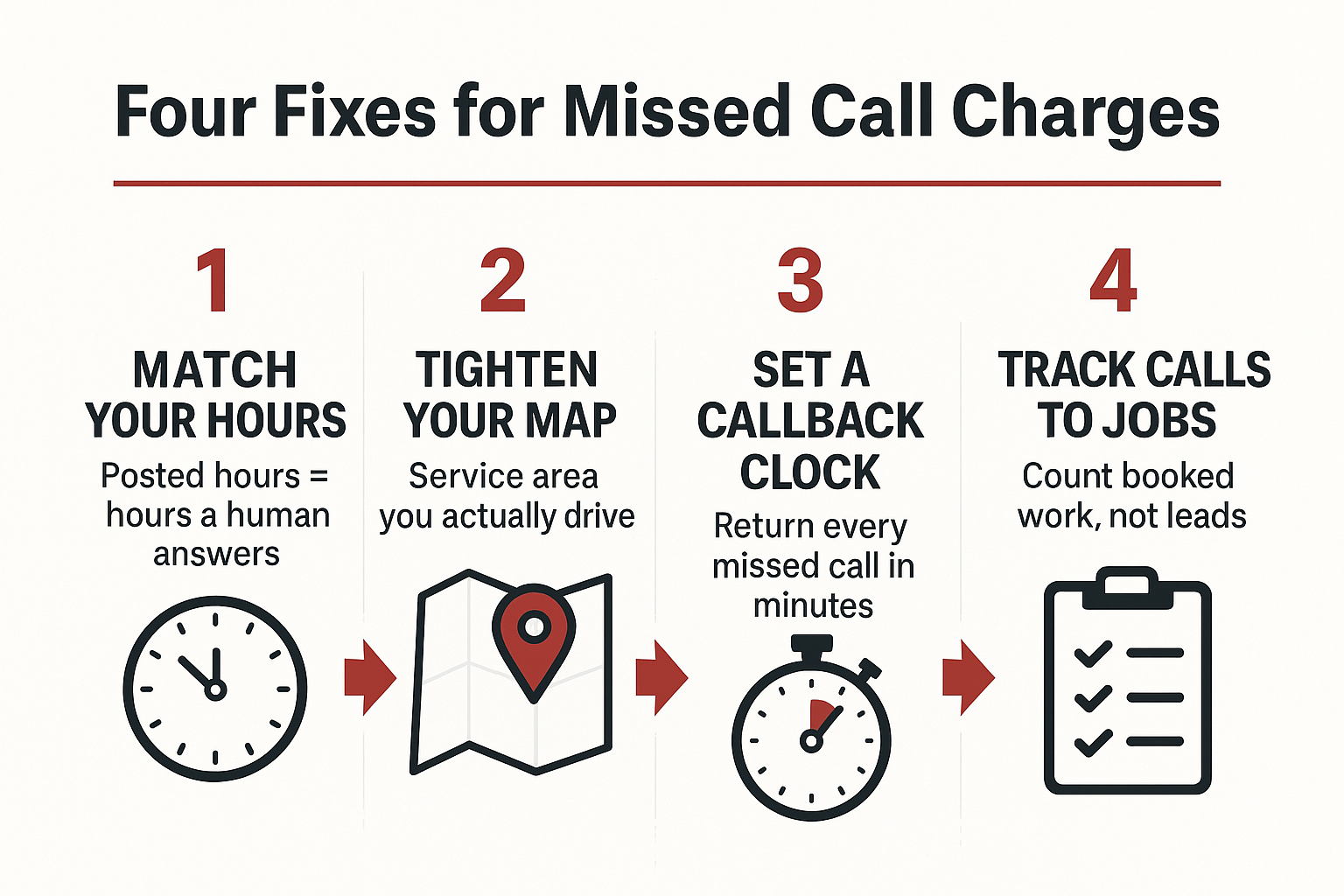
The Four Settings and Habits to Fix This Week
This is the sequence I’d run through with an owner who only has an hour to spend on it.
Count Cost Per Booked Job, Not Cost Per Lead
I get a version of this question constantly from owners on the Peninsula deciding whether to keep the channel running through a slow winter. The lead price feels high, so they want to shut it off.
A lead price on its own tells you almost nothing. It only means something next to how many of those leads turned into invoices.
Run your own number instead:
- Total spend on the channel last month
- Divide by jobs booked from it, not leads received
- Compare that to your average ticket in that service line
A roofing lead in the high $100s looks brutal until you close one in four and your average job is five figures. A cleaning lead at a fraction of that looks cheap until you realize half of them never answered the callback.
That’s the whole argument I made in Cost Per Lead Is the Wrong Number to Judge Marketing By. Missed call billing just makes the gap between the two numbers wider, because now the calls you never worked still land on the invoice.
What You Can Actually Control
You can’t negotiate the billing rule. You can move your answer rate, and that’s the lever with the most money attached.
Practitioners who work in this channel day to day consistently point to responsiveness as the input with the most influence on where you show. The common observation is that missed calls get weighed for something like 90 days, so a rough month follows you into the next one. That’s field observation from people running these accounts, not a figure Google publishes.
Four things to change on Monday:
- Match posted hours to real coverage. If nobody answers after 4 p.m., say 4 p.m.
- Set a callback standard in minutes, not hours. Fifteen minutes is a standard. “When I get off the roof” is not.
- Decide who answers after hours. A rotating crew phone, a spouse, a service, somebody. Just decide, and make sure that person can give a real answer on price range and timing.
- Track which calls became jobs. Without that, you’re guessing about the only number that matters.
Those calls are also the best content source most shops are sitting on, which I covered in Your Phone Calls Are the Best SEO Content You’re Not Using.
The Conversion Intelligence side of our program is built around showing owners exactly where calls stall and which questions keep coming up before people book. The team still does the closing. We just help them see what they’ve been missing.
Frequently Asked Questions About Local Services Ads Missed Call Charges
If I never pick up, how is that a lead I should pay for?
That’s the reaction every owner has, and I get it. The logic on Google’s side is that the ad worked: a homeowner with a real problem found you and called during hours you said you were open. The charge is for the connection, not the conversation. Whether you agree or not, the way to control it is coverage, not complaint.
Can I still dispute bad leads?
Some categories, yes. But out of area and wrong service type leads stopped being automatically credited back in 2024, which removed the two easiest appeals. Check the current dispute rules in Google’s help documentation, because this area has moved more than once in the past two years.
Does a phone menu protect me?
Reportedly the opposite. Trade coverage says a key press on an IVR restarts the qualifying timer, so a caller who sits through your menu and presses a number may push past the threshold before a human ever gets on. If you run a menu, keep it short.
Should I just shrink my hours to the minimum?
Not automatically. Shrinking hours cuts your exposure but also cuts the window where you can win work, and emergency calls at 6 p.m. are often the best jobs of the week. The better move is figuring out what after hours coverage actually costs you versus what those jobs are worth, then setting hours to match the answer.
Does any of this affect my regular Google Ads or my organic rankings?
The billing rule is specific to the Local Services Ads side. But answer rates and response speed show up everywhere, including in how homeowners rate you and how your reviews read. A pattern of unreturned calls has a way of ending up in writing.
Want a Clearer Read on Where Your Calls Are Going?
If you run trucks anywhere from Salinas to the Monterey Peninsula and you’ve got a sense that calls are slipping through without knowing where, a strategy session with Phil Fisk is a straightforward way to look at it. We review where your demand comes from, where revenue is leaking, and whether your territory is still open. You can reach the office at (831) 789-9320 Monday through Friday.