Direct Answer: If your site’s content could belong to any contractor in any city, it’s likely hurting your rankings. Generic AI-generated pages trigger algorithmic penalties and suppress clicks from AI Overviews.
A lot of contractors on the Central Coast have more content on their site than they realize. Blog posts, service pages, city pages, sometimes dozens of them, published over the past year or two by an agency working on their behalf. The problem is that much of that content may be working against them, not for them.
AI-generated content that looks professional on the surface but says nothing specific is what Google now classifies as scaled content abuse. When a site has too many of those pages, rankings compress, clicks drop, and AI-powered search tools stop citing the business altogether. I’ve seen this happen to contractors in Salinas, Seaside, and across Monterey County who had no idea their own site was the issue.
This list walks through the clearest warning signs, what to look for, why each one hurts, and what the measurable consequences actually are. If any of these match what you’re seeing on your site, you’ll know exactly where to start fixing it.
1. Your Pages Could Belong to Any Contractor in Any City
This is the single most common problem I find when I audit a contractor’s site. Read your service pages out loud. If you could swap your business name for a competitor’s name in Fresno or Phoenix and nothing would change, the page has no local grounding.
Google’s guidance on scaled content abuse is direct: pages generated at volume without adding real value for users can trigger manual or algorithmic action. The clearest warning signs on a contractor site include:
- Pages that open with phrases like “our team of experienced professionals is committed to quality service”
- No mention of specific neighborhoods, job types, or local conditions
- No photos of actual work done in your service area
- Descriptions that match every competitor in the category word for word
This kind of content does not tell Google anything it cannot find on 500 other contractor sites. And it tells AI tools like ChatGPT and Perplexity even less, because those systems are looking for specific, citable detail, not reassuring generalities. I wrote more about what AI-powered local SEO actually checks before recommending a contractor if you want to understand how those systems make their decisions.
2. Your City Pages Are Just Copy-Paste With a Different Location Name
City-swapped pages are everywhere right now. An agency builds one solid page for “plumber in Salinas,” then clones it twelve times by replacing the city name, Monterey, Marina, Watsonville, Seaside, while the rest of the text stays identical.
This approach worked in 2018. It does not work now. Google’s systems are good at detecting near-duplicate content across a domain, and city pages that differ only by location name are a reliable signal of thin, scaled content.
What a legitimate city page needs:
- A specific job story or project detail from that area
- A reference to local conditions that actually affect the work (coastal salt air, the Salinas Valley’s clay soil, the age of housing stock in Pacific Grove)
- Service area detail that a real local contractor would know, not just the ZIP code
A roofing contractor who explains why homes in Carmel Valley face different moss and moisture issues than homes two miles down the hill in Carmel has something to say. A page that says “we provide roofing services in Carmel Valley” does not.

3. Your Blog Posts Answer Generic Questions With No Local Proof
Blog content is where AI slop contractor marketing does the most quiet damage. An agency using AI tools can publish 17 posts a month at around $131 per post, compared to roughly $611 for human-written content. That math is compelling for agencies trying to keep margins up. But the content that comes out of that process tends to be technically readable and completely empty.
A post titled “How Often Should You Service Your HVAC System?” that gives the same answer you’d find on any manufacturer’s FAQ page does two things. First, it gives Google nothing it hasn’t already indexed hundreds of times. Second, and this is the consequence most contractors don’t anticipate, it gets absorbed by AI Overviews.
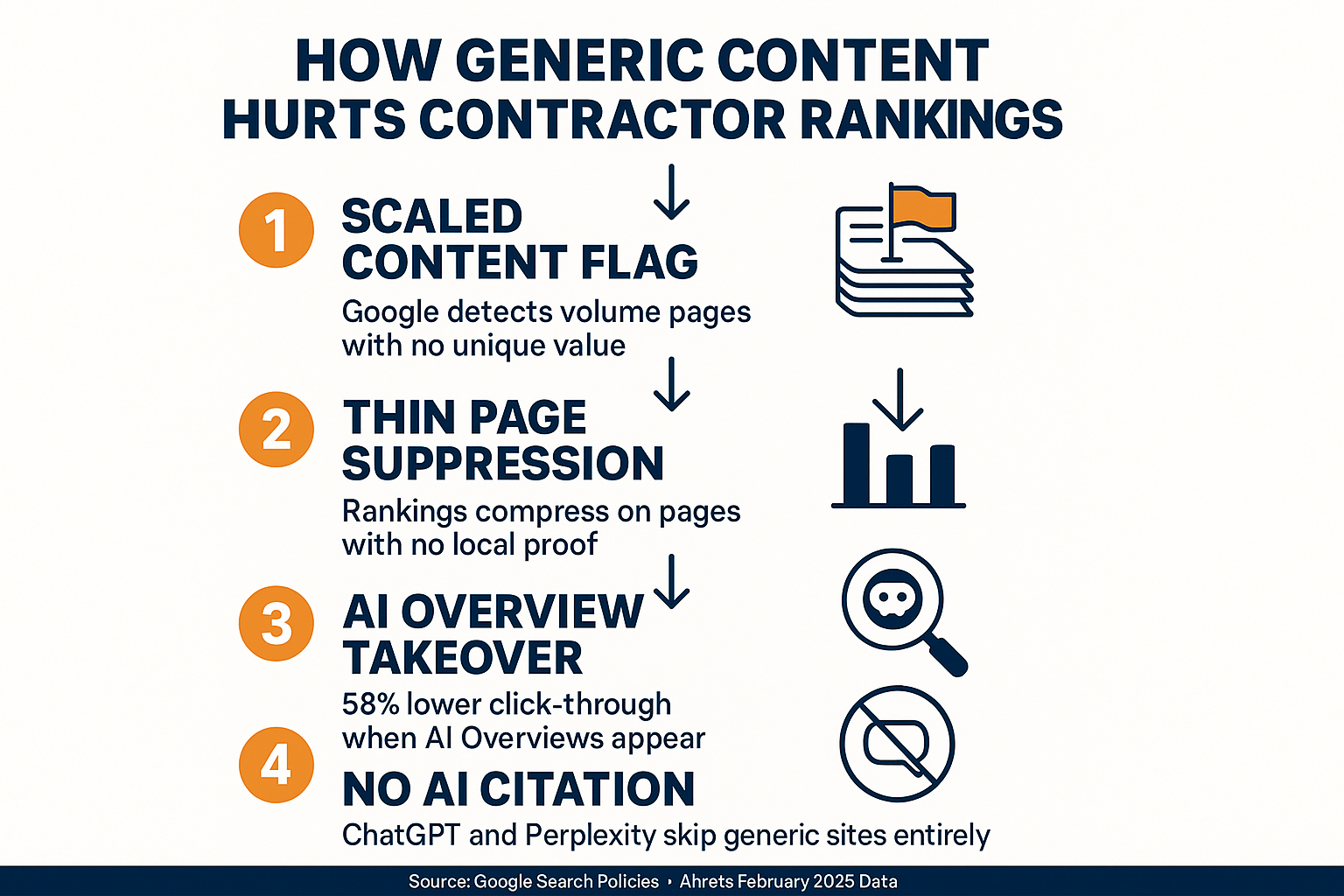
Ahrefs’ February 2026 data found that AI Overview presence correlates with a 58% lower average click-through rate on top-ranking pages. Generic informational content is the most exposed category, because AI Overviews summarize the answer and remove the need to click. If your blog posts are answering common questions with no local specificity and no real job experience behind them, you’re building content that AI will harvest and then cut you out of entirely.
What actually gets cited by AI tools is content like: how Central Coast fog and salt air near the Monterey Bay waterfront affect HVAC system lifespan, or why homes built in Salinas before 1980 have specific wiring concerns that newer homes don’t. That’s content with a point of view. The content you’re already sitting on is exactly this kind of local, specific detail, most contractors just haven’t written it down yet.
The Ranking Consequences of Generic Content at a Glance
This infographic breaks down the four ways generic AI content affects a contractor site’s search performance, from Google’s content quality signals to click loss from AI Overviews.
4. Your Agency Is Publishing Content You’ve Never Reviewed
This one is harder to talk about, but it comes up regularly. 87% of marketers now use AI to help create content, according to Ahrefs’ 2025 survey. A lot of agencies have built their entire content workflow around AI tools because the economics make sense on their end. The problem is that the output often goes live on client sites without the client seeing it first.
I’ve audited contractor sites in Monterey County where the client had no idea 30 or 40 blog posts existed. The posts were technically published under their domain, written by their agency, and doing quiet damage to their rankings.
If you’re paying an agency for SEO or content, you should be able to answer these questions:
- What was published on my site last month?
- Did I review it before it went live?
- Does any of it reference a real job my company did, a real customer scenario, or a real local condition?
If the answer to the last question is no, that’s the problem. 5 signs your marketing agency is filling your site with AI slop goes deeper on how to recognize when this is happening.
Generic Content vs. Locally Grounded Content: What Each One Looks Like
Here’s a quick comparison of what generic AI content looks like next to the kind of locally grounded content that actually earns rankings and AI citations.
| Content Element | Generic AI Version | Locally Grounded Version |
|---|---|---|
| Service page opening | “Our team of experienced professionals delivers quality results.” | “We’ve been replacing water heaters in Salinas since before the 2010 housing boom, here’s what Monterey County homes typically need.” |
| Blog post topic | “How to Choose the Right HVAC System” | “Why Coastal Fog Near the Monterey Bay Shortens HVAC Coil Life by 20-30%” |
| City page content | “We provide plumbing services in Seaside, CA.” | “Older homes near Broadway Ave in Seaside still have galvanized pipes, here’s what that means for your water pressure.” |
| Customer proof | “Our customers love us!” | “A homeowner in Pacific Grove called after reading our post on salt-air corrosion, she said it was the reason she picked up the phone.” |
| AI citation potential | Low, summarized and skipped | High, cited as a specific local source |
5. Your Traffic Looks Fine But Calls Have Dropped
This is the signal most contractors miss because they’re looking at the wrong number. An agency shows them a traffic report. Sessions are up. “Things are working.”
But calls are flat or down. And the calls that do come in are lower quality, people shopping price, wrong-service inquiries, or callers who seem uncertain about what the company even does.
What’s often happening is that AI Overviews are answering the generic questions your content was targeting, and the people who actually need to hire a contractor are getting their informational questions resolved without ever visiting your site. The only people who click through are the least-ready ones.
Reviews from contractors’ clients tell a different story when the content is right. Homeowners who mention reading a specific blog post before calling are a direct signal that locally grounded content is doing real work. Your customers already wrote your best SEO content, their language, their specific concerns, their descriptions of the job, is exactly the kind of detail that pulls ready-to-hire callers, not just browsers.
The fix is not deleting AI content wholesale. It is adding what only your company can supply: specific jobs, real customer scenarios, photos with context, and local conditions that your competitors in another county would have no reason to know about. That’s the content that AI Overviews name contractors for, and it’s the content worth building.
Frequently Asked Questions About AI Slop Contractor Marketing
How do I know if my site has been flagged for scaled content abuse?
You may not get a direct notification. The clearest signs are a sudden drop in rankings across multiple pages at once, declining organic traffic over 3-6 months with no obvious cause, or pages that used to rank on page one now showing up on page three or four. Google Search Console can show you which pages lost impressions, if it is mostly blog or city pages, that is where to look first.
Does all AI-generated content hurt rankings, or just some of it?
AI-assisted content is not automatically a problem. The issue is AI content that adds no real value, pages that could have been written about any contractor in any market. If AI helps you write faster but the final content includes specific local jobs, real customer scenarios, and trade-specific detail your company can actually verify, it is far less exposed. The problem is volume-first publishing where specificity was never added.
My agency says they’re doing SEO. How do I know if the content they’re publishing is generic?
Ask them to show you the last three pieces of content published on your site. Read them and ask yourself: does any of this mention a real job we did, a real neighborhood we work in, or a real condition specific to Central Coast homes? If the answer is no, ask them directly how they’re adding local detail. If they cannot answer that clearly, what happens to contractor websites stuffed with AI content is worth reading before your next agency conversation.
Will fixing my content recover my rankings quickly?
It depends on how much generic content is live and whether your site has received a manual action. For most contractors, adding locally grounded content to existing pages and publishing new posts with real job specificity starts showing ranking movement within 30 to 60 days. Recovering from a manual action takes longer and requires a reconsideration request through Google Search Console.
What kind of content do AI tools like ChatGPT and Perplexity actually cite?
They cite content that is specific, attributable, and locally credible. A post explaining why homes in Marina built on sandy soil near the dunes have different foundation drainage concerns than homes on the Monterey Peninsula hillside is the kind of content an AI system can point to as a real local source. Generic content with no verifiable detail gets summarized or skipped entirely. Why Perplexity pulls live data on contractors explains the mechanics behind how those recommendations get made.
Want to Know If Your Site Has This Problem?
If you’re a contractor in Monterey County and your calls have gone quiet while your traffic looks fine on paper, the content on your site is worth a hard look. Phil Fisk works directly with a small roster of Central Coast contractors and can walk you through what’s on your site and what it’s actually doing for your rankings. Book a 30-minute discovery call at https://calendly.com/core6-marketing/30min, no agency pitch, just a straight answer on where you stand.