Direct Answer: Contractor marketing on the Monterey Bay Area in 2026 means getting found by AI search tools, not just Google Maps. The contractors winning jobs have better business information online, not bigger budgets.
I’ve been watching contractor marketing on the Central Coast long enough to know when something has actually changed and when it’s just noise. What happened between 2024 and mid-2026 is not noise. The way homeowners in Salinas, Monterey, and Watsonville find a contractor has shifted in a way that most business owners haven’t caught up to yet, and that gap is costing real jobs.
The frustration I hear most often from contractors isn’t that marketing doesn’t work. It’s that they’ve paid for marketing that produced reports full of impressions and clicks but almost nothing in the call log. That’s the gap this article is about. What does contractor marketing on the Monterey Bay Area actually need to produce in 2026, and what does it take to get there?
I’m going to focus on two things: where homeowner discovery actually happens now, and why the competitive gap on the Central Coast comes down to information quality, not ad spend. Those two points explain most of what I see working and most of what I see failing.
Where Homeowner Discovery Actually Happens Now
For years, the front door for contractor leads on the Central Coast was the Google Maps 3-pack. A homeowner in Pacific Grove needed a plumber, typed something into Google, and called one of the first three results. That model still exists, but it’s no longer the whole picture.
BrightLocal’s 2026 Local Consumer Review Survey found that consumer use of AI tools for local business recommendations jumped from 6% to 45% in a single year. That is not a gradual shift. When nearly half of local searchers are now asking ChatGPT, Perplexity, or Google’s AI Overviews which contractor to call, the rules about what makes a business visible have changed underneath contractors who weren’t looking.
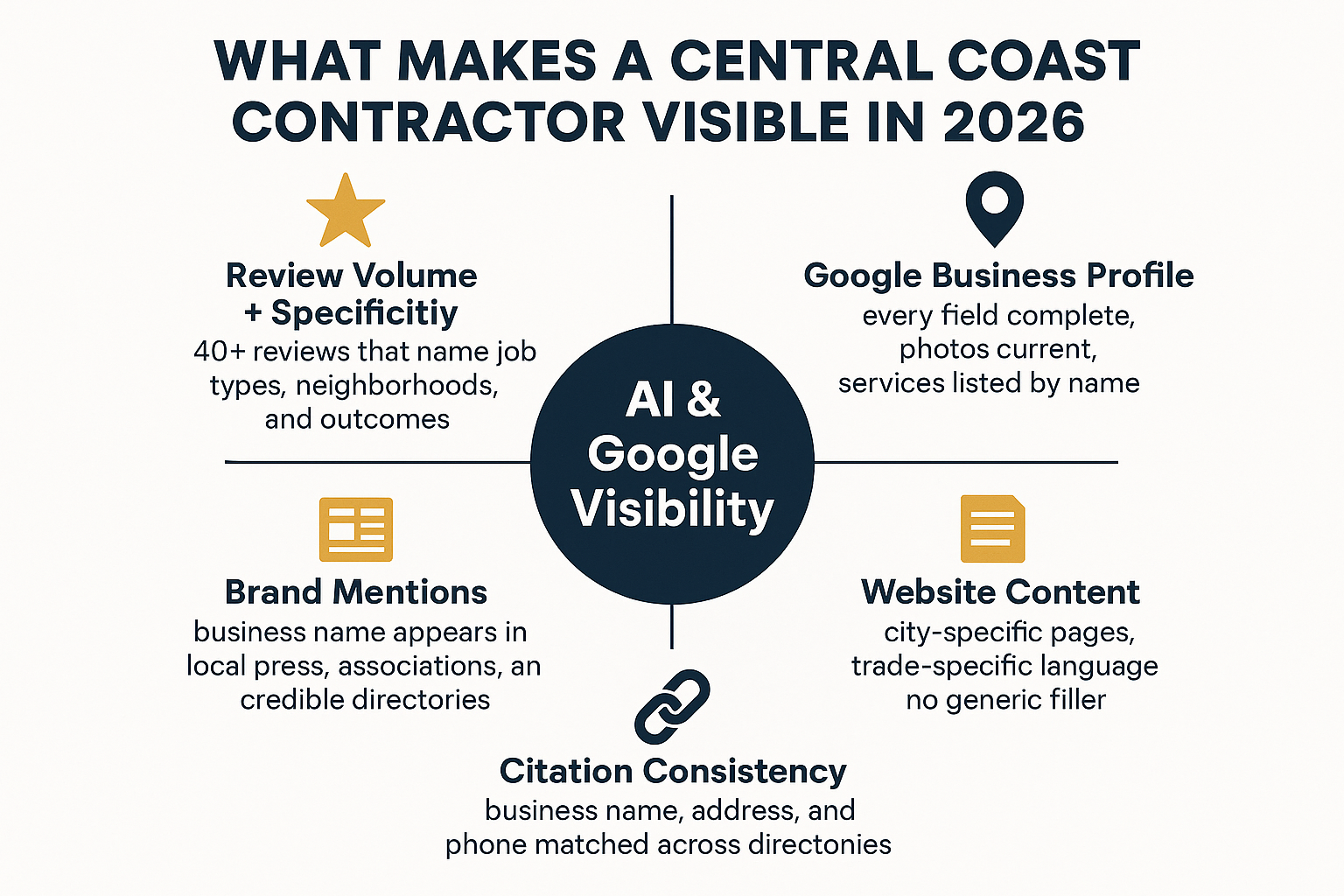
AI tools don’t pull a list of paid listings. They synthesize what they can verify about a business from multiple sources: your Google Business Profile, your reviews, your website content, mentions of your business name across directories and local press, and how specific and consistent all of that information is. I wrote more about this in what AI-powered local SEO actually checks before recommending a contractor if you want the mechanics.
What this means practically is that a contractor who has done nothing to build their online presence since 2022 is increasingly invisible to a large chunk of the homeowners searching right now. And the contractors who built that presence are getting recommended by name in AI answers, which is a different category of visibility than a ranking.
This is why we built AI Search Sync specifically for the Monterey Bay Area market. It’s not about chasing a trend. It’s about making sure a contractor in Seaside or Marina shows up where homeowners are actually looking, including in AI-generated answers, not just in a rankings report that doesn’t trace back to calls.

Why the Competitive Gap Here Is About Information, Not Budget
I want to be direct about something I see regularly in this market: the contractors winning the most leads in Salinas, Monterey, and King City are not always the largest or the longest-established. The ones winning are the ones with the most complete, accurate, and specific business information online.
Here’s what that looks like in practice. A plumber in Pacific Grove with 60 detailed Google reviews, a fully built-out Google Business Profile with current photos and service descriptions, and a website that actually mentions the neighborhoods they serve will outperform a larger competitor with a thin profile and generic content. I’ve seen it happen. The information gap is real and it’s measurable.
Reviews matter here in a way that’s different from what most contractors expect. They’re not just reputation management. AI systems use review volume and sentiment as a trust signal before surfacing a business in a recommendation. A roofing contractor in Santa Cruz County who has reviews that mention specific job types, neighborhoods, and outcomes is feeding the exact signals AI tools are looking for. That’s why review strategy and SEO are the same conversation now, not separate ones. We covered that angle more in when AI Overviews name a contractor, what just happened.
The same principle applies to website content. A site that says ‘serving the Monterey Bay Area’ in a footer does something very different than a site with pages that mention Carmel Valley, Hollister, and King City by name, with content specific to what homeowners in those areas actually search for. Generic content reads as generic to both homeowners and AI systems.
The Monterey Bay Area is not one market. It’s a collection of distinct communities with different homeowner demographics, different seasonal demand patterns, and different competitive dynamics. An HVAC company in Monterey is not competing the same way as one in King City. Treating this region like a single uniform market is one of the most common mistakes I see, and it shows up in content that doesn’t rank and profiles that don’t convert.
The Information Quality Gap: What Separates Visible Contractors from Invisible Ones
This breakdown shows the specific signals that determine which contractors get recommended by AI tools and which ones get skipped, based on what we see across the Central Coast market.
What Good Contractor Marketing Actually Produces in 2026
The measurement question is where I see contractors get burned most. Agencies report what’s easy to report: impressions, sessions, click-through rates. Those numbers are real, but they’re not the number a contractor actually runs their business on.
The number that matters is calls. And within calls, the number that really matters is estimates booked and jobs closed. Everything upstream of that is a proxy, and proxies don’t pay the crew.
I hear from contractors all the time who describe form submissions from people who never responded to a follow-up call, or Google Ads campaigns where the traffic looked healthy but the jobs didn’t materialize. The problem is usually one of two things: either the leads were low-quality to begin with (wrong geography, wrong job type, not ready to hire), or the calls themselves revealed objections that nobody was tracking.
Call tracking isn’t glamorous, but it’s the honest version of marketing performance data. When every inbound call is recorded and transcribed, you find out what questions people are asking before they book, what’s killing deals in the conversations that don’t convert, and which services are generating the most interest in which neighborhoods. That information feeds back into content, into Google Ads targeting, and into what gets prioritized on a website. We talked about this more directly in the calls sitting in your voicemail are worth more than your blog.
Good contractor marketing in 2026 produces a measurable, traceable path from search to call to job. If your current marketing investment can’t show you that path, the investment is flying blind.
What Contractors Are Actually Comparing When They Evaluate Marketing
These are the questions I hear most often from contractors on the Central Coast when they’re trying to figure out whether their current marketing is working or whether something needs to change.
| What Contractors Ask | What Good Marketing Answers | What to Watch For |
|---|---|---|
| Are my calls increasing? | Month-over-month call volume from tracked numbers | Agencies reporting clicks or impressions instead |
| Who is calling me? | Call recordings and transcripts showing job type and location | No call data at all, just form leads |
| Where are my best leads coming from? | Source attribution tied to specific campaigns or pages | A single ‘marketing’ attribution with no breakdown |
| Are my reviews helping me rank? | Review volume, recency, and content specificity tracked over time | Review count only, no analysis of content quality |
| Am I showing up in AI search? | Visibility in ChatGPT, Perplexity, and Google AI Overviews for local queries | Only Google organic rankings reported |
| Is my website converting visitors to calls? | Call-to-visit ratio by page and device type | Traffic reports with no conversion data |
The Geography Problem Most Agencies Miss
One thing I want to call out specifically because it affects almost every contractor I talk to on the Central Coast: your market is not what a national agency thinks it is.
Salinas, Seaside, Marina, and Watsonville have different homeowner demographics, different income levels, different seasonal demand patterns, and in some cases different competitive density. A landscaping company in Carmel Valley is marketing to a completely different customer than one in Seaside. A pest control company serving Hollister and San Benito County has gopher and rodent pressure patterns that are genuinely distinct from what a company in Monterey deals with.
When a marketing agency builds generic content that says ‘serving the Monterey Bay Area’ and calls it local SEO, it doesn’t rank locally and it doesn’t read as credible to the homeowners in those specific communities. The contractors who have invested in genuinely location-specific content, with pages that address the actual conditions and job types in each area, are the ones showing up when someone in King City or Pacific Grove searches for a specific trade.
This is not just about Google rankings. AI tools are reading that content too, and they can tell the difference between a contractor who actually serves Carmel Valley and one who put the city name in a footer. We covered that dynamic in why AI gives out one or two contractor names and skips everyone else.
If your current marketing doesn’t treat each community in this region as its own distinct audience, you’re leaving real jobs on the table. And more competitors are producing AI content every month that fills the same general search queries. The way to stand out is specificity, not volume.
Frequently Asked Questions About Contractor Marketing on the Monterey Bay Area
Do I actually need to worry about AI search, or is Google still where most leads come from?
Both matter, and they’re increasingly connected. Google’s own AI Overviews pull from the same signals that ChatGPT and Perplexity use: your Business Profile, your reviews, your website content, and how consistent your business information is across the web. Improving your position in AI search almost always improves your Google Maps ranking at the same time. The contractors who are treating these as separate problems are doing twice the work for half the result.
How many reviews do I actually need to make a difference?
There’s no magic number, but 40 to 60 reviews is where I see a real difference in AI recommendation frequency for contractors on the Central Coast. Volume matters, but so does content. Reviews that mention the specific job type, the neighborhood, and an outcome are worth more than five-star ratings with no text. A roofing contractor in Watsonville with 50 detailed reviews will outperform one with 200 generic ones in AI recommendations.
I’ve tried SEO before and didn’t see results. Why would this time be different?
That’s the most common thing I hear, and it’s usually traceable to one of two things. Either the work was generic, meaning it wasn’t built for this specific market and these specific communities, or the results were measured in rankings instead of calls. Rankings that don’t produce calls aren’t the right rankings. I’d want to look at what content was built, whether it was tied to specific cities and job types, and whether there was any call tracking in place to close the loop. Those three things together tell you whether the SEO was real or just activity.
What does marketing investment look like for a contractor my size?
It varies based on how competitive your trade is in your specific area, what services you want to generate calls for, and whether you’re starting from scratch or building on an existing presence. A plumber in Salinas is in a different competitive position than a handyman in Carmel Valley. The honest answer is that a real evaluation has to start with your actual market situation. General ranges can give you a ballpark, but they don’t account for the specifics that determine what your investment actually needs to accomplish.
My Google Business Profile is set up. Isn’t that enough?
A basic profile is a starting point, but ‘set up’ and ‘optimized’ are very different things. Most contractor profiles I look at are missing service-specific descriptions, have outdated photos, haven’t posted in months, and have categories that don’t match how homeowners actually search. The Google Business Profile is now treated by AI tools as a live data feed, not a static listing. If it’s not being actively maintained, it’s not doing the job it could be. We wrote about this directly in your Google Business Profile is now an AI feed, not just a listing.
Should I be running Google Ads alongside SEO, or pick one?
For most contractors on the Central Coast, the two serve different timelines. Google Ads produces calls faster, typically within the first few weeks of a well-built campaign. SEO builds the foundation that compounds over months and years. If your phone needs to ring now, ads fill that gap while SEO develops. If you’re planning six months out, SEO gives you an asset you own. The contractors I see doing best are running both, but with campaigns built specifically for their service area and job types, not broad national templates.
Ready to See What Your Current Marketing Is Actually Producing?
If you’re a contractor in Salinas, Monterey, Seaside, Watsonville, or anywhere on the Central Coast and you want a straight answer about where your leads are coming from, what your online presence looks like to AI tools right now, and what it would take to change that, a 30-minute discovery call with Phil Fisk at Core6 Marketing is the right starting point. No reports dressed up as results, just an honest look at where you stand and what would actually move the needle. Book directly at https://calendly.com/core6-marketing/30min.