Direct Answer: AI systems like ChatGPT and Gemini recommend contractors based on consistent business data, review volume and specificity, and content that answers pre-purchase questions, not just Google rankings.
Most contractors I talk to in Salinas and Monterey County think SEO still means getting into Google’s map pack. And honestly, that was the right way to think about it, until about two years ago. Today, a growing share of homeowners are typing questions into ChatGPT, Gemini, or Perplexity, and those tools are naming specific contractors. One gets mentioned. Everyone else gets skipped.
According to SOCi’s 2026 Local Visibility Index, which analyzed more than 350,000 business locations, only 1.2% of locations were recommended by ChatGPT, compared to 35.9% appearing in Google’s traditional local pack. That gap isn’t about who has better SEO in the old sense. It’s about which businesses have given AI enough consistent, corroborating evidence to recommend with confidence.
What I want to walk through here is what those AI systems are actually checking, and what it means for a plumber in Marina, a roofer in Watsonville, or an HVAC company on the Monterey Peninsula who wants their name to be the one that comes up.
AI Doesn’t Rank You, It Either Trusts You or It Doesn’t
This is the most important shift to understand. Traditional local SEO is a ranking system. AI-powered local recommendations are a confidence filter. The question Google asks is roughly: “Who is most relevant for this search?” The question ChatGPT asks is closer to: “Which business can I recommend without looking wrong?”
That distinction changes everything about what you should be focused on.
AI systems pull from dozens of sources simultaneously, your Google Business Profile, your website, Yelp, local directories, news mentions, and customer reviews, and they’re looking for agreement. When those sources tell the same story, confidence goes up. When they contradict each other, confidence drops, and the AI moves on to whoever looks more verifiable.
For a general contractor in Seaside or an electrician in Marina, a single character difference in an address format across five directories can quietly remove them from AI recommendations they never knew they were competing for. I’ve seen this firsthand with contractors who had strong map pack positions but zero AI visibility. Why AI gives out one or two contractor names and skips everyone else gets into this pattern in more detail, it’s worth reading if this is new territory.
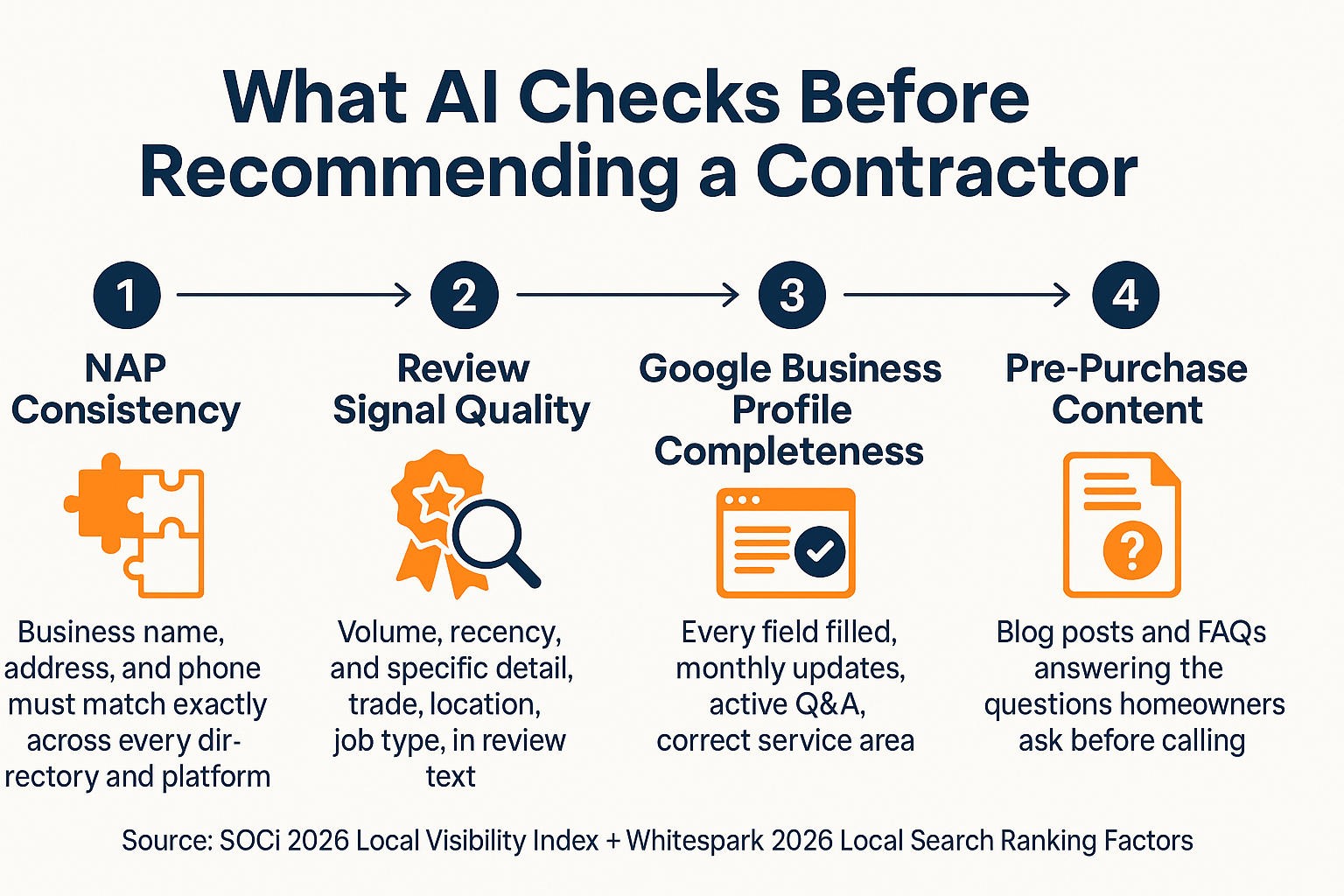
The first thing I look at when auditing a contractor’s AI-readiness is NAP consistency: Name, Address, and Phone number, matched exactly across every platform. Not approximately. Exactly.
What Review Content Tells AI That Star Ratings Don’t
Most contractors focus on their star rating. AI systems care about that, but it’s not the whole picture. Research tied to the SOCi data shows that businesses recommended by ChatGPT averaged 4.3 stars, but the more telling factor was the richness of the review content itself.
Think about the difference between these two reviews:
- “Great service, highly recommend.”
- “Miguel came out same-day to replace our water heater in Pacific Grove. He explained everything clearly and the price matched the quote. We’ll definitely call him again.”
The second review tells an AI system the trade, the service area, the technician’s name, the job type, and the outcome. That’s real signal. The first one tells it almost nothing.
An HVAC company in Pacific Grove with 80 reviews mentioning specific neighborhoods, technician names, and the nature of the repair sends a richer data signal than a competitor with more stars but thinner review content. I’ve seen competitors with 4.7 stars and 20 reviews get skipped entirely in AI results while a client with 4.3 stars and 70 detailed reviews gets named regularly.
Recency matters too. AI systems treat a review from three years ago as weaker evidence than one from last month. A consistent trickle of new, specific reviews beats a big batch that goes stale. If you’re a pest control company in Salinas or a cleaning service in Monterey and you’re not actively asking customers to leave specific reviews, this is the gap that’s costing you the most.
Your customers already wrote your best SEO content explains how that review language feeds into your broader visibility, not just AI recommendations, but on-page content and Google Business Profile updates too.
The Four Things AI Checks Before Recommending a Contractor
This breaks down the core confidence signals AI-powered local SEO systems evaluate, and how each one affects whether your business gets named or skipped.
Traditional Local SEO Is Now the Eligibility Layer, Not the Finish Line
Here’s something I want to be direct about: traditional local SEO still matters. Whitespark’s 2026 Local Search Ranking Factors places proximity at roughly 55% weight and Google Business Profile signals combined at around 32% for the classic local pack. If you’re not showing up in Google Maps, you have a foundational problem that needs to be fixed first.
But a strong map pack position no longer carries over into AI recommendations automatically. SOCi found that in retail categories, only 45% of top traditional local search brands also appeared in AI recommendations. For contractors, that number is almost certainly lower.
The way I explain this to roofing contractors in Monterey County: your Google Business Profile and citation consistency are now the entry ticket. They get you into the pool of businesses AI might consider. But the businesses that actually get named are the ones that have layered review quality, content depth, and consistent brand mentions on top of that foundation.
This is exactly what our AI Search Sync methodology addresses. It’s built to work both layers at the same time, keeping contractors visible in the traditional local pack while building the signals that AI systems need to recommend them by name. When AI Overviews name a contractor, what just happened gets into the mechanics of that recommendation moment in more detail.
Traditional Local SEO vs. AI-Powered Local Recommendations: What Each One Checks
These two systems evaluate your business differently. Understanding where they overlap, and where they don’t, is what separates contractors who show up everywhere from those who only show up in one place.
| Signal | Traditional Google Local Pack | AI Recommendation (ChatGPT, Gemini, Perplexity) |
|---|---|---|
| NAP Consistency | Important | Critical, inconsistency kills confidence |
| Google Business Profile | ~32% of ranking weight | Treated as primary verification source |
| Proximity to Searcher | ~55% of ranking weight | Considered but weighted differently |
| Review Star Rating | Matters for click-through | 4.3+ avg seen in recommended businesses |
| Review Content Specificity | Minimal direct impact | Strong signal, trade, location, job type |
| Service Page Content | Core ranking factor | Eligibility only, not a differentiator |
| Pre-Purchase Blog Content | Helpful for rankings | Major factor in AI Overview inclusion |
| Brand Mentions Across Web | Indirect signal | Direct confidence-building signal |
The Content Gap That Keeps Contractors Invisible During the Decision Phase
There’s a pattern I see constantly with contractors in Hollister, Watsonville, and King City. Their websites have a homepage, a services page, and a contact page. That’s it. And for years, that was enough to get calls.
It isn’t anymore. Not because Google changed its mind about service pages, but because homeowners now ask questions before they ever get to a service page. Queries like “how much does a sewer line replacement cost in Hollister” or “what should I expect during a roof inspection in Monterey” now trigger AI Overviews on 58 to 92% of informational and hybrid-intent searches, according to data on AI Overview frequency across search types.
A contractor whose site has no content addressing those pre-purchase questions is invisible during the phase where the homeowner is deciding who to call. By the time that homeowner lands on a service page, they’ve already got two or three names in mind, and none of them are yours.
This is one of the angles our work is most focused on right now. The content you’re already sitting on and not using for SEO shows where that content actually comes from, and it’s not from a keyword list. It comes from the questions people ask before they book, the way customers describe their problem when they fill out a form, and the outcomes they mention in reviews. That’s the raw material.
A roofing contractor on the Monterey Peninsula with three or four blog posts answering common local roofing questions, combined with a complete GBP, consistent citations, and 60-plus specific reviews, is far more likely to appear in an AI response than a competitor with a newer website, better design, and a single generic service page. The signals AI cares about most are the ones that prove the business is real, local, active, and trusted by real customers.
Frequently Asked Questions About AI-Powered Local SEO for Contractors
Does ranking well in Google Maps automatically mean I’ll show up in ChatGPT or Gemini recommendations?
No, and this surprises most contractors. SOCi’s 2026 data showed that only 45% of top traditional local search businesses also appeared in AI recommendations, and that was in retail, where those brands have bigger web footprints than most contractors. A strong map pack position is the starting point, not the finish line. AI systems need additional evidence: consistent citations, detailed reviews, and content that answers real questions.
How many reviews do I actually need before AI starts recommending me?
There’s no hard threshold, but businesses recommended by ChatGPT averaged 4.3 stars with meaningful review volume. More important than hitting a specific number is the consistency and specificity of the reviews you have. Twenty detailed reviews mentioning your trade, service area, and the type of work performed will outperform 80 generic five-word reviews. Focus on quality and a steady flow of new ones, not a one-time push.
What’s the biggest mistake contractors make with their Google Business Profile that hurts AI visibility?
Leaving fields incomplete and never updating it. AI systems treat your GBP as a primary verification source. When your service area, business category, hours, and photos are incomplete or outdated, AI has less to work with and less confidence to recommend you. The Google Business Profile mistake costing contractors AI visibility walks through the specific fields that matter most.
My address is listed slightly differently on a few directories. Is that really a problem?
Yes. AI systems cross-reference your business data across multiple sources. If your phone number on Yelp differs from your website, or your suite number appears on some listings but not others, those inconsistencies reduce confidence. For a general contractor in Seaside or an electrician in Marina, a single formatting difference across five directories can quietly remove you from AI recommendations you never knew were possible.
Do I need to write blog posts, or will a good service page do the job?
Both serve different purposes. Your service page tells AI what you do and where. But the informational content, posts that answer questions like ‘what causes low water pressure in older Salinas homes’ or ‘how long does a roof inspection take in Monterey’, is what gets you included in AI Overviews and conversational AI responses during the research phase. A contractor without that content is invisible when homeowners are deciding who to call.
Want to Know Where You Actually Stand with AI-Powered Local SEO?
If you’re a home service contractor in Monterey County and you’re not sure whether AI systems have enough consistent, verified information to recommend your business, that’s exactly what a discovery call with our team is designed to figure out. We’ve worked with more than 38 contractors on the Central Coast, and in 20-plus years in this market, the gap between showing up and getting skipped almost always comes down to a handful of fixable signals. Book a time that works for you at https://calendly.com/core6-marketing/30min, or call us directly at (831) 789-9320.