Direct Answer: When Google’s AI Overview names a contractor, it has pulled their content, reviews, or profile as the most credible answer to a specific question. Being named there matters more than ranking fifth below it.
A few months ago, a plumber in Salinas told me his phone had picked up noticeably, but he hadn’t changed anything. No new ads, no website update. When we looked at where the traffic was coming from, part of the answer was a Google AI Overview citing one of his service pages. He hadn’t even known it was there.
That’s the part most contractors on the Monterey Peninsula are missing right now. Google AI Overviews are not just a cosmetic change to search results. They are a filtered recommendation system, and when one names your business, something specific happened behind the scenes to put you there.
Understanding what that something is, and whether you can repeat it, is the whole point of this article.
What Google’s AI Overview Actually Is (and Isn’t)
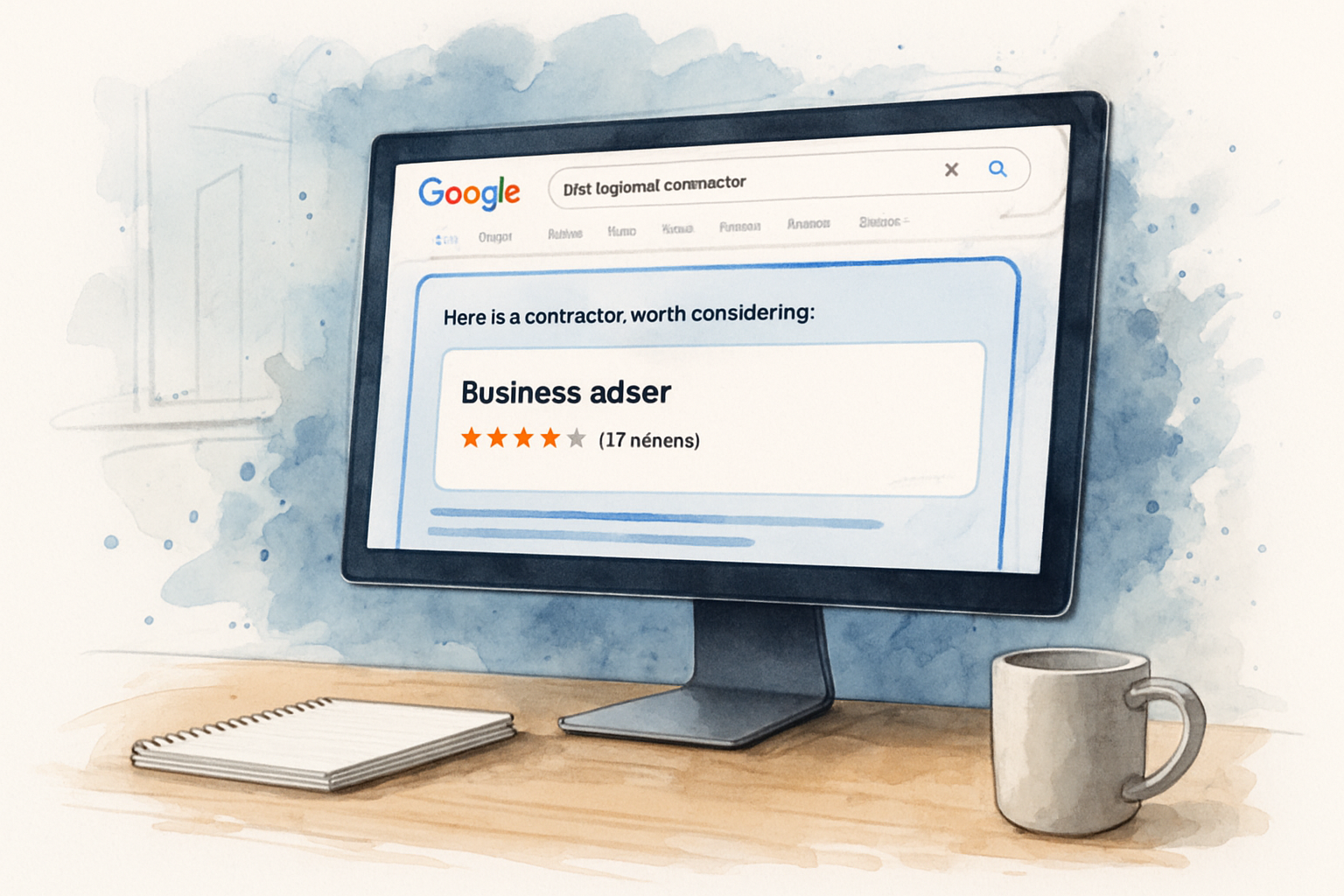
An AI Overview is the blue-bordered summary box that appears above traditional organic results on certain Google searches. Google generates it on the fly, pulling from pages it considers credible, and it typically includes inline citations linking back to the sources it used.
As of Google’s May 2026 I/O updates, that structure got more detailed. There are now five distinct elements that can appear inside an Overview:
- Inline citations with source links embedded in the text
- Hover previews that show a snippet of the cited page before you click
- An Expert Advice block pulling first-hand perspectives from forums and review sites
- A Further Exploration section pointing to deeper content on the topic
- Agentic booking prompts on some local service queries, where Google can initiate a booking action directly
For a roofing contractor in Santa Cruz County or an HVAC company in Seaside, this means the results page now looks less like a ranked list and more like a curated answer. Google’s official I/O 2026 post confirms the expansion of these structural updates and their effect on local services.
And the businesses named inside that curated answer are not always the ones with the strongest traditional rankings.
The Two Different Signals That Drive AI Visibility
Here is the thing that trips up most contractors when they first hear about AI Overviews: they assume it works like traditional SEO. Rank higher, get named. But that is not how it works.
Research from SEMrush shows that pages cited by AI tools in local searches often rank at position 21 and beyond in traditional organic results, nearly 90% of the time. A landscaper in Carmel Valley with a well-written page answering a specific question can get cited in an AI Overview even if they have never cracked page one for a broad keyword.
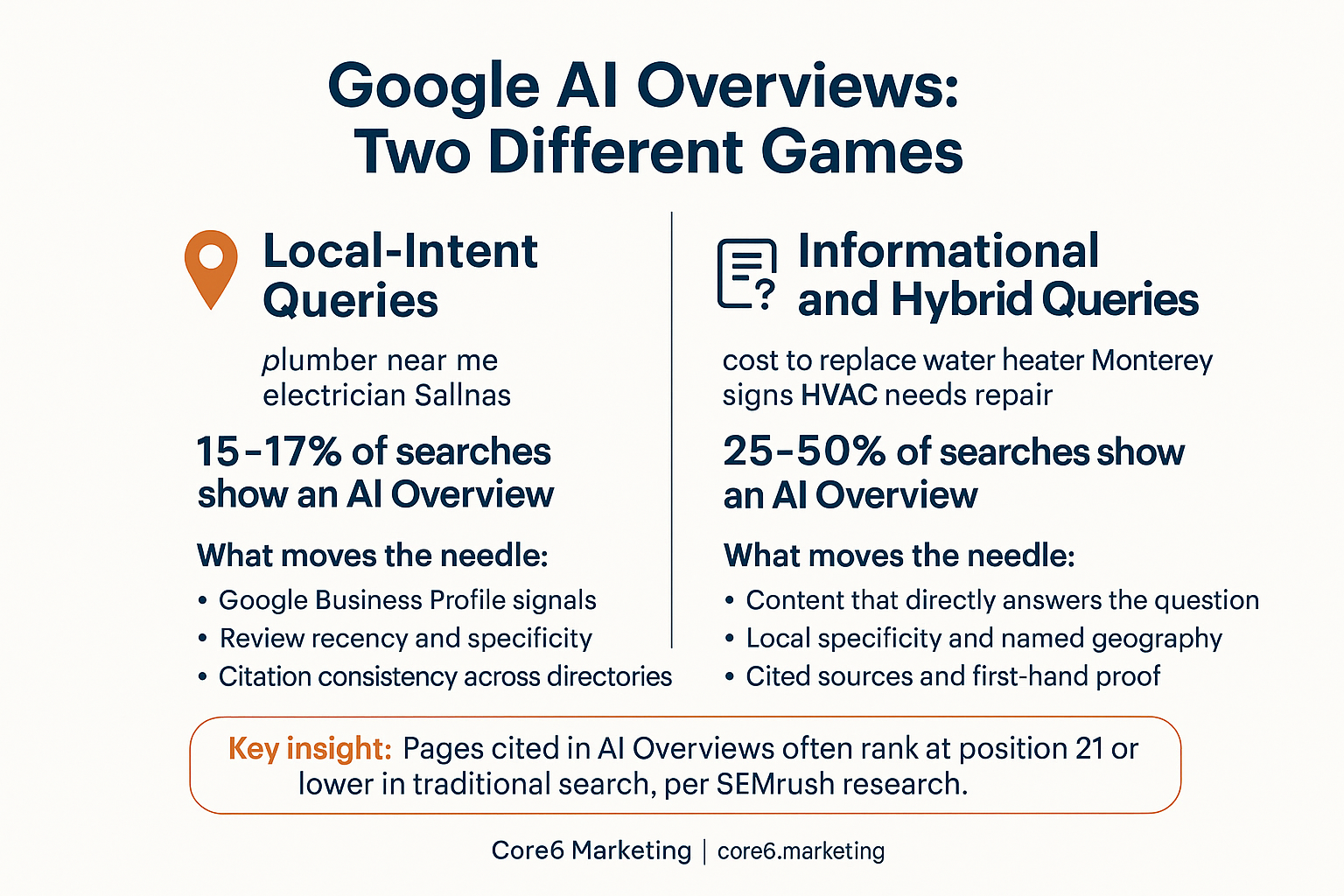
But, and this matters, AI Overviews only appear on about 15-17% of pure local-intent searches like “plumber near me” or “electrician Salinas.” They appear far more often, roughly 25-50% of the time, on informational and hybrid queries: “how much does a water heater replacement cost in Monterey,” “signs your HVAC needs replacing,” or “what kind of roof works best near the coast.”
That split tells you two separate things need to be true at once:
- Your Google Business Profile signals need to be strong for direct-service queries, that is still your local pack, your maps visibility, your bread and butter
- Your content needs to be citable for the cost, process, and comparison questions that people ask before they pick up the phone
Treating both as one problem leads to a strategy that solves neither. I’ve seen contractors in Watsonville put all their energy into review volume and ignore their content entirely, and miss every AI Overview on pre-purchase questions. I’ve also seen the reverse: solid blog content, weak GBP, and no local pack presence.
You need both working. The way we approach this at Core6 is through AI Search Sync, which treats your Google Business Profile, your on-page content, and your citation footprint as one connected system, not three separate projects. See What Google’s 2026 Updates Actually Mean for Contractor Content for more on how those signals interact.
Where AI Overviews Show Up, and What Drives Them
This breakdown shows the two types of queries where AI Overviews appear and the distinct signals that influence each one.
Why Your Reviews Are Now AI Citation Material
The Expert Advice block inside AI Overviews is one of the most underestimated changes from Google’s May 2026 update. It pulls first-hand perspectives from review platforms, forums, and public discussions, and it attaches a name or handle to each one.
That means a detailed Google review describing a specific job is no longer just social proof for the next person scrolling your profile. It is potential citation material for an AI-generated answer.
Here is the difference in practice. A generic five-star review, “Great service, very professional”, helps your star rating. It does almost nothing for AI visibility. But a review that says something like, “They replaced our furnace in Marina in January, explained why the old unit had been short-cycling, and had heat back on the same day,” gives an AI system specific, verifiable, local information to work with.
Proper nouns. Described outcomes. Named neighborhoods. That is what gets pulled.
I’ve written more about this dynamic, particularly how Perplexity evaluates contractor credibility, in How Perplexity Decides Which Contractor to Recommend. The same logic applies to Google’s Expert Advice block. Generic input produces generic (or no) AI output.
One pest control company in Watsonville we worked with had 80-plus reviews but almost no AI visibility on treatment-related queries. When we looked at the review content, nearly every one said some version of “great job, would recommend.” No specifics. No outcomes. No locations mentioned. Encouraging customers to describe what actually happened, the pest they dealt with, the area of the home, the result after treatment, changed what the AI had to work with.
Generic Reviews vs. Citable Reviews: What Changes
Not all five-star reviews carry the same weight when AI systems scan for evidence. Here is how the two types compare across what actually matters.
| Factor | Generic Review | Specific, Citable Review |
|---|---|---|
| Star rating impact | Yes | Yes |
| AI Expert Advice block eligibility | Unlikely | More likely |
| Includes named location | Rarely | Often (city, neighborhood, street area) |
| Describes a specific outcome | No | Yes (e.g., leak fixed same day, no callbacks) |
| Names a technician or trade task | No | Yes (e.g., ‘replaced the pressure regulator’) |
| Useful as Voice of Customer content | Low | High, reveals real customer language and priorities |
| Builds AI credibility over time | Minimal | Cumulative, each one adds a data point |
What Happens to Click-Through When an AI Overview Appears
There is a real cost to showing up fifth below an Overview that names one of your competitors. Research shows that organic click-through rates drop as much as 58-61% on pages where an AI Overview is present, compared to traditional results without one.
But pages that are cited inside the Overview see click-through rates rise. Google’s recommendation carries a different kind of credibility than a plain blue link. People click on what Google is actively pointing to.
For a general contractor in Monterey or a flooring installer in Pacific Grove, this changes the math considerably. Being on page one but below an Overview that names someone else is worth a lot less than it used to be. Being the page the Overview cites, even if you rank lower overall, is worth considerably more.
This is part of why I keep coming back to the same point: traditional ranking position is one signal among many now. The contractors who will win local search in 2026 and beyond are the ones whose content gets treated as a source, not just a result. Why AI Gives Out One or Two Contractor Names, and Skips Everyone Else gets into the selection logic in more depth.
And if you want to understand what your content looks like to these systems right now, start by reading Your Customers Already Wrote Your Best SEO Content, because the material that gets cited is almost never the generic service description. It is the specific, experience-backed answer to a real question.
Frequently Asked Questions About Google AI Overviews for Contractors
Does my business need to be in the Google Maps 3-Pack to appear in an AI Overview?
No. The two systems pull from different signals. The local 3-Pack is driven by proximity, review signals, and GBP completeness. AI Overviews pull from content relevance, specificity, and perceived credibility. A contractor in King City could get cited in an Overview for a process question without ever ranking in the local pack for that query. But strong local pack signals do help, especially for direct-service searches where Overviews are less common.
How do I know if an AI Overview is citing my website?
Search the specific questions your customers ask most often, cost questions, process questions, comparison questions, from a private or incognito browser. If an Overview appears, look at the inline citations. You can also use tools like Google Search Console to watch for traffic from informational queries where an Overview might be active. If you see impressions but low clicks on informational keywords, an Overview may be absorbing that traffic.
Can a small contractor in Salinas compete with bigger companies for AI Overviews?
Yes, and in some ways the playing field is more level here than in traditional SEO. AI systems are looking for specificity and credibility, not domain authority or ad spend. A detailed page from a small HVAC company in Seaside that directly answers a specific repair question, with local references and real customer outcomes, can get cited over a national brand’s generic page. The advantage goes to the contractor willing to publish real, specific content, not the one with the biggest budget.
Does getting cited in an AI Overview help my regular search rankings too?
Not directly, citation in an Overview is not a ranking factor for traditional organic results. But the same qualities that make content citable, depth, specificity, local relevance, credibility signals, also tend to improve traditional rankings over time. Treating them as separate goals is less efficient than building content that qualifies for both.
What kind of content is most likely to get cited?
Pages that directly answer a specific question, use local place names, include real proof (reviews, described outcomes, before-and-after detail), and are written in plain language. Cost breakdown pages, process explanation pages, and repair-vs-replace guides tend to perform well. Thin service pages with no depth rarely get cited. For more on this, see The Content You’re Already Sitting On (And Not Using for SEO).
Want to Know Where You Stand in AI Search Right Now?
If you are a contractor in Monterey County, Salinas, or anywhere on the Central Coast and you are not sure whether AI Overviews are naming you, a competitor, or nobody at all, that is worth finding out before another quarter goes by. We have spent more than 20 years working exclusively with home service contractors in this market, and we built AI Search Sync specifically around the question of what makes a contractor visible when AI systems are doing the recommending. If you want a clear read on where your business stands and what the most practical next step looks like, you can book a Discovery Call with Phil Fisk at https://calendly.com/core6-marketing/30min.