Direct Answer: Google’s 2026 updates penalized templated, AI-generated location pages and rewarded content with real local detail, clear authorship, and genuine trade experience — the exact signals AI platforms like ChatGPT also use to decide who to recommend.
If your phone got quieter between February and April of 2026 — and stayed that way into May — you weren’t having a slow season. Google ran three separate algorithm updates in roughly five weeks, followed by a second broad core update in May. For home service contractors on the Monterey Peninsula and across Salinas, that stretch was the largest search volatility event of the year.
Most contractors I’ve talked to didn’t know what hit them. They saw their rankings slip, their call volume drop, and their Google Business Profile traffic flatten out. And most of the agencies they were working with had no explanation beyond ‘Google changed something.’
I want to be specific about what actually happened — because once you understand what these updates were targeting, the fix is less mysterious than it looks.
What Google Was Actually Going After
The February Discover Core Update and the March 2026 Core Update weren’t random reshuffles. They had a clear target: templated content that looked local but wasn’t.
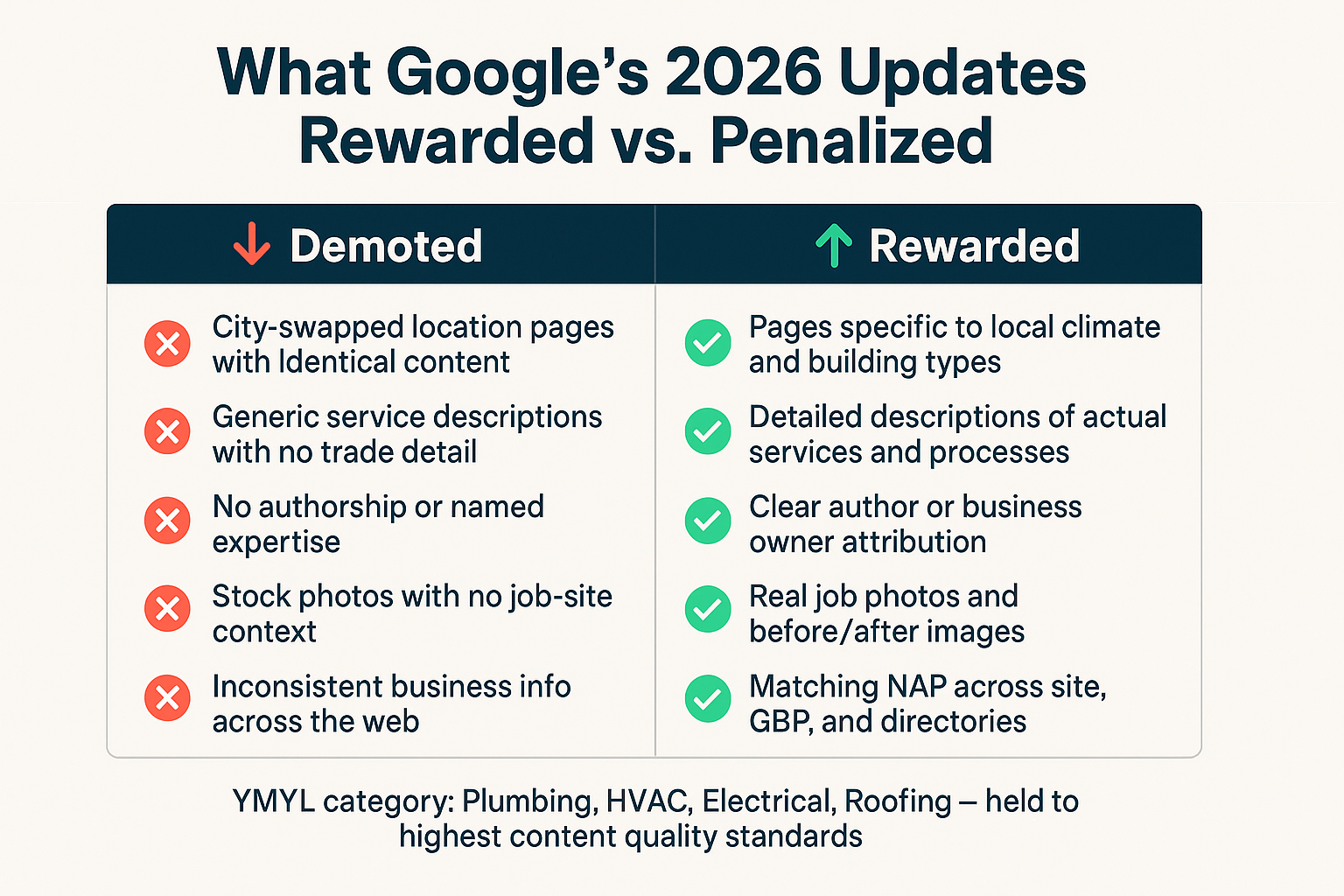
You’ve seen this pattern on competitor sites. An HVAC company has a page for Salinas, a page for Marina, a page for Seaside — and all three pages are identical except for the city name dropped into the headline and the first paragraph. Same four bullet points. Same generic paragraph about ‘serving the area for years.’ Same contact form at the bottom. That content pattern is exactly what the March update was designed to demote.
Google classifies plumbing, HVAC, roofing, and electrical under YMYL — Your Money or Your Life — the same content quality standards it applies to healthcare and legal information. That means it holds contractor content to a higher bar than a lifestyle blog or a news site. The Google Search Quality Rater Guidelines make clear that YMYL pages are evaluated for expertise, authorship, and real-world accuracy — not just keyword presence.
The SpamBrain sweep that followed completed in under 20 hours — the fastest spam rollout in Google’s history. That tells you how confident the system was in what it was identifying. These weren’t judgment calls. The patterns were obvious enough to catch at scale, almost instantly.
Contractors in Santa Cruz County and San Benito County who had been building out location page libraries with swapped city names saw the clearest drops. The sites that held steady — or gained ground — had something different going on.
What the Winning Pages Actually Had in Common
Google’s own description of the March update said it was designed to ‘better surface relevant, satisfying content for searchers.’ That’s worth taking seriously — because it tells you exactly what to build.
The contractor sites that gained visibility after March shared a consistent profile. They had:
- Real photos — job site images, before-and-after shots, photos of the crew and equipment
- Specific service detail — not ‘we handle all HVAC needs’ but the actual systems they service, the brands they carry, and what a typical service call looks like
- Clear authorship — a named technician, owner, or team lead associated with the content
- Consistent business information — matching name, address, and phone number across the site, Google Business Profile, and directories
- Locally grounded content — pages that reflected what’s actually common in this climate and these building types
That last one matters more than people realize for the Central Coast specifically. A roofing page written for a contractor in Carmel Valley shouldn’t read like it was written for any roof in any city. Carmel Valley has specific conditions — the interior heat variance versus coastal fog, the age of the housing stock in areas like Carmel Knolls, the permit requirements through Monterey County Building Services. A page that reflects those realities signals to Google that the person who wrote it has actually worked there.
For how this connects to your Google Business Profile, the principle is the same — specificity signals real experience, and Google’s systems are getting better at detecting the difference.
AI-Generated Content vs. Real Local Content: What Google Rewards
This comparison breaks down what the 2026 updates rewarded versus what they demoted — specific to home service contractors.
The AI Citation Problem Nobody’s Tracking
Here’s the part most contractors — and honestly, most agencies — are missing entirely.
The same signals Google rewards in traditional rankings are the signals that determine whether AI platforms like ChatGPT, Gemini, and Perplexity cite your business when someone asks for a recommendation. Research from 2026 found that less than 10% of sources cited in ChatGPT, Gemini, and Copilot even rank in the top 10 Google organic results for the same query.
Read that again. The sources AI platforms recommend are mostly not the same sources sitting at the top of Google’s first page. They’re pulling from a different set of signals — and those signals look a lot like E-E-A-T: real experience, demonstrated expertise, authorship, and local specificity.
So if you’ve been thinking about ‘AI search optimization‘ as a separate project from your regular SEO work, the 2026 updates should settle that question. Building content for AI citation and building content for human relevance is the same work. Specific, experience-grounded, locally anchored pages that reflect real trade knowledge perform in both places.
This is the core premise behind our AI Search Sync methodology — not treating Google rankings and AI visibility as two separate tracks, but building the kind of content that earns both at once. If you want to understand how ChatGPT actually decides which plumber or roofer to recommend, that article goes deeper on the mechanics.
What Content Signals Matter Across Google and AI Platforms
These signals came up repeatedly in post-update analysis of which contractor sites gained and which ones dropped. They apply to both traditional search rankings and AI platform citations.
| Signal | Why Google Cares | Why AI Platforms Care |
|---|---|---|
| Real job photos | Visual evidence of actual work performed | Confirms business is active and legitimate |
| Named authorship | Ties content to a real person with accountability | Establishes source credibility for citation |
| Local specificity | Matches search intent to actual service area | Supports geographic relevance in responses |
| Consistent NAP | Verifies business legitimacy across the web | Cross-references business identity across sources |
| Detailed service descriptions | Signals expertise on the specific topic | Provides citable substance for AI answers |
| Customer review language | Fresh, first-party signals about real outcomes | Voice-of-customer language matches conversational queries |
Where Contractor Content Actually Falls Short
I’ve looked at a lot of contractor websites across Salinas, Watsonville, Hollister, and the Monterey Peninsula over the past few years. The content problem is almost always the same thing: pages that were written to exist, not to actually answer anything.
A pest control company in Marina shouldn’t have a service page that says ‘we handle all your pest control needs in Marina.’ That page tells a prospective customer — and Google — nothing. What pests are actually common in Marina’s coastal soil conditions? What does treatment typically involve for a single-family home built in the 1970s? How does the proximity to Fort Ord’s former land use affect certain pest pressures in that area? That’s the kind of specificity that earns trust.
The same applies to form submissions and reviews — and this is something I’ve been focused on for a while now. The content your customers are already giving you in their own words — the questions they ask before booking, the language they use in reviews, the way they describe the problem when they fill out a contact form — that’s raw material that generic AI content generation can’t replicate.
One landscaping client in Carmel Valley had reviews mentioning ‘clay soil drainage’ and ‘deer-resistant planting’ specifically. Those exact phrases, woven into a locally grounded service page, signal real local experience in a way that no templated content can fake. For a deeper look at how to use your phone calls as SEO content, that’s worth reading alongside this.
And if you want a quick test to see whether your current site has an AI-generated content problem, this contractor website audit walks through exactly what to look for.
Frequently Asked Questions About Google’s 2026 Updates and Contractor Content
Did the 2026 updates only affect contractors with a lot of location pages?
Not exclusively. Contractors with templated location pages took the clearest hits, but the updates also affected single-location sites whose main service pages were thin — no real detail, no authorship, no local specificity. If your Salinas plumbing page reads like a generic template, the number of city pages you have doesn’t change how Google evaluates the quality of what’s there.
Is AI-generated content now penalized by Google?
Google hasn’t banned AI-generated content outright — it’s said publicly that it evaluates content quality, not how the content was produced. But the practical reality after the 2026 updates is this: content that reads like it was written for any city, any trade, and any customer gets treated as low-quality regardless of who or what wrote it. AI tools that help you write faster are fine. Using AI to mass-produce city-swapped pages with no real local knowledge baked in is what got contractors penalized.
How do I know if my contractor site was actually affected by these updates?
Look at your Google Search Console traffic between February 1 and May 31, 2026. If you saw ranking drops or significant impressions decreases during that window — particularly on location-specific service pages — the updates likely played a role. A drop in Google Business Profile views or call volume during the same period reinforces that. The pattern to look for is a step-down that happened in a short window, not a gradual slide.
Do these updates change how I should think about my Google Business Profile?
Yes. Your GBP is now feeding AI platforms, not just showing up in the Map Pack. How your GBP functions as an AI feed is different from how most contractors are managing it — posting frequency, photo specificity, review response language, and service detail all matter more than they did two years ago.
What’s the single most important thing I can fix first?
Pick your top two or three service pages — the ones that should be generating your most profitable call types — and rewrite them with real specificity. Name the local conditions relevant to your trade. Add a real photo from an actual job in that area. Put your name or your company owner’s name on the page. That’s not a complete fix, but it’s the work that moves rankings most directly.
Want to Know Where Your Site Actually Stands?
We work with home service contractors across Monterey County, Salinas, Santa Cruz, and the Central Coast — and we look at contractor content through this exact lens every day. If you’re not sure whether your pages held up through the 2026 updates, or you want a clear read on what’s actually driving your ranking and call volume, you can book a discovery call with Phil at https://calendly.com/core6-marketing/30min.