Direct Answer: ChatGPT, Perplexity, and Gemini pull from your Google Business Profile when recommending local contractors. An incomplete or inconsistent profile means AI tools skip you entirely — not just Google Maps.
Most contractors I talk to in Salinas and on the Monterey Peninsula think of their Google Business Profile the same way they thought about the Yellow Pages — it’s the thing that puts you on the map. Fill in your address, pick a category, upload a couple photos, and you’re done.
That thinking made sense in 2018. In 2026, it’s leaving real jobs on the table.
ChatGPT, Perplexity, and Google’s own Gemini are now answering questions like “who’s the best plumber near me in Seaside” or “find a licensed roofer in Watsonville” — and the contractors they recommend aren’t always the ones at the top of the traditional map pack. The data feeding those AI answers comes directly from your GBP, and if that data is thin, inconsistent, or incomplete, the AI simply passes on your business and moves to someone else.
How AI Tools Actually Use Your Google Business Profile Data
When someone asks ChatGPT or Perplexity for a contractor recommendation in Monterey County, those tools aren’t running a new search from scratch. They’re drawing on indexed data — and Google Business Profile is one of the primary structured sources they pull from.
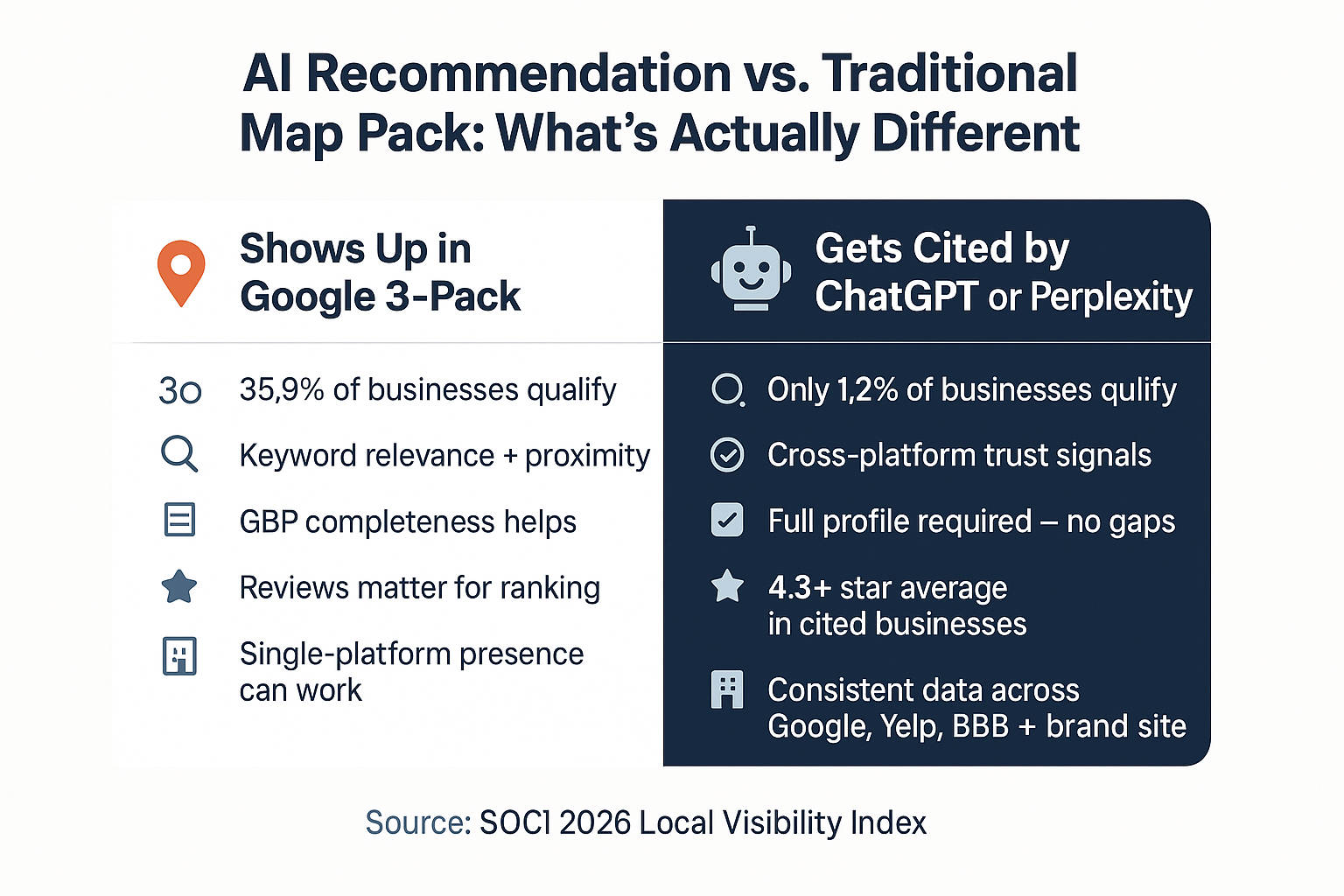
This isn’t theoretical. Research from SOCi’s 2026 Local Visibility Index tracked which businesses appeared in AI-generated local recommendations versus traditional Google search results. The gap was significant: 35.9% of businesses appeared in Google’s traditional 3-pack, but only 1.2% were recommended by ChatGPT. That compression tells you something important — the filter AI uses isn’t keyword stuffing or backlink counts. It’s the overall trust picture your business presents across every platform where it appears.
For a pest control company in King City or an HVAC contractor in Marina, that means your GBP isn’t just a listing anymore. It’s the primary document the AI uses to decide if your business is real, trustworthy, and worth recommending to a homeowner who asked a direct question.
The signals that AI systems appear to weight most heavily include:
- Star rating and volume — ChatGPT-recommended businesses averaged 4.3 stars in SOCi’s data
- Data accuracy — name, address, phone number, and service area must match across Google, Yelp, and BBB
- Profile completeness — categories, services listed, hours, photos, and Q&A all factor in
- Cross-platform consistency — a strong GBP with a weak or absent presence elsewhere gets downgraded
A roofing contractor in Watsonville with a 4.1-star profile and 22 reviews might rank well in the traditional map pack — and still get skipped entirely when an AI assembles its recommendation list. The 3-pack and the AI recommendation aren’t the same race. Understanding how AI search is changing who gets called for home repairs is the first step to doing something about it.
The Service Area Problem Most Contractors in Salinas Don’t Know They Have
Here’s something I see consistently with home service contractors across Monterey County: they set up their GBP years ago, checked a few boxes, and haven’t touched the service area settings since.
For contractors who operate out of a physical shop — a plumbing supply house in Salinas or an HVAC showroom on the Peninsula — Google can cross-reference your listed address with your service area. But for the majority of contractors on the Central Coast who work out of a truck and don’t show a storefront address, the service area cities you list in your GBP settings are often the only geography an AI has to work with.
If your service area says “Salinas” and nothing else, an AI tool fielding a question from a homeowner in Seaside or Hollister has no signal connecting your business to their location. You may as well not exist for that query.
Google has stated directly that businesses with complete and accurate GBP information are more likely to appear in local results, and that verified profiles carry more weight in ranking decisions. That’s not a secret — but it does require actually going into your profile settings and being specific about where you work.
For electricians and general contractors covering the full Central Coast — from Carmel Valley to Watsonville to King City — your service area list should reflect that geography precisely. Add the individual cities. Don’t just list “Monterey County” and assume the algorithm fills in the blanks. It doesn’t. And when an AI tool is deciding whether to recommend you to a homeowner in Pacific Grove who just asked “who should I call for a panel upgrade,” that omission is what keeps you off the list.
This is also why how local SEO actually works for home service contractors on the Central Coast matters more now than it did three years ago — the fundamentals haven’t changed, but the stakes have.
What Separates a Contractor Who Gets Recommended by AI From One Who Doesn’t
This breakdown shows the specific profile signals that separate contractors who appear in AI-generated recommendations from those who get passed over.
Why Review Language Now Shows Up Inside AI Answers
Google’s May 2026 AI Overview updates introduced something called a Community Perspectives panel. It pulls real reviewer language directly into AI-generated answers — not just star counts, but actual sentences from actual reviews.
That changes the math on reviews in a meaningful way.
A generic five-star review — “Great service, would recommend!” — still helps your overall rating. But it won’t get quoted inside an AI response. A review that says “fixed our water heater in Carmel Valley same day, gave us a flat price upfront, and walked us through what actually failed” is now the kind of content an AI tool surfaces when a homeowner asks who to trust.
I want to be careful here: coaching customers on what to include in a review is not the same as asking them to fabricate specifics. The goal is to prompt the details that are already true — the city where the job was done, the type of work, the thing that stood out about how your crew handled it. A pest control customer in Hollister who mentions the specific pest problem, the response time, and whether the technician explained the treatment plan has written a review that works harder than ten generic ones.
This is also connected to something broader I’ve written about before — the language your customers use when they talk about your work is some of the most valuable content you have. Your phone calls are the best SEO content you’re not using — and the same principle applies to the words showing up in your reviews.
The practical move: after every completed job, ask your customer for a review, and give them a brief, honest prompt. Something like: “If you mention where the job was, what we fixed, and anything that stood out, that really helps future customers know what to expect.” You’re not writing their review. You’re helping them write a useful one.
GBP Fields That AI Systems Use — and What ‘Complete’ Actually Means
This is the difference between a profile that passes the AI’s trust filter and one that gets skipped. Each field below has a practical standard attached to it.
| GBP Field | Minimum Standard | Why It Matters for AI Visibility |
|---|---|---|
| Business Name | Exact legal trade name — no keyword stuffing | Inconsistency across platforms triggers trust flags |
| Phone Number | Same number on your website, Yelp, and BBB | Mismatched phone numbers are the most common data accuracy failure |
| Service Area Cities | Every city where you actively take jobs | Service-area contractors with no storefront need this to exist geographically for AI |
| Primary Category | Most specific applicable trade category | Vague categories reduce match quality for trade-specific queries |
| Services List | Individual services named and described | AI uses service entries to match recommendations to specific job types |
| Reviews — Count and Rating | 4.3+ stars, minimum 25–30 reviews for competitive trades | SOCi data shows AI-recommended businesses cluster above this threshold |
| Review Language | Specific job details, location, outcome mentioned | Community Perspectives panel pulls exact reviewer language into AI answers |
| Photos | Current, job-site photos updated within 90 days | Freshness signals active business status to both Google and AI indexers |
The Cross-Platform Trust Problem (And Why It’s Different From SEO)
One of the patterns I keep coming back to when I look at which contractors get recommended by AI versus which ones don’t: the ones who get skipped often look fine on Google alone. Their GBP is reasonably complete, they have decent reviews, they rank in the 3-pack for their primary city.
But when you look at their Yelp page, their BBB listing, and their own website, the picture starts to fragment. The phone number is slightly different. The business name has an “LLC” in one place and not another. The website doesn’t list Carmel, Pacific Grove, or Seaside as service areas even though the contractor works there every week.
AI systems use that cross-platform picture to assess whether your business is trustworthy enough to recommend to a stranger. A roofing contractor in Santa Cruz County who has a spotless GBP but a three-year-old Yelp profile with an old address and a disconnected phone number is presenting a conflicted identity to the AI. And the AI, like a cautious homeowner, tends to pick the business that has its story straight everywhere it appears.
This is why our AI Search Sync approach doesn’t start and end with Google. It treats citation consistency, GBP completeness, and on-site trust signals as a connected system — because that’s how the AI reads them. If you’re curious why your competitor keeps showing up in ChatGPT answers for Monterey County jobs and you don’t, your competitor showing up in ChatGPT while you didn’t is usually a cross-platform trust problem, not a Google rankings problem.
Frequently Asked Questions About Google Business Profile and AI Visibility
Does my Google Business Profile actually affect what ChatGPT recommends?
Yes. ChatGPT, Perplexity, and Gemini all pull from structured local business data when answering location-specific questions, and GBP is one of the primary sources. An incomplete or inconsistent profile reduces the likelihood that an AI tool will cite your business — even if you rank well in traditional Google search.
I don’t have a storefront. Does that hurt my AI visibility?
It can, if your service area settings aren’t specific. For contractors in Salinas, Hollister, or anywhere on the Central Coast who operate without a public address, the cities listed in your GBP service area are often the only geographic signal an AI has when a homeowner asks for a recommendation nearby. List every city you actually serve — individually, not just the county name.
How many Google reviews do I need before AI tools start recommending me?
SOCi’s 2026 data showed that AI-recommended businesses averaged 4.3 stars, with stronger review volume than businesses appearing only in the traditional map pack. There isn’t a single magic number, but for most trades on the Central Coast, fewer than 25–30 reviews with a rating below 4.3 puts you at a disadvantage when the AI is making a recommendation. Quality of review language matters too — not just the count.
What should I actually tell customers to write in a review?
Don’t script it — prompt it. After a job in Pacific Grove or Marina, ask your customer to mention where the job was, what you did, how long it took, and anything that surprised them in a good way. That level of specificity is what gets pulled into Google’s Community Perspectives panel and cited inside AI-generated answers. Honest detail beats a five-star generic every time.
Is this different from traditional local SEO?
Related, but not the same. Traditional local SEO gets you into Google’s 3-pack — and 35.9% of businesses can show up there. Getting cited in an AI recommendation is a much smaller group — closer to 1.2% in SOCi’s study. The filter isn’t just keyword relevance and proximity. It’s the overall trust picture your business presents across Google, Yelp, BBB, and your own website. That’s a higher bar.
Should I be worried about AI replacing my need for a website or Google Ads?
Not replacing — but changing how they work together. Your website is still where the AI sends people to verify you’re a real business, and Google Ads still captures homeowners who are ready to hire right now. What’s shifting is the top of the funnel — the discovery phase — and that’s where your GBP and cross-platform presence now carry more weight than they used to.
Want to Know Where Your Profile Actually Stands?
If you’re a contractor in Salinas, Monterey, Watsonville, or anywhere on the Central Coast and you’re not sure whether your Google Business Profile is feeding the right signals to AI search tools — that’s exactly what we look at in a Discovery Call with Core6 Marketing. We’ve worked with more than 38 contractors across this market, and the profile gaps that cost jobs are almost always fixable once you know where to look. You can book a 30-minute call directly at https://calendly.com/core6-marketing/30min.