Direct Answer: Starting summer 2026, Google’s AI can call contractors on a homeowner’s behalf. If your Google Business Profile and website aren’t structured to answer the agent’s signals, it skips you.
At Google I/O on May 19, 2025, Sundar Pichai announced something that most contractors on the Central Coast have no idea is coming. Google is expanding agentic booking to home repair this summer. That means a homeowner in Salinas can ask Google to call plumbers, roofers, or HVAC companies on their behalf — and Google’s AI agent will do exactly that.
Google confirmed it plainly on their own blog: ‘For select categories like home repair, beauty or pet care, you can ask Google to call businesses on your behalf.’ This isn’t a feature being tested in a lab. It’s rolling out to real homeowners in real markets, including the Monterey Bay Area.
I’ve been watching AI changes reshape how local contractors get found online for the past couple of years. But this one is different. It doesn’t just change who shows up in search results — it changes who gets called. And if your business isn’t structured to pass the agent’s checks, it moves to the next contractor on the list without you ever knowing the opportunity existed.
What the Agent Actually Does Before It Dials
This is the part most people miss when they hear about agentic booking. The AI doesn’t pick up the phone and start calling random contractors. It runs a check first.
Based on early reporting on how these agentic systems operate, the agent looks for specific signals before it considers placing a call on a homeowner’s behalf:
- Structured service descriptions that match the exact language the homeowner used in their request
- Up-to-date availability information in your Google Business Profile
- Pricing context — even a general range helps the agent determine fit
- A GBP that maps your services to how homeowners actually ask for them
Here’s a concrete example worth sitting with. A Salinas HVAC company that lists ‘heating and cooling’ in its GBP services field may get passed over in favor of a competitor who lists ‘furnace repair,’ ‘AC tune-up,’ and ‘heat pump installation’ separately. The agent needs to match the homeowner’s specific request to a specific service. Vague categories don’t give it enough to work with.
This is directly connected to something we’ve written about before — why ChatGPT recommends your competitor and not you. The underlying logic is the same: AI systems reward specificity and skip over businesses that give them incomplete data.
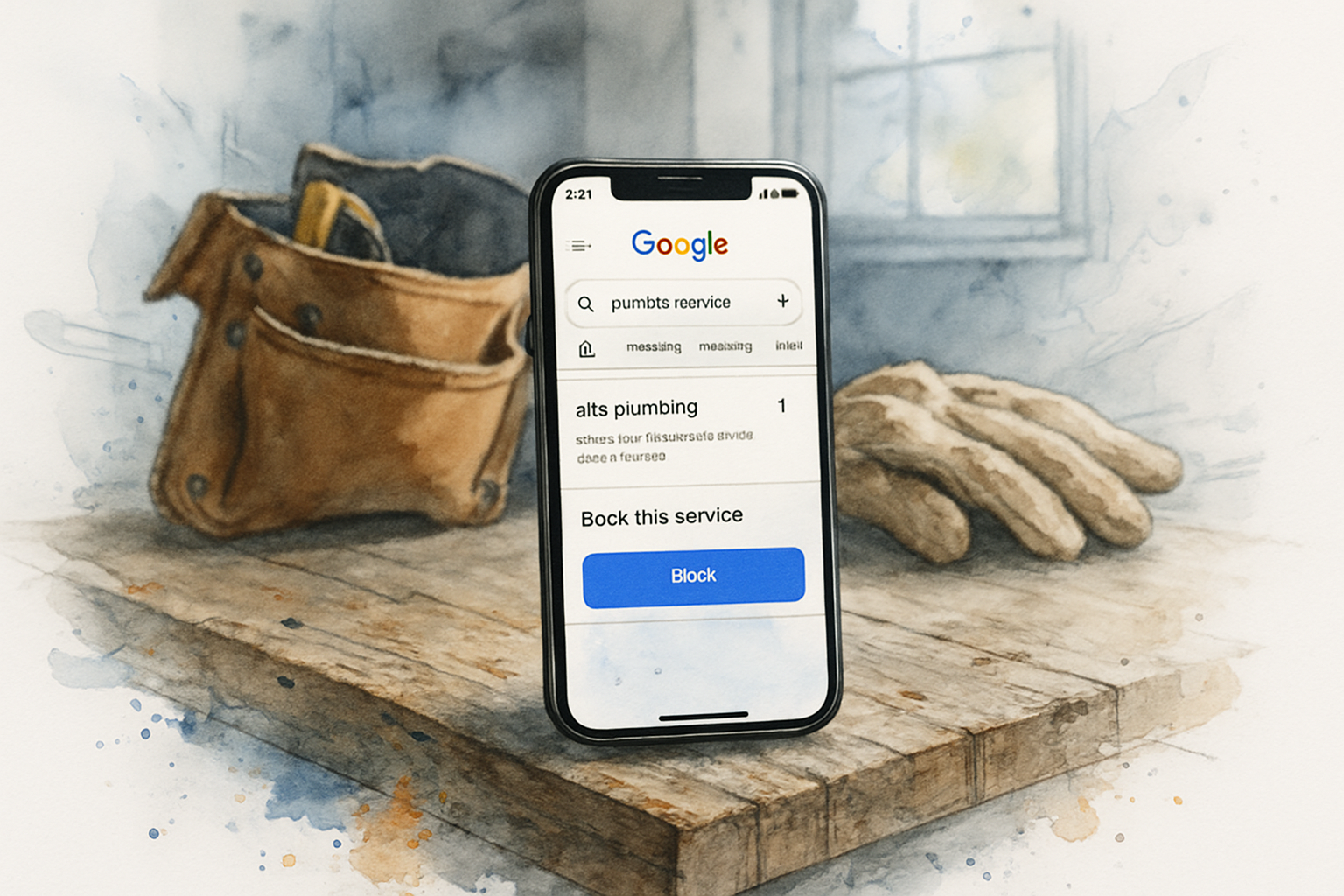
The 90-Second Problem Owner-Operators Need to Hear
Getting past the agent’s pre-dial check is only half the equation. What happens when it actually calls matters just as much.
Reports on pilot-stage agentic booking behavior indicate the AI expects a structured answer in under 90 seconds — covering price range, availability, and what the service includes. If the call goes to voicemail, or if whoever answers says ‘someone will call you back,’ the agent moves on to the next contractor. The booking is gone before anyone on your team even knows the call came in.
For owner-operated shops on the Central Coast — and most of the contractors we work with are exactly that — this is a real operational gap. If you’re on a job site in Carmel Valley or Marina and your phone rings from an unknown number, you may let it go. Under the old model, that was a minor inconvenience. Under agentic booking, it’s a lost job with no callback opportunity.
I’m not suggesting every contractor needs to hire a receptionist. But it’s worth thinking honestly about what happens when your phone rings during peak hours. A voicemail that says ‘leave a message and I’ll call you back’ was fine in 2022. In the summer of 2026, it may cost you jobs you never knew you lost.
This connects directly to why call tracking matters — if you don’t know which calls came from AI-referred sources versus direct search, you can’t measure what you’re losing or gaining. Understanding how your phone calls tie back to your SEO and content becomes even more important when the caller might be an AI agent, not a human.
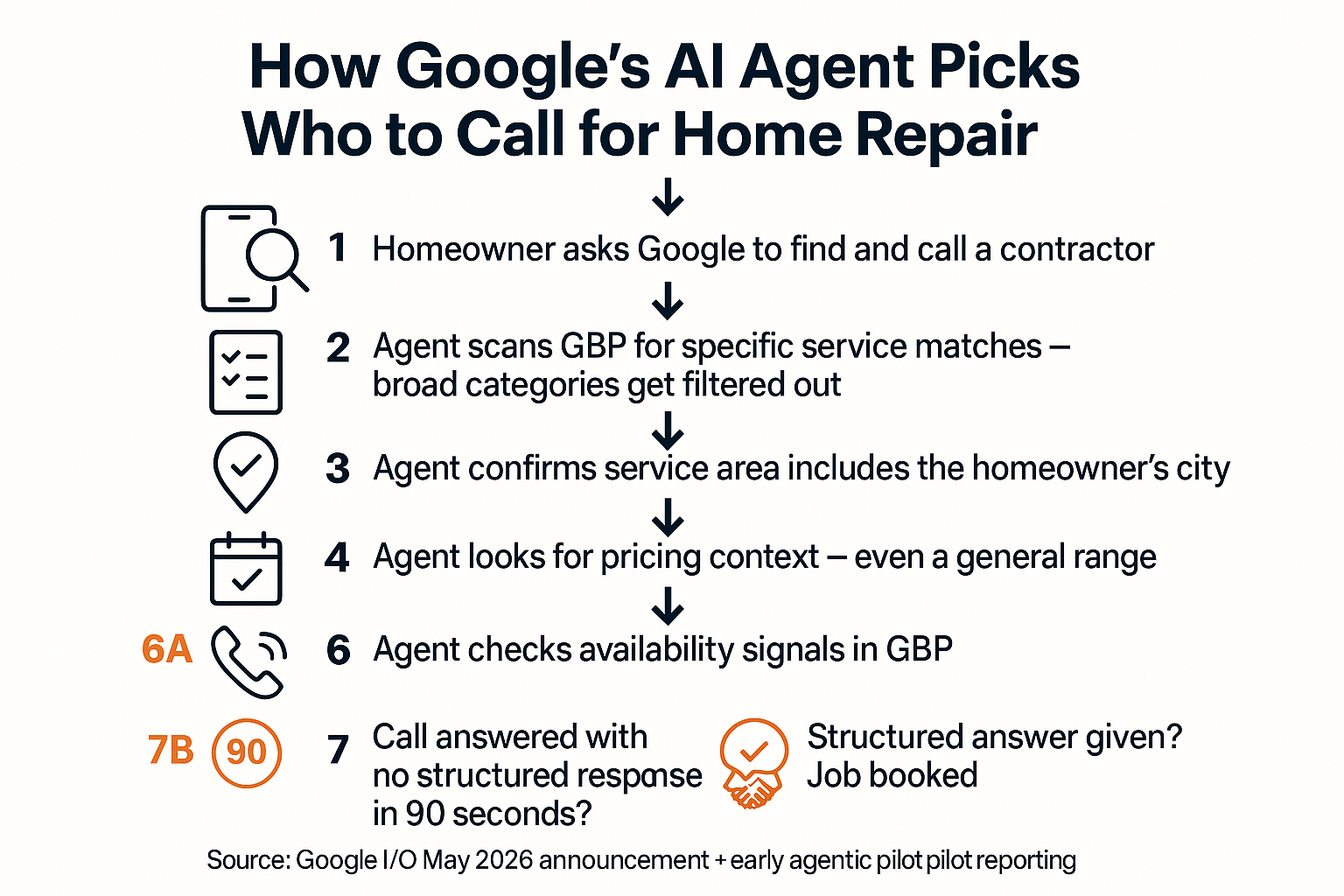
How Google’s Agentic Booking Decides Who Gets Called
This breakdown shows the sequence the agent follows from a homeowner’s request to an actual call — and where contractors get filtered out along the way.
Your Google Business Profile Is Now a Data Feed for Every AI Tool
I want to be direct about something that gets underestimated. Your Google Business Profile is no longer just a ranking factor for Google Search. It’s the primary data source that AI tools across the board pull from when a homeowner asks for a local contractor recommendation.
ChatGPT leans on GBP data for local queries. So does Gemini. So does Perplexity. When a homeowner in Seaside types ‘who does good roof repairs near me’ into any of those tools, the GBP is what feeds the answer. A profile with sparse service descriptions, photos from three years ago, and no service-area cities listed isn’t just a weak ranking signal anymore. It’s incomplete data that every AI system passes along — or more accurately, doesn’t pass along.
For contractors in Monterey, Pacific Grove, or Carmel, this means GBP maintenance is no longer optional maintenance work. It’s the foundation that every inbound channel — Google Search, Maps, ChatGPT, Gemini, Perplexity, and now agentic booking — depends on. We cover this in depth in our breakdown of how AI search is changing who gets called for home repairs.
The specific things that matter most for agentic readiness on your GBP:
- Service entries written in plain homeowner language, not trade jargon
- Every city you actually serve listed in your service area — Salinas, Marina, Seaside, Carmel Valley, and any others you actively take jobs in
- Recent photos — interior work shots, job site photos, finished project images updated within the last six months
- Business hours that reflect when you actually answer, not placeholder hours from when you first set up the profile
- Attributes filled in completely, including veteran-owned if applicable, languages spoken, and payment methods
GBP Readiness: What the Agent Checks vs. What Most Contractors Have
This is a rough picture of what agentic systems are looking for versus what most contractor GBP profiles actually show when we audit them.
| What the Agent Looks For | Typical Contractor GBP | Agentic-Ready GBP |
|---|---|---|
| Service descriptions | 1-2 broad categories (e.g., ‘HVAC’) | 8-15 specific services with plain-language names |
| Service area cities | Missing or incomplete | Every city actively served, listed by name |
| Pricing context | None | General price ranges or ‘starting at’ language |
| Photos | 3-5 photos, years old | 20+ recent photos updated within 6 months |
| Business hours | Set once, never updated | Accurate current hours including holiday/seasonal changes |
| Response to calls | Voicemail or ‘call you back’ | Structured answer: service, price range, availability |
Why Thin Service Pages Are an Agentic Booking Problem
Most contractor websites have service pages. Most of those pages don’t do what an AI agent needs them to do.
A 300-word generic page that says ‘we offer roofing services in the Monterey area’ doesn’t satisfy the checks an agentic system runs. What the agent is looking for is a page that answers a specific homeowner question: what does the service include, what does it cost in your area, how long does it take, and what should I know before booking?
A focused, locally specific page — written around how a homeowner in Salinas or Marina would actually ask for the service — is the kind of content that gets cited and matched. Not because it’s clever SEO. Because it answers the question completely.
This matters beyond just agentic booking. We’ve written before about what makes a contractor website actually generate calls and why contractor websites rank but don’t ring. The same gap that kills conversions on a human visit also fails the agent’s content check.
If you want a quick self-assessment, pull up your top three service pages and ask: could a homeowner read this page and know exactly what they’re getting, what it will roughly cost, and how to book? If the answer is no, the agent’s answer is the same.
Frequently Asked Questions About Google Agentic Booking for Contractors
When is Google’s agentic booking actually going live for home repair?
Google confirmed at I/O on May 19, 2025 that agentic booking is expanding to home repair ‘this U.S. summer’ — meaning it’s rolling out in 2026. The exact date for full availability across all markets hasn’t been pinned down publicly, but contractors in the Monterey Bay Area should treat this as imminent, not theoretical.
Does this replace regular Google Search and Google Maps?
No. Agentic booking is a new layer on top of existing search behavior — it doesn’t replace Maps or organic results. Homeowners who want to research first will still browse. But some percentage of homeowners will choose to let Google handle the outreach entirely, and that percentage will grow over time. Both channels matter — this is additive, not a replacement.
What if I don’t want Google calling on customers’ behalf?
That’s a fair question. Businesses can opt out of this feature, but opting out means you won’t receive calls generated through the agent channel at all. For most contractors, being opt-in and structuring your profile to compete well is the better play. Opting out is the same as not being listed — you remove yourself from a growing category of inbound calls.
My GBP already has five-star reviews. Isn’t that enough?
Reviews help — they’re a trust signal the agent uses — but they’re not a substitute for complete service data. An agent trying to match ‘I need someone to replace a heat pump in Seaside’ needs to find ‘heat pump installation’ in your service list and ‘Seaside’ in your service area. Reviews tell the agent you’re credible. Service structure tells the agent you’re the right match. You need both.
How is this different from what AI Search Sync already addresses?
AI Search Sync is our approach to making sure a contractor’s local presence is readable and matchable across all AI-powered platforms — Google, ChatGPT, Perplexity, Gemini, and now agentic booking. Agentic booking is one more output channel that depends on the same underlying data quality: GBP structure, service-specific content, and local relevance signals. If that foundation is solid, the business shows up across all of these. If it’s weak, it shows up in none of them.
Should I be worried about competitors in Salinas or Monterey getting ahead of me on this?
Honestly, yes — but not in a panic-inducing way. Most contractors in the area haven’t heard about this yet, which means there’s a real first-mover window right now. The contractors who clean up their GBP, build specific service pages, and structure their call-answer process before summer will be in a much stronger position than those who wait to see how it plays out.
Want to Know If Your Business Is Ready for Agentic Booking?
We’ve been helping home service contractors on the Central Coast build the kind of local presence that AI tools actually act on — from GBP structure to service page depth. If you’re a contractor in Salinas, Monterey, Marina, or anywhere across the Monterey Bay Area and want to know where your current setup stands, Core6 Marketing offers a straightforward discovery call where we look at exactly that. Book a time with Phil directly at https://calendly.com/core6-marketing/30min.