
Direct Answer: The questions homeowners ask when they call you are the same questions they type into Google and AI search. Answering those questions on your website is one of the most effective SEO moves available to a local contractor.
Every week, homeowners across Monterey County call plumbers, roofers, HVAC companies, and electricians with the same questions. How much will this cost? Do I need a permit? Should I repair it or replace it entirely? Most contractors answer those questions on the phone — and then those answers disappear forever.
That’s a real loss, because those exact questions are what homeowners type into Google and ask AI assistants before they ever pick up the phone. When your website doesn’t answer them, you’re invisible to the homeowner who researches before they call. And in 2025, that’s most of them.
This isn’t a theory about content marketing. It’s a practical observation from watching what actually moves rankings and drives inbound calls for home service contractors on the Central Coast. Your calls are already doing the work of keyword research — you’re just not capturing it yet.
Why Inbound Calls Are the Most Accurate Keyword Research Available
Keyword research tools give you volume estimates and competition scores. They’re useful, but they’re indirect. They tell you what people are searching for in aggregate — not what the specific homeowner in Salinas or Pacific Grove is worried about before they call a contractor.
Your call log tells you exactly that.
When a homeowner in Seaside calls an HVAC company and asks, “My system is 14 years old but it’s still running — how long can I wait before I have to replace it?” — that’s a search query. Someone else asked the same thing on Google this morning before calling. If your website answers it specifically, with real local context about what HVAC systems cost to replace in Monterey County and what signs actually mean it’s time to stop waiting, you’ve created something far more useful than a page full of service descriptions.
The voice-of-customer language in those calls matters too. Homeowners don’t say “HVAC system replacement services.” They say “my heater is making a banging noise” or “my AC can’t keep up when it’s hot in Carmel Valley.” Those are the phrases they type. That’s the language your pages should reflect. No agency-generated keyword report captures it as precisely as the words coming out of your callers’ mouths.
This is also why understanding how local SEO actually works for home service contractors starts with the customer — not the algorithm.

The Specific Questions That Show Up in Google and AI Search
There’s a category of search queries that researchers call hybrid informational-transactional queries. These are questions where the person is close to hiring someone but still gathering information first. Examples from the trades:
- “How much does it cost to replace a water heater in Monterey?”
- “Should I repair or replace my HVAC unit?”
- “Do I need a permit to replace a fence in Salinas?”
- “How long does a roof replacement take?”
- “What causes low water pressure in older homes?”
Whitespark’s local AI Overview research found that AI Overviews appear on 97% of these hybrid query types. That means when a homeowner asks ChatGPT or Google “should I repair or replace my furnace,” an AI-generated answer appears at the top of the results — and that answer cites sources. A contractor whose website gives a detailed, locally-grounded answer to that question stands a real chance of being one of those sources.
This is the core idea behind how we approach AI search visibility — building visibility not just in traditional Google results but in the AI systems that homeowners are increasingly turning to first. A contractor in Marina or Carmel doesn’t get cited by those systems for having a clean website. They get cited for having content that actually answers the question.
And the fastest way to know which questions to answer? Check your call recordings.
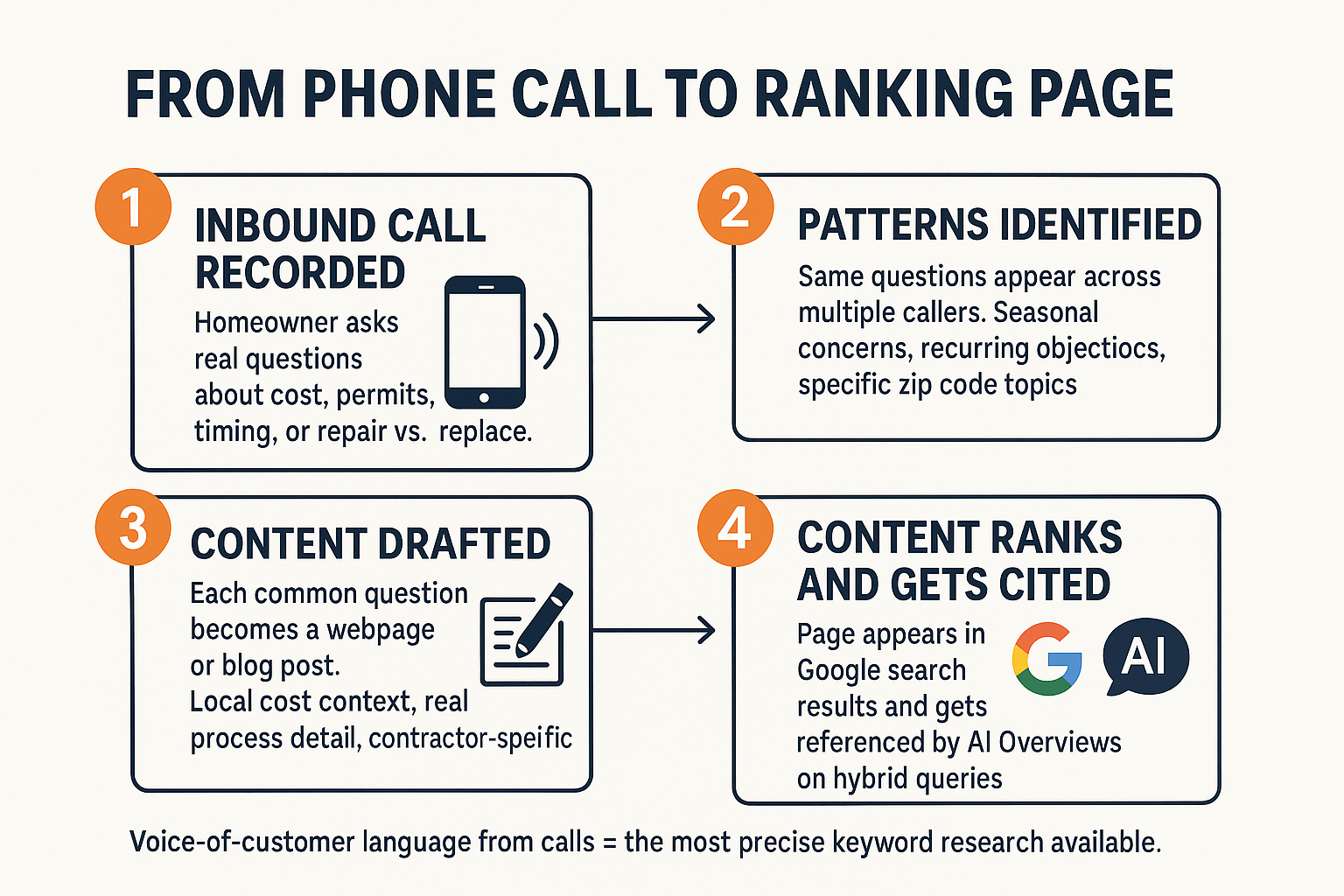
From Phone Call to Ranking Page: How the Process Works
This shows the four-step path from a real inbound call to a piece of website content that can rank in Google and get cited by AI search.
The Barrier Isn’t Motivation — It’s Having a System
Most contractors I talk to already understand, at some level, that their website could be doing more. The problem isn’t that they don’t want better content. The problem is they have no systematic way to get the raw material out of their heads and onto a page.
A job ends. A call gets answered. The knowledge disappears.
Call tracking tools that record and transcribe inbound calls change that dynamic. When calls are transcribed and searchable, patterns across dozens of conversations become visible. You start to see:
- The same three objections coming up in calls where the job didn’t close
- The same five questions asked before every fence permit or roofing estimate in Salinas
- Seasonal concerns — like homeowners in King City asking about swamp cooler maintenance every spring
- Specific zip-code concerns, like questions about older cast iron pipes in historic Monterey neighborhoods
That’s a content calendar. Built from actual demand, not guesswork.
Our call tracking add-on includes call recording, transcription, a live call dashboard, and a monthly Call Intelligence Report at $497/month. That report identifies your top caller questions, the objections in calls you lost, and three prioritized action items — which often point directly to content gaps on the website. It’s one of the more direct paths from “I don’t know what to write” to “here are six pages you should build this quarter.”
When your site starts answering the questions callers are asking before they call — and AI search is increasingly how they find you first — the phone rings with better-informed, more qualified leads.
Call Questions vs. Website Content: What’s Missing
This is a rough picture of how common contractor call questions map to the type of website content that could answer them — and what that content needs to include to be useful to both readers and search engines.
| Common Caller Question | Content Type to Create | What Makes It Rank |
|---|---|---|
| How much does it cost to replace my water heater? | Local cost guide page | Specific price ranges for Monterey County, factors that affect cost, brand considerations |
| Do I need a permit for this project in Salinas? | FAQ page or permit explainer | City-specific permit info, process steps, who pulls the permit |
| Should I repair or replace my HVAC unit? | Repair vs. replace article | Age thresholds, cost comparison, what signs point to replacement |
| How long will this take from start to finish? | Process / timeline page | Day-by-day or week-by-week breakdown, what causes delays, what the homeowner needs to do |
| What warranty comes with this work? | Service FAQ or warranty explainer | What’s covered, what voids it, how to make a claim |
Why Competitors Can’t Copy This Content
Generic contractor website content is everywhere. You can buy it, generate it, or copy it from someone else’s site. And it all sounds exactly the same — because it is.
Content built from your actual call transcripts is different. It reflects what your customers in Salinas, Watsonville, and Hollister are actually worried about. It uses the words they use. It answers the questions that come up in your specific market — not in some national contractor template.
That specificity is what search engines reward and what AI systems cite. AI search tools recommend contractors when their website content matches the exact language and intent of the query. A page that says “we offer HVAC services in Monterey County” doesn’t match the way a homeowner asks a question. A page that says “how to tell if your furnace is too old to repair — what Monterey County homeowners ask before replacing” comes much closer.
No competitor can replicate what came out of your phone conversations. That’s the raw material, and it belongs to you.
It’s also worth pairing this kind of content with the right website structure. If a page ranks but doesn’t convert visitors into calls, the content did half the job. Contractor websites that actually generate calls do both — they answer the question and give the homeowner a clear next step.
Frequently Asked Questions About Using Customer Calls for SEO Content
Do I have to tell callers they’re being recorded in California?
Yes. California is a two-party consent state, which means all parties on a call must be informed it’s being recorded. The standard approach is a brief automated disclosure at the start of the call — something like “this call may be recorded for quality purposes.” Any call tracking system used in California should handle this compliance step automatically. If you’re not sure how your current setup handles it, that’s worth checking before you start recording.
How do I turn a caller’s question into actual website content?
Start with the question exactly as the caller asked it. Then answer it the way you would on the phone — but add local detail (costs in Monterey County, permit requirements in Salinas, how long jobs typically take in your area) and explain the process. That combination of a real question, a direct answer, and local specifics is exactly what search engines and AI systems look for.
How many calls do I need before patterns start showing up?
In most cases, 30 to 50 recorded calls is enough to see recurring questions and objections clearly. For contractors doing higher call volume — like HVAC companies during summer in the Salinas Valley — meaningful patterns can show up faster. The goal isn’t to analyze every call individually; it’s to let transcription make the patterns searchable and visible across the batch.
Is this only useful for SEO, or does it help with sales too?
Both. When you know the three objections that show up in nearly every call that doesn’t close, you can address those proactively. That changes how your team answers the phone and how your website frames the value of your work. Better calls and better content tend to improve together.
What if I’m not a writer — how do I actually produce the content?
You don’t have to write it yourself. The call transcript gives whoever is creating the content — whether that’s you, a team member, or an agency — the raw material they need. The job of the writer is to organize and refine what’s already there, not to invent it. The knowledge comes from you; the formatting and SEO structure is someone else’s job.
Ready to Turn Your Calls Into Content That Ranks?
If you’re a contractor in Monterey County and your website isn’t answering the questions your callers are already asking, we can help you identify exactly where those gaps are. At Core6 Marketing, we work specifically with home service contractors on the Central Coast — and we’ve seen firsthand how much ranking potential is already sitting in a contractor’s call history, unused. Book a Discovery Call with Phil at https://core6.marketing/work-with-us/ to talk through what that process looks like for your trade and your market.