Direct Answer: Most Central Coast landscapers get low-ball leads because their online presence attracts price shoppers instead of serious buyers. The fix is targeting the right keywords and showing up where qualified buyers actually search.
You’re getting calls. But every third one opens with ‘what’s your cheapest option?’ or ‘I got a quote for $400 — can you beat that?’ If that’s your week, you’re not alone. Landscaping contractors from Salinas to Carmel Valley tell us the same thing: the leads coming in from the internet are a waste of time.
The problem isn’t that the internet doesn’t work for landscapers. The problem is that most landscaping businesses online are invisible to the buyers who actually spend money — and wide open to the ones who don’t.
This isn’t a mystery. There are two specific things that send low-quality leads your way, and both of them are fixable. We’ll break them down here.
The Keywords You Rank For Determine the Callers You Get
When someone searches ‘cheap landscaper Salinas’ or ‘affordable lawn care near me,’ they’ve already told you everything you need to know. They’re shopping on price. And if your website shows up for those searches, that’s exactly who’s calling you.
Most landscaping websites on the Central Coast rank for price-sensitive keywords because that’s what their content accidentally targets. Pages that talk about ‘affordable landscaping’ or ‘low-cost lawn maintenance’ attract one type of visitor — and it’s not the homeowner in Carmel looking to spend $15,000 on a backyard renovation.
The keywords that bring in real money are different:
- ‘landscape design Monterey County’
- ‘backyard hardscape contractor Carmel Valley’
- ‘drip irrigation installation Salinas’
- ‘weekly lawn maintenance service Seaside’
- ‘landscape lighting Pacific Grove’
Those searches come from people with a specific project and a budget to match. Understanding which keywords actually drive contractor leads is the first step toward filtering out the tire-kickers before they ever pick up the phone.
The good news is that most of your local competitors aren’t targeting those phrases either. Ranking for them isn’t necessarily a long fight — it often starts producing results within 30 days if your site is set up right.

Your Website Is Sending the Wrong Signal to the Right Buyers
Keyword targeting gets people to your site. What happens after that is up to your website — and most landscaping websites on the Central Coast do a poor job of convincing a serious buyer to call.
Here’s what a price shopper sees when they land on a contractor’s website: vague service descriptions, stock photos, no project photos showing the actual quality of work, and no clear reason to pick this company over the next one in the Google results. So they call three companies and go with whoever quotes the lowest number.
A buyer with a real budget behaves differently. They’re looking for proof:
- Before-and-after photos of projects similar to what they want
- Specific services listed — hardscape, irrigation, landscape lighting, drainage
- Reviews that mention the type of project they’re planning
- A clear description of your process — consultation, design, installation
- Pricing context — not a price list, but enough to know if they’re in the right ballpark
When a homeowner in Pebble Beach is thinking about a $20,000 outdoor living project, they’re not calling the landscaper with three photos and a generic ‘contact us’ form. They’re calling the one whose website looks like they’ve done that project before.
If your website doesn’t reflect the quality of your work, it’s likely losing you jobs before you even answer the phone. That’s not an exaggeration — it’s just what happens when a buyer’s first impression doesn’t match what they’re willing to spend.
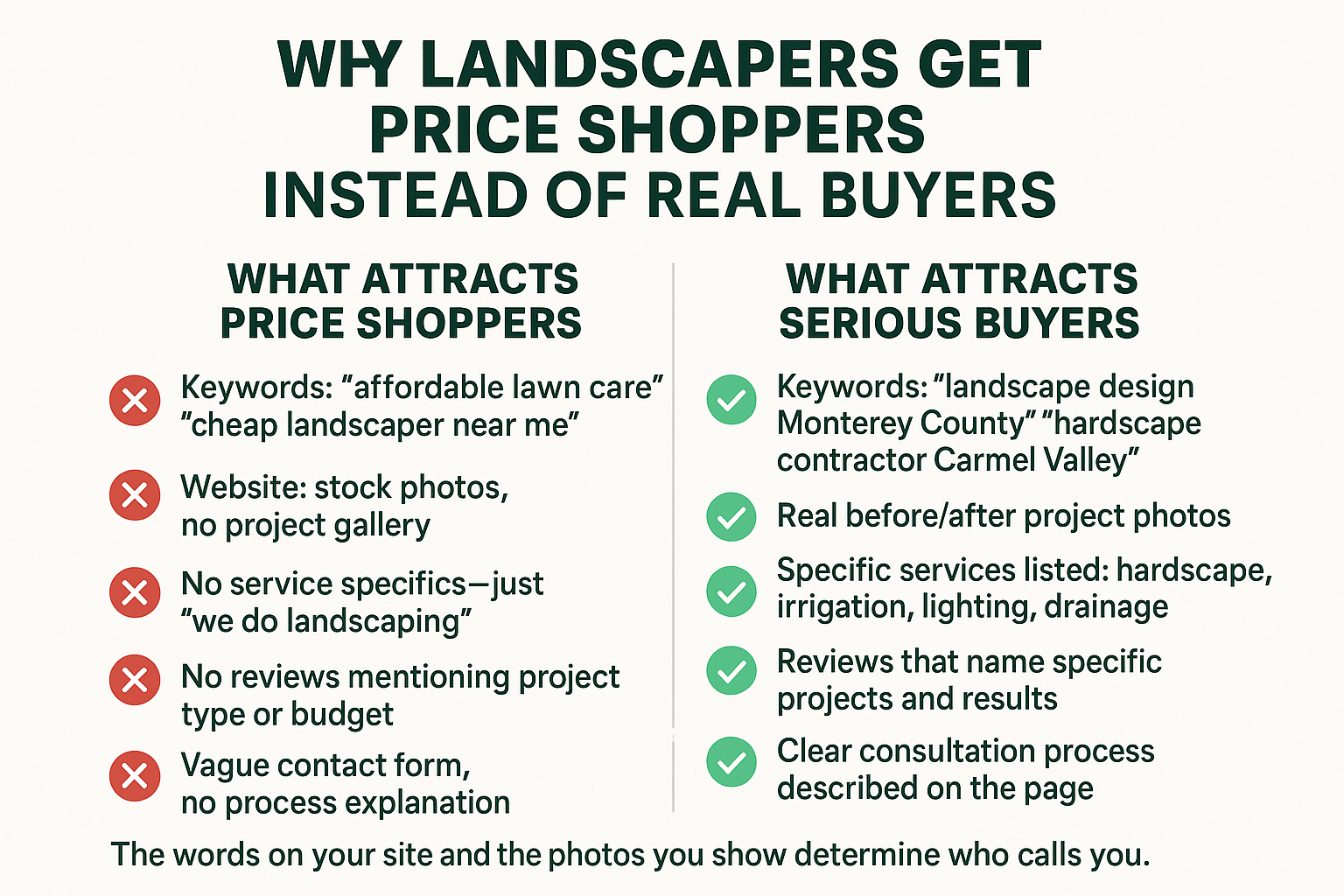
Two Filters That Separate Quality Leads From Price Shoppers
This breakdown shows how keyword targeting and website positioning work together to either attract or repel the callers you want.
Why Lead Aggregators Make This Problem Worse
A lot of landscapers on the Central Coast have tried Angi, HomeAdvisor, or Networx at some point. And a lot of them stopped because the leads were exactly what we’ve been describing — price-first callers who went to three other contractors before deciding.
That’s not an accident. Those platforms are built around price comparison. The buyer fills out a form, the platform sells that lead to four or five contractors at once, and the race to the bottom begins. The landscaper who wins is usually the one who quoted the least, which means the one who makes the least.
Understanding the actual ROI of lead aggregator platforms before spending money on them is worth doing. But the bigger point here is this: those platforms train buyers to think about landscaping services as a commodity, where price is the only variable.
Your own website, optimized for the right keywords, works the opposite way. The buyer found you specifically. They read about your work. They looked at your photos. By the time they call, they’re not asking what your cheapest option is — they’re asking when you can come out.
Lead Source Comparison for Central Coast Landscapers
This gives you a side-by-side look at how different lead sources compare on the factors that actually affect your bottom line.
| Lead Source | Lead Quality | Avg. Monthly Cost | Who Controls It |
|---|---|---|---|
| Angi / HomeAdvisor | Low — shared with 3-5 competitors | $200–$600+ | The platform |
| Google Ads (your own campaign) | Medium-High — exclusive to you | $500–$2,000+ | You (with your agency) |
| Local SEO / Organic Rankings | High — buyer found you intentionally | $400–$1,200/mo in mgmt fees | You (builds over time) |
| Word of Mouth / Referrals | Highest — pre-sold on your work | $0 direct cost | Your reputation |
| Unoptimized website / no SEO | Low — whoever stumbles on it | $0 (but opportunity cost is real) | Nobody |
What Actually Changes When You Fix the Targeting
When a landscaping company in Salinas or Marina gets the keyword targeting right and the website content to match, the calls shift in a noticeable way. The first thing most contractors say is that callers already know what they want — they’re not fishing for a ballpark, they’ve already decided they want a drip system or a new patio and they’re calling to schedule a site visit.
The second thing that changes is close rate. When a buyer found you by searching for the specific service you do, and your website showed them real project photos and a clear process, they’re not shopping around as hard. The competition dropped off the moment your website did its job.
A landscaping website that works after hours — meaning one that’s ranking for the right searches and converting those visitors to calls — is one of the highest-ROI things a landscaping company on the Central Coast can build.
For landscapers in Monterey County, ranking in the Google map pack for specific service-plus-location searches is where the biggest volume comes from. That means your Google Business Profile needs to be fully built out, your service areas need to be accurate, and your website needs to back it up with matching content. That’s the core of what our AI Search Sync methodology addresses — getting your business visible not just on Google, but on the AI-powered search tools like ChatGPT and Perplexity that more buyers are starting to use.
Frequently Asked Questions About Landscaper Lead Quality Online
Why do I keep getting calls from people with tiny budgets even though I do high-end work?
Your website is probably ranking for the wrong searches, or not ranking at all — which means the only people finding you are using price-driven search terms. When your site starts showing up for specific, project-type searches like ‘backyard hardscape Carmel’ instead of ‘cheap landscaper,’ the caller profile changes. It takes intentional keyword work to make that shift happen.
Is Google Ads worth it for a landscaping company on the Central Coast?
It can be, but it depends heavily on how the campaign is set up. A Google Ads campaign aimed at ‘landscaping services’ will burn through budget on junk clicks fast. One aimed at ‘drought-tolerant landscaping Salinas’ or ‘retaining wall installation Monterey’ pulls a much better caller. The geography matters too — Monterey County has enough search volume to make paid ads work, but the targeting has to be tight or you’re paying for the same price shoppers you’re trying to avoid.
How long does it take to see better leads from SEO?
Most landscaping companies on the Central Coast start seeing measurable ranking movement within 30 days when their site is properly optimized. Quality lead volume usually builds over 90 to 180 days as rankings stabilize and the Google Business Profile gains traction. It’s not instant, but it compounds in a way that paid ads don’t.
Does my Google Business Profile really matter that much?
For local service searches, the map pack — those three business listings that show up at the top of Google before the organic results — gets more clicks than anything else on the page. If you’re not in it for searches like ‘landscaper near me’ or ‘landscape design Monterey County,’ you’re invisible to the buyers who are ready to call right now. Your Google Business Profile is the engine behind that visibility, and most contractors have it half-filled out at best.
What’s the difference between a landscaper with a website and one who actually gets found?
Having a website and being visible in local search are two completely different things. A site that isn’t optimized for local keywords, doesn’t have a properly configured Google Business Profile behind it, and isn’t earning any citations or reviews is essentially parked. It exists, but nobody’s finding it. The gap between having a website and getting found applies just as much to landscapers as it does to any other trade.
Want to Know What’s Pulling the Wrong Callers to Your Business?
Core6 Marketing works exclusively with home service contractors on the Monterey Bay Area and Central Coast — and we’ve helped landscaping companies in Salinas, Marina, and across Monterey County identify exactly where their online presence is bleeding lead quality. If your phone is ringing with price shoppers more than real buyers, there’s a specific reason — and it’s usually findable in about 20 minutes. Phil Fisk offers a no-pressure discovery call where we look at your current visibility and tell you what we actually see. Book a time at https://calendly.com/core6-marketing/30min.