
Direct Answer: If your landscaping website isn’t generating calls without you doing anything, it’s just a digital brochure. A working site ranks on Google, loads fast on mobile, and turns visitors into phone calls — day and night.
You finished a long day on a job in Salinas or Carmel Valley, put the truck away, and turned your phone off. Meanwhile, someone in Monterey was searching for a landscaping company at 9:30pm. Did your website show up — and did it make them call?
For most landscaping contractors on the Central Coast, the honest answer is no. The site exists. It might even look decent. But it’s not ranked where anyone can find it, and if someone does land on it, there’s nothing compelling them to pick up the phone.
This article breaks down the two specific things that determine whether your website generates leads while you sleep: where it ranks and what it does when someone shows up. Fix both, and your site stops being a cost and starts being an asset.
Why Most Landscaping Sites in Monterey County Never Get Found
Ranking on Google in Monterey County is more competitive than most contractors realize. You’re not just competing with other local landscaping companies — you’re competing with Yelp, Angi, Houzz, and regional directories that have been building authority for years.
The contractors who consistently show up at the top of local search results aren’t there by accident. They’re there because their sites are built around the specific words real customers type in — things like “landscaping company Salinas” or “irrigation repair Pacific Grove” — and because their Google Business Profile is fully optimized and actively maintained.
Most landscaping websites fail this test for a handful of predictable reasons:
- No location-specific pages — one generic page for a service area that spans three counties
- Thin or missing content — fewer than 300 words on the homepage, nothing explaining what they actually do
- Unclaimed or incomplete Google Business Profile — the single biggest missed opportunity in local SEO
- No backlinks or citations — the site exists in isolation, and Google has no reason to trust it
- Slow load speed — anything over 3 seconds on mobile costs you a significant share of visitors
We’ve looked at why landscaping websites don’t bring in calls in detail before, and the pattern is almost always the same. The site was built to look good, not to rank. Those are two very different goals.
Getting Found Is Half the Battle — Then the Site Has to Close
Say someone searches “landscapers near me” from their phone while sitting in their driveway in Seaside at 8pm. Google serves them three results in the local map pack, and your company appears. They tap your listing.
Now what happens?
If your site loads in under 2 seconds, shows a clear phone number at the top, has photos of real work you’ve done in this area, and has at least a handful of Google reviews — there’s a real chance they call you that night or leave a message. If the site loads slowly, the phone number is buried, the photos are stock images, and the reviews are nonexistent — they’re back on Google in under 15 seconds looking at the next contractor.
This is where conversion lives. It’s not a design question. It’s a trust question. Homeowners in Monterey County — especially in neighborhoods like Del Rey Oaks, Ryan Ranch, or the Carmel Highlands — are not bargain hunters. They’re choosing based on who looks like the most credible, professional option.
The specific elements that actually move someone to call:
- A phone number visible without scrolling, on mobile, above the fold
- Photos of local work — recognizable Monterey County properties, not generic green lawns
- Google reviews in the double digits, with at least a 4.5-star average
- Clear service descriptions — what you do, where you do it, and roughly what it costs
- Fast load time — aim for under 2.5 seconds on a 4G connection
We covered a similar conversion breakdown for HVAC companies in this article on website visibility in Monterey County — the same principles apply to landscaping. The phone has to ring without you being there to make it happen.
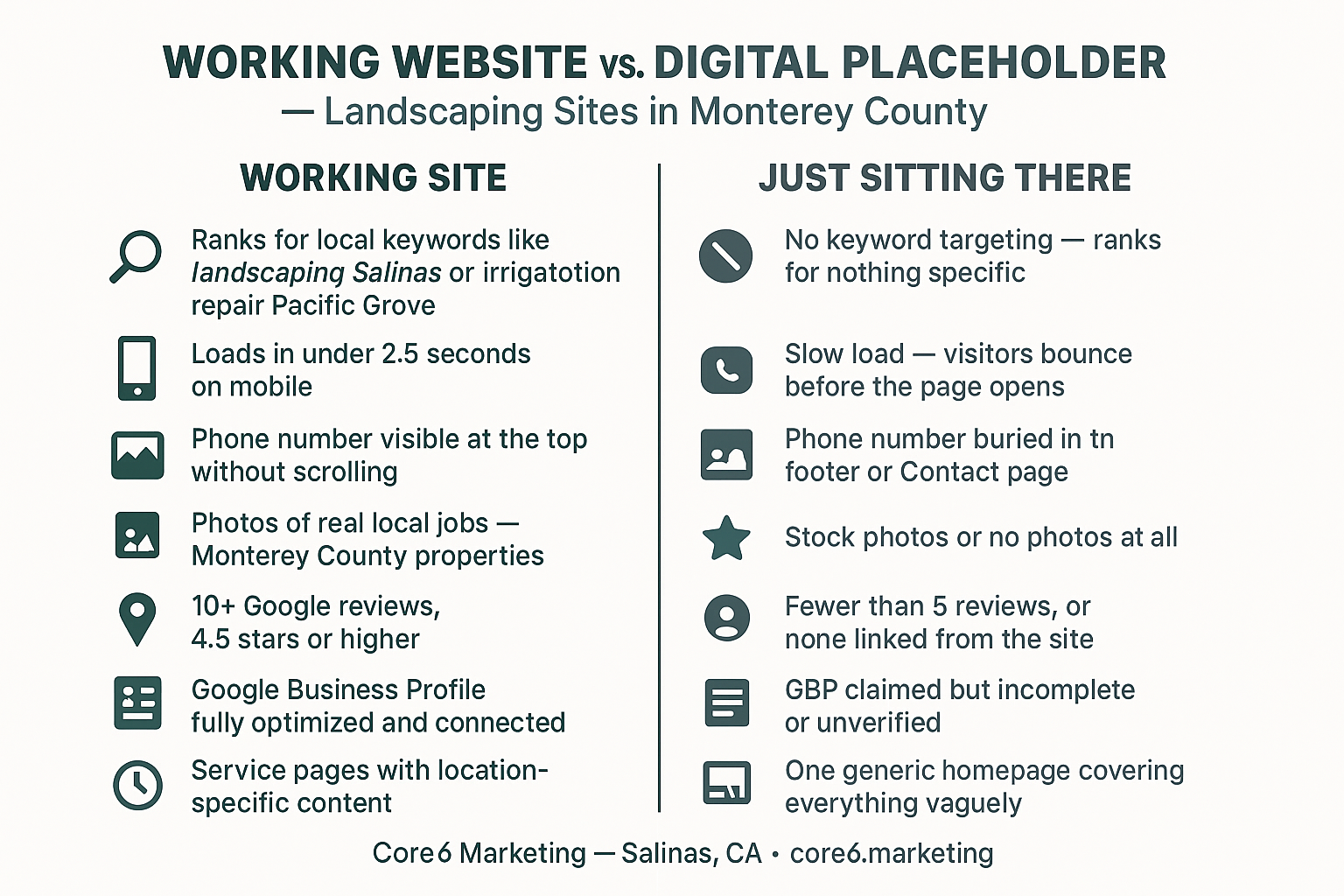
What a Working Landscaping Website Does — vs. One That Just Sits There
This comparison breaks down the eight factors that separate a lead-generating landscaping site from a digital placeholder.
The SEO Gap Most Landscaping Contractors Don’t Know They Have
Here’s something that’s changed in the past two years that most landscaping business owners haven’t caught up to yet: Google is no longer the only place people search for contractors.
Homeowners in Carmel Valley and Marina are now asking ChatGPT and Google’s AI Overviews things like, “What’s a good landscaping company near me that does drought-tolerant installs?” These AI platforms pull answers from sources they consider trustworthy — and if your business isn’t structured to appear in those results, you’re invisible to a growing slice of your market.
Our AI search visibility approach to local SEO is built specifically for this shift. It’s not just about ranking in Google’s traditional blue links. It’s about being the business that AI platforms surface when someone asks for a landscaping contractor in your specific service area.
For landscaping companies, the content that tends to drive AI visibility includes:
- Specific service descriptions with real detail — not “we do landscaping” but “we install drip irrigation systems for water-efficient yards in Monterey County”
- Location-specific pages that mention actual cities and neighborhoods you serve
- Structured data that tells Google and AI platforms exactly what your business does and where
- Consistent citations across directories — your name, address, and phone number matching everywhere
This is also why improving your search ranking on Google requires a different approach today than it did even three years ago. The landscape of search has changed. Most contractor websites haven’t.
What Landscaping Website Problems Actually Cost You
These are realistic estimates based on what landscaping contractors in Monterey County typically spend and earn per job — not national averages.
| Website Problem | What It Costs You | Fix Timeframe |
|---|---|---|
| Not ranking in Google’s local pack | Missing 3-5 inbound calls per month from organic search | 30-90 days with active SEO |
| Slow mobile load speed (5+ seconds) | Up to 50% of visitors leave before the page loads | 1-2 weeks with a proper rebuild |
| No Google Business Profile optimization | Not showing up in map results for high-intent searches | 2-4 weeks to see initial impact |
| Missing or low review count | Losing jobs to competitors with more social proof | Ongoing — 60-90 days to build |
| No location-specific service pages | Invisible for city-level searches like ‘landscaper Seaside CA’ | 30-60 days with new content |
| No call tracking in place | Can’t measure which efforts are generating actual phone calls | Immediate — trackable same week |
The One Question That Tells You Everything
Pull out your phone right now. Search for “landscaping company” plus your city — Salinas, Monterey, Marina, wherever your best customers are. Look at the top three results in the map pack.
Are you there?
If not, someone else is getting every call that should be yours. And those calls are happening at 7am before jobs start, at lunch, and at 9pm when homeowners are finally sitting down to research contractors. Your truck wraps and yard signs don’t help you at those hours.
Your website either works around the clock or it doesn’t work at all. There’s no middle ground for a local service business.
The good news is that 30 days of focused SEO work can produce the first measurable ranking improvements for a landscaping site that’s been sitting dormant. It’s not magic — it’s consistent, specific work: fixing the technical issues, building the right content, getting the Google Business Profile dialed in, and making sure AI platforms can find and understand your business. We’ve done this for local contractors across the Central Coast and the pattern holds across trades.
Frequently Asked Questions About Landscaping Website Performance
How do I know if my landscaping website is actually generating leads?
The clearest signal is call volume — specifically, calls that came from people who found you online without a referral. If you don’t have call tracking set up, you’re guessing. A dedicated tracking number tied to your website tells you exactly how many calls came in, when, and from which pages. Without that data, you can’t separate website leads from referrals or repeat customers.
My site looks great — why isn’t it getting calls?
Design and performance are two different things. A site can look professional and still rank nowhere on Google. If you built the site to look good but didn’t build any content targeting what your customers actually search for, Google has no reason to show it. Looking good doesn’t make you findable.
How much does it cost to fix a landscaping website in Monterey County?
It depends on what’s broken. A full rebuild with SEO built in runs $3,000–$6,000 for most landscaping contractors on the Central Coast. Ongoing local SEO to maintain and grow your rankings is typically $500–$1,500/month depending on the scope. If your current site just needs technical fixes and content updates, that could be a fraction of a full rebuild. The breakdown of website design costs for contractors covers this in more detail.
Does my Google Business Profile really matter that much?
Yes — probably more than your website right now. For searches with local intent, Google’s map pack gets more clicks than the organic listings below it. A fully optimized Google Business Profile with regular photo updates, accurate service descriptions, and a steady stream of reviews can generate calls on its own. If yours is claimed but incomplete, you’re leaving significant visibility on the table.
Can a landscaping company in a smaller city like King City or Hollister compete online?
Often easier than competing in Salinas or Monterey, where there are more established competitors. Smaller markets have less competition for local search terms, which means a well-built site and optimized Google Business Profile can move to the top of results faster. The same fundamentals apply — keywords, content, citations, reviews.
What’s the difference between regular SEO and what AI Search Visibility does?
Traditional SEO focuses on ranking in Google’s blue link results. AI search visibility covers that ground and also structures your online presence so AI platforms — ChatGPT, Perplexity, Google’s AI Overviews — can find, understand, and recommend your business when someone asks a natural language question about landscaping contractors in your area. It’s the same foundation, built further.
Ready to Find Out What Your Site Is Actually Doing?
If you’re a landscaping contractor serving Monterey County — Salinas, Seaside, Pacific Grove, Carmel, or anywhere in between — and you’re not sure whether your website is generating calls or just collecting dust, a 30-minute conversation can answer that. Core6 Marketing works exclusively with home service contractors on the Central Coast, and we can tell you quickly where your site stands and what it would take to change it. Book a Discovery Call with Phil Fisk at https://core6.marketing/work-with-us/.