Direct Answer: If your HVAC website isn’t generating inbound calls from local homeowners, it’s failing — regardless of how it looks. A working site ranks, loads fast, and converts visitors into phone calls.
Most HVAC contractors in Monterey County have a website. But having one and having one that works are two completely different things. If you’ve ever said “we have a site, but I don’t think it does much” — you’re probably right.
Your website has one job: turn a local homeowner searching for HVAC help into a phone call or a booked appointment. That’s it. If it’s not doing that, it doesn’t matter how nice the photos look or how many pages it has.
This article walks through the specific signs your HVAC website is failing — and what’s actually causing it. No guesswork, no theory. Just the things we see most often with contractor sites on the Central Coast.
The First Question: Is Anyone Actually Finding Your Site?
Before we talk about whether your site converts visitors, we need to ask a more basic question — are people even landing on it?
An HVAC company in Salinas or Seaside can have a beautifully built website that gets zero organic traffic because it doesn’t rank for anything homeowners actually search. Think “AC repair Salinas” or “furnace tune-up Marina CA.” If your site doesn’t show up for those phrases, the page quality is irrelevant.
There are a few ways to check this without any special tools:
- Open Google and search “HVAC repair [your city]” — if you’re not on page one, you’re mostly invisible
- Search your business name — you should appear at the top of Google Maps with reviews visible
- Ask your last five customers how they found you — if none of them say “Google search,” that tells you something
In Monterey County, the search volume for HVAC-related terms spikes every June when marine layer gives way to inland heat, and again in October when homeowners start thinking about heating. If your site isn’t ranking before those windows, you’re handing calls to whoever is.
We covered this visibility problem in depth for another trade in Your HVAC Truck Is Everywhere — Is Your Website Nowhere? — the same principles apply here.
What Happens When Someone Does Land on Your Site
Let’s say a homeowner in Pacific Grove finds your site. You have about eight seconds before they decide to stay or leave. That’s not an exaggeration — it’s consistent with what we see in actual call tracking data across contractor sites.
Here are the most common reasons an HVAC site loses a visitor in those first eight seconds:
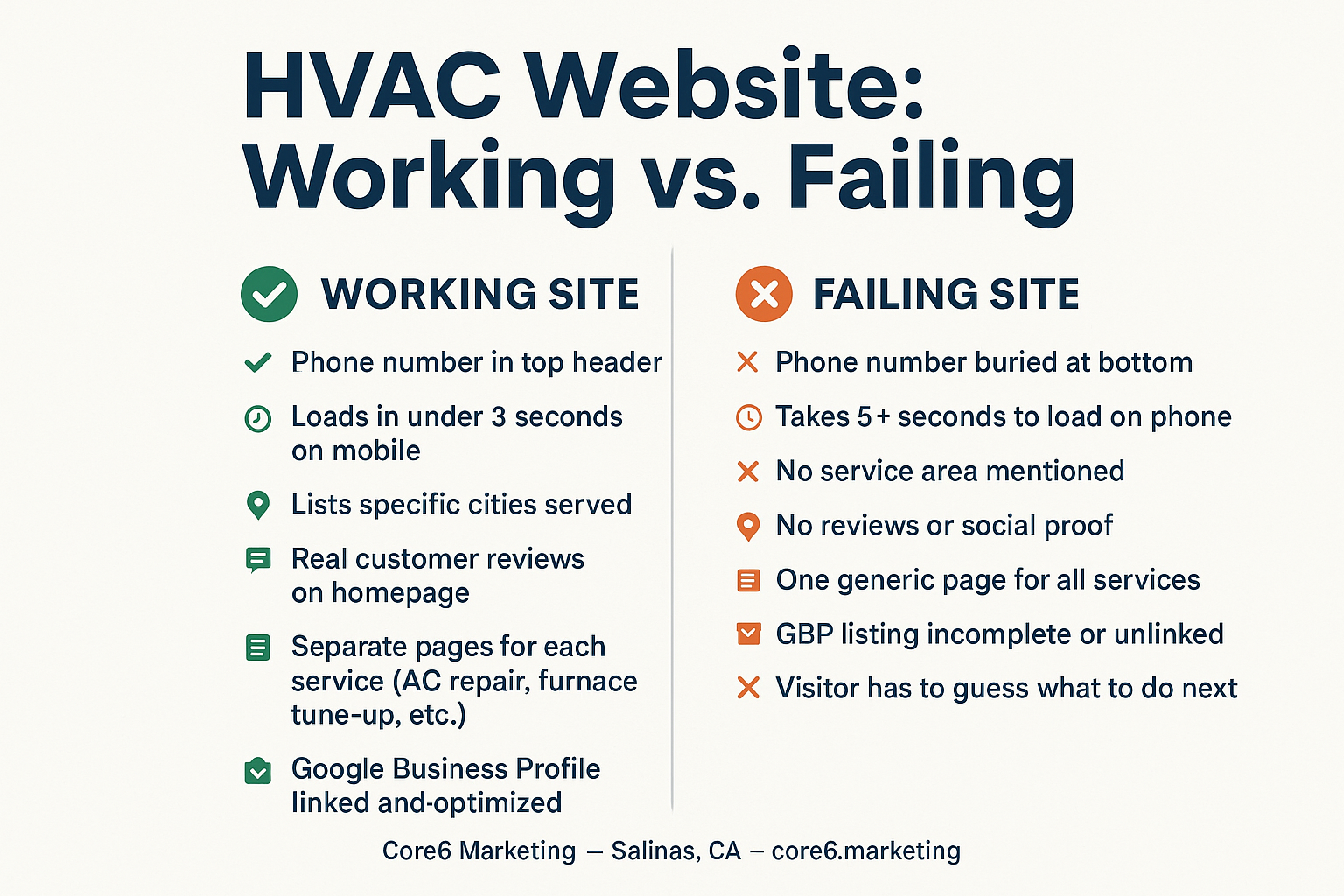
- No phone number visible above the fold — if they have to scroll to find your number, most won’t
- Slow load time — anything over three seconds on mobile and you’re losing people; Monterey County homeowners are searching on their phones, not desktops
- No clear service area — if the site doesn’t say “serving Salinas, Marina, and Monterey” somewhere prominent, visitors assume you might not cover their neighborhood
- Generic stock photos — a site full of photos that look like they came from a national brand feels impersonal and untrustworthy
- No reviews or proof — a homeowner dealing with a broken AC in July wants to know someone else trusted you first
The fix for most of these isn’t a full redesign. It’s targeted changes to the homepage — phone number in the header, a short “we serve [cities]” line near the top, and a few real Google reviews pulled onto the page.
But if the structure of the site itself is working against you — built on a template that can’t be edited properly, or loading in five-plus seconds on mobile — you’re looking at a rebuild. We break down what that actually costs in Contractor Website Design Cost Explained.
The Anatomy of an HVAC Website That Actually Generates Calls
This breakdown shows what a working HVAC website includes — and what a failing one is typically missing.
HVAC Website Performance: What Good Numbers Look Like vs. Warning Signs
If you have access to Google Analytics or Search Console, these benchmarks give you a quick read on where your site stands. If you don’t have either set up, that’s a problem on its own.
| Metric | Healthy Range | Warning Sign |
|---|---|---|
| Page load time (mobile) | Under 3 seconds | Over 4 seconds |
| Bounce rate | 40–60% | Over 75% |
| Monthly organic visitors | 100+ for a local market | Under 30 |
| Google Maps ranking (city name + HVAC) | Top 3 in local pack | Page 2 or not showing |
| Phone calls from website (monthly) | 10+ calls | 2 or fewer |
| Google reviews (count) | 20+ with 4.5 stars or higher | Under 10 or below 4.0 stars |
The Hidden Problem: Your Site Doesn’t Exist in AI Search
There’s a newer layer to this that most HVAC contractors haven’t thought about yet. A growing number of homeowners in Monterey County are now asking ChatGPT or Google’s AI Overview things like “who’s the best HVAC company near Salinas” before they even look at traditional search results.
If your business isn’t appearing in those answers, you’re losing a segment of potential calls that didn’t even exist two years ago.
This is the gap that standard website fixes don’t address. Traditional SEO gets you onto Google’s page one. AI Search Sync — the methodology we use at Core6 — goes further, building the kind of structured authority signals that AI platforms draw from when generating recommendations. That includes your Google Business Profile, local citation consistency, and on-page content that answers the specific questions AI systems are trained to reference.
For an HVAC company in Marina or Carmel Valley, showing up in AI-generated answers could mean being the first name a homeowner sees before they’ve even looked at a list of options. That’s a meaningful difference in lead quality.
The same gap affects other trades too — we’ve written about it from the electrician’s perspective in The Difference Between an Electrician With a Website and One Who Gets Found.
How to Know If Your Site Is Actually Generating Calls — Right Now
Most HVAC contractors don’t know how many calls come from their website because they’ve never set up a way to track it. When we ask new clients to estimate their website-generated calls per month, the answer is usually “I think maybe a few?”
“I think maybe a few” is not a number you can run a business on.
The simplest way to start measuring this is with call tracking — a dedicated phone number that only appears on your website. When that number rings, you know the call came from the site. You can set this up for as little as $30–$50/month through basic services, though you won’t get much beyond raw call counts.
For HVAC companies that want to understand not just how many calls they’re getting but why callers are choosing them or hanging up, a more detailed system gives you call recordings, transcriptions, and a report that identifies common questions and objections. That kind of data is what lets you actually improve — not just measure.
The point is this: if you can’t tell whether your site is generating calls, you can’t fix it. Start there. Check your popular SEO keywords performance in Google Search Console, set up call tracking, and look at your site on your phone as if you were a first-time visitor. You’ll spot the problems fast.
Frequently Asked Questions About HVAC Websites in Monterey County
My HVAC site has been up for three years. Wouldn’t I know if it wasn’t working?
Not necessarily. Most contractor sites generate a baseline of referral calls — people who already know you and search your name directly. That can make a site feel like it’s working when it’s actually invisible to homeowners who don’t know you yet. The real test is whether strangers are finding and calling you through organic search. That’s the number worth checking.
How long does it take to see ranking improvements after making changes?
For on-page SEO changes and Google Business Profile improvements, you can typically see measurable movement within 30 days. Full competitive rankings in a market like Salinas or Monterey take longer — usually 3 to 5 months of consistent work. Anyone promising overnight results is not being straight with you.
Is a fast website really that important? Most of my customers are older and patient.
Load speed matters regardless of age. 53% of mobile users abandon a page that takes more than 3 seconds to load — that’s not an age-specific behavior, it’s how everyone uses their phone when they have a problem to solve. And Google factors page speed directly into rankings, so a slow site hurts your visibility before a visitor even arrives.
Should I have separate pages for AC repair, furnace repair, and maintenance — or just one HVAC services page?
Separate pages perform significantly better. A dedicated page for “AC repair in Salinas” with its own content, photos, and local context will rank far more effectively than a single catch-all services page. Each page targets a specific search phrase and gives Google a clear, focused signal about what that page covers. For HVAC companies in competitive markets like Monterey County, this structure is one of the biggest differences between sites that rank and sites that don’t.
What does a new HVAC website typically cost in this area?
For a properly built contractor site — mobile-first, fast-loading, with individual service pages and conversion-focused structure — budget between $2,500 and $6,000 in most Central Coast markets. Template-based sites can run cheaper, but they often come with speed problems, limited flexibility, and no local SEO foundation built in.
Want to Know Exactly Where Your HVAC Site Is Falling Short?
We work with HVAC companies and home service contractors across Monterey County, Salinas, Marina, Pacific Grove, and the surrounding Central Coast — and we’ve seen the same site problems cost contractors thousands in missed calls every year. If you want a straight answer on what your site is actually doing and where it’s losing you business, book a Discovery Call with Phil Fisk at https://calendly.com/core6-marketing/30min. No pitch, no pressure — just a clear read on where you stand.