
Direct Answer: Yes — a slow, unclear, or hard-to-navigate landscaping website turns away potential customers before they ever call you, no matter how good your actual work is.
You finished a backyard renovation in Carmel Valley last week. The photos look great. Your Google reviews are solid. But your phone isn’t ringing the way it should. The most likely reason isn’t your price. It’s your website.
Most landscaping websites on the Monterey Peninsula were built to look decent — not to convert visitors into calls. And there’s a real difference between those two things. A homeowner in Salinas or Seaside searching for a landscaper at 7pm on a Tuesday is making a decision in under a minute. If your site doesn’t answer their questions fast, they move on to the next result.
This article breaks down the two biggest ways a landscaping website costs you jobs before you ever pick up the phone — and what you can do about both of them.
The First 8 Seconds Decide Whether They Call or Leave
When someone lands on your site, they’re not reading. They’re scanning. They want to know three things immediately: What do you do, where do you work, and can I trust you? If your homepage doesn’t answer all three within 8 seconds, most visitors leave.
Here’s what that looks like in practice. A homeowner in Marina types “landscaper near me” into Google on their phone. Your site loads. They see a slow-loading hero image, a tagline like “Bringing Beauty to Your Outdoor Space,” and a navigation menu with five dropdowns. They have no idea if you serve Marina, what a project costs, or whether you’ve done work like theirs. They hit the back button.
That’s not a hypothetical — that’s what happens on most contractor sites. The specific things that cause it:
- No clear service area mentioned above the fold (Monterey County, Salinas, the Peninsula — say it)
- No phone number visible without scrolling
- Taglines over information — “Passion for landscapes” tells them nothing
- Slow load speed — Google’s own data shows mobile bounce rates climb sharply past 3 seconds
- No photos of actual local work — stock images of lawns in Ohio don’t build trust in Carmel
Fix the first 8 seconds and you’ve already separated yourself from 80% of the landscaping sites in this market. We’ve written more about what actually drives landscaping site performance in why most landscaping websites don’t bring in a single call.
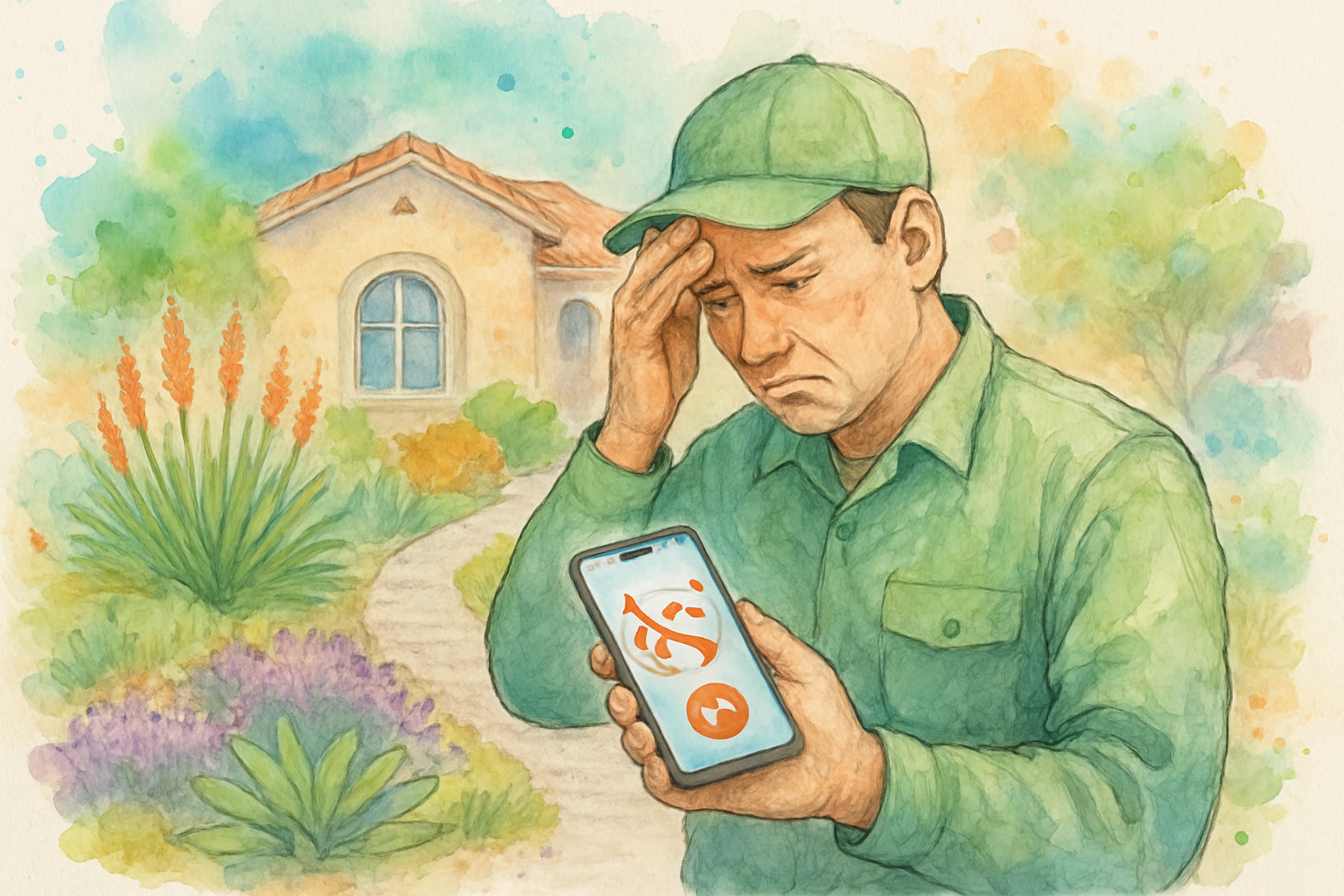
What Happens When a Homeowner Can’t Tell What You Actually Offer
This is the second job-killer, and it’s less obvious than load speed. Many landscaping sites list services in ways that make total sense to the contractor — and almost no sense to the customer searching.
A homeowner in Pacific Grove wants someone to pull out their old lawn, install drought-tolerant plants, and add a drip system. They don’t know if that’s called “xeriscaping,” “water-wise landscaping,” or just “landscape renovation.” If your services page just says “Landscape Design & Installation” with no further detail, they can’t tell if you do what they need.
Compare that to a site that says: “We replace traditional lawns with drought-tolerant designs using native Central Coast plants — serving Pacific Grove, Monterey, and Carmel.” That homeowner knows immediately you’re the right call.
The services that cause the most confusion when they’re described vaguely:
- Irrigation and drip system work — homeowners often don’t know the terminology
- Hardscape vs. softscape — most homeowners have no idea what these words mean
- Maintenance contracts — weekly, biweekly, seasonal? Say it plainly
- Tree trimming vs. tree removal — these are different jobs and different budget conversations
- Drought-tolerant conversions — huge demand in Monterey County right now due to water restrictions, but often buried or unlabeled on sites
Water use restrictions in Monterey County — enforced by MCWRA and local water districts — have pushed a lot of homeowners toward landscape conversions. If you do that work and your site doesn’t say so clearly, you’re leaving real jobs on the table. For a deeper look at how your landscaping site performs after business hours, that piece covers the after-hours visibility angle specifically.
The 5 Website Problems That Cost Landscapers Jobs
These are the five most common site issues that cause Monterey County landscapers to lose calls before the phone ever rings.
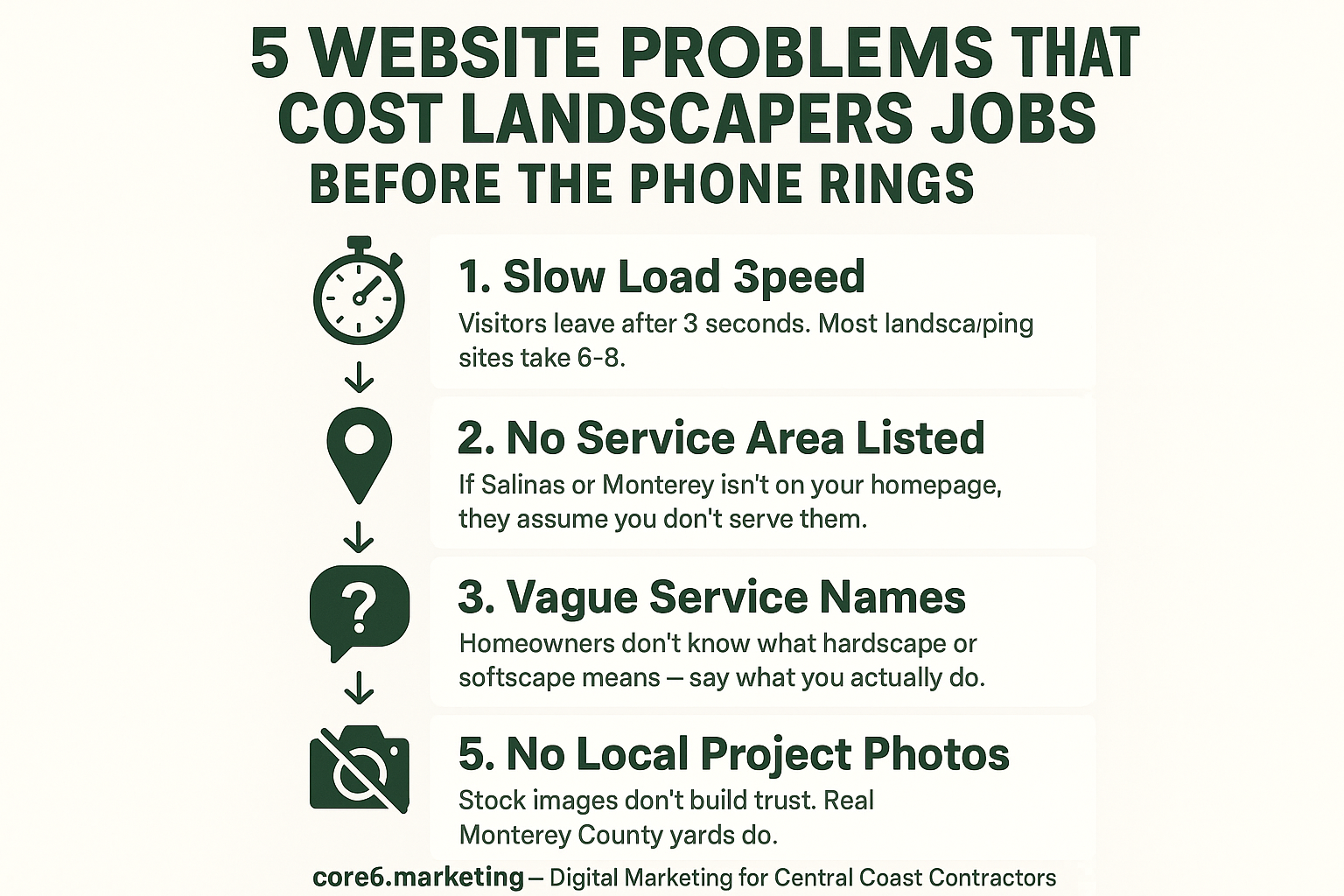
Landscaping Website Issues: What It Costs You
Each of these problems has a direct impact on whether a visitor calls or leaves. Here’s how they stack up in terms of what you’re actually losing.
| Website Problem | What the Visitor Does | Estimated Job Loss Risk |
|---|---|---|
| Page loads in over 4 seconds | Hits back button before seeing anything | High — affects 40-60% of mobile visitors |
| No city or service area mentioned | Assumes you don’t serve their neighborhood | High — especially outside Salinas proper |
| Vague or jargon-heavy service descriptions | Can’t tell if you do what they need | Medium-High — confusion = no call |
| No visible phone number above the fold | Won’t scroll to find it on mobile | Medium — adds friction at the worst moment |
| No photos of actual local work | Doesn’t trust the quality without visual proof | Medium — especially for $5,000+ projects |
| No mention of drought-tolerant or water-wise work | Calls a competitor who does mention it | High in current Monterey County water climate |
How Search Fits Into the Picture — Before Anyone Visits Your Site
There’s a step that happens even before a homeowner lands on your site: they have to find it first. And in Monterey County, the landscaping search market is more competitive than most contractors realize.
Search results for terms like “landscaper Salinas” or “landscape company Monterey” now include three different places where you either show up or you don’t — Google’s Map Pack, organic search results, and AI-powered answers from tools like ChatGPT and Perplexity. A homeowner asking ChatGPT “who does drought-tolerant landscaping in Carmel Valley” will get a specific answer pulled from web data. If your site doesn’t clearly describe that service with local language, you won’t be part of that answer.
This is why the structure and language of your website matters for more than just first impressions. The right SEO keywords for contractor lead generation make the difference between ranking and being invisible — and the same language that helps you rank also helps the right visitor understand immediately that you’re the right call.
If you want to understand how local search rankings actually improve over time, this guide on improving search rankings for contractors walks through the mechanics without the agency spin.
Frequently Asked Questions About Landscaping Websites and Lead Generation
How do I know if my landscaping website is actually costing me leads?
Pull up your site on your phone — not your laptop — and time how long it takes to load. Then look at the first screen you see. Does it say what you do, where you work, and show a phone number? If any of those three things are missing or buried, you’re losing people. A free Google PageSpeed Insights test will also show you your load time score.
Does load speed really matter that much for a local landscaping site?
Yes — and it matters more on mobile than desktop. Most homeowners searching for a landscaper in Salinas or Seaside are on their phones. Google’s own research shows that 53% of mobile visitors leave a page that takes longer than 3 seconds to load. Most contractor sites take 5 to 9 seconds. That’s a lot of jobs walking out the door.
What should my landscaping site’s homepage actually say?
At minimum, your homepage needs: your business name, what type of landscaping you do, the cities you serve (name them — Monterey, Salinas, Carmel, wherever), a real phone number at the top, and at least one photo of actual work you’ve done locally. Everything else is secondary. Get those five things right and you’re ahead of most of your competitors.
Should I mention drought-tolerant landscaping specifically on my site?
If you do that work, yes — and prominently. Water use restrictions from MCWRA and local water districts have made lawn conversions one of the most searched landscaping services in Monterey County right now. Homeowners are actively looking for contractors who understand the local requirements and can do the conversion properly. If your site doesn’t mention it, you’re invisible to that search.
What does a contractor website redesign typically cost in this market?
For a properly built, mobile-first contractor site, expect to pay somewhere between $2,500 and $6,000 for the design and build, depending on the number of pages and whether copy is included. Monthly hosting and maintenance plans typically run $100 to $300/month. Sites built purely on templates for under $500 almost never perform the way a contractor needs them to. For a full breakdown, this contractor website design cost guide covers what you’re actually paying for.
Can AI tools like ChatGPT really affect whether homeowners find my landscaping business?
Increasingly, yes. More homeowners are asking AI tools for local contractor recommendations instead of typing a query into Google. If your site uses clear, specific language about what you do and where you do it, AI tools are more likely to pull your business into those answers. This is still a developing area, but it’s moving fast enough that it’s worth building your site with it in mind from the start.
Ready to Find Out What Your Site Is Actually Costing You?
If you’re a landscaping contractor in Monterey County and your site isn’t generating consistent calls, there’s a specific reason — and it’s usually fixable. Core6 Marketing works exclusively with home service contractors on the Central Coast and has been doing this work locally since 2007. Book a Discovery Call with Phil Fisk at https://core6.marketing/work-with-us/ and get a straight answer on what’s working, what isn’t, and what would actually move the needle for your business.