
It’s a common question we hear from contractors: they think SEO means putting a few keywords like “plumber in Salinas” on their homepage and waiting for the calls to roll in. But that hasn’t been true for years. If that's your strategy, you're getting buried online.
The game has changed. The simple answer to why SEO isn’t just about keywords anymore is that Google's algorithm has gotten incredibly smart. It now prioritizes genuine trust and a great user experience over just matching words on a page.
Why Your Old SEO Playbook No Longer Works in Monterey Bay
Think of it like this: an old, keyword-stuffed website is like a resume filled with fluff. It might list the right skills, but it doesn't prove you can actually do the job. A modern, well-optimized site, on the other hand, is like acing the interview—it demonstrates your expertise, showcases your reliability, and builds the confidence a customer in Monterey County needs before they decide to hire you.
This shift is huge for local businesses. According to industry data, a staggering 97% of consumers go online to find local services. But here's the kicker: they don't just pick the first name they see. They choose the business that looks credible, trustworthy, and genuinely helpful. Google’s entire job is to connect them with that business.
From Keywords to Credibility
So, what does Google look for? What this actually means is that SEO is a system, not a single task. Google’s AI knows when a site is stale, spammy, or trustworthy by looking at a whole ecosystem of trust signals.
These signals include things like:
- A fast, mobile-friendly website: If your site is a pain to use on a phone, potential customers will leave, and Google notices.
- Fresh, engaging local content: Regularly adding helpful blog posts or photos from jobs in Santa Cruz proves your business is active and relevant.
- Consistent positive reviews: A steady stream of new reviews shows that you’re consistently delivering great service to local homeowners.
- An updated Google Business Profile: This is your digital handshake and a powerful signal of a legitimate, active local business.
This visual breaks down the evolution from old-school keyword tactics to the new trust-based system that Google's AI understands.
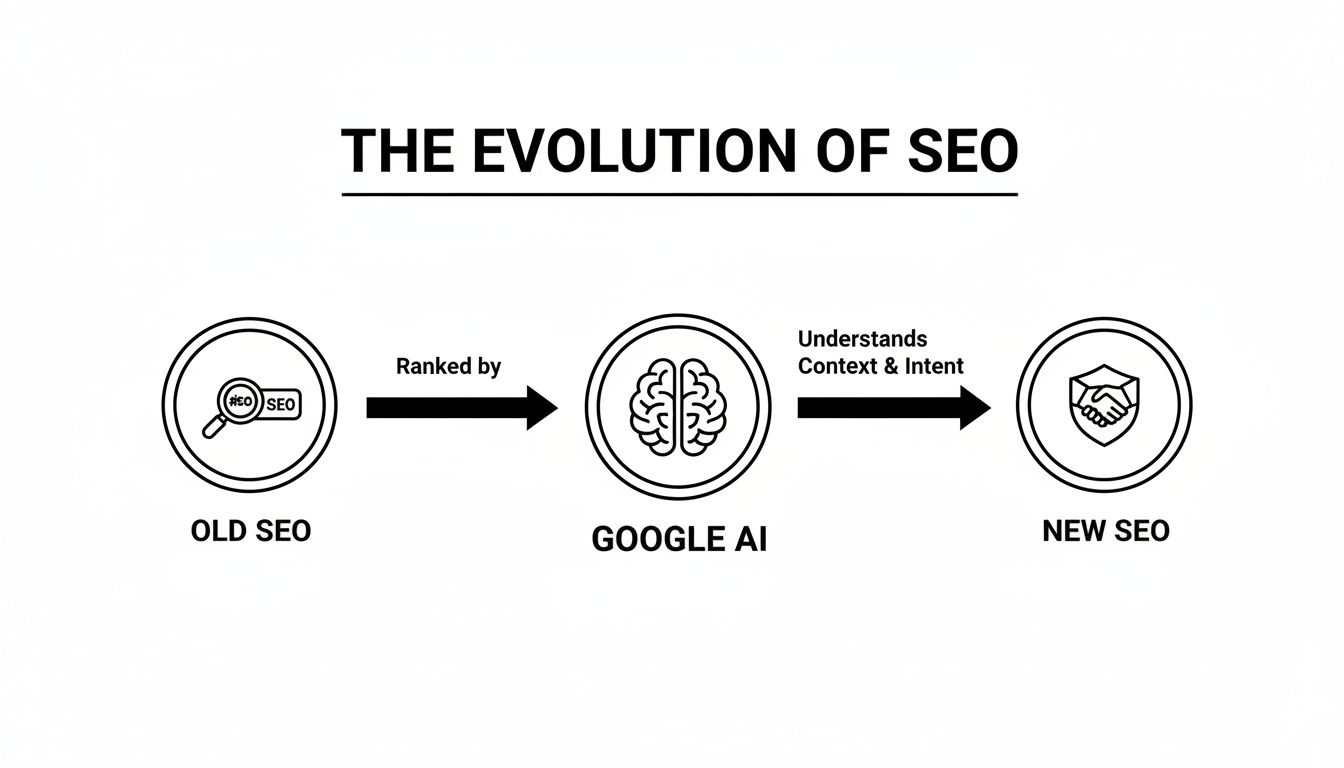
The key takeaway here is simple: Google's AI can now tell the difference between a site that's just trying to rank and one that's genuinely trying to help.
Your First Actionable Step
The good news? You don't need to be a tech wizard to start making improvements. Start by auditing your site for mobile usability and local content depth.
Do you have individual service pages? Do you feature local reviews? Do you have geo-targeted blog posts or photos from recent jobs? If not, that’s where to begin. Because design and SEO are tightly connected, you can learn more about building a strong foundation with our post on Monterey Bay website design for contractors.
If you're unsure why your site isn’t ranking—or why traffic isn't turning into leads—reach out. We’ll explain what’s working, what’s not, and how to fix it without the jargon.
How Google's AI Changed the Rules of Search
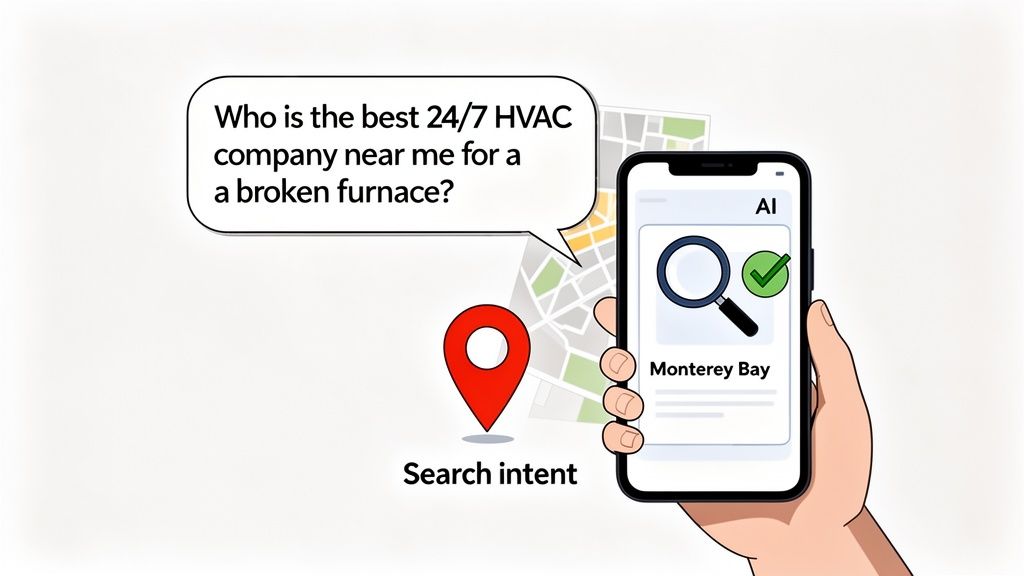
The single biggest reason why SEO isn’t just about keywords anymore is Google's massive leap forward in artificial intelligence. Years ago, search engines were like clumsy filing clerks, just matching the exact words you typed to words on a page. Today, Google acts more like an expert librarian who actually understands the meaning behind your question.
This shift completely changes the game for a local contractor. Imagine a homeowner in Santa Cruz whose furnace gives out on a freezing night. A decade ago, they might have typed "HVAC repair." Now, they're more likely to ask their phone, “Who is the best 24/7 HVAC company near me for a broken furnace?”
Google's AI no longer just scans for the term "HVAC repair." It understands the person is in a bind, needs immediate help, and wants a local, trustworthy business. It’s searching for a website that answers that entire need, not just a page that stuffs in a keyword.
Understanding Search Intent
This idea of getting to the goal behind a search is called user intent. Modern SEO is all about matching your website's content to what a potential customer is actually trying to do. Google’s AI is plenty smart enough to know that someone searching for “how to fix a leaky faucet” needs a totally different answer than someone searching for “plumber for leaky faucet in Salinas.”
The first search is informational—the user wants a DIY guide. The second is commercial—they're ready to hire someone. Your website has to deliver clear, helpful content that satisfies the specific intent of the customers you’re trying to attract.
Ignoring user intent is a huge misstep. If your website only lists your services but fails to answer common questions, you're missing out on connecting with homeowners early in their journey.
The Rise of AI Overviews and Zero-Click Searches
This intense focus on intent has led to a major change on the search results page: the emergence of AI Overviews. These are AI-generated answers that pop up at the top, aiming to solve a user's query directly so they never have to click on a website.
This is a big deal. It's predicted that by 2026, a staggering 60% of all Google searches will end in zero clicks. Users get their info from these summaries and never even see the traditional website listings.
But there’s a silver lining here for home service contractors in Monterey County. High-intent, commercial searches—think "best roofer for hail damage"—are far less likely to trigger these AI summaries. Google knows that for these critical needs, people want to connect with a real business. To get ahead, it's a good idea to learn how you can use AI for your own SEO strategy.
How to Adapt Your Strategy
So, how do you adjust to this new, AI-powered reality? The goal is no longer just ranking for keywords; it’s about becoming the most helpful, authoritative answer to your potential customers' problems in your specific service area.
Here’s where you can start:
- Think Like Your Customer: Get inside the head of a homeowner in Gilroy or Watsonville. What are the actual questions they'd ask? What information would make them feel confident enough to pick up the phone?
- Create Solution-Focused Content: Ditch the generic "Services" page. Instead, build out detailed pages for each service that explains the problem, walks them through your solution, and proves why you’re the right choice.
- Answer Questions Directly: Use your blog to tackle common questions head-on, like "How much does it cost to replace a water heater in Marina?" or "What are the signs of a failing electrical panel?"
When you focus on providing real answers, you align your website with exactly what Google’s AI is built to reward: genuine expertise and a great user experience. This approach doesn't just help your rankings; it builds trust and turns curious searchers into paying customers.
Building Digital Trust With E-E-A-T
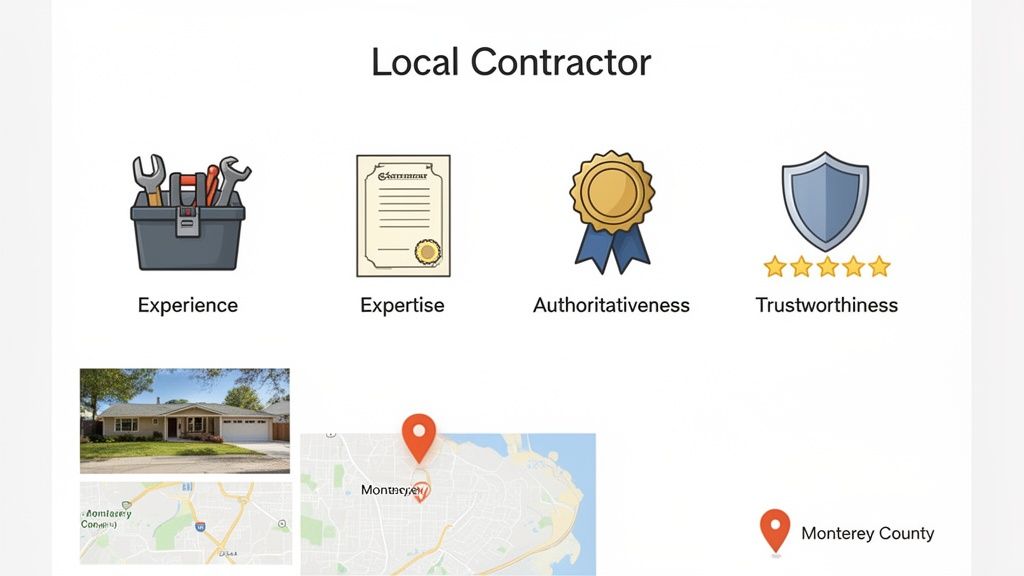
If keywords were the old currency of SEO, then trust is the new gold standard. And Google has a specific way of measuring that trust: a framework called E-E-A-T.
It stands for Experience, Expertise, Authoritativeness, and Trustworthiness. For a contractor in the Monterey Bay Area, this is your digital word-of-mouth. It’s how you prove to both Google and a potential customer in Hollister that you’re a legitimate, skilled, and reliable pro.
Think of it this way: you'd never hire a roofer just because they said "roofer" ten times on their website. You'd look for proof of their work, check their license, and ask around for references. Google's AI does the exact same thing online, and E-E-A-T is the report card it uses to grade you.
This system is a core reason why SEO isn’t just about keywords anymore; it's about proving your real-world credibility in the digital world.
What E-E-A-T Looks Like in Practice
For contractors, E-E-A-T isn't some fuzzy marketing concept—it’s a set of real, tangible signals you can build right on your website. When a homeowner in San Benito County has a plumbing emergency, these are the trust signals that make them pick up the phone and call you.
Here’s what each piece means and how you can show it off:
- Experience: Show, don’t just tell. This means project galleries featuring completed jobs in Pacific Grove or Carmel-by-the-Sea. It means demonstrating your hands-on, in-the-trenches knowledge.
- Expertise: This is about proving your qualifications. Your contractor's license number, insurance credentials, and any industry certifications you hold need to be front and center.
- Authoritativeness: This is all about your reputation in the local community. A constant stream of recent, positive customer reviews is one of the strongest authority signals you can have.
- Trustworthiness: This is the bedrock of it all. An easy-to-find phone number, a physical business address, and a detailed 'About Us' page that tells your story all build trust.
E-E-A-T is your chance to turn your website from a simple digital brochure into a powerful credibility engine that converts skeptical visitors into confident leads.
This focus on provable trust has become even more important as search technology gets smarter. For a deeper dive into this shift, we've outlined why E-E-A-T beats keywords and what Google's AI is really looking for now.
The table below breaks down the seismic shift from old-school tactics to the new trust-based approach that actually gets results.
The Old Way vs. The New Way of SEO
| SEO Element | Old Tactic (Keyword-Focused) | New Strategy (Trust-Focused) |
|---|---|---|
| Content Focus | Repeating keywords like "plumber Salinas" over and over. | Creating helpful guides on "choosing faucets for hard water in Monterey County." |
| About Page | A generic paragraph about being the "best." | A detailed story with photos of your team and your license number displayed. |
| Proof of Work | A simple list of services offered. | Detailed project galleries with photos and descriptions of jobs in specific towns. |
| Reputation | Ignoring online reviews. | Actively encouraging reviews and showcasing recent testimonials on the website. |
| Technical SEO | Basic website setup, maybe a bit slow. | A fast, secure (HTTPS), mobile-friendly site that’s easy for customers to use. |
As you can see, the new way is all about building a comprehensive digital footprint that mirrors your real-world reputation. It requires more effort, but the payoff is attracting higher-quality leads who already trust you before they even call.
Your E-E-A-T Action Checklist
Building these signals isn't a one-and-done task; it's an ongoing commitment to showing off the great work you do every day.
Use this quick guide to see where your business stands:
- Your "About Us" Page: Does it actually tell your story? Does it feature photos of you and your real team? A bland, one-paragraph page builds zero trust.
- Credentials Front and Center: Is your contractor's license number and "licensed, bonded, and insured" status clearly visible on your homepage? Don't make people dig for this info.
- Showcase Your Work: Do you have a photo gallery with high-quality images of recent projects? Make sure you add captions that mention the location, like "Kitchen Remodel in Gilroy" or "New Roof Installation in Watsonville."
- Customer Reviews: Are you actively asking every single happy customer for a review? Do you have a page on your site that proudly displays fresh testimonials? New reviews signal ongoing quality.
By focusing on just these four areas, you can start laying a powerful foundation of digital trust that both Google and your future customers will reward.
How Your Website Experience Shapes Your Rankings
Think of your website as your digital storefront. If a customer walks into your shop and the lights are flickering, the aisles are a mess, and they can't find what they’re looking for, they're not sticking around. It’s the exact same with your website, and you can bet Google is paying close attention.
Even if you have amazing content, a slow, clunky, or confusing website will absolutely torpedo your rankings. This is a huge piece of the puzzle that explains why SEO isn’t just about keywords anymore. A bad user experience (UX) sends a loud, clear signal to Google that your site isn't actually helping people.
Picture this: a homeowner in Watsonville has a burst pipe and is frantically searching for an emergency plumber. They click on your site, but it takes a full ten seconds to load on their phone. Frustrated, they hit the back button and click on your competitor. Google sees this action—known as a "bounce"—and takes it as a major red flag.
Your Site Has to Be Fast and Mobile-Friendly
Let's be real—most of your customers are finding you on their phones. They might be standing right in front of the leaky faucet they need you to fix. If your website isn’t built for a mobile screen, you are actively turning away business.
Google now uses what's called mobile-first indexing. This just means that Google primarily looks at the mobile version of your website to decide how to rank it. A beautiful desktop site paired with a messy mobile experience will drag down your visibility.
Here are the technical elements Google is looking at:
- Page Speed: How fast does your site load? According to Google, the chance of a user bouncing skyrockets by 32% as page load time goes from just 1 second to 3 seconds.
- Mobile Usability: Are the buttons big enough to tap? Can you read the text without pinching and zooming? Is your phone number easy to find and click?
- Clear Navigation: Can visitors figure out how to get around your site in a few seconds? A confusing menu is a one-way ticket to a quick exit.
A poor user experience has a direct impact on your bottom line. To get a better handle on this, you can learn more about how to improve your site's bounce rate and keep visitors from leaving.
Structure Your Site for People and Search Engines
A well-organized website pulls double duty. First, it guides potential customers right to the service they need. Second, it helps Google understand the full scope of what your business does.
The best way to do this is by creating a dedicated page for each distinct service you offer.
Don't lump everything onto a generic "Services" page. Create separate, detailed pages for every single thing you do. This approach transforms your website from a simple brochure into a powerful, organized resource that speaks directly to your customers' needs all over Monterey County.
For example, a plumber shouldn’t stop at a single "Plumbing" page. They need individual pages for:
- Drain Cleaning in Gilroy
- Water Heater Repair in Seaside
- Slab Leak Detection in Monterey
- Emergency Plumbing Services
This structure allows you to target very specific, high-intent searches. When someone in Gilroy needs their drain cleared, a page dedicated to that exact service is far more relevant—and far more likely to rank—than a generic page that just mentions it. This is a cornerstone for any good digital marketing plan for Santa Cruz retailers and service providers.
Winning with Off-Site Local SEO Signals
So far, we've focused on turning your website into a powerhouse of trust. But modern SEO doesn't just stop at your domain name. A huge part of why SEO isn’t just about keywords anymore is that Google now looks at your entire digital footprint to see if you're a real, active, and respected business in Monterey County.
Think of it like getting a loan. They don't just take your application at face value. They check outside sources to confirm you are who you say you are. Google does the exact same thing with your business by looking at "off-site signals" scattered all over the internet.
These signals are incredibly powerful because they act as third-party validation. When other reputable websites are all saying the same great things about your contracting business, it tells Google you're a pillar of the local community.
Your Google Business Profile is Your Digital Handshake
If there's one tool you need to master for local SEO, it's your Google Business Profile (GBP). This is the information box that pops up in Google Maps and on the side of the search results page. For many potential customers in Salinas or Santa Cruz, this is their very first impression.
An incomplete or outdated profile instantly torpedoes your credibility.
To make your GBP a true lead-generating machine, you have to treat it like a mini-website that's always on. This means:
- Keeping everything 100% accurate: Your hours, phone number, and service areas must be perfect.
- Uploading fresh photos regularly: Get in the habit of posting pictures from recent jobs around the tri-county area.
- Using Google Posts: Share updates, announce special offers, or link to your latest blog posts. This keeps your profile looking fresh and active.
- Answering questions promptly: The Q&A feature is a public forum. When you answer questions quickly, it shows you're engaged and helpful.
A well-oiled GBP is absolutely critical for ranking in that coveted map pack. If you want to claim that prime digital real estate, you first need to understand what local contractors still get wrong about the map pack and how to fix it.
Reviews and Citations Are Your Digital Reputation
Beyond your GBP, Google scours the web for two other key indicators of your local relevance and trustworthiness: online reviews and local citations.
Online Reviews are today's word-of-mouth marketing, supercharged. A steady stream of new, positive reviews on Google, Yelp, and other industry sites sends a massive signal of trust. It's not just about hitting a five-star rating; Google also cares about the frequency and recency of those reviews.
Local Citations are simply mentions of your business's Name, Address, and Phone Number (NAP) on other websites. Think online directories like Yelp, Angi, and your local Chamber of Commerce page. The name of the game here is consistency. If your business name or address is even slightly different across these sites, it creates confusion for search engines.
The search landscape is clearly shifting. While organic traffic still drives nearly 47% of all website traffic, that number is dipping as search gets smarter. You can discover more insights about these SEO statistics to see how user behavior is changing firsthand. By actively managing your off-site presence, you're not just optimizing a website; you're winning over new customers all across the Monterey Bay Area.
Your Action Plan for a Stronger Digital Foundation
Knowing why SEO isn't just about keywords anymore is one thing. Now it’s time to actually do something about it.
Here are a few straightforward actions you can take right now to build a stronger presence for your business in San Benito County. This isn't about becoming a tech wizard; it's about making smart, practical improvements that get you noticed.
Your First Moves in Modern SEO
Think of your online presence like your work truck—it has a bunch of critical parts that all need to work together. A quick check-up can reveal some easy wins that make a real difference.
Start with your website. Pull it up on your smartphone right now and ask yourself two gut-check questions:
- Is this site actually helpful on a phone? Is your phone number a single, easy tap away? If it’s frustrating to use, you're losing customers. Period.
- Does my content prove I'm a local expert? Do you have dedicated pages for each service, like "Furnace Repair in Gilroy"? Do you have a blog with helpful advice that answers real customer questions?
Next, turn your attention to your Google Business Profile. Make sure it's 100% accurate. Finally, get a simple process in place for asking every happy customer for an online review. Fresh, positive reviews are one of the most powerful trust signals you can have.
For a deeper dive, our guide on SEO for contractors breaks down these elements and more. And remember, your digital foundation extends beyond just your website. To truly stand out, you need a cohesive strategy across multiple platforms, as shown in this guide on holistic channel optimization strategies.
Your 30-Day SEO Foundation Checklist
Feeling a bit overwhelmed? Don't be. Here’s a simple checklist of high-impact tasks you can tackle over the next month to get the ball rolling.
| Week | Task | Why It Matters |
|---|---|---|
| Week 1 | Audit Your Website on Mobile. | Over 60% of searches for local services happen on a phone. A frustrating mobile experience is a guaranteed lost lead. |
| Week 2 | Optimize Your Google Business Profile. | This is your digital storefront. Ensure your hours, services, and photos are current. An incomplete profile signals you might not be in business. |
| Week 3 | Start a Review Request System. | Ask 3-5 past happy clients for a review. Fresh reviews build immense trust and directly impact your local ranking. |
| Week 4 | Publish One Locally-Focused Blog Post. | Write a short article answering a common customer question (e.g., "How to Prepare Your AC for a Hollister Summer"). This proves your expertise to both Google and potential clients. |
This checklist isn't about doing everything at once. It's about taking small, consistent steps that build momentum.
If you’ve tried some of this and still aren’t seeing your site rank—or you’re wondering why your phone isn’t ringing—just reach out. We’ll cut through the noise, explain what’s working, what isn’t, and how to fix it without the technical jargon.
By Phil Fisk, CEO, Core6 Marketing
Phil Fisk is the founder of Core6 Marketing, an SEO agency in Salinas dedicated to helping local contractors and small businesses in the Monterey Bay Area generate more leads and grow their revenue. He focuses on straightforward, no-jargon strategies that deliver measurable ROI.
Core6 Marketing
1628 N. Main St #263, Salinas, CA 93906
831-789-9320
[email protected]
If you're ready to see how a modern, comprehensive SEO strategy can generate more qualified leads for your business, the team at Core6 Marketing is here to help.