
If you're a contractor in Salinas or Santa Cruz, you've felt the pinch: your Google Ads budget doesn't go as far as it used to. You’re not imagining it. The short answer to why Google Ads got more expensive for contractors in 2025 is a perfect storm of more competitors, smarter Google AI, and new customer search habits.
Think of it like the wharf in Monterey on a holiday weekend—more boats (your competitors) are fighting for the same limited dock space (the top ad spots), driving the price up for everyone. It's a real issue for businesses rooted in our coastal economy.
Your 2025 Google Ads Wake-Up Call in Monterey Bay
For contractors all over the Central Coast, from Hollister to Watsonville, the digital advertising game has changed. What once felt like a dependable lead source now feels like a constant battle to stay visible without torching your budget. If your cost-per-click is climbing while your phone rings less, you're experiencing a market-wide shift that's hitting local pros hard.
The current market data shows a significant shift. Cost-per-click for contractor keywords now exceeds $40, and more competitors are investing heavily in online advertising than ever before. With more home service pros doubling their online marketing post-2020, you're now bidding against bigger competitors and national chains right here in Monterey County.
The Three Forces Driving Up Your Costs
So, what’s really going on behind the curtain? These rising costs aren't random. They're the result of three major forces all hitting at the same time. Understanding them is the first step toward building a smarter, more resilient ad strategy that actually works.
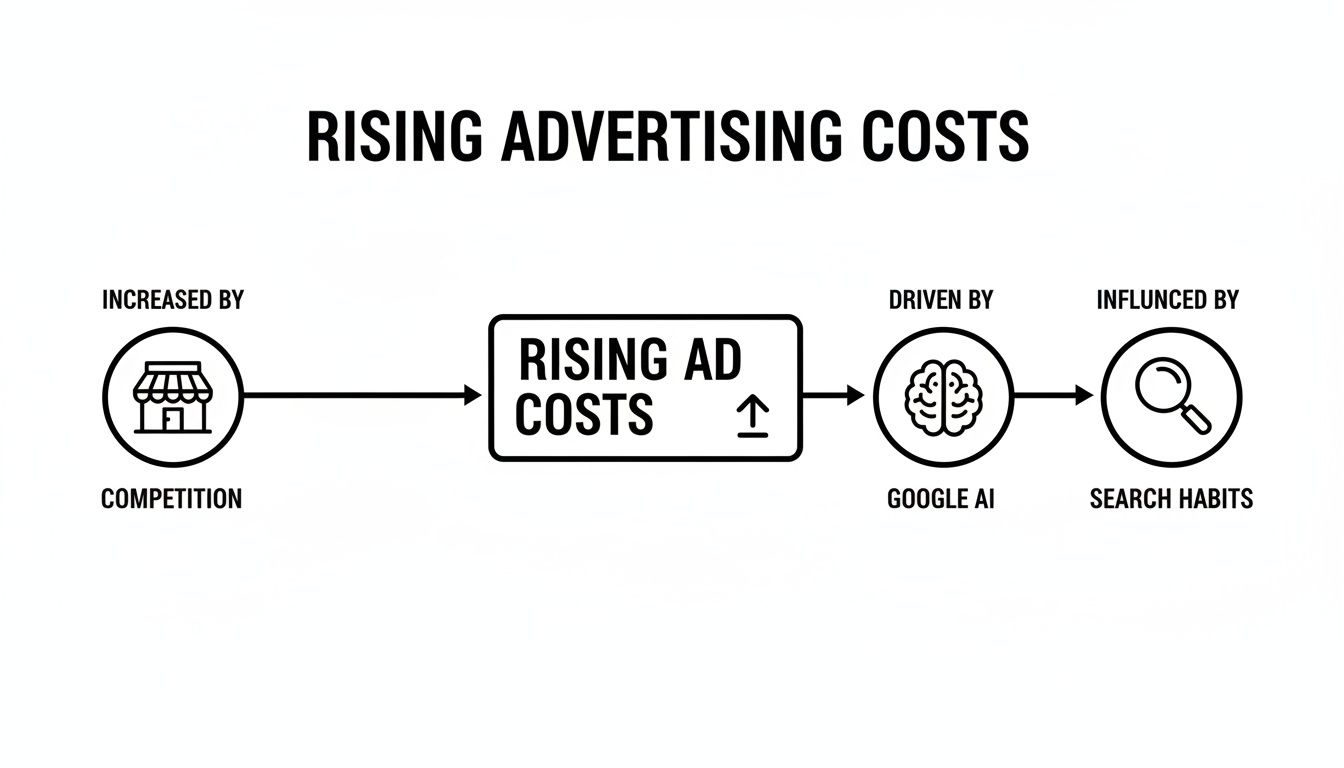
This diagram shows how a crowded local market, increasingly complex AI, and new customer behaviors are all teaming up to make your ads more expensive.
To give you a quick overview, here are the core factors squeezing your ad budget.
Key Factors Driving Up Your Ad Costs in 2025
| Driving Factor | Impact on Your Contractor Business | What This Means for Your Budget |
|---|---|---|
| Fierce Local Competition | National brands and aggressive local rivals are flooding the Monterey Bay market, pushing bids for top keywords past $40. | You're paying more just to be seen, and a higher budget doesn't guarantee top placement anymore. |
| Smarter Google AI | Google's automated bidding now heavily favors advertisers with perfect data. If your tracking is off, the AI wastes your money on junk clicks. | Small mistakes in your campaign setup can lead to significant wasted ad spend as the algorithm makes poor decisions. |
| New Customer Search Habits | Homeowners use urgent, specific phrases like "emergency plumber near me" or "roofer in Santa Cruz County." Generic ads miss this high-intent traffic. | Your ad budget is wasted on broad searches instead of capturing ready-to-buy customers who need you now. |
Each of these forces alone would be a challenge, but together, they create an environment where it's easy to waste money. We see this all the time with home service pros in Monterey Bay who are losing leads. If your campaigns are not tightly optimized, you risk running out of budget before the right customer finds you.
This guide is your blueprint to navigate these changes and start winning more jobs—without just throwing more money at the problem.
By Phil Fisk, CEO, Core6 Marketing
Phil Fisk leads Core6 Marketing, a specialized agency dedicated to helping Monterey Bay Area contractors achieve measurable growth through data-driven digital marketing. With years of local market experience, Phil focuses on practical strategies that deliver real ROI.
Core6 Marketing
1628 N. Main St #263, Salinas, CA 93906
831-789-9320
[email protected]
https://core6.marketing/
National Chains Are Crowding Your Local Ad Space
It’s not just you against the other local plumber down the street anymore. The game has totally changed.
One of the biggest reasons why Google Ads got more expensive for contractors in 2025 is the flood of new, deep-pocketed competitors crowding our local turf here in Monterey County. These aren't just local guys—they're national franchises and private equity-backed groups with marketing budgets that would make your head spin.
Think of the Google Ads auction like a plot of land. A few years ago, you were bidding on a quiet corner lot. Now, a dozen high-rise developers have shown up, ready to pay almost anything for that prime spot.
They can afford to bid aggressively on keywords like “HVAC repair Salinas,” pushing the cost-per-click (CPC) for valuable terms well over $40. This kind of spending makes it nearly impossible for a local contractor to stay visible without a much smarter, more targeted strategy.
You're now up against companies that treat marketing as just another line item on a national spreadsheet. Their goal is total market saturation, and they have the cash to absorb higher lead costs that would absolutely cripple a smaller, local business.
A Real-World Hollister Scenario
Let's make this real. Imagine you’re an HVAC contractor based in Hollister. For years, you’ve run successful Google Ads targeting homeowners in San Benito County. Your competition was a handful of other local pros, and everyone had a good feel for what a lead should cost.
Now, fast forward to 2025. All of a sudden, three new national HVAC brands are popping up at the top of every search. They’re bidding on the exact same keywords you are, but their daily budget is probably bigger than your entire monthly spend.
Your ads, which used to sit comfortably in the top three spots, are now pushed way down the page—or they don't show up at all unless you jack up your bids.
This forces a tough choice:
- Spend More: You can try to match their bids, burn through your budget for fewer clicks, and just hope you land a job big enough to cover the insane cost.
- Lose Visibility: You can keep your bids the same and watch your impression share tank, making you practically invisible to the very customers who need you.
This isn't some made-up problem. It's the new reality for contractors all over the Central Coast. The increased competition from these giants directly inflates ad costs for everyone, turning a once-profitable channel into a money pit if you don't manage it with precision.
Why Their Big Budgets Hurt You
These national chains don't just outspend you; they warp the entire dynamic of the ad auction. Their sheer volume of spending signals to Google's algorithm that the "market price" for a click is now much higher.
Even if they're wasting money on sloppy, inefficient campaigns, their budget firehose skews the landscape for every single advertiser in the game.
The key to fighting back isn't a bigger budget—it's a smarter one. You have to understand their strategy and find the gaps they're missing. A crucial first step is to perform a detailed review of who you're really up against. We've created a guide on how to conduct competitor analysis that can help you pinpoint their weaknesses and your opportunities.
This is how a local contractor in Carmel-by-the-Sea can outmaneuver a national brand that just sees our region as another pin on their map.
How Google's AI Is Changing the Bidding Game
Think of Google’s ad system like a powerful, self-driving car. You tell it where you want to go—more leads—but the AI is the one behind the wheel. This shift to AI is the single biggest reason why Google Ads got more expensive for contractors in 2025, hitting those who haven’t adapted the hardest.
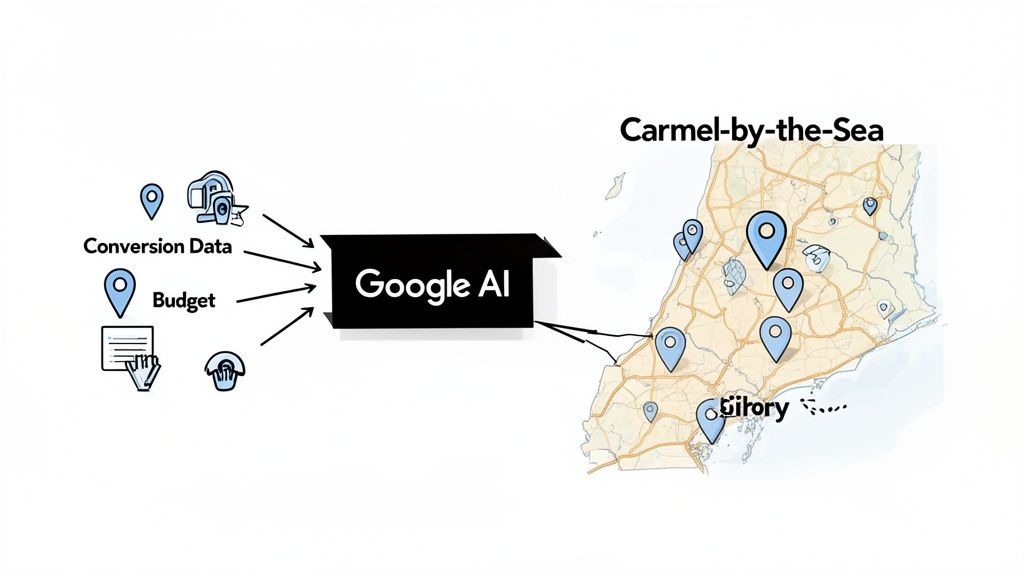
Google's AI operates like a "black box." You feed it your data—your budget, your ads, and most importantly, what you count as a real lead. In return, the AI decides who sees your ads, when they see them, and exactly how much you’ll pay for a click.
But here’s the catch: it massively rewards advertisers who feed it the best, cleanest data. This means contractors with perfect conversion tracking and healthy budgets see great results, while everyone else ends up paying more for a lot less.
The Problem with Unoptimized Campaigns
If your campaigns aren't dialed in just right, Google's AI can turn into a massive money pit. It might burn your budget showing your plumbing ads to someone in Gilroy doing casual research when your ideal customer—the one with an emergency leak—is frantically searching in Carmel-by-the-Sea.
Without clear signals telling the AI which clicks actually turn into paying jobs, it starts making expensive guesses. This is where unoptimized campaigns spring a leak, wasting money on low-quality clicks that never become customers and hurting your bottom line here on the Central Coast. To compete in today's AI-driven search world, you need every advantage, including the 12 best AI SEO tools for 2025 that can help sharpen your strategy.
PMax: The Powerful but Tricky Tool
A perfect example of this AI-first approach is Performance Max, or PMax, one of Google’s flagship campaign types. PMax is designed to hunt for customers across all of Google's channels—Search, YouTube, Gmail, Maps—all from a single campaign. It’s incredibly powerful, but it demands excellent data to work correctly.
Here’s how it can go wrong for a local contractor:
- You tell PMax you want "leads." But your website tracking is a mess. It counts someone filling out a contact form the same as someone who just clicks your "About Us" page.
- The AI gets confused. It starts spending your money to get more "About Us" page clicks because that's the easiest "lead" it can find, not the qualified phone call you actually need.
- Your budget disappears. You blow through hundreds of dollars and get plenty of website traffic, but no new jobs in Santa Cruz County.
This is where the cost increase becomes personal. The AI isn't trying to waste your money; it’s just doing exactly what you (unintentionally) told it to do. If you feed it bad data, it will deliver bad results at a high cost.
Certain home service trades have felt this pain more than others. In 2025, some sectors saw cost-per-click spikes exceeding 40%. The roofing industry saw its average cost per conversion soar to $145.10, while the broader home improvement sector faced an 18.7% jump in click costs.
Feeding the AI the Right Information
The solution isn't to fight the AI. It's to give it exactly what it needs to win on your behalf. That means setting up flawless conversion tracking that tells Google precisely which clicks are turning into booked jobs. It’s also about understanding how AI can help other parts of your business, which you can learn more about in our guide on what AI can actually do for your trade business.
When you feed the AI clear, accurate data, it becomes your most valuable employee. It learns to ignore the tire-kickers and focus your budget exclusively on homeowners in your service area who are ready to hire you right now. This is how you stop bleeding cash and turn Google Ads into a predictable, lead-generating machine.
Your Blueprint for Winning Leads in Monterey County
It’s frustrating feeling the squeeze from national chains and confusing AI, but you don't have to give up your local market. Instead of just throwing more money at the problem, it’s time to spend smarter. A targeted, data-driven approach is how a local contractor can outmaneuver even the biggest competitors right here in the Monterey Bay Area.
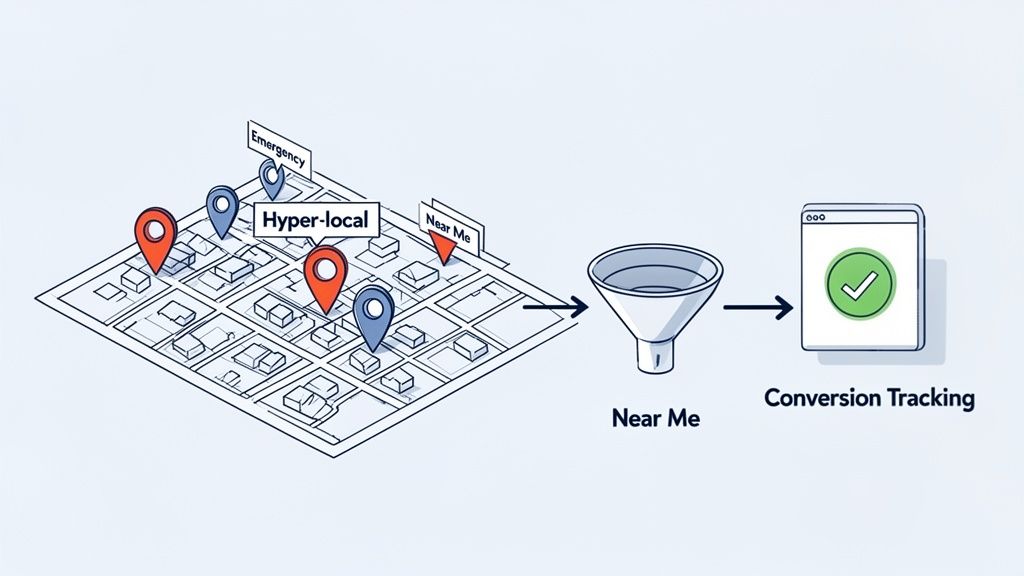
This isn't about finding a secret trick; it's about executing a proven blueprint that counters high costs. By focusing on precision and intent, you can plug the leaks in your ad spend and make sure every dollar is working to bring you profitable jobs. This is how you reclaim your advantage.
Strategy 1: Hyper-Local Targeting and Geo-Fencing
Big national brands often take a "shotgun" approach, blasting ads across entire counties or even states. This is your biggest advantage. Instead of bidding for all of "Santa Cruz County," you can use hyper-local targeting to focus your budget on specific, profitable neighborhoods.
Imagine you're a roofer. You can tell Google to only show your ads in the zip codes around Scotts Valley or specific neighborhoods in Capitola known for older homes. This strategy, called geo-fencing, creates a digital boundary around your most valuable service areas.
You immediately stop wasting money on clicks from people too far away. Your budget gets concentrated where it matters most, giving you maximum visibility in front of your ideal customers while your national competitors burn cash on irrelevant clicks.
Strategy 2: Prioritize "Emergency" and "Near Me" Searches
When a homeowner in Salinas has a burst pipe, they aren't casually searching for "plumbing companies." They're frantically typing "emergency plumber near me" or "24/7 plumbing repair Salinas." These are high-intent keywords, and they signal an urgent need.
Bidding on these specific, action-oriented phrases is far more effective than competing for broad, expensive terms like "plumber."
By focusing on immediate-need keywords, you capture customers at the exact moment they need you most. This not only leads to a higher conversion rate but also lets you win the lead before your slower, less-targeted competitors even see it.
The key is to build your campaigns around the customer's mindset. We shift the focus from what you do (plumbing, roofing, HVAC) to what the customer needs right now. This is a fundamental change that directly lowers your cost per qualified lead.
Strategy 3: Implement Flawless Conversion Tracking
Like we talked about, Google's AI needs good data to work for you. Flawless conversion tracking is the single most important element for success in 2025. It’s how you prove your return on investment (ROI) and train the algorithm to find more customers just like your best ones.
Proper tracking goes way beyond just counting form fills. It means setting up:
- Phone Call Tracking: To know which specific ads and keywords are making your phone ring.
- Lead Scoring: To tell Google which leads are high-quality (a booked job) versus low-quality (a price shopper).
- Offline Conversion Imports: To connect your ad spend directly to actual revenue by telling Google which leads turned into paying customers.
When you feed the AI this level of precise data, it stops guessing and starts making intelligent, budget-saving decisions. It learns to prioritize the clicks that actually make you money, a critical piece of the puzzle for successful advertising for contractors.
Strategy 4: Craft Ads and Landing Pages That Convert
Getting the click is only half the battle, especially when that click costs you $40 or more. Once a potential customer lands on your site, you have just a few seconds to convince them you're the right choice. Your ad copy and landing page have to work together seamlessly.
Your ad should make a clear promise—for example, "Fast, Reliable HVAC Repair in Monterey." The landing page they arrive on must immediately deliver on that promise. It should feature trust signals like local reviews, your phone number displayed prominently, and a simple form to request service.
Every expensive click needs the maximum possible chance to become a profitable job. By ensuring your messaging is consistent and your landing page is built to convert, you stop wasting money on clicks that go nowhere and start turning that valuable traffic into a full job pipeline.
Turning Smart Strategy Into Lower Lead Costs
Let’s talk results. A smart blueprint is great on paper, but it’s only useful if it directly impacts your job pipeline and your bottom line. For a contractor in the Monterey Bay Area, every dollar spent on advertising has to work its tail off.
By ditching a high-spend, low-precision approach for a targeted, data-driven one, you can turn the tide on rising ad costs. This isn't just about surviving in 2025; it's about building a sustainable lead generation machine that keeps your phone ringing with qualified customers. With smarter targeting, your cost per lead goes down, qualified calls go up, and you stay visible even when competitors outspend you.
The Real-World Impact on Your Bottom Line
Let's break down the payoff with a clear, relatable scenario. Imagine your average cost to get a qualified lead—a real person in your service area who actually needs your help—drops from an unsustainable $150 to a much more manageable $95. That isn't just a small tweak; it's a game-changer for your business.
For a roofer in Salinas, that simple change has a massive ripple effect. Every $1,000 in ad spend now generates over 10 qualified leads instead of just six. That’s four more opportunities to win profitable jobs in Monterey County from the exact same budget. You're not just staying afloat; you're actively growing your business while your competitors are burning cash.
This strategic shift delivers two crucial wins:
- More Lead Volume: You get more shots on goal from your existing budget, filling your pipeline with legitimate prospects who are ready to hire.
- Better Profitability: With a lower cost per lead, the profit margin on every single job you win through Google Ads goes up, putting more money back in your pocket.
How Better Data Translates to Better Jobs
Here’s the good news: while click costs are up, conversion rates are also improving for businesses that get their strategy right. Recent industry analysis shows a positive trend for 2025: 65% of industries saw better conversion rates, with the average hitting 7.52%, a 6.84% increase year-over-year.
What this means is that while contractors are paying more per click, those clicks are more likely to turn into actual customer leads. You can dig into more of these Google Ads conversion benchmarks on Search Engine Land.
This data proves that a smarter approach isn't just theory—it's a practical way to counterbalance rising expenses. By focusing on high-intent keywords and flawless tracking, you tap into this trend of higher conversions, ensuring your ad spend delivers real, measurable value.
The key is precise measurement. Without it, you're flying blind.
Optimizing your Tracking Template Google Ads is one of the most direct ways to see what’s truly working. It lets you connect the dots between clicks, calls, and booked jobs, so you can see exactly which ads are driving revenue and which are just wasting money.
This isn't about just cutting costs; it's about reallocating your budget to the strategies that deliver the highest return. It’s how a local electrician in Santa Cruz can consistently generate more profitable work than a national competitor who is blindly blanketing the entire region with generic ads. By spending smarter, you ensure your business not only survives the high-cost ad environment of 2025 but actually thrives in it.
Your Next Step: A No-Risk Google Ads Audit
Feeling the heat from rising ad costs and a phone that isn't ringing like it used to? You're not alone. The reasons why Google Ads got more expensive for contractors in 2025 are complicated, but finding a solution shouldn't be. It’s time to stop guessing what’s wrong and start fixing it.
If you're a contractor working in Salinas, Monterey, or anywhere on the Central Coast, your best next move is a straightforward, no-risk Google Ads audit with our team. We can audit your campaign and show you where to plug budget leaks and boost ROI—fast. We’ll personally dive in and show you exactly where your budget is getting wasted.
Find and Fix Budget Leaks Fast
Our team will get right into your account to pinpoint the biggest opportunities for improvement. We look for the quick wins that can immediately lower your cost per lead and give you a clear, actionable plan to boost your return on investment. We'll show you how to plug the holes in your ad spend and start landing more profitable jobs.
As a certified Google Partner, we have the know-how to navigate even the toughest advertising markets. You can learn more about what our Google Ads Partner certification means for clients and the direct advantages it brings to your campaigns.
Right now, your competitors are either spending smarter or they’re wasting money just like everyone else. An audit will show you which side of the fence you're on and give you the blueprint to get ahead. Don't let another month slip by with a campaign that’s bleeding cash.
It’s time to take back control of your advertising and turn your budget into a reliable source of qualified leads. Let’s get your phone ringing again with the right kind of customers.
Ready to see what’s really going on with your ad spend? Contact Core6 Marketing today for your free, no-obligation audit.
By Phil Fisk, CEO, Core6 Marketing
Phil Fisk leads Core6 Marketing, a specialized agency dedicated to helping Monterey Bay Area contractors achieve measurable growth through data-driven digital marketing. With years of local market experience, Phil focuses on practical strategies that deliver real ROI.
Core6 Marketing
1628 N. Main St #263, Salinas, CA 93906
831-789-9320
[email protected]
https://core6.marketing/
Your Questions About Contractor Ad Costs, Answered
We talk to contractors all over San Benito County and the Monterey Bay area, and a lot of the same questions come up. Here are some straight answers to the most common concerns we hear about running Google Ads in 2025.
Is Google Ads Still Worth The Investment For Contractors?
Absolutely. When a homeowner in Monterey has a burst pipe or a roofer in Salinas needs a quote for a new construction project, where do they go first? Google. For those high-intent, "I need help now" moments, Google Ads is still the fastest, most direct way to get your business in front of them.
The game has changed, though. It’s no longer about which company has the deepest pockets. It’s about who can spend the smartest with a sharp, data-backed strategy that zeros in on real, local customers ready to make a call.
Can’t I Just Increase My Budget To Get More Leads?
Throwing more money at a broken campaign is like trying to fix a leaky hose by turning up the water pressure—it just makes a bigger mess, faster. If your ads aren't targeted correctly and you aren’t tracking what works, a bigger budget just means you’ll burn through cash on the wrong clicks.
The real fix is to shore up your strategy first. By fine-tuning your ads, keywords, and landing pages, you make sure every dollar you invest is actually working to bring you a qualified lead, not just random website traffic.
How Does This Differ From SEO?
Think of it like fishing off the Santa Cruz wharf. Google Ads is like casting your line with the perfect bait right where you know the fish are biting right now. It gets you immediate visibility for those urgent searches.
On the other hand, Search Engine Optimization (SEO) is like carefully building a healthy, permanent reef that attracts fish naturally over time. It’s about establishing your long-term authority and organic presence. While Ads deliver speed, SEO builds a sustainable foundation. Honestly, they work best when they're working together.
How Quickly Will I See Results From An Optimized Campaign?
You’ll see some things change almost immediately, like better ad positioning or more people clicking on your ads. That can happen as soon as we launch a properly optimized campaign. But the big wins—like a significantly lower cost per lead and a reliable flow of good calls—take a little time to dial in.
Typically, we need about 60-90 days to collect enough performance data to make the smartest decisions. During that time, we're constantly tweaking bids, refining targeting, and cutting what doesn't work to build a predictable lead-generating machine for your business.
Feeling the squeeze from rising ad costs? Let Core6 Marketing take a look under the hood. We’ll do a complimentary, no-risk audit of your Google Ads account to show you exactly where your budget is leaking and how you can boost your ROI. Get your free audit today by visiting https://core6.marketing.