
Your website should be more than a digital business card—it should be your hardest-working salesperson. A good website works for you 24/7. It brings in local homeowners, builds trust, and turns visitors into leads ready to book a job.
For roofers trying to stand out in the crowded Monterey Bay Area, a generic, cookie-cutter website just isn't going to work.
Your Website Is Your Best Salesperson
Let's be honest—your time is better spent on a roof in Salinas or managing a crew in Santa Cruz. You shouldn't be chasing down leads that go nowhere. That's where your website helps. Think of it as your front-line employee, working hard to convince homeowners from Pacific Grove to Gilroy that you are the best choice for their roofing needs.
A great site doesn't just look professional; it solves your biggest problem. It brings in a steady stream of local, high-quality leads.
The days of a homeowner flipping through the phone book are over. Today, when a leak starts in a Carmel-by-the-Sea home, their first move is a Google search. Your website is that important first impression. It decides whether they call you or your competitor. It’s an asset that should be making you money.
Why a Smart Website Matters
A smart website doesn't just sit there; it actively works for your business. It's built with one goal: turning a visitor into a paying customer. This means every part of it—from photos of your jobs to where you put your phone number—is done on purpose.
Here’s what a high-performance website does for you:
- Builds Instant Trust: Showing your licenses, certifications, and good photos of local projects tells visitors you’re a serious pro.
- Answers Customer Questions: It gives clear info on your services and service areas. This saves you from answering the same questions on the phone.
- Gets Leads Automatically: With clear contact forms and calls-to-action, it makes it easy for a potential customer in Monterey County to ask for an estimate, even late at night.
Standing Out in a Crowded Market
The roofing industry is competitive. With over 101,679 roofing contractors across the U.S., you have to find a way to stand out. More and more, that battle is won online. A huge 58% of new roofing projects now begin with an online search. For home service pros, a well-designed website isn't just a marketing tool; it's the engine that brings in leads and lets you focus on your work.
To make your website your best salesperson, you have to constantly improve website conversion rates and boost its performance. It's a process of making small changes to make sure every visitor has a clear path to becoming a customer.
If you're still not sure if a professional site is needed, our guide on why contractors need a professional website in 2026 explains it further. This is how a good website leads to real business growth.
By Phil Fisk, CEO, Core6 Marketing
Phil Fisk is the founder of Core6 Marketing, a digital marketing agency in Salinas, CA. He helps home service contractors in the Monterey Bay Area get more leads and grow their businesses. With a focus on data-driven strategies, Phil helps local roofers, plumbers, and other tradespeople succeed.
Core6 Marketing
1628 N. Main St #263, Salinas, CA 93906
831-789-9320
[email protected]
https://core6.marketing/
The Plan for a High-Converting Roofing Website
Before you think about colors or fonts, you need a plan. A great roofer website isn't just a digital brochure. It’s a machine built to turn a homeowner into a customer. It's all about creating an easy-to-follow path that solves their problem and makes you the obvious choice.
Think of your website as your best salesperson, working 24/7. This simple flow shows how an online search becomes a solid lead for your business.
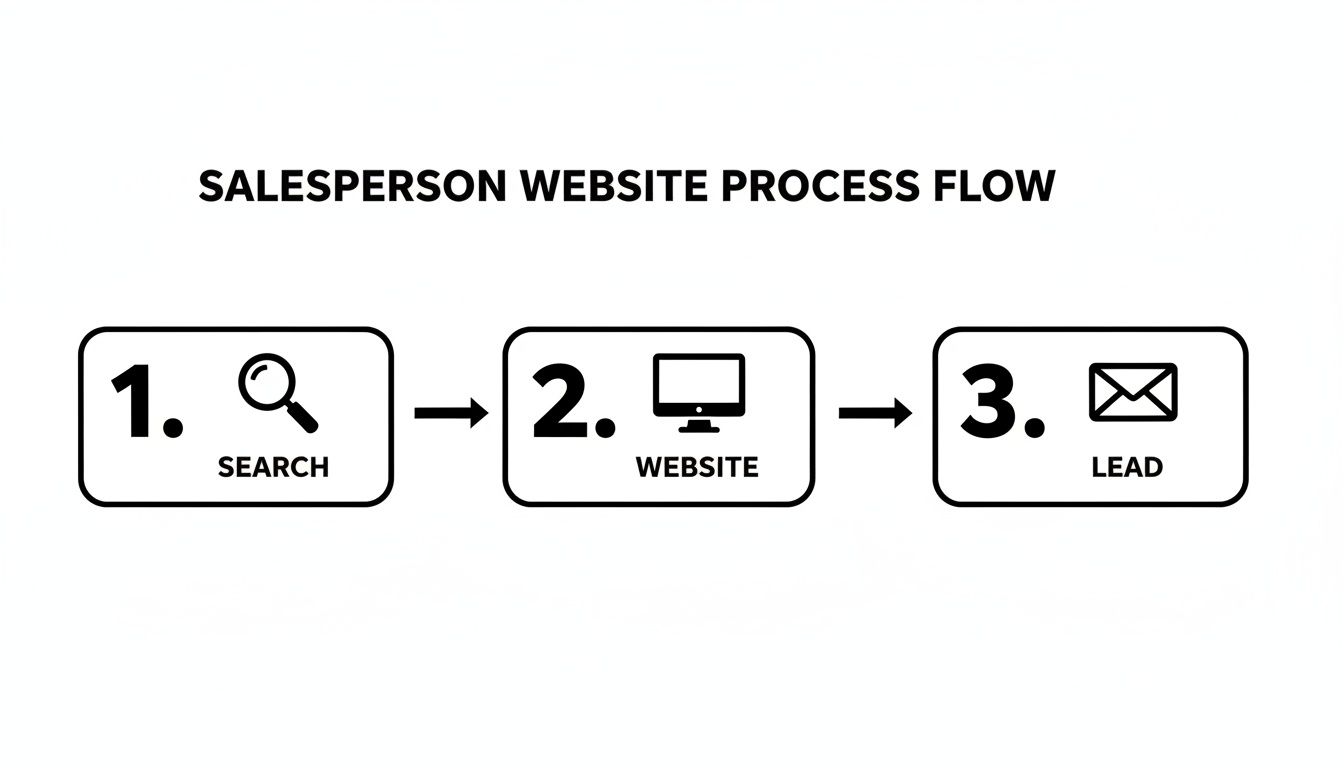
This process shows why having the right pages in the right order is so important. Each page has a job: to move that visitor from just looking to calling you.
What Pages Does Every Roofer Website Need?
For a roofer trying to win jobs, some pages are a must-have. They are the foundation for building trust, showing your skill, and making it easy for a homeowner to hire you.
Each page should have a clear purpose, but they all need to work together. Here is a list of the key pages your roofing website must have.
| Essential Pages for Your Roofing Website |
| :— | :— | :— |
| Page Type | Primary Goal | Key Elements to Include |
| Homepage | Grab attention and build trust quickly. | Your services, service area, phone number, a strong call-to-action (CTA), and reviews. |
| About Us | Build trust and show the people behind the brand. | Your company story, team photos, certifications, and what makes you different. |
| Service Pages | Explain what you do and attract local traffic. | Details on each service (like roof repair or replacement), materials you use, and local keywords. |
| Project Gallery | Show visual proof of your quality work. | High-quality photos of finished jobs, sorted by project type or location. Before-and-after photos work great here. |
| Contact Page | Make it easy for leads to contact you. | A simple contact form, phone number, email address, and a map of your service area. |
A well-organized website knows what a visitor is looking for and gives it to them. The goal is to answer their questions with every click, building their confidence in you.
Use Service Area Pages to Dominate Local Search
If you want to own your local market, you have to prove to Google you’re the top roofer in every town you serve. This is where special service area or "city" pages help.
Creating pages like "Metal Roofing in Salinas" or "Commercial Roof Repair in Monterey" sends strong signals to search engines and customers that you are the local expert. These pages need unique content that talks about that community. You could mention local weather, common roof styles, or a job you did nearby.
The truth is, most generic roofer websites get lost online. Some studies show that 98% of roofing website content gets no traffic because it’s not specific enough. The best websites we build here at Core6 often have 15-30 pages, including these important city pages that beat the competition.
Building a Smart Site Structure
How you organize these pages is just as important as what's on them. A logical site structure helps visitors find what they need and helps Google understand your site. To see how this fits into the big picture, check out our guide on what a good contractor website should have.
A clean sitemap usually looks like this:
- Home
- About Us
- Services
- Asphalt Shingle Roofing
- Tile Roof Repair
- Commercial Roofing
- Service Areas
- Salinas
- Santa Cruz
- Hollister
- Project Gallery
- Contact Us
By setting this foundation first, you’re not just building a professional website. You’re creating a tool designed to bring in leads for years.
Designing for Trust and Action in Monterey County
When a homeowner in Monterey County has a leaky roof, they need a roofer they can trust. You have about three seconds to make that connection. If your website fails, that customer is gone, clicking over to your competitor in Seaside or Marina.
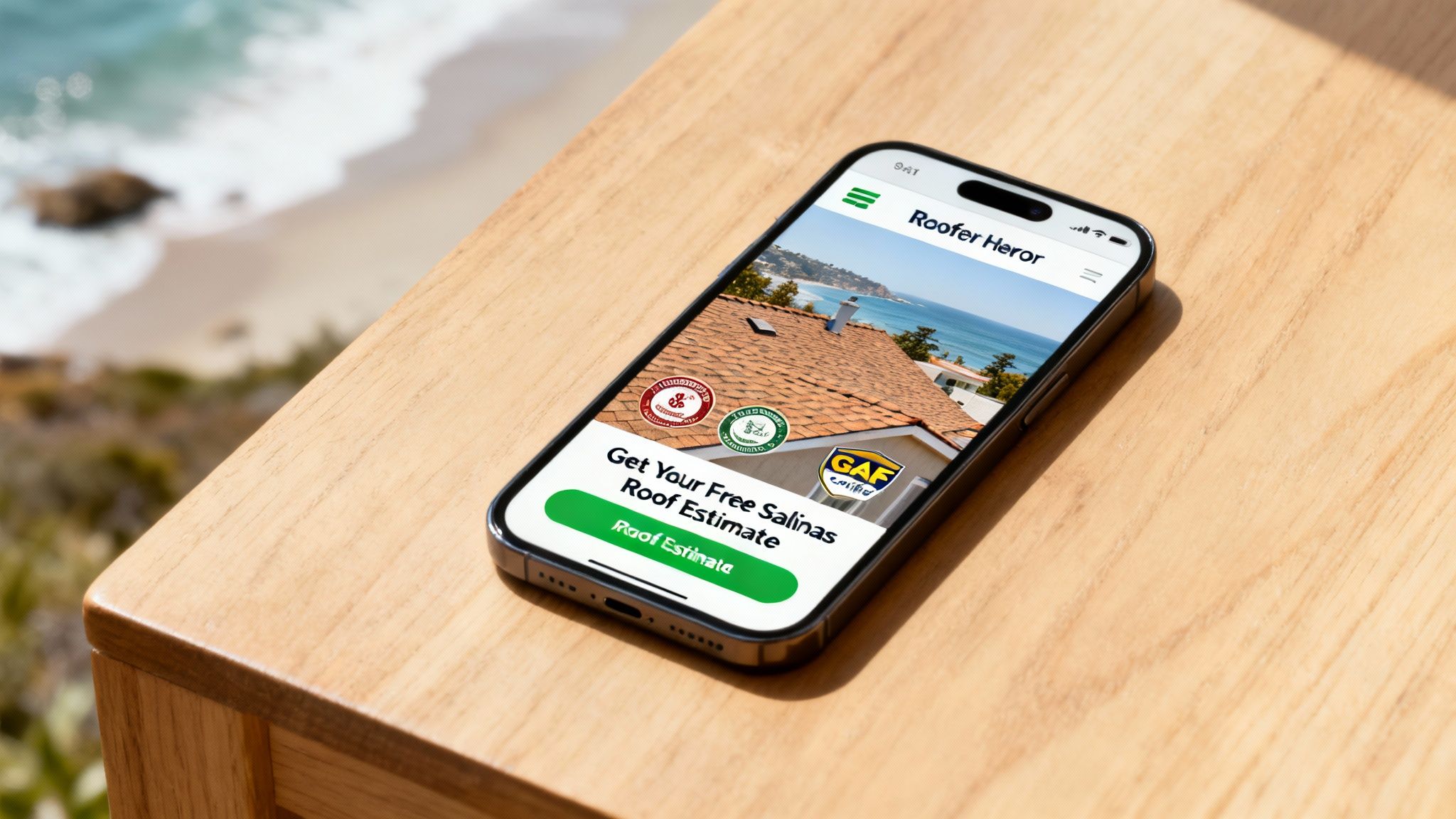
Effective website design for roofers is less about fancy graphics and more about building confidence. It’s about showing a homeowner that you are the safe, reliable, and professional choice. This is how you turn a nervous visitor into a confident lead.
Put Trust Signals Where People Can See Them
Trust signals are the visual clues that instantly tell a visitor you're the real deal. These are essential and need to be front and center on your homepage. A homeowner shouldn't have to search to find proof that you're legitimate.
Here are the trust signals your site must have:
- Manufacturer Certifications: Are you a GAF Master Elite® or Owens Corning Platinum Preferred Contractor? Put those logos on your site. They tell customers you've been approved by big names in the industry.
- Local Affiliations: Being a member of the Monterey Peninsula Chamber of Commerce or other local groups shows you’re an established part of our coastal economy.
- Licensed & Insured: This is a must. Put your California contractor's license number where it can be seen and state that you're fully insured.
- Customer Reviews: Positive reviews are powerful. Adding a live feed of your latest Google reviews provides real-time proof that you do great work. We discuss this more in our article on why customer feedback matters more than ever.
The best places for these are in your site’s header, footer, or in a "trust bar" below your main menu. The goal is to constantly reassure the visitor.
Your Own Photos Are Your Best Sales Tool
Using generic stock photos is a fast way to lose trust. Homeowners in Santa Cruz and Hollister can spot a fake a mile away. They want to see your team, your trucks, and the actual roofs you have worked on right here in the Monterey Bay Area.
A gallery of high-quality, original photos of your completed projects is your most powerful sales tool. It provides real proof of your work and helps a customer see the quality you bring.
Invest in a photographer or use a good smartphone to take pictures of your work. Showing before-and-after shots of a roof replacement in Carmel-by-the-Sea is much better than any stock photo you can buy.
Create Calls-to-Action That Get Clicks
Once you’ve built trust, you need to tell the visitor what to do next. That's the job of your Call-to-Action (CTA). A weak button like "Contact Us" is a missed opportunity. Your CTAs need to be specific and make the next step feel easy.
Think action-oriented and local:
- "Get Your Free Salinas Roof Estimate"
- "Schedule a Roof Inspection in Watsonville"
- "Call Now for Emergency Leak Repair"
Your phone number must be everywhere and clickable on a phone. Keep your "Request an Estimate" form simple. Just ask for what you need to start the conversation. Every extra field you add is another reason for them to leave.
By combining trust signals, real photos, and clear CTAs, you turn your website from a simple page into a lead-generating machine.
Dominating Local Search with Roofer-Specific SEO
You can have the best website in the world, but if homeowners can't find it, it's not working. This is where local Search Engine Optimization (SEO) comes in. For roofers in the Monterey Bay Area, a smart SEO plan is what separates the busy companies from the invisible ones.
The goal is simple: show up when a homeowner in your service area searches for things like "roofer near me" or "roof repair in Seaside." SEO is about proving you are the most relevant and trustworthy local answer to their problem.
Master Your Google Business Profile
Your Google Business Profile (GBP) is your most important local SEO tool. It’s the free listing that shows up in Google Maps and the "Map Pack" at the top of search results. For a roofer, that visibility is everything.
Optimizing your GBP is a must-do task.
Here’s where to focus:
- Fill Out Everything: Complete every single field Google gives you. Add your services, list every city you work in (like Hollister, Marina, and Watsonville), and be exact with your hours. The more complete your profile, the more Google trusts you.
- Upload Real Photos: Don't use stock images. Regularly upload pictures of your crew, your trucks, and finished roofs across Monterey County. If you can, geotag those images to give Google more local proof.
- Get Reviews (and Respond): Reviews are a huge ranking factor. Ask your happy customers to leave a review and make sure you respond to every single one.
For more on winning the map pack, check out our guide on how to rank higher in "near me" searches.
On-Page SEO for Local Keywords
On-page SEO just means optimizing the content on your website. It’s how you tell Google what you do and where you do it. The key is to use location-based keywords naturally in your site's text.
For example, instead of a page called "Roof Replacement," be specific. Title it "Asphalt Shingle Roof Replacement in Salinas." That small change makes it clear who you're trying to reach. This is a key part of getting more leads for your roofing company in Santa Cruz County.
A common mistake I see is roofers building a website that looks good but isn't designed to get leads. A good strategy is about more than just keywords; it's about guiding a searcher to become a caller.
Many roofers invest in SEO, but their efforts fail because the site itself isn't built for lead generation. While 70% of roofers invest in SEO, the ones who grow are those with custom, mobile-friendly sites built to get results.
Building Local Authority
Your work isn't done once your site is optimized. You also need to build signals online that confirm your business is a real part of the local community. This comes down to two things: local citations and backlinks.
Here's a quick checklist of the key local SEO tasks every Monterey Bay roofer should be doing.
Local SEO Checklist for Monterey Bay Roofers
| SEO Task | Why It Matters | Action Step |
|---|---|---|
| Claim & Optimize GBP | This is your online storefront and a customer's first impression on Google. | Fill out every section, add weekly photos, and ask for reviews. |
| Build Local Citations | Consistent listings on sites like Yelp prove to Google that your business is legitimate. | Create profiles on the top 20 local directories. Make sure your Name, Address, and Phone (NAP) are identical everywhere. |
| Target Local Keywords | This tells Google which searches you are most relevant for, like "tile roof repair in Carmel." | Create individual pages for each service and city you target. |
| Earn Local Backlinks | Links from other local businesses (like a supplier) act as votes of confidence. | Sponsor a local event or team in exchange for a link from their site. |
| Publish Local Content | Writing blog posts about local projects shows you're an active expert. | Write a post titled "3 Roof Issues for Coastal Homes in Monterey Bay." |
This checklist covers the basics that drive real results in local search.
Local citations are mentions of your business's Name, Address, and Phone number (NAP) on other websites like Yelp or Angi. Consistency is key—your NAP has to be exactly the same everywhere.
Backlinks are links from other websites to yours. Getting a link from the Santa Cruz County Chamber of Commerce, for example, is a powerful signal to Google that you're a trusted local business. A solid small business SEO strategy is your roadmap to earning these kinds of links and winning at local search.
By combining an optimized Google Business Profile with targeted content and local authority signals, your roofing company can climb the search rankings and become the top choice for homeowners across the Monterey Bay.
Keeping Your Lead Generation Machine Running
Launching your new website is a big step, but it’s just the start. A website isn't a "set it and forget it" tool. To keep the leads coming in, you have to treat it like any other important piece of equipment. It needs regular attention to perform at its best.
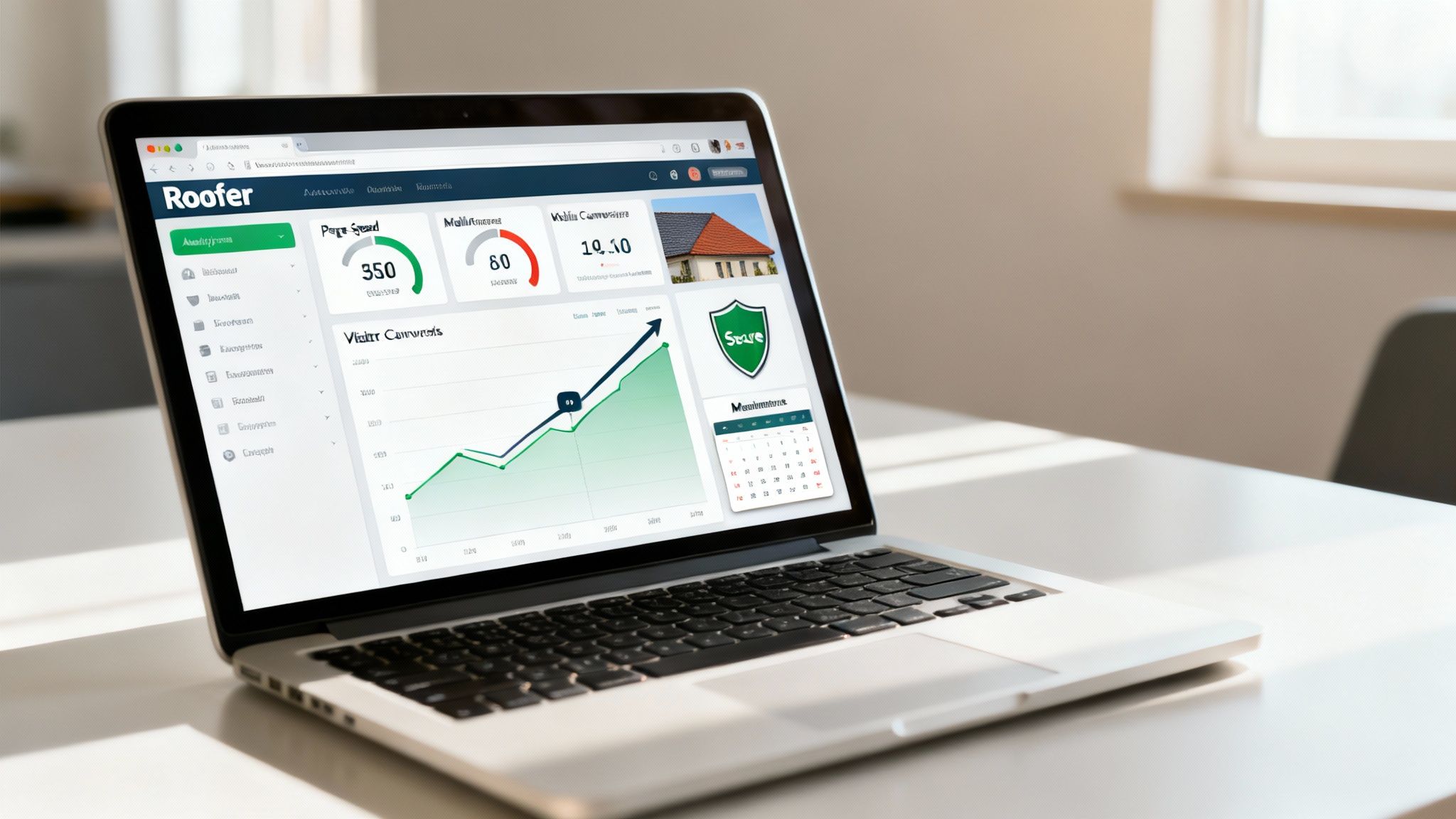
Your website is your digital sales engine. Just like your trucks need oil changes, your site needs ongoing monitoring to run smoothly and stay secure. If you neglect it, you're leaving money on the table for roofers across Monterey County.
Focus on Speed and Mobile Performance
In this business, speed is key. A potential customer in Watsonville searching for an emergency roof repair won't wait for a slow-loading website. They'll just hit the back button and call your competitor.
It's even more important on mobile. Over half of all website traffic now comes from smartphones. If your site is hard to read on a phone, you’re losing business. A bad mobile experience seems unprofessional and sends customers away. They should be able to find your number and fill out a contact form with just their thumbs.
Slow load times also hurt your Google rankings, making it harder for new customers to find you.
Here’s what you need for mobile and speed:
- Fast Loading: Aim for a load time of under three seconds. This means optimizing image sizes and using clean code.
- Responsive Design: Your site must look great and work perfectly on any screen, from a desktop to a smartphone.
- Click-to-Call Numbers: Make sure every phone number is a clickable link. One tap, and they're calling you.
- Simple Forms: Keep your contact forms short. Nobody wants to fill out a long form on a tiny screen.
Understand Your Website Analytics
So, how do you know if your website is working? You track the numbers. Setting up a free tool like Google Analytics is a must. It’s the dashboard for your online business, showing you what’s happening.
Analytics can seem complex, but you only need to watch a few key things:
- How many people are visiting? (Your overall traffic).
- Where are they coming from? (Google, Facebook, a local directory?).
- Which pages are the most popular? (This tells you what your customers care about).
- How long are they staying? (Longer visits usually mean they're interested).
A quick monthly check-in on this data gives you great insight. For example, if you know you're getting calls but aren't sure where they came from, you can learn how call tracking can pinpoint your best lead sources. This helps you make smart decisions based on real data instead of just guessing.
The Importance of Security and Maintenance
Your website is a valuable asset, and you need to protect it. You wouldn't leave your tools unlocked on a job site. The same logic applies here. Your site needs basic security to protect it from hackers and technical glitches. A hacked website can destroy the trust you’ve spent years building.
Regular website maintenance is not just a chore; it's a key business function. It protects your investment, makes sure customers have a good experience, and guards your reputation in the local community.
Simple, consistent maintenance is your best defense. This comes down to three things:
- Regular Backups: Your website should be backed up automatically every day. If something breaks, you can restore it in minutes.
- Software Updates: The platforms that run your website (like WordPress) release frequent updates to fix security holes. Keep them current.
- Security Scans: Running scans helps find and remove any bad code that might have gotten on your site.
A Simple Content Strategy for Growth
Finally, keeping your site fresh with new content helps both your customers and your search rankings. You don't need to be a professional writer. Adding a new blog post every month or so can make a big difference over time. This is a simple way to improve your website design for roofers strategy without a huge time commitment.
Think about the questions your customers always ask you. Turn those answers into short, helpful articles. A blog post titled "Choosing the Best Roof for Coastal Weather in Santa Cruz County" or "5 Signs It’s Time for a Roof Replacement in Hollister" does two things: it gives real value to local homeowners and shows Google you’re an active, knowledgeable expert.
Over time, this simple content plan will bring in more local traffic, build trust, and secure your reputation as the top roofer in your area.
Common Questions We Hear From Roofers
Investing in a new website is a big step, and you probably have questions. We get it. Here are the most common questions we hear from roofers around the Monterey Bay Area, with straight-up answers.
Our goal is to show you what makes a roofing website actually work. Then you can see how it leads to more jobs and better pay.
How Much Does a Good Roofing Website Cost Around Salinas?
For a professional, lead-generating website built to compete in a market like Salinas, you should plan to invest between $3,500 and $10,000. That price usually gets you a custom design, a mobile-friendly site, and the basic local SEO needed to start ranking.
Be careful with cheap, template-based options. The low price is tempting, but they almost never rank well in local searches or convince a homeowner to call you. Think of it as an investment in a 24/7 salesperson that brings in good jobs for years.
A cheap website is often the most expensive mistake a contractor can make. It costs you lost leads, missed opportunities, and the money you'll eventually spend to rebuild it the right way.
How Long Does It Take to Build a New Website for a Santa Cruz Roofing Company?
A good timeline for a custom roofing website is 6 to 12 weeks. That’s from our first strategy call to launch day. The process is detailed because it needs to be—it covers strategy, design, content writing, and the actual build.
Could a simple template site be built faster? Sure. But a strategic build, one that's optimized for the competitive Santa Cruz market, takes time to do right. Rushing things usually just gets you a generic site that doesn't meet your goals.
Do I Really Need a Blog on My Roofing Website?
Yes. A blog is one of the most powerful tools you have for local SEO, especially in our area. When you write articles that answer your customers' real questions, you start bringing in qualified traffic from people who are already looking for a solution.
Here’s how a blog helps your business:
- It boosts your local SEO. Publishing content like "Signs You Need a Roof Replacement in Pacific Grove" helps you show up for those specific, local searches.
- It builds trust. A good blog positions you as the expert, not just another roofer in Monterey County. It shows you know your stuff.
- It keeps your site fresh. Google loves seeing new, relevant, and locally-focused content. It’s a signal that your website is active and helpful.
Can You Guarantee I'll Be Number One on Google?
No, and you should run from any agency that says they can. No good marketing professional can guarantee a #1 ranking on Google. The search engine's algorithm is very complex and changes all the time. That makes promises like that impossible to keep.
What we can do is use a complete strategy based on proven best practices in website design for roofers. That means strong local SEO, a great user experience, and valuable content. This greatly increases your chances of landing on the first page for the keywords that matter. At Core6 Marketing, we focus on a clear, data-driven process designed to get your business the best visibility possible.
Ready to turn your website into a machine that generates leads while you sleep? Let's talk about building a strategy that will make your roofing business the obvious choice in the Monterey Bay Area.
Contact Core6 Marketing today for a no-obligation strategy session. https://core6.marketing