
For any plumber in Monterey County, your website should be your number one employee, tirelessly working 24/7 to bring in jobs. Let's move beyond just pretty designs and focus on what actually makes the phone ring. Smart web design for plumbing is all about building immediate trust and making it incredibly easy for a homeowner in Salinas with a burst pipe to hire you.
Build a Website That Works as Hard as You Do
Think of your website not as a digital brochure, but as your hardest-working team member. It never takes a lunch break, calls in sick, or sleeps. Its one and only job is to convince potential customers—from a restaurant owner in Carmel-by-the-Sea with a grease trap emergency to a family in Hollister needing a new water heater—that you are the right person for the job.
A high-performance website is built on a strategic foundation that guides visitors from panic to solution. When someone lands on your site, they aren’t there to admire your logo; they’re there to solve an urgent problem. Your website has seconds to answer their most important questions.
The Blueprint for Trust and Action
A plumber’s website needs to be ruthlessly efficient. Every single element, from the menu to the footer, must serve a dual purpose: build your credibility and drive action. From the moment the page loads, potential customers are looking for signals that you are professional, reliable, and, most importantly, local.
Your site's structure is the blueprint for this to happen. It needs a logical, clean flow that makes perfect sense to someone who knows nothing about plumbing but everything about the water pouring onto their floor. This means an uncluttered layout where information is exactly where people expect to find it.
These principles of clear navigation and trust-building are universal for home service businesses. For a deeper dive, you can explore our detailed guide on website design for home service contractors to see how these concepts apply across different trades.
Core Pages Every Monterey Bay Plumber Needs
A great website isn't a single page; it's a collection of pages all working together. Each one plays a specific role in turning a frantic searcher into a paying customer. To get started, you absolutely need a few essential pages. These are the foundation of a site that generates real business.
Here's a breakdown of the must-have pages that turn a plumbing website into a lead-generation tool.
Essential Pages for a Monterey Bay Plumber's Website
| Page Type | Core Purpose | What to Include |
|---|---|---|
| Homepage | Your digital storefront. Instantly answers "Who, What, Where, and Why?" | Your company name, a clear headline (e.g., "Reliable Plumbing in Salinas & Monterey"), your phone number, and social proof like reviews. |
| About Us | Build a personal connection and establish trust. | Your story, your company values, real photos of your team (not stock photos!), and any local community involvement. |
| Services Pages | Prove your expertise and rank for specific plumbing problems. | Dedicated pages for each core service (e.g., Drain Cleaning, Water Heater Repair, Leak Detection). Detail your process and benefits. |
| Service Areas | Show you're a true local and capture location-based searches. | A main page listing all cities and towns you serve (Salinas, Monterey, Gilroy, etc.). Ideally, create individual pages for top-priority cities. |
| Contact Page | Make it effortless for customers to get in touch. | A simple contact form, your phone number (clickable!), email, business address, and an embedded Google Map. |
Each of these pages contributes to a seamless user experience, guiding visitors toward the ultimate goal: picking up the phone and calling you.
A common mistake I see is burying the phone number. Your number and a clear "Request Service" button should be locked in the header, visible on every single page. Don't make a customer in a panic hunt for how to hire you.
Master Mobile Design for On-the-Go Customers
Picture this: a restaurant owner in Carmel-by-the-Sea has a clogged kitchen drain during the Friday dinner rush. They're grabbing their phone to find a plumber, now. If your website is slow, hard to read, or clumsy on their phone, you just lost the job to a competitor whose site worked flawlessly. This isn't a rare scenario; it's the new standard for how local customers find help.
A huge majority of your potential customers will find you on their smartphone, often in a moment of distress. This makes a mobile-first approach to web design for plumbing completely non-negotiable. It’s no longer about making your desktop site "fit" on a small screen; it’s about designing the experience for the mobile user from the ground up.
Build for the Palm of Their Hand
Mobile-friendly design is about more than just looks. It’s about speed, accessibility, and turning a frantic search into a confident service call. When a homeowner in Santa Cruz County is dealing with a leak, they don't have the patience to pinch and zoom just to find your phone number. They need a solution right away.
The data backs this up. According to Google, over 60% of local searches happen on mobile devices. And if a page takes more than three seconds to load, bounce rates—the percentage of people who leave after viewing only one page—climb by a staggering 32%.
Key Features for a High-Converting Mobile Site
A truly effective mobile plumbing website prioritizes function over flash. Every single element should be designed to get the user the information they need and make contacting you as simple as possible.
- Click-to-Call Buttons: This is your most important feature, period. Your phone number needs to be a large, tappable button that’s always visible, usually locked in the header or footer. Don't make someone in Gilroy with a flooded basement copy and paste your number.
- Simplified Navigation: Forget complex, multi-level dropdown menus. A mobile menu should be clean, with direct links to your most critical pages: Services, Service Areas, About Us, and Contact. The goal is one or two taps, max.
- Thumb-Friendly Design: People use their thumbs to get around on their phones. Make sure all buttons, links, and form fields are large enough to be tapped easily without hitting something else by mistake. It’s a small detail that dramatically improves the user experience.
- Legible Fonts and High Contrast: Text has to be large enough to read without squinting. Use clean, simple fonts and ensure there's strong contrast between your text color and the background so it's readable in any light.
A great mobile experience is all about removing friction. The easier you make it for someone to contact you, the more likely they are to do it. Think of your mobile site as a direct line to your dispatch.
Showcasing Trust on a Small Screen
Just because the screen is smaller doesn't mean trust signals are less important. In fact, they might be even more crucial. Mobile users are often in a hurry and need to make a fast decision.
You must prominently display your five-star reviews, certifications, and any local affiliations. These elements need to be formatted so they're easy to scan on a phone. A scrolling testimonial slider works well, as does highlighting a key review from a customer in a well-known Monterey Bay town.
A complete strategy for digital marketing for plumbers weaves this mobile-first thinking into every part of your online presence. By focusing on speed, ease of use, and visible trust signals, you turn your website into a powerful lead-generation tool that works perfectly wherever your customers are. Your mobile site is often your first—and only—chance to make a great impression.
Dominate Local Search Results in the Monterey Bay
Let’s be honest. When a homeowner in Santa Cruz County frantically searches for an "emergency plumber," you don’t get that call by luck. You get it because of smart, targeted Local Search Engine Optimization (SEO). Proper web design for plumbing isn’t just about making a pretty site; it's about strategically cementing your presence exactly where local customers are looking for you.
Think of Local SEO as making your business impossible for Google to ignore when someone in your service area has a problem. You’re sending consistent, undeniable signals that you are the most relevant, authoritative plumber for their specific need, right in their neighborhood. This is how you win the jobs happening in your own backyard—today.
Your Google Business Profile Is Your Digital Handshake
Long before a potential customer lands on your website, they'll probably see your Google Business Profile (GBP). This free listing is one of the single most powerful tools in your local marketing kit. Optimizing it correctly isn't a recommendation; it's an absolute must if you want your phone to ring.
Your first move is to claim and meticulously fill out your profile. I’m talking high-quality photos of your team and branded trucks, a detailed business description, and selecting all the right service categories. But the most critical piece? Your Name, Address, and Phone number (NAP) must be 100% consistent.
The NAP on your Google profile has to be an exact match to what's on your website's footer and contact page. Even a tiny difference like "St." versus "Street" can confuse search engines and tank your local rankings.
Build Hyper-Local Authority with Location Pages
A single "Services" page just won't cut it if you want to compete across the different communities in the Monterey Bay Area. To truly own the map, you have to prove to Google you’re not just an expert in plumbing, but in plumbing right here. The secret is creating dedicated pages on your site for each city you serve.
Picture a customer in Salinas searching for "drain cleaning." A generic services page is okay, but a page titled "Expert Drain Cleaning in Salinas" is a game-changer. It instantly tells both the user and Google that you're laser-focused on their community.
These pages need to be more than just copies with the city name swapped out. They should include:
- Unique, Localized Content: Talk about common plumbing headaches in that area. Maybe it's hard water issues in the agricultural parts of Monterey County or the challenges of old pipes in historic Pacific Grove homes.
- Local Testimonials: Nothing builds trust faster than social proof. Feature glowing reviews from happy clients in that specific city. A review from someone in Hollister carries so much more weight on your Hollister page.
- Embedded Local Map: Include a map of the service area you're targeting on that page. It's a simple, visual way to reinforce your local expertise.
This strategy transforms your website from a generic brochure into a powerful, localized resource that Google loves. It demonstrates your commitment to the community and directly answers the questions local customers are asking. To see a real-world example of how these pieces fit together, it’s worth checking out how we approach local SEO services for plumbing contractors in Salinas, where these very principles are put into action.
By obsessively managing your GBP and building out a network of hyper-local service pages, you tell Google that you are the #1 choice for plumbing services from Watsonville to Gilroy and everywhere in between. This is how you stop being just another name on a list and become the obvious solution.
Write Website Copy That Sells Your Services
Your website's design might be what catches their eye, but it’s the words on the page that actually close the deal. Think of your website copy as your best salesperson—one who works 24/7 to build trust, answer urgent questions, and convince a visitor with a plumbing disaster to pick up the phone and call you.
Great copy is the difference between a site that just gets clicks and a site that gets you paying customers.
It’s not about using fancy, complicated language. For a plumbing business, effective copy is all about clarity, empathy, and proving you’re the right choice for the job. You need to speak directly to your ideal customer—whether that’s a panicked homeowner in Pacific Grove staring at a growing water stain or a property manager in Marina who needs a reliable pro for routine maintenance.
Speak Their Language, Solve Their Problem
When someone lands on your site, they're usually stressed. They have a problem, and they're hunting for a fast, reliable solution. They don’t care about the brand of your wrenches; they want to know if you can fix their overflowing toilet before it ruins their new flooring or install that tankless water heater correctly the first time.
Your service descriptions need to go beyond just listing what you do. They have to scream "I can solve your problem."
- Instead of: "We offer drain cleaning services."
- Try: "Get your drains flowing freely again. We use advanced hydro-jetting to completely clear clogs and prevent future backups, protecting your home from water damage."
See the difference? The second one shifts from what you do to what you solve for the customer. It shows you understand their anxiety and have a specific, expert solution ready to go. You’re not just a plumber; you’re the problem-solver who gets how homes and businesses in Monterey County work.
Pro Tip: Write with a confident, helpful tone. Imagine you're on the phone with a new customer. You’d be calm, reassuring, and clear about the next steps. Your website copy should project that same professional demeanor.
Weave in Trust Signals and Social Proof
Your words are powerful, but words from other happy customers? Even better. In the home services world, testimonials and reviews are the currency of trust. A potential customer is far more likely to believe a neighbor's five-star review than your own claims about how great you are.
Don't bury your best testimonials on a separate "Reviews" page that no one visits. Sprinkle them strategically throughout your website, especially on your key service and location pages.
For example, on your "Water Heater Repair in Hollister" page, you could feature a quote like this:
"When our water heater died on a Sunday, we were in a panic. [Your Company Name] was here within an hour and got our hot water back on fast. Incredibly professional and a lifesaver!"
- Maria S., Hollister, CA
This kind of specific, local social proof is incredibly persuasive. It proves you have a track record of success right in their community. Pairing this with a clear Call-to-Action (CTA) creates a powerful one-two punch that gets people to act. It’s a foundational piece of a solid online presence, and if you want to dig deeper, you can read about our approach to local SEO for plumbing contractors in Watsonville.
Write Clear and Compelling Calls-to-Action
Every single page on your website needs a clear purpose. It has to guide the visitor toward the next step. You can't just assume they'll figure out what to do. You have to tell them, clearly and directly, with what we call a Call-to-Action, or CTA.
Vague, passive CTAs like "Contact Us" are weak and don't inspire action. Get specific and use punchy, action-oriented language that highlights a clear benefit.
- Good: "Request an Estimate"
- Better: "Get a Free, No-Obligation Estimate"
- Best: "Schedule Your Service Call Now"
Placing these prominent buttons throughout your content makes it incredibly easy for a visitor to take that next step the moment they feel confident in your ability to help. This trifecta—problem-solving copy, powerful social proof, and crystal-clear CTAs—is what turns your website from a simple online brochure into a machine that generates real business across the tri-county area.
Turn Website Visitors into Paying Customers
A stunning website that doesn't generate leads is just an expensive online business card. I've seen it happen time and time again. The real goal of your plumbing website isn't just to look good—it's to turn clicks into calls and visitors into scheduled jobs.
This whole process is called conversion rate optimization (CRO), and it’s where a good website becomes a great one. It’s all about creating the shortest, smoothest path for a potential customer to go from landing on your site to becoming a new job on your schedule.
Think about it. When a homeowner in Santa Cruz has a burst pipe, they don’t have time for a scavenger hunt. Your phone number, contact forms, and special offers must be front and center, guiding them straight to the solution they desperately need.
This simple, three-step booking process is exactly what your website should aim for.
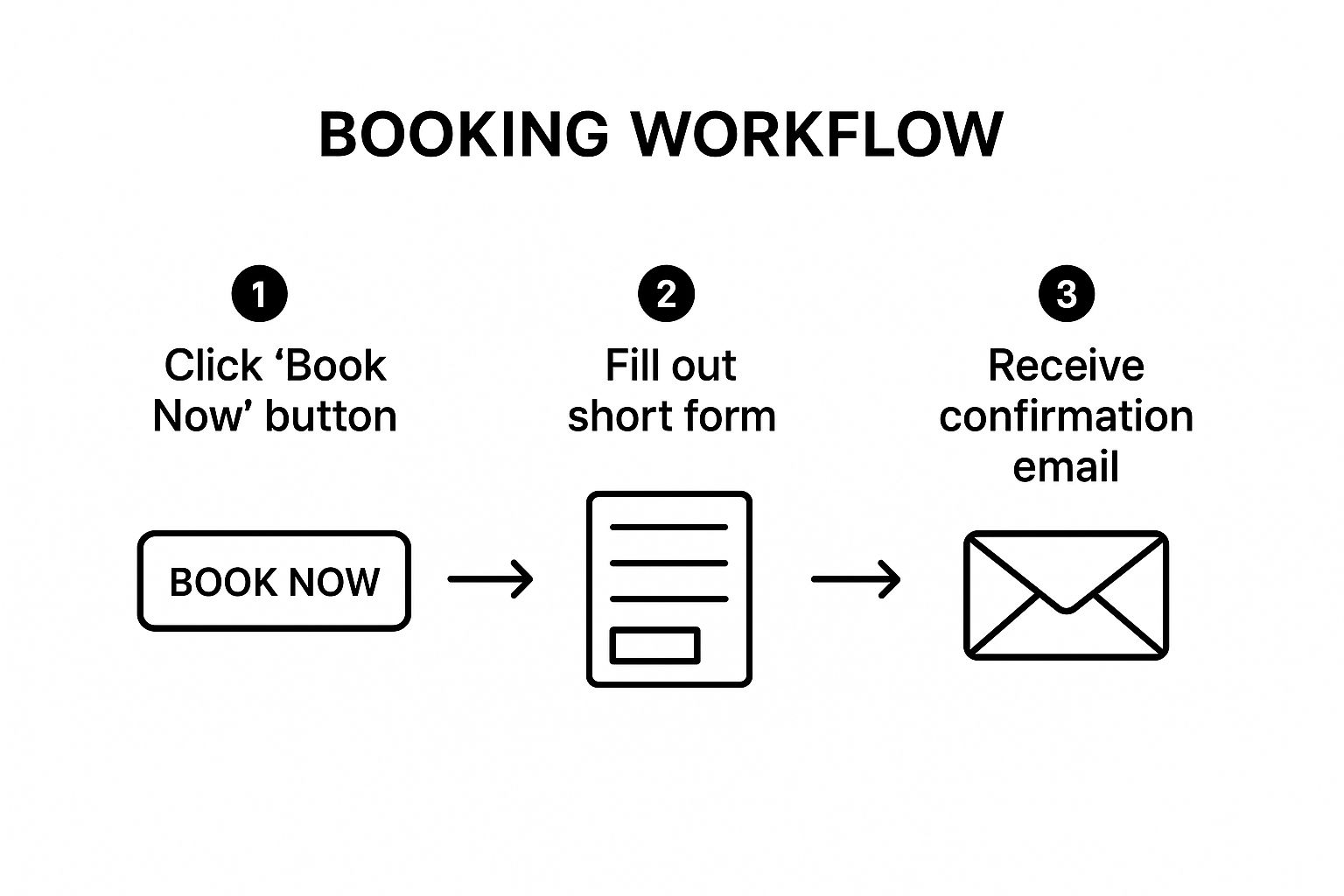
The key takeaway here is simplicity. The fewer steps a visitor has to take, the higher the chances they'll actually complete the process and book a job with you.
Make Your Contact Info Impossible to Miss
Your phone number should be the most prominent element on your website, especially on mobile. It needs to be in the header, in the footer, and on every single page. Critically, it must be a "click-to-call" link. A single tap is all it should take for a potential customer in Monterey County to reach you.
Next up are your contact forms. Don't just hide one on a "Contact Us" page and call it a day. Place a short, simple form right on your homepage and at the bottom of every service page. The goal is to capture their information the moment they decide you're the right plumber for the job.
The Anatomy of a High-Converting Lead Form
When it comes to lead forms, less is always more. A panicked customer with a flooded bathroom won’t fill out a ten-field questionnaire. All you really need to get the conversation started is their name, phone number, and a brief description of their problem.
Ask for the bare minimum. Every extra field you add to a form decreases the chance someone will complete it. You can always gather more details during the follow-up call.
A form that actually works has a few key ingredients:
- Keep it Short: Limit fields to just Name, Phone, and a "How can we help?" box. That's it.
- Use a Compelling Button: Ditch the generic "Submit." Use action-oriented text like "Request My Free Estimate" or "Schedule Service Now."
- Provide Clear Follow-Up: After they hit the button, a thank-you page or message should tell them exactly what to expect next. Something like, "Thanks! We'll call you within 15 minutes to confirm."
This focus on conversion is absolutely essential. Attracting visitors is only half the battle. For plumbers, an average website conversion rate is between 2% and 5%. If you can push your site past that 5% mark, you’ve built a top-performing machine that turns your marketing investment into real, measurable revenue.
Once you capture a lead, you need a system to follow up quickly. For those looking to streamline this process, you can learn about Hubspot automation features for lead generation that help turn inquiries into scheduled appointments without letting anyone slip through the cracks.
Below is a quick checklist of the most important elements you'll want to include on your site to maximize your lead capture opportunities.
High-Impact Lead Capture Elements for Your Site
| Element | Best Practice for Plumbers | Why It Works |
|---|---|---|
| Click-to-Call Phone Number | Place it prominently in the header and footer of every page. | Makes it effortless for mobile users to contact you during an emergency. |
| Simple Contact Forms | Use short forms (Name, Phone, Issue) on the homepage and all service pages. | Reduces friction and captures leads the moment a visitor is interested. |
| Action-Oriented Buttons | Use text like "Get a Free Estimate" instead of "Submit." | The language encourages action and clearly states the value to the user. |
| Live Chat Widget | Offer an optional live chat for instant answers to simple questions. | Catches visitors who prefer not to call and can guide them to book a service. |
| Emergency Service Banner | A clear banner for "24/7 Emergency Service" with a phone number. | Immediately addresses the most urgent customer need, building trust fast. |
| Thank-You Page Confirmation | After a form submission, confirm receipt and set expectations (e.g., "We'll call you in 15 mins"). | Reassures the customer their request was received and tells them what's next. |
By combining these unmissable contact points with frictionless forms, you create a seamless experience that guides visitors toward becoming paying customers. This entire framework is a core part of effective lead generation for home services, ensuring you capture every possible opportunity from Salinas to Santa Cruz.
Got Questions About Your Plumbing Website? We've Got Answers.
Jumping into a new website project can feel overwhelming. You’re busy running your plumbing business across the Monterey Bay Area, focused on fixing leaks and helping customers, not getting tangled up in web design jargon. It's totally normal to have questions about how much it all costs, how long it takes, and if it's even worth it.
We hear the same questions from plumbers all over Monterey, Santa Cruz, and San Benito Counties. So, let's clear the air and give you some straight answers to help you make the right call for your business.
How Much Does a Good Plumbing Website Cost in Monterey Bay?
This is always the first question, and the honest answer is: it really depends. The best way to think about it is an investment in your hardest-working sales and marketing tool—one that’s on the clock 24/7.
You could get a basic, cookie-cutter site for a few thousand dollars. But a custom web design for plumbing—one that’s actually built to show up in local searches and turn visitors into paying customers—is a different beast. For a professional website designed to get your phone ringing with jobs from Salinas or Santa Cruz, you should budget somewhere in the $5,000 to $15,000+ range.
What makes the price vary? A few things:
- Custom Features: Need a built-in scheduling system for appointments or a calculator for complex service estimates?
- Content Creation: Do you need a pro to write all the copy for your service and location pages so it ranks on Google?
- Local SEO Foundation: How much work is needed to make sure you’re visible when someone in Monterey County has a plumbing emergency?
Here's the bottom line: a cheap website that never brings in a single call is way more expensive than a professional one that delivers a steady stream of qualified leads and a clear return on your investment.
How Long Does It Take to Build a New Plumbing Site?
Good things take time. For a professional plumbing website that’s built right, you’re typically looking at 8 to 12 weeks from our first conversation to launch day. This timeline gives us the room to do things properly, including discovery and planning, design mockups, development, professional copywriting, and making sure everything works perfectly on every device.
Sure, you could get a simple template site slapped together in 4-6 weeks, but rushing usually means cutting corners. That often leads to poor quality, weak local SEO, and a site that just doesn't perform well on mobile—all things that will kill your ability to compete in busy markets like Gilroy and Hollister. A good agency will give you a clear project timeline and keep you in the loop every step of the way.
Should I Use a DIY Builder like Wix or Squarespace?
The low upfront cost and "easy-to-build" promises of DIY platforms like Wix or Squarespace are definitely tempting. And for some businesses, they can be a starting point. But for a local service business that lives and dies by local search rankings, they almost always fall short.
These platforms often don't have the technical SEO muscle or the customization you need to get found when a potential customer has an emergency.
A professionally built WordPress website gives you far more power and flexibility to optimize for Google. This is absolutely critical for getting your "Water Heater Repair in Watsonville" page to rank above your competitors. If your main goal is to generate a consistent flow of leads, a professional build is the smarter long-term move.
What Ongoing Maintenance Does My Website Need?
Your website isn't a "set it and forget it" tool. Think of it like one of your work trucks—it needs regular maintenance to run reliably and stay secure. A little upkeep now prevents bigger, more expensive headaches later.
Ongoing support and care plans typically cover:
- Software and Plugin Updates: This keeps your site secure from hackers and ensures everything plays nicely together.
- Security Scans: We're always on the lookout for malware or any funny business.
- Regular Backups: We create copies of your site, so if anything ever goes wrong, we can restore it in a snap.
- Performance Checks: We make sure your site stays fast, because slow-loading sites frustrate users and hurt your rankings.
Beyond the technical tune-ups, ongoing SEO is what keeps the phone ringing. This means doing things like publishing blog posts about common plumbing problems in San Benito County or updating your service pages to stay fresh and relevant. Consistent care ensures your site remains a secure, high-performing asset that brings in business.
Ready to build a plumbing website that works as hard as you do? The team at Core6 Marketing is here to answer all your questions and map out a strategy that drives real results for your business.
Schedule your free, no-obligation consultation today. Let's discuss how we can get your phone ringing with qualified leads from across the Monterey Bay Area.
Schedule Your Free Website Consultation Now
By Phil Fisk, CEO, Core6 Marketing
Phil Fisk is the founder and CEO of Core6 Marketing, a digital marketing agency based in Salinas, CA. With over a decade of experience helping home service contractors grow their businesses, Phil specializes in creating data-driven web design and local SEO strategies that deliver measurable ROI for plumbers, electricians, and other trades across the Monterey Bay region.
Core6 Marketing
1628 N. Main St #263, Salinas, CA 93906
(831) 789-9320
[email protected]
https://core6.marketing/