
If you're a home service contractor in Monterey County, showing up in the Google Maps 'Map Pack' isn't just a vanity metric; it's the difference between a ringing phone and a silent one. For Salinas plumbing or HVAC businesses, local visibility drives real leads. Over 55% of your potential customers start their search there, and the top three results capture the vast majority of those high-intent clicks. If your business isn't in that top section, you’re practically invisible.
The problem is, many contractors overlook the critical, evolving signals that Google now uses for local rankings in 2026. This isn't just about dropping a pin on a map. It's a competitive arena where details like review velocity, AI-readiness, and local authority matter more than ever before. Unoptimized Google Business Profiles, inconsistent business data across the web, and a weak review strategy are holding you back from a steady stream of qualified customers.
This guide moves past generic advice to deliver actionable strategies. We will detail the top 5 ways to rank in Google Maps faster in 2026, focusing on what works for service businesses here on the Central Coast. You will learn how to fully optimize your Google Business Profile (GBP), build a powerful review engine, create location-specific content that attracts customers in Santa Cruz County, and establish the digital authority needed to dominate the local search results. It's time to stop being invisible and start getting found.
1. Master Your Google Business Profile for the AI Era
Your Google Business Profile (GBP) is no longer a simple digital business card. In 2026, it's the foundational data source for Google's local search algorithm and its increasingly sophisticated AI Overviews. Think of it as the single most powerful, direct-control asset you have for improving your Map Pack visibility. A partially completed or neglected profile in Monterey is a major red flag to Google, signaling a lack of reliability and ultimately hurting your chances to rank.
To dominate local search, you must treat your GBP as a dynamic, content-rich hub for your business. This means going far beyond basic NAP (Name, Address, Phone) information. A fully optimized profile is the difference between showing up for a generic search and winning the click for a high-intent, specific service request. Google's algorithm rewards completeness because it provides a better, more trustworthy experience for the user searching for your services.
Why GBP Optimization is Non-Negotiable in 2026
With AI features like Google's Search Generative Experience (SGE) and AI Overviews becoming standard, your GBP data is being used in new ways. AI pulls information directly from your profile to answer complex user queries. If a homeowner in Salinas asks Google, "Find me a veteran-led HVAC contractor near me that offers 24/7 emergency repair for ductless mini-splits," the AI will scan GBP profiles for those exact attributes and services. If your profile is incomplete, you simply won't be part of the conversation.
Key Insight: An incomplete Google Business Profile doesn't just lower your ranking; it makes you invisible to Google's AI-driven answer engine. Every empty field is a missed opportunity to connect with a potential customer.
To truly 'Master Your Google Business Profile for the AI Era,' a key strategy involves Mastering Geo Generative Engine Optimization (GEO), which specifically tailors your profile content and updates for AI-driven local search engines. This ensures your information is structured in a way that AI can easily understand and recommend.
Actionable Checklist for a Complete, AI-Ready GBP
Take control of your local visibility by meticulously completing every section of your profile. This isn't a one-time task but an ongoing strategy.
- Choose the Right Primary Category: This is critical. If you are a roofing specialist in Monterey County, your category must be "Roofing Contractor," not the more generic "General Contractor." Precision here tells Google exactly who your ideal customer is.
- Detail Every Single Service: Don't just list "Plumbing." Create individual entries for every service you offer, such as 'tankless water heater repair,' 'hydro-jetting services,' and 'emergency leak detection.' A homeowner isn't searching for a general plumber; they're searching for a solution to their specific problem.
- Leverage All Applicable Attributes: Scroll through the list of attributes and check every single one that applies to your business. This includes details like 'Veteran-led,' 'Family-owned,' 'Accepts new patients,' or 'Wheelchair accessible entrance.' These are powerful filters in modern search. For example, a Pacific Grove dental practice using all available attributes will appear more frequently in filtered "near me" searches.
- Build a Robust Photo Library: Aim for a minimum of 100 high-quality, geo-tagged photos. Showcase your team, your branded vehicles, before-and-after shots of your work in places like Santa Cruz, and your storefront or office. This builds trust and provides visual context for Google's AI.
- Engage with the Q&A Section: Don't wait for customers to ask questions. Proactively populate this section by asking and answering common questions yourself. Think like a customer: "Do you offer financing?" or "What is your service area in Monterey County?"
- Publish Weekly Google Posts: Use Google Posts to share updates, promotions, recent projects, or helpful tips. This is a direct signal to Google that your business is active and engaged. A consistent posting schedule is one of the clearest indicators of a well-managed profile.
By implementing these steps, you provide the rich, structured data that Google’s local and AI algorithms need to rank you at the top. For a deeper dive into optimizing your profile for the next generation of search, you can learn more about how to prepare your GBP for AI on core6.marketing. This detailed approach is the first and most crucial step in any plan to rank in Google Maps faster in 2026.
2. Generate and Optimize Reviews to Build Local Trust
In the competitive landscape of 2026, positive customer reviews are more than just social proof; they are one of the most powerful ranking signals for the Google Maps algorithm. A steady stream of positive feedback directly correlates with higher visibility. In fact, 86% of consumers read reviews before calling, and 57% won’t even consider a business rated under 4 stars.
For home service contractors in Monterey County, reviews are the digital equivalent of word-of-mouth referrals. A potential customer in Salinas is far more likely to trust a roofer with 150 recent, positive reviews than a competitor with only a handful of outdated ones. Google's algorithm understands this user behavior and rewards businesses that consistently earn customer trust.

Why Reviews are a Dominant Ranking Factor
Google's primary goal is to provide the best and most reliable answer to a user's search query. In local search, "best" is often defined by customer satisfaction. Factors like review quantity, velocity (how frequently you get new reviews), recency, and your response rate all contribute to your "prominence" score.
Furthermore, the content within the reviews matters. When a customer in Hollister leaves a detailed review mentioning "emergency plumbing repair for a burst pipe," it creates a powerful keyword signal that reinforces your expertise for that specific service. This user-generated content helps you rank for long-tail keywords you might not even be targeting directly.
Key Insight: Your review profile is a living, breathing signal of your business's health and relevance. Google prioritizes businesses that are consistently earning positive feedback from real customers because it's a low-risk, high-quality signal of trustworthiness.
A crucial part of this strategy isn't just getting reviews, but actively managing them. Learning how to respond to reviews on core6.marketing is essential for both customer service and SEO, as Google values engagement and timely responses.
Actionable Checklist for a Powerful Review Strategy
Building a 5-star reputation requires a systematic process. Integrate these steps into your daily operations to turn satisfied customers into your best marketing asset.
- Systematize Your Requests: Implement automated email and SMS review requests sent 24-48 hours after a service is completed. This timing is critical, as it catches the customer while the positive experience is still fresh in their mind.
- Make It Effortless: Provide a direct, one-click link to the "Leave a Review" section of your Google Business Profile. The fewer steps a customer has to take, the higher your conversion rate will be.
- Empower Your Team: Train your technicians and customer-facing staff in places like Pacific Grove and Carmel-by-the-Sea to verbally ask for a review upon successful job completion. A personal request is incredibly effective.
- Respond to Every Review: Aim to respond to all new reviews, positive and negative, within 24-48 hours. Thank positive reviewers by name and address specific points in negative reviews professionally, offering to resolve the issue offline.
- Encourage Descriptive Feedback: When requesting a review, gently prompt customers to mention the specific service they received (e.g., "We'd love to hear about your experience with your new tankless water heater installation!").
- Monitor Review Velocity: Your goal should be a steady, natural-looking flow of new reviews each month, not a sudden burst. Consistency signals ongoing quality service to Google.
3. Create Location-Specific Content and Landing Pages
Ranking across an entire service area like Monterey County requires more than just a single homepage mentioning the cities you serve. To truly dominate the Map Pack in 2026, you must signal to Google that you are the most relevant, authoritative expert in each specific community. A location-specific content strategy achieves this by creating dedicated digital assets for every town and city you target.
Think of it this way: a homeowner in Carmel-by-the-Sea has different local concerns and landmarks than someone in Salinas. A generic website fails to connect with either one on a local level. By building unique, high-quality landing pages for each location, you create a powerful signal of local relevance that both users and Google's algorithms reward.
Why Localized Pages are a Ranking Superpower in 2026
Google's algorithm prioritizes providing searchers with the most locally relevant results. A generic "plumbing services" page struggles to compete against a page specifically titled "Emergency Plumbing Repair in Watsonville" when a user in that city performs a search. These hyper-local pages act as targeted nets, capturing high-intent search traffic that broader content misses.
This approach is particularly effective for contractors who want to expand their footprint. For example, a successful electrical contractor based in Santa Cruz could develop dedicated service pages for Gilroy and Hollister. This not only boosts their visibility for searches like “electrician in Gilroy” but also establishes them as a definitive local authority, which is a key component of a good SEO agency in Salinas strategy.
Key Insight: Google rewards depth and specificity. A dedicated landing page for each target location demonstrates a level of authority and local commitment that a single, generalized homepage simply cannot match, making it one of the most effective ways to rank in Google Maps faster in 2026.
Actionable Checklist for Building High-Ranking Local Pages
Creating effective local pages requires more than just swapping out a city name in a template. Each page must be unique, valuable, and genuinely focused on the community it represents.
- Create Unique, Substantial Pages: Each location page should have a minimum of 500 words of unique content. Discuss local challenges (e.g., "HVAC solutions for coastal humidity in Pacific Grove"), mention local landmarks, or reference nearby streets to prove your local knowledge.
- Conduct Hyper-Local Keyword Research: Go beyond broad terms. To ensure your hyper-local content truly resonates with your target audience, a deep dive into localised keyword research is essential. Use Google Maps suggestions and competitor analysis to find what people in Hollister or Gilroy are actually searching for.
- Integrate Local Proof: Add photos of your team or vehicles on a job in the specific city. Include testimonials from customers in that area, mentioning their town. This visual and social proof reinforces your local presence.
- Implement Location Schema: Add
LocalBusinessand geo-targeting schema markup to the backend of each page. This structured data gives search engines explicit information about your service area, making it easier for them to rank you correctly. - Answer Location-Specific Questions: Build an FAQ section on each page addressing local concerns. For a roofer in Salinas, this might include, "What type of roofing material is best for the Salinas Valley climate?"
By building out this digital infrastructure, you create a network of assets that signal your dominance across the Monterey Bay Area. For a comprehensive look at how to integrate this with other powerful tactics, explore our guide on local SEO for contractors at core6.marketing. This strategy ensures that no matter where your next customer is searching from, you have a tailored piece of content ready to meet them.
4. Ensure NAP Consistency Across Local Directories
Beyond your Google Business Profile, Google’s algorithm seeks to verify your business's legitimacy by cross-referencing its information across the web. This is where citations and NAP (Name, Address, Phone) consistency come in. A citation is any online mention of your business's NAP, and ensuring it is identical everywhere is crucial.
Think of each accurate citation as a vote of confidence for your business. When high-authority websites like Yelp, Apple Maps, or industry-specific directories list your business with perfectly consistent information, it signals to Google that your data is trustworthy. In contrast, inconsistent or sparse citations can create confusion, erode Google's confidence, and suppress your visibility in the highly competitive Map Pack. Even small errors can keep you out of the top results.
Why Quality Citations are Non-Negotiable in 2026
The era of blasting your business information to hundreds of low-quality, generic directories is over. Google's algorithm now heavily prioritizes relevance and authority. A single citation on a highly respected, industry-specific directory is far more valuable than dozens on irrelevant, spammy sites. For a roofing contractor in Salinas, a listing on a site like Angi or the Better Business Bureau carries immense weight because it's where customers in Monterey County expect to find reputable tradespeople.
This focus on quality over quantity means your citation strategy must be deliberate and strategic. Google uses these high-quality listings to corroborate the service areas and specialties you claim on your GBP. If you say you serve Santa Cruz, but authoritative directories only show a Monterey address with no mention of your expanded service area, your chances of ranking in Santa Cruz diminish significantly.
Key Insight: In 2026, citations are less about volume and more about an authoritative, consistent, and relevant digital footprint. Every high-quality citation builds a stronger foundation of trust with Google, making your business a more reliable and rank-worthy result for local searchers.
Actionable Checklist for Authoritative Citation Building
To leverage citations for maximum ranking impact, focus on a clean, consistent, and relevant portfolio of listings. This is a foundational task that requires precision and regular maintenance.
- Establish Foundational Citations First: Ensure your NAP is 100% accurate on top-tier platforms like Apple Maps, Facebook Business, Yelp, and Bing Places. These are the heavy hitters that many other smaller directories pull data from.
- Prioritize Industry and Local Relevance: Identify the most authoritative directories for your specific trade. A plumber in Pacific Grove should be on Angi and HomeAdvisor. A medical practice in Gilroy needs listings on Healthgrades and Zocdoc. Local relevance matters too; a listing with the Salinas Valley Chamber of Commerce sends a powerful geographic signal.
- Ensure 100% NAPW Consistency: Your Name, Address, Phone number, and Website (NAPW) must be identical across every single listing, down to the last comma and abbreviation (e.g., "St." vs. "Street"). Inconsistencies are a major red flag for Google.
- Perform a Quarterly Citation Audit: Once a quarter, review your citation portfolio. Check for accuracy, identify and correct any discrepancies, and request the removal of your business from any low-quality or irrelevant directories that may have listed you without permission.
- Enhance Your Listings: Don't just list your NAP. Where possible, add your business description, hours, photos, and a link back to your website to create a richer, more valuable profile on each directory.
By methodically building a portfolio of high-quality, relevant citations, you provide Google with the consistent verification it needs to rank you higher and faster. To get started, you can explore a comprehensive list of valuable platforms by learning more about the top free business listing sites on core6.marketing. This strategic approach is a critical component for achieving top rankings in Google Maps in 2026.
5. Build Local Authority with Relevant Backlinks
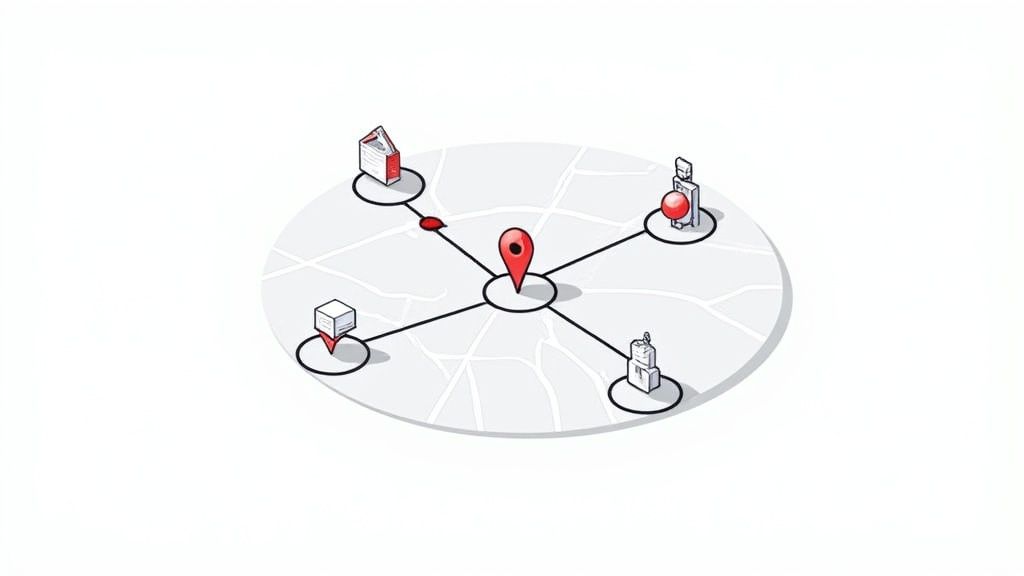
While your Google Business Profile is your foundation, backlinks are the high-authority endorsements that tell Google you're a trusted local leader. A backlink is simply a link from another website back to yours. In 2026, the algorithm prioritizes links that are both locally and topically relevant, signaling that you are a prominent and respected business within your specific industry and service area.
Strategic backlink acquisition is about earning these high-quality endorsements. This means getting a link from the Santa Cruz County Chamber of Commerce is far more valuable than a dozen links from generic directories. For a contractor in Salinas, a feature in a local Monterey County news outlet or a link from a respected home improvement blog carries immense weight, significantly boosting your local Maps visibility by proving your authority and community connection.
Why Niche-Relevant Local Links are a Superpower in 2026
Google's algorithms are smarter than ever. They can easily distinguish between a random, paid link and a genuine, earned link that contextually makes sense. When a reputable local source links to you, it's a powerful vote of confidence. This is especially true for digital marketing for Santa Cruz retailers, where a link from a local lifestyle blog can drive both rankings and foot traffic.
This is why link quality and relevance have become critical ranking factors. A dental practice in Monterey that earns links from local health blogs and the regional dental association will see a much greater lift in Map Pack rankings than one with hundreds of generic links. The goal is to build a backlink profile that tells a clear story: you are the go-to expert for your specific service in your community.
Key Insight: In 2026, five exceptional links from locally and topically relevant sources will do more for your Maps ranking than 50 mediocre, generic links. Quality and context have completely overshadowed quantity.
Building this kind of authority requires a strategic approach that goes beyond just keywords. This strategy is central to establishing topical authority, a concept that AI-driven search engines prioritize heavily. To dive deeper into this, you can learn more about what is topical authority and why AI trusts it on core6.marketing. This understanding is key to creating a backlink strategy that truly resonates with modern search algorithms.
Actionable Checklist for Building a Powerful Local Backlink Profile
Earning high-quality links is a long-term strategy that requires effort, but the payoff in local authority is unmatched. Here’s how to get started.
- Sponsor Local Events: Sponsoring a youth sports team in Watsonville, a community festival in Hollister, or a charity event in Santa Cruz often results in a link from the event organizer's website. These are high-quality, community-focused links.
- Join Local Business Associations: Become an active member of organizations like the Monterey Peninsula Chamber of Commerce or your local trade association. These memberships almost always include a link from their directory, which is a powerful local signal.
- Develop Newsworthy Content: Create a press release or blog post about a significant company achievement, a new eco-friendly service you're offering, or a community involvement project. Share it with local news outlets like those covering San Benito County.
- Partner with Complementary Businesses: A plumber in Gilroy could partner with a local restoration company. You can recommend each other's services and create opportunities for guest posts or features on each other's websites, creating relevant link exchanges.
- Create Valuable Local Resources: Develop a guide like "The Ultimate Checklist for Winterizing Your Home in Monterey County." This type of helpful content is highly linkable and can be shared with local bloggers, real estate agents, and community groups.
By focusing on building a portfolio of genuine, relevant, and local links, you are sending the strongest possible signals to Google that your business is a pillar of the community and an authority in its field. This is one of the most effective long-term strategies for securing and maintaining a top spot in the Google Maps pack.
Ready to Get Found in Salinas or Monterey in 2026?
Dominating the local search landscape in 2026 isn't about luck; it's about a deliberate strategy. We’ve unpacked the top 5 ways to rank in Google Maps faster in 2026, giving you a blueprint for success right here in Monterey County and Santa Cruz County. From optimizing your Google Business Profile for AI search to building trust with a powerful review engine, each element works together to signal your relevance and authority.
You must prove your local expertise with hyper-specific content, such as creating dedicated landing pages for services in Watsonville or showcasing projects in Pacific Grove. This localized approach, combined with consistent NAP information across reputable directories and the acquisition of powerful local backlinks, forms a comprehensive ecosystem that Google’s algorithm can't ignore. In 2026, the Map Pack is a dynamic space that rewards businesses that are deeply embedded and trusted within their community.
Your Blueprint for Map Pack Dominance
Let’s distill this down to your most critical takeaways. Think of these as your non-negotiable checklist for capturing high-intent leads from local search:
- Your GBP is Your Digital Storefront: Treat your Google Business Profile with the same care as your physical headquarters. Every field, from services and attributes to Q&As and regular photo uploads, is a ranking signal.
- Reviews are Your Ranking Fuel: Build a system to actively request reviews. Responding to every single one demonstrates engagement and boosts your local authority. Remember, 86% of customers are reading them before they call you.
- Hyper-Local is the New Standard: General content won't cut it. To win in Salinas, you need to talk about Salinas. Create content that speaks directly to the needs, challenges, and landmarks of the specific neighborhoods you serve.
- Consistency is King: From your NAP information across the web to the user experience on your website, consistency signals reliability. Inaccuracies create friction for customers and confusion for search engines, actively hurting your rankings.
Mastering these five strategies is the most effective way to ensure that when a homeowner in Santa Cruz or a business owner in Hollister needs your services, your business appears at the very top of their screen. This isn't just about ranking; it's about connecting with real, local customers ready to hire you. Core6 helps Central Coast contractors improve their local visibility with real strategies, not fluff.
By Phil Fisk, CEO, Core6 Marketing
Phil Fisk is the founder and CEO of Core6 Marketing, a digital marketing agency based in Salinas, CA. With over a decade of experience helping Central Coast businesses grow, Phil specializes in local SEO and lead generation strategies that deliver measurable results for service-based contractors.
Core6 Marketing
1628 N. Main St #263, Salinas, CA 93906
831-789-9320
[email protected]
https://core6.marketing/
Contact us to see what’s holding your business back—and how to fix it.