
Imagine a salesperson who works for you 24/7, answers every customer question instantly, and never takes a day off. That’s what a strategic HVAC website design can do for your business. For too many HVAC contractors here in the Monterey Bay Area, their website is just a forgotten, underperforming asset—let’s fix that.
Why Your Website Is Your Most Valuable Sales Tool
It’s time to stop thinking of your website as a digital business card. Instead, see it for what it truly is: your primary sales and customer service hub, built to generate leads and grow your bottom line.
From the agricultural heart of Salinas to the coastal homes of Santa Cruz, your online presence is often the very first interaction a potential customer has with your brand. It’s the digital handshake, the first impression. Think of it as your best technician arriving at a customer’s door—it needs to look professional, feel trustworthy, and be ready to solve a problem right away.
A powerful HVAC website does more than just list your phone number. It actively works to build trust and generate leads. It’s your chance to show a homeowner in Gilroy why you’re the right choice for their furnace repair or convince a business owner in Hollister that you have what it takes to handle their commercial AC installation.
Capturing the Undecided Customer
Let’s be honest: in our local market, most people don’t have a go-to HVAC company on speed dial. When the AC dies on a hot afternoon or the furnace sputters out on a cold night, they grab their phone and start searching. This is your moment. This is where a great website makes all the difference.
The data backs this up. With 84% of HVAC clients starting their search online without a specific company in mind, your website is your frontline defense and your best offensive play. It’s not just a brochure; it’s the tool that shapes their opinion and pushes them to act. You can dig deeper into these customer behaviors in recent HVAC industry analyses.
A well-planned site immediately tells a story about your value. It’s where you prove you’re the expert and build the confidence a customer needs before they invite a stranger into their home.
Did You Know?
The Monterey Bay Area is home to one of the world’s deepest underwater canyons, Monterey Canyon. Just like this natural wonder, a well-designed website has hidden depths—powerful features that can channel a steady stream of local customers right to your business.
Turning Clicks into Profitable Service Calls
At the end of the day, your website has one main job: turn visitors into paying customers. Every single element, from the text to the photos to the buttons, should guide them toward booking a service call. In a competitive market like Monterey County, a modern, user-focused design is what sets you apart.
A great site gets this done by:
- Building Instant Credibility: It shows off professional photos of your actual team, real customer testimonials from local towns, and clear proof of your licenses and insurance. No stock photos, no generic claims.
- Providing Clear Solutions: It makes it ridiculously easy for a stressed-out visitor to find information on the exact service they need, whether it’s an emergency repair or a quote for a full system upgrade.
- Driving Action: It uses big, obvious call-to-action buttons, simple contact forms, and click-to-call phone numbers that make scheduling an appointment completely seamless.
This guide will walk you through transforming your website from a dusty, forgotten tool into your hardest-working employee—one that consistently brings in qualified leads you can turn into revenue.
Building the Foundation for a High-Performing HVAC Website
Before you even think about picking colors or fonts, your HVAC website design needs a rock-solid foundation. It’s a lot like framing a custom home; you have to build a solid structure that meets code long before you hang any art on the walls. This section is your blueprint for the absolute must-haves that turn website visitors into scheduled service calls.
These core features are what capture customers across the region, whether it’s an emergency call in Gilroy or a routine maintenance check in Marina. A pretty website that’s missing these essentials is like a shiny new work van with no engine—it looks good, but it won’t take your business anywhere. Let’s dig into the non-negotiable elements that form the bedrock of a high-performing site.
Make It Effortless for Mobile Users
First things first: your website absolutely must work flawlessly on a smartphone. Period. When a homeowner’s AC dies on a warm Salinas afternoon, they aren’t firing up a desktop computer. They’re on their phone, desperate for immediate help.
A mobile-first design isn’t just a nice-to-have; it’s a pass/fail test. It means your site automatically adapts to any screen size, making text easy to read without pinching and zooming. Buttons need to be big enough for thumbs to tap, and navigation has to be dead simple. If your site is clunky or slow on mobile, a potential customer will just hit the “back” button and call your competitor.
Get the Call with Obvious Calls-to-Action
A visitor on your site should never have to wonder, “Okay, what do I do now?” Your job is to guide them with clear, compelling Calls-to-Action (CTAs). These are the buttons and links that tell them exactly what to do next, like booking a job or requesting an estimate.
For an HVAC business, your CTAs have to be impossible to miss. They need to use strong, action-oriented language and stand out visually from everything else on the page.
Some key CTAs for your HVAC site include:
- “Request Emergency Service”: This needs to be big, bold, and visible on your homepage for customers in distress.
- “Schedule a Tune-Up”: Perfect for prompting routine maintenance and keeping your team busy during the off-season.
- “Get a Free Estimate”: This is for the customer planning a bigger project, like a full system installation in Carmel-by-the-Sea.
The goal is to reduce friction. Every single extra click or moment of confusion is an opportunity for a potential lead to slip through your fingers. Make contacting you the easiest thing they do all day.
Unmissable Contact Information and Click-to-Call
When a furnace breaks down on a chilly Hollister night, your customer needs one thing: your phone number. Don’t make them hunt for it. Your phone number must be prominently displayed in the header and footer of every single page. No exceptions.
But just having it there isn’t enough. It has to be “click-to-call.” This simple feature lets a mobile user just tap the number to start a call, getting rid of the frustration of trying to copy and paste or memorize it. It’s a small detail that can have a huge impact on the number of inbound calls you get straight from your website. These foundational elements, often missed in DIY designs, are a major focus in our approach to marketing for contractors.
The infographic below shows how these essential features stack up on the websites of top-performing HVAC companies.
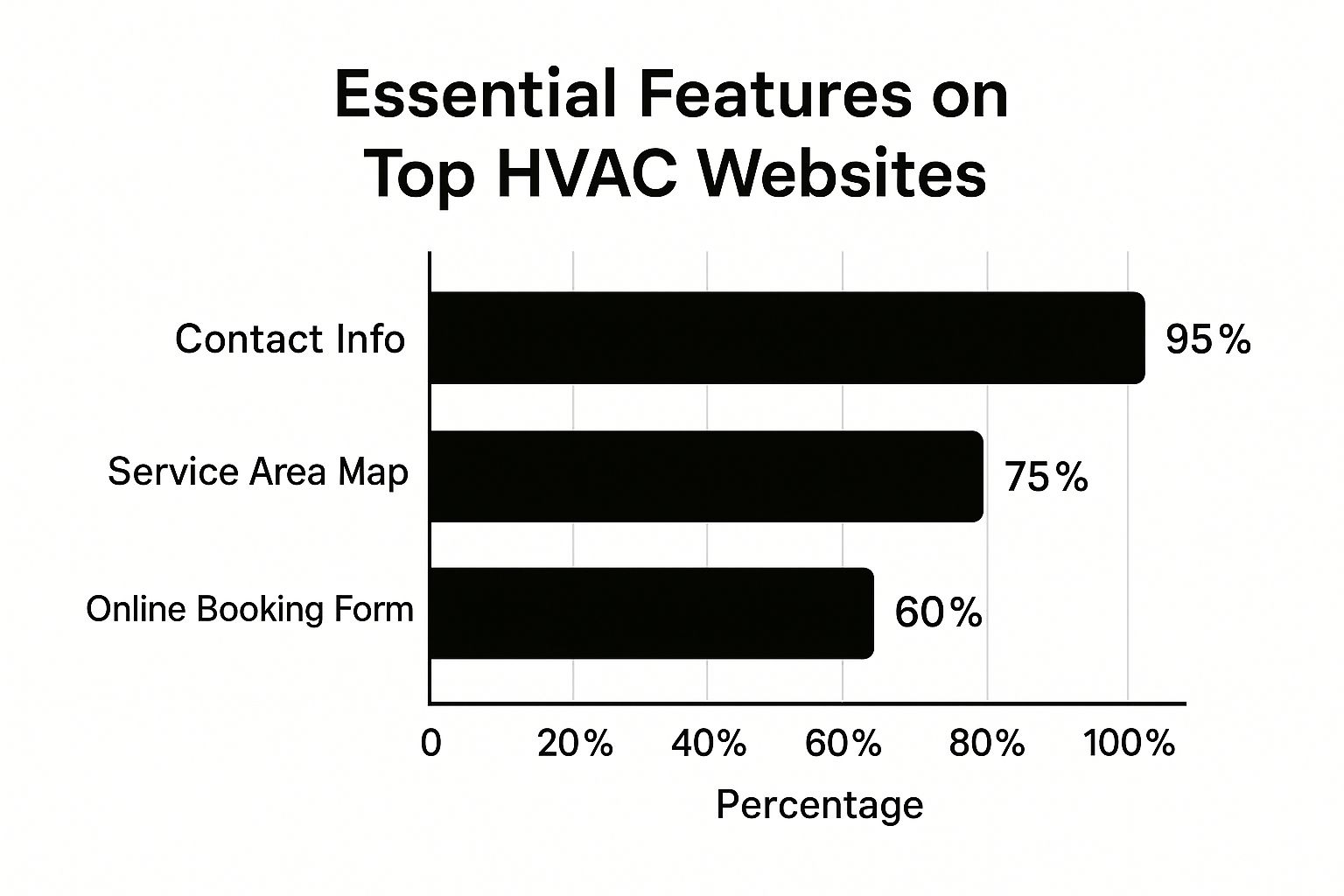
As you can see, making contact info a priority is table stakes. By building a foundation that includes all these core elements, you create a website that not only looks professional but functions as a true lead-generation machine for your business across the Monterey Bay Area.
Designing for Trust to Convert Visitors into Customers
In the home services industry, trust is everything. Before a potential customer in Santa Cruz even considers picking up the phone, they need to feel completely confident about inviting your team into their home. Your website is your first and most powerful opportunity to build that confidence.
Think of it this way: your website is the digital equivalent of your service van. A clean, professionally branded vehicle signals reliability and quality, while a dented, unmarked van raises questions. A thoughtful HVAC website design ensures you present the best possible image from the very first click.
Show Your Real Team and Real Work
Generic stock photos are the enemy of trust. A homeowner in Seaside wants to see the actual, friendly faces of the technicians who might be servicing their furnace, not a catalog model holding a wrench. Using high-quality, professional photos of your team on the job is one of the fastest ways to humanize your business and build an immediate connection.
Showcasing your team does two critical things:
- It builds familiarity: Seeing your uniformed technicians gives customers a preview of the professional experience they can expect.
- It demonstrates local commitment: Photos of your team working on projects in recognizable Monterey County neighborhoods prove you’re an active part of the community, not a faceless national chain.
This simple switch from generic to genuine can dramatically increase a visitor’s comfort level and their likelihood of reaching out. Authenticity sells because it feels safe and reliable.

Your website isn’t just a portfolio; it’s a promise. Every element, from your team photos to your customer reviews, should work together to assure visitors that you are a professional, trustworthy, and safe choice for their home.
Display Social Proof and Credentials Loudly
When a potential customer is evaluating their options, they are actively looking for reasons to trust you over a competitor. Make it easy for them. Your website must prominently feature the signals that instantly communicate credibility and professionalism.
This is where you showcase your hard-earned reputation. Sprinkle customer testimonials throughout your site, especially those from local towns. A glowing review from a family in Salinas or a business in Watsonville carries immense weight.
Beyond reviews, create a dedicated “Why Choose Us” section or a trust-building footer that clearly displays:
- Licenses and Certifications: Display your CSLB license number and any industry certifications (like NATE or EPA).
- Insurance and Bonding: Explicitly state that you are fully insured and bonded to protect your customers.
- Local Affiliations: Feature logos from organizations like the Salinas Valley Chamber of Commerce or other local business groups.
These elements aren’t just decorative badges; they are powerful proof points that address a customer’s biggest anxieties. As you can learn more about in our complete guide to website design for HVAC companies, these trust signals are vital for conversion.
Align with Modern Customer Expectations
The HVAC industry is evolving, and so are customer priorities. The market is driven largely by demand for energy-efficient systems and smart home integrations. Your website design must reflect these modern trends to show you’re a forward-thinking provider.
For example, interest in smart home capabilities among homebuyers has skyrocketed, a trend that directly impacts what customers look for in an HVAC contractor. Highlighting your expertise in high-efficiency units or smart thermostat installations positions you as a premium, knowledgeable choice in a growing market.
Local SEO to Dominate Monterey Bay Search Results

Let’s be honest: a beautiful website is completely useless if local customers can’t find it. This is where Search Engine Optimization (SEO)—specifically local SEO—comes in. It’s what turns your website from a digital brochure into your best lead-generation tool.
SEO is the practice of making your website the most attractive and relevant answer when people search on Google. For an HVAC contractor, that means showing up instantly when a panicked homeowner in Hollister searches for “emergency furnace repair” or a business in Marina looks up “commercial HVAC maintenance.”
This section will demystify SEO and give you actionable steps, without all the confusing tech jargon. We’ll focus on the essentials that will get your HVAC website design ranking higher and pulling in real, qualified customers across the Monterey Bay region.
Be the Go-To Expert for Every Town You Serve
Google absolutely loves a local expert. The single best way to prove you’re the authority is by creating dedicated pages on your site for each specific service you offer in each specific city you cover. A generic “Services” page just won’t cut it anymore if you want to compete.
Put yourself in the customer’s shoes. A search for “AC repair Salinas” is incredibly specific. Google’s job is to deliver the best result, so it will always prioritize a website with a page dedicated to that exact topic. This one move shows both search engines and potential customers that you are the go-to pro in their town.
Your website should be built out with pages like these:
- Furnace Installation Santa Cruz: A page focused entirely on your furnace installation services for Santa Cruz homeowners.
- Air Conditioning Repair Watsonville: Content tailored to solving AC problems for customers right in the Watsonville area.
- Ductless Mini-Split Services Carmel-by-the-Sea: Targeting clients in upscale coastal homes who are looking for modern heating and cooling.
- Commercial HVAC Hollister: Speaking directly to the unique needs of businesses over in San Benito County.
Each of these pages needs unique content. Mentioning local landmarks, common home styles, or specific neighborhood challenges can seriously boost your local authority. This hyper-local approach is a cornerstone of any solid HVAC SEO plan, which we cover in more detail in our deep dive on HVAC SEO.
Optimize Your Google Business Profile
Your Google Business Profile (GBP) is, without a doubt, your most important local SEO tool. It’s that free business listing that pops up in Google Maps and the local search results, showing off your reviews, hours, phone number, and service area. An incomplete or neglected profile is a huge missed opportunity.
A fully optimized Google Business Profile is like having a prime storefront on the busiest digital street in your town. It builds instant trust and makes it incredibly easy for customers to find and contact you.
To get your GBP in top shape, you need to:
- Claim and Verify Your Listing: First things first, make sure you have complete control over your profile.
- Complete Every Single Section: Fill out all your services, your exact service area, hours, photos, and write a detailed business description. Don’t skip anything.
- Use High-Quality Photos: Post real pictures of your team on the job, your branded vans, and your completed work in local homes and businesses.
- Actively Collect Reviews: Encourage happy customers to leave you a review. Just as important, make sure you respond to every single one—good or bad.
- Use Google Posts: Keep your profile looking active by regularly sharing updates, special offers, and helpful tips using the Posts feature.
Build Your Digital Footprint with Local Citations
Beyond your own website and Google profile, it’s critical to ensure your business information is identical everywhere else online. Local citations are simply mentions of your business Name, Address, and Phone number (NAP) on other websites like Yelp, Angi, and local business directories.
Think of each consistent citation as another vote of confidence in Google’s eyes. The more accurate, high-quality citations you have, the more Google trusts that your business is real and located exactly where you claim. This is non-negotiable for ranking in map-based searches. Working with an SEO agency in Salinas can help you build out these citations efficiently across all the right platforms.
This digital foundation is vital, yet so many contractors struggle with it. In fact, industry reports show that around 70% of HVAC companies aren’t happy with their SEO providers, often because these fundamental steps were rushed or ignored. When a website combines smart, foundational SEO with a great user experience, it becomes a magnet for both new customers and talented technicians. You can read more about these HVAC industry marketing challenges and see for yourself why a focused strategy makes all the difference.
A great HVAC website design is more than just an online business card; it’s a problem-solver. Before a customer in the Monterey Bay Area ever picks up the phone, your website should be answering their questions and building their confidence in your company. This is how you transform a simple digital brochure into a powerful resource that guides visitors right into a service call.
Your content strategy is your chance to get specific. Don’t just say “we fix air conditioners.” Instead, create pages that speak directly to the real-world benefits of your work, like better energy efficiency for those drafty coastal homes in Pacific Grove, or improved indoor air quality for families in Salinas who deal with seasonal agricultural dust. It’s about proving you understand their unique, local challenges.
Go Beyond a Simple Services List
A potential customer isn’t just looking for a quick fix; they’re looking for a lasting solution. Your website content needs to be structured to address their deeper concerns, like cost, comfort, and the long-term value of your work. This means you have to dedicate some digital real estate to explaining the “why” behind your services.
Here’s how you can build out content that truly educates and converts:
- Detail the Benefits: Don’t just list “furnace maintenance.” Explain how routine tune-ups prevent expensive breakdowns during those chilly Santa Cruz winters, lower utility bills, and ultimately extend the life of their entire system.
- Explain the Process: Walk your visitors through exactly what to expect when they book a service with you. A clear, step-by-step breakdown demystifies the whole thing and goes a long way in reducing anxiety, especially for first-time customers.
- Showcase Your Technology: Do you use state-of-the-art diagnostic tools or install high-efficiency systems? Create content that highlights this. It immediately positions you as a modern, forward-thinking provider who invests in the best.
When you frame your services around customer benefits, you connect with their needs on a much deeper level. This approach shows you’re not just another contractor, but a trusted advisor for their home’s comfort.
Address the Elephant in the Room: Financing
Let’s be honest: one of the biggest hurdles for homeowners thinking about a new HVAC system is the price tag. A major installation is a significant investment, and many potential customers, from San Benito County to the coast, will hesitate or click away if they don’t see a clear path to affording it. Your website must address this head-on.
A dedicated and easy-to-find “Financing Options” page is one of the most powerful conversion tools you can have. It shows empathy for your customers’ financial concerns and provides a clear, immediate solution, preventing them from leaving your site to search for contractors who do advertise payment plans.
Keep your financing page simple and reassuring. Clearly lay out the options available, include a prominent link to any online application forms, and provide a direct contact number for someone who can answer their financing questions. This kind of transparency can be the single deciding factor that turns a hesitant browser into a confirmed customer.
Establish Authority with a Helpful Blog and Project Gallery
Your expertise is your greatest asset. A blog and a project gallery are the perfect stages to put that expertise on full display, building both your authority and a strong connection with the local community.
A blog filled with genuinely helpful articles establishes you as the go-to expert. Just think about the questions you get asked all the time and turn them into posts. Topics like “When to Repair vs. Replace Your Furnace in Monterey” or “Choosing the Right AC Size for a Watsonville Home” attract highly qualified traffic from people who are actively looking for solutions. For more inspiration, you can check out these 10 HVAC marketing ideas to help fuel your content calendar.
Similarly, a project gallery is the visual proof that backs up your claims. Ditch the generic stock photos and showcase real pictures of your team completing jobs in recognizable local areas. A simple caption like, “New high-efficiency system installed for a family in Hollister,” provides powerful social proof and cements your status as a trusted, active member of the local business community.
Your Blueprint for a Winning HVAC Website
You now have a solid blueprint for turning your website from a simple digital business card into a powerful lead-generation engine. It’s not about tacking on every possible bell and whistle; it’s about a strategic focus on what your customers across the Monterey Bay Area actually care about.
When you bring together a solid technical foundation, trust-building design, laser-focused local SEO, and genuinely helpful content, you create an online presence that’s tough to beat. This is an investment that will pay for itself many times over in new jobs, sustainable growth, and a stronger connection to the community you serve.
From Plan to Action
The strategies we’ve walked through—from building out dedicated pages for Salinas and Santa Cruz to showcasing your credentials—are what separates a site that just exists from one that actively grows your business. An effective HVAC website design is a complete system where every part works together to attract, convince, and convert local customers.
This isn’t just theory; it’s the proven path to digital success right here in our unique coastal economy. A strategic website is your hardest-working employee, delivering qualified leads from Monterey County and beyond, 24/7.
It builds your credibility before a truck ever pulls into a driveway in Gilroy and answers questions for homeowners in Hollister long after your office has closed for the day. That’s the real power of a well-executed digital strategy, and it’s completely within your reach.
Ready to Build Your Lead-Generation Engine?
If you’re ready to put this blueprint into action, the next step is simple. The team at Core6 Marketing is here to help you dominate your local market. We specialize in turning websites into revenue-generating assets for contractors just like you.
Contact us for a free, no-obligation consultation to review your current site and map out your path to digital dominance across the Monterey Bay.
- Schedule a Free Consultation: https://core6.marketing/contact-us/
- Call Us Directly: 831-789-9320
- Email Our Team: [email protected]
Frequently Asked Questions
Even with a solid plan, I get it—investing in a new HVAC website design can feel like a huge commitment. Over the years, I’ve heard the same questions and hesitations from business owners all across the Monterey Bay Area. Let’s tackle the most common ones head-on so you can move forward with confidence.
How Much Does a New HVAC Website Cost?
The honest answer? It varies. Think of it like buying a new work van. A basic, no-frills model will get you from point A to B, but a fully-equipped, custom-built vehicle is an investment in efficiency that pays for itself over the long haul.
A cheap website that doesn’t bring in calls is far more expensive than a professional site that consistently pulls in new customers from Salinas, Monterey, and beyond. At Core6 Marketing, our goal is simple: deliver a positive return on your investment. We build websites that are designed from the ground up to make you money, not just to look pretty.
How Long Does It Take to Build a New Website?
A realistic timeline for a professional HVAC website is typically 6 to 12 weeks. This isn’t just about throwing a few pages together. The process includes deep-dive strategy sessions, creating custom design mockups, writing targeted content, and performing meticulous development work.
Rushing things almost always means cutting corners on the stuff that actually matters, like local SEO and conversion optimization. A proper timeline ensures the final product is built to compete effectively across Santa Cruz County from day one. It’s not just built to launch; it’s built to win.
Can I Just Use a DIY Website Builder?
While DIY builders like Squarespace or Wix might seem like a good way to save money upfront, they often fall short. They lack the powerful SEO features, deep customization, and conversion-focused tools an ambitious HVAC business needs to truly grow.
Properly implementing advanced local schema for Google, building out unique service pages for every town you cover, and integrating reliable scheduling software is a world away from what a simple drag-and-drop template can handle.
A professional design ensures your site is engineered to generate leads from the moment it goes live. A DIY platform is like bringing a hand-held toolkit to a job that requires a fully-stocked workshop.
What’s More Important: Design or SEO?
This is a classic trick question, because you can’t have one without the other. They are two sides of the same coin and are completely codependent on each other for success.
Great SEO might get a customer from Hollister to your website, but a clunky, untrustworthy design will send them clicking away before they ever pick up the phone. On the flip side, you could have the most beautiful website in the world, but if it has zero SEO, no one will ever find it.
A winning HVAC website strategy powerfully weaves both together. You need a site that attracts visitors through smart SEO and converts them into paying customers with a professional, trust-building design. To see how these elements combine for powerful results, check out our guide on modern contractor lead generation.
By Phil Fisk, CEO, Core6 Marketing
Phil Fisk is the founder and CEO of Core6 Marketing, a digital marketing agency in Salinas, CA, dedicated to helping local businesses thrive online. With over a decade of experience, Phil specializes in crafting lead-generation strategies for home service contractors across the Monterey Bay Area.
Core6 Marketing
1628 N. Main St #263, Salinas, CA 93906
831-789-9320 | [email protected] | https://core6.marketing/