Direct Answer: Automated blog content costs less per post but often costs more overall, because generic pages get summarized away by AI results and can trigger Google’s scaled content abuse policy.
A contractor in Salinas showed me a report with forty blog posts published in one quarter. His traffic was flat. His phone was not ringing any more than it had been the year before.
That gap between output and results is the whole story with automated content for contractor websites. The posts are cheap to make, so agencies make a lot of them, and the volume itself becomes the thing being sold.
I want to walk through the actual math here. What the owner pays, what the site gives up in rankings, and where the break-even point sits for a home service business on the Monterey Bay Area coast.
Why automated content for contractor websites got so cheap so fast
The economics changed first, and everything else followed. A widely cited 2025 marketer survey put the average cost of an AI-generated blog post at roughly $131, against around $611 for a human-written one. Treat those as general market context, not anyone’s price list.
That same survey found teams using AI published a median of 17 posts a month, compared with 12 for teams that did not. So the cost dropped by about four fifths and the output went up.
When a post costs a fifth as much to produce, volume becomes the product. That is why contractor content packages started advertising post counts instead of outcomes.
Here is what that shift looks like on the invoice side:
- The line item says posts per month, not calls per month
- Topics repeat across service areas with the town name swapped out
- Nobody on the production side has been to Carmel Valley, Watsonville, or King City
- The reporting shows pages published and words written
I am not against the tooling. I am against paying for output that a search engine has no reason to show anyone.

What the cheap post actually costs on the ranking side
Google’s own documentation allows AI-assisted content. What it does not allow is using generative AI to spin up many pages that add no value for users, which it names as scaled content abuse. Its spam policies also now name attempts to manipulate generative AI responses in Search.
Read the policy language yourself in the Google Search spam policies. The line is drawn at value to the reader, not at whether a machine helped write it.
This matters because of a defense I hear constantly. A human reviewed it, a human clicked publish, so it is fine.
A contractor site with forty interchangeable pages is not protected by the fact that a human clicked publish. The pages are still interchangeable. If your plumbing page for Seaside and your plumbing page for Marina differ only by town name, that is the pattern the policy describes.
What I see happen after that:
- Rankings across the whole site soften, not just on the thin pages
- Pages that used to bring calls slide down without any obvious cause
- Cleanup takes longer than the publishing did
If you are trying to work out whether your own site is in that spot, this walkthrough on spotting content that is hurting your rankings goes through the checks in order.
Cost per post versus cost per call
The per-post number is the wrong unit to compare. Here is how the two approaches tend to shake out over a year on a contractor site, framed as general market patterns rather than fixed pricing.
| Approach | Typical production cost per post (market context) | What usually happens over 12 months |
|---|---|---|
| Fully automated, high volume | Roughly $131 range per the 2025 survey | High page count, generic topics, little to no lift in qualified calls |
| Automated draft, no local input | Similar low cost plus light editing time | Reads fine, ranks briefly, gets summarized away in AI results |
| Human written from job data and calls | Roughly $611 range per the same survey | Fewer pages, more of them earn rankings and inbound calls |
| Automation used on process steps only | Between the two, varies by workflow | Faster production without losing the on-site detail that ranks |
The traffic math nobody runs before publishing
Volume made sense when every ranking page collected clicks. That assumption is now shaky.
Ahrefs reported in early 2026 that the presence of an AI Overview correlated with roughly 58 percent lower average click-through for the top ranking page. Ranking first does not mean what it did three years ago.
Now think about which pages get summarized away most easily. Generic cost explainers. Definition posts. “What is a heat pump.” “How much does a roof cost.” Those are exactly the pages automation produces best, because they require no local knowledge to write.
So the volume play collides with itself:
- The cheapest pages to produce are the easiest for an AI answer to replace
- The pages hardest to replace need someone who has been on the job site
- Paying more for the second kind can cost less per booked call
I have written more about how the summary layer picks names in this piece on what happens when AI Overviews name a contractor. The short version is that being quotable beats being present.
Where automation helps and where it hollows out a site
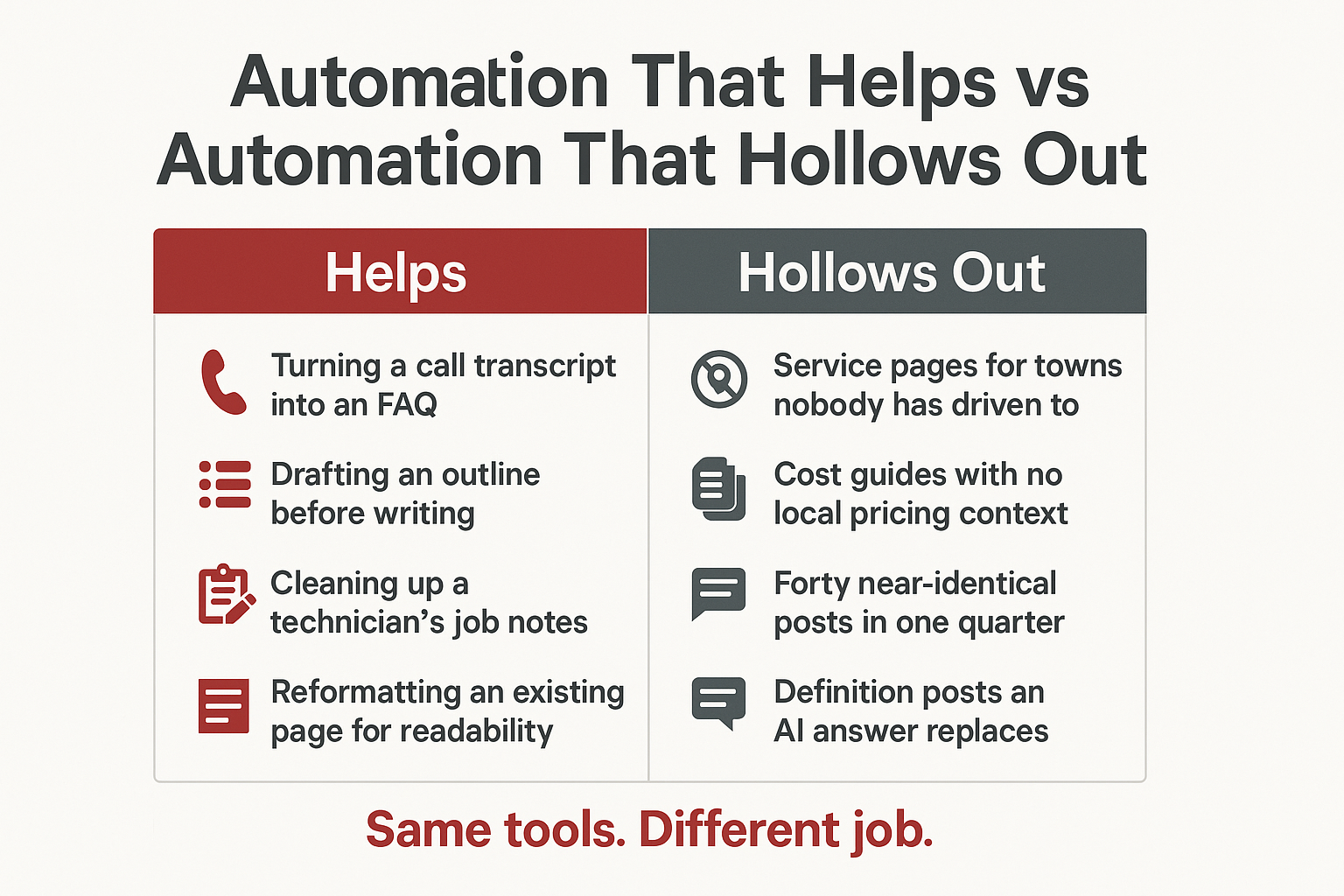
This is the line I hold with every contractor account we run. Same tools, very different jobs.
The uses of automation I have no problem with
I want to be clear that this is not a purity argument. We use automation on parts of our own process every week.
The uses that hold up share one trait: they start with real material from the business and speed up the handling of it. The uses that fail start with nothing and manufacture filler.
What I consider fair game:
- Turning a recorded call transcript into an FAQ section in the caller’s own words
- Drafting an outline before a human writes the actual page
- Cleaning up a technician’s rough job notes into readable paragraphs
- Reformatting a long existing page so it scans on a phone
What I will not do is generate a service page for a town nobody at the company has driven to. That page has no proof in it, and both the reader and the summary layer can tell.
Call recordings are the single most underused raw material I see. The questions people ask before they book are already the exact wording of your best pages, which is the whole point of using what your customers already said as SEO content.
What local proof looks like on an actual page
Take a roofing page for a Salinas or Prunedale customer. A model with no field experience writes about shingle types and average lifespans.
A page written from real jobs on this coast covers different ground:
- How wind driven rain off Monterey Bay finds failed flashing before it finds bad shingles
- What the inspection actually involves, step by step, including what gets photographed
- Roughly how long a tear-off runs on a typical single story ranch house in Salinas
- Why fog and salt air near Pacific Grove change how fasteners hold up
None of that can be produced by a model that has never been on the roof. And that specificity is what survives an AI summary, because it is information the summary cannot supply on its own.
This is also the material that feeds everything else. Our AI Search Sync work leans on the same details across the site, the Google Business Profile, and ad headlines, so a homeowner searching in Monterey County gets a consistent story no matter where they look.
One of our clients put it plainly in a review: “we’ve increased our visibility and been able to grow our business significantly.” That came from pages built out of their jobs, not out of a topic generator.
Where the break-even actually sits
Here is how I would run the numbers if I owned a contracting business in Hollister or Marina.
Take what you spend on content each month and divide it by qualified calls the content produced, not by posts published. If your agency cannot tell you which pages produced calls, that is its own answer.
A small number of pages that earn rankings and get named in AI answers can beat a large number that do neither, even at four or five times the per-post cost. The break-even usually shows up somewhere around the point where the content contains something only your crew could know.
One more thing worth checking. If your site already carries a pile of thin pages, adding better ones on top does not neutralize them. What happens to contractor sites stuffed with AI content covers the cleanup side of that in detail.
Frequently Asked Questions About Automated Contractor Content
Will Google penalize my site just for using AI to write posts?
No. Google’s documentation allows AI-assisted content. The problem is scaled content abuse, which is producing many pages that add nothing for the reader. A human clicking publish does not change how the pages read.
How many blog posts should a contractor site publish a month?
I would rather see two posts built from real jobs than fifteen built from nothing. Post count is a production metric, not a results metric. Judge it by which pages bring calls.
My agency publishes a page for every city we serve. Is that a problem?
It depends entirely on what is on them. If the Seaside page and the Marina page say the same thing with the town name swapped, that is the pattern Google’s policy describes. If each one references jobs you actually did there, permit realities, and local conditions, they earn their place.
If AI Overviews cut clicks anyway, why write content at all?
Because the summary has to pull its answer from somewhere, and it names sources. Generic pages get absorbed with no credit. Pages with details only your business has are the ones that get cited, and those citations send people who are already close to calling.
What is the cheapest honest way to produce content if my budget is tight?
Record your calls and mine them. The questions homeowners ask before booking, and the wording they use in reviews, will give you more usable page material in a month than any topic generator. Automation can help format it. It should not be the source.
Want a second opinion on what your content is actually costing you?
If you are a home service contractor in Monterey County and you are not sure whether your content spend is producing calls or just page counts, that is a reasonable thing to have looked at by someone local. Phil Fisk keeps time open for discovery calls with Central Coast contractors, and the office line is (831) 789-9320. No pressure either way, and you will leave the conversation knowing where your site stands.