
Direct Answer: AI website builders like Lovable, Durable, and Wix produce something that looks like a website. They don’t produce the local search signals, schema markup, or Google Business Profile alignment that actually generate contractor calls.
A roofer in Salinas spent $497 on a Durable-built website last year. It looked clean. It had his logo, a services list, and a contact form. And in twelve months, it generated exactly zero inbound calls.
That’s not a hypothetical. That pattern shows up constantly on the Central Coast — contractors who paid almost nothing for a website and got exactly what they paid for. The problem isn’t the price. The problem is confusing a good-looking page with a working marketing system.
This article breaks down what AI website builders actually produce, what they leave out, and why that gap matters if you’re a contractor in Monterey County trying to get your phone to ring.
What AI Website Builders Actually Give You
Tools like Lovable, Durable, and Wix have gotten genuinely good at one thing: producing a website that looks credible in under an hour. You type in your trade and location, pick a layout, and out comes something with photos, a headline, and a contact button.
For a homeowner who wants a personal portfolio or a pop-up shop, that’s fine. For a contractor in Seaside or Marina who needs the phone to ring, it’s a starting point that goes nowhere.
Here’s what these tools typically produce:
- A visually presentable homepage
- Pre-written placeholder content with your business name swapped in
- A mobile-friendly layout
- Basic contact form or click-to-call button
And here’s what they don’t produce:
- Local business schema markup that tells Google who you are and where you work
- Google Business Profile alignment (your website and your GBP need to say the same things)
- City-specific service pages for Salinas, Monterey, Carmel, Watsonville, or anywhere else you actually work
- Call tracking to know which visitors called and which ones left
- Crawlable site architecture that search engines can actually read
A site can look clean and be completely invisible to search engines. Contractors confuse these two things constantly — and the AI builders don’t help, because their whole pitch is the design.
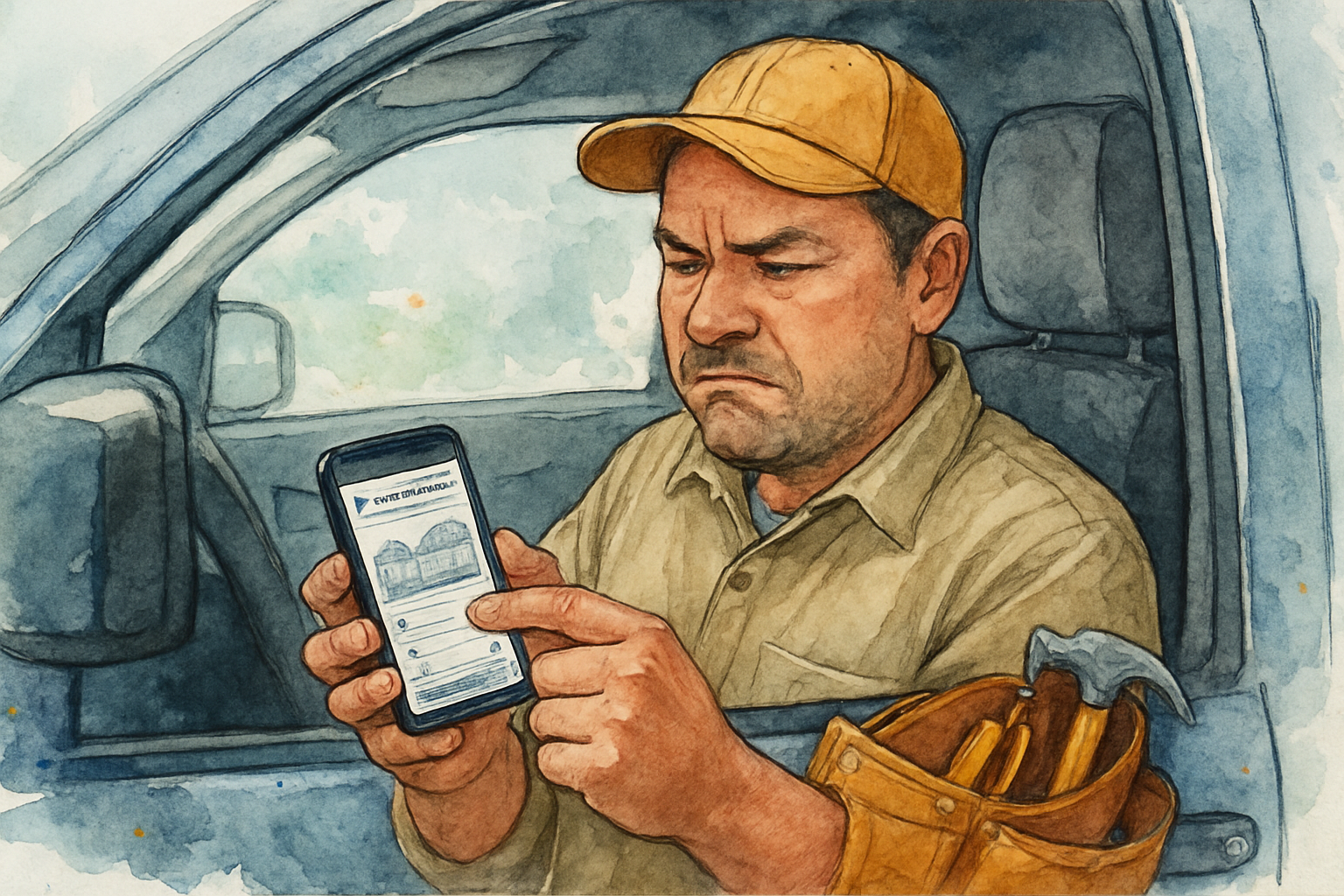
Google Reads Code — Not Design
When a homeowner in Pacific Grove searches “electrician near me” at 9pm, Google isn’t looking at your header image. It’s reading structured data — schema markup, NAP consistency (name, address, phone), crawl signals, page speed scores, and whether your content actually matches what the person searched for.
AI builders generally produce thin code. There’s no local business schema telling Google you serve Monterey County. There’s no service-area markup. The page titles are often generic — “Home” or “Services” instead of “Licensed Plumber in Salinas, CA.”
The difference between an electrician with a website and one who gets found comes down almost entirely to this: one site was built to look good, and one was built to send the right signals to search engines. They can look identical to a human and perform completely differently in search.
Wix has improved somewhat in recent years — their SEO tools are more capable than they were in 2018. But “more capable” and “built for local contractor search visibility” are two different things. You still have to know what to do with those tools, and most contractors don’t have time to figure that out while running a crew.
The 3-Pack Is Where the Jobs Are — And AI Sites Don’t Get You There
When someone in Carmel Valley searches for an HVAC company or a roofer, they almost always click one of the three map results at the top of the page before they ever scroll to the organic listings. That local 3-pack is where most residential service calls originate.
Getting into that map pack isn’t just about your Google Business Profile. It’s also about what your website signals to Google. Specifically:
- Consistent NAP data across your website, GBP, and every citation online
- Location-relevant content — pages that mention the cities you actually serve
- Website authority — earned through backlinks and consistent indexing over time
- Schema markup that connects your site to your GBP listing
An AI-built site does almost none of this automatically. You can publish a Durable site in 45 minutes, but it won’t have a Salinas citation profile. It won’t have a page that says “We serve Seaside, Marina, and Sand City.” It won’t be linked from any local directories or chamber websites.
Does AI search change how customers find a plumber or roofer? The answer is yes — and the contractors showing up in AI-generated answers are the ones with well-structured websites and strong local signals. An AI builder doesn’t build those signals. It just builds a page.
Your competitor who paid for a real contractor website two years ago is pulling further ahead every month. The gap between a site with proper local infrastructure and one without widens quietly — until one day you notice you’re not getting calls and they are.
What a Contractor Website Actually Needs to Generate Calls
This breaks down the components that separate a website that ranks and converts from one that just sits there.
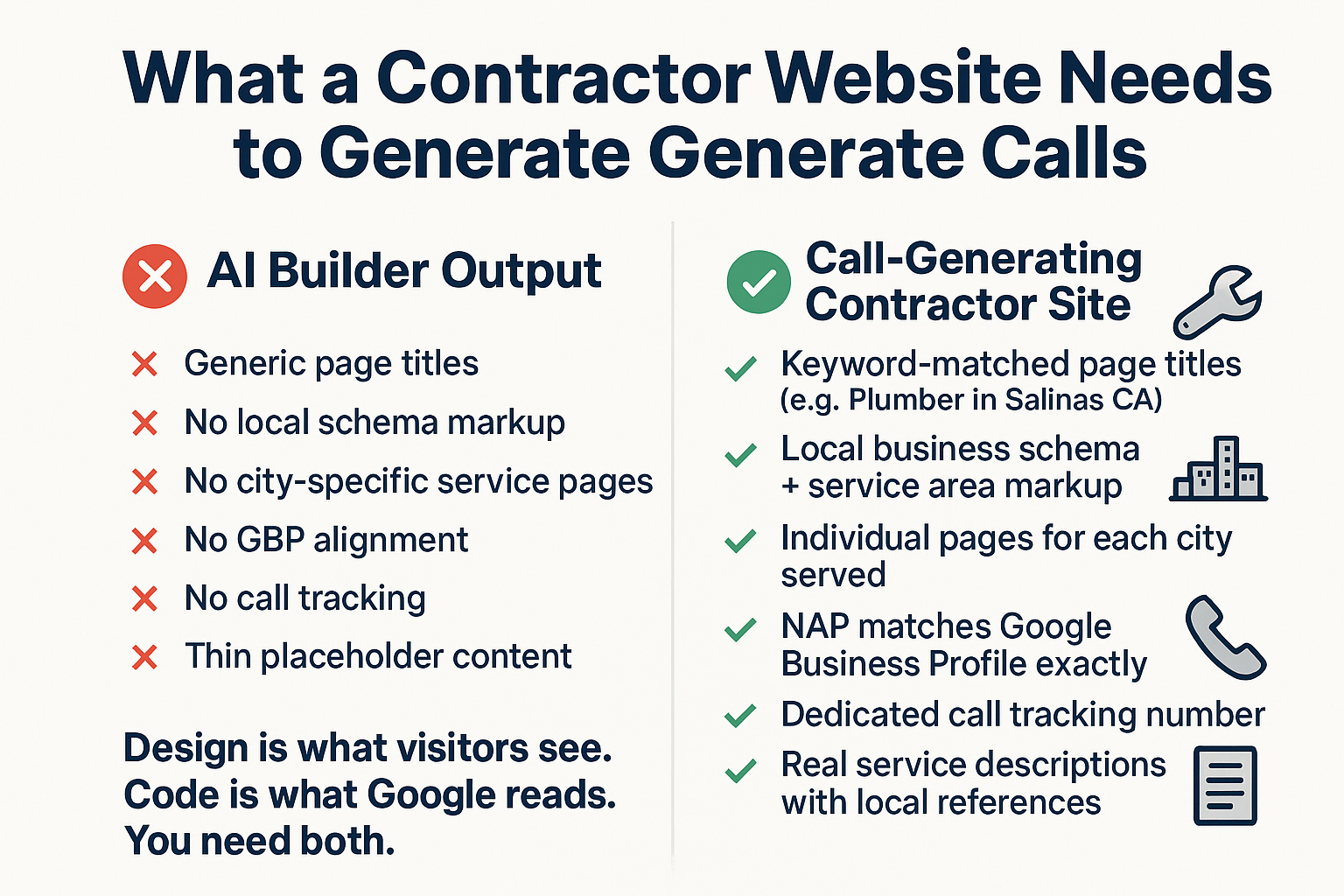
AI Builder vs. Contractor-Built Website: What You Actually Get
Here’s a direct comparison across the features that affect whether your site generates calls in Monterey County.
| Feature | AI Builder (Lovable/Durable/Wix) | Contractor Website Built for Local SEO |
|---|---|---|
| Time to launch | Under 1 hour | 2–4 weeks typically |
| Up-front cost | $0–$500 | $2,500–$6,000+ |
| Local business schema | None by default | Built in at launch |
| City-specific service pages | Not included | Yes — one per service area |
| Google Business Profile alignment | Manual, often skipped | Built to match GBP exactly |
| Call tracking | Not available | Available as add-on |
| Page speed / Core Web Vitals | Variable, often slow | Engineered for mobile speed |
| Indexing / crawlability | Basic | Full structured sitemap + schema |
| Ongoing SEO support | None | Depends on agency relationship |
| Estimated calls generated / year | 0–few (most report none) | Depends on market; measurable within 30–60 days |
The Real Cost of a Free Website
Let’s talk money, because this is where contractors get the calculation backwards.
A Durable website costs around $15/month after a free trial. A Wix site with their mid-tier plan runs about $17–$35/month. Lovable offers a free tier. These feel like nothing compared to a $3,500 contractor website.
But here’s the math that matters. One missed roofing job in Monterey County is worth $8,000 to $15,000 in revenue. One missed HVAC replacement is $6,000 to $10,000. If your AI-built site generates zero calls for twelve months — and many of them do exactly that — you didn’t save money. You spent a year not getting found.
Why the cheapest website usually costs the most jobs isn’t a hypothetical. It’s what happens when a contractor in Watsonville or Hollister builds a site that looks fine but ranks for nothing.
The comparison that actually matters isn’t AI builder vs. real website. It’s zero calls vs. consistent inbound calls. Once you frame it that way, the $3,500 website that generates two roofing leads per month pays for itself in the first job.
If you want to go deeper on what website projects actually cost and what drives those numbers, contractor website design cost explained breaks it down without the sales pitch.
When an AI Builder Might Actually Be Fine
To be fair — there are situations where an AI-built site is the right temporary move.
If you just got your contractor’s license and you’re working a few jobs a month through word of mouth, spending $4,000 on a website before you have consistent revenue doesn’t make sense. A Wix or Durable site gives you something to send to a referral who wants to check you out online. That’s legitimate.
Similarly, if your primary marketing channel is Google Ads and you’re sending paid traffic to a landing page — not relying on organic search — a basic site can work as a placeholder while you build revenue. Though a purpose-built landing page will almost always outperform a template when it comes to conversion rate.
But if your goal is to show up in local search results in Salinas, Monterey, or anywhere else on the Central Coast without paying for every click, an AI builder is not a path to that. It’s a starting point that most contractors outgrow — or realize never worked — within the first year.
Frequently Asked Questions About AI-Built Contractor Websites
Can I rank on Google with a Wix or Durable website?
Technically yes, but it’s rare for competitive local contractor searches in Monterey County. Wix has improved its SEO tools, but the platform still produces thinner code than a purpose-built site, and most contractors don’t have time to configure it correctly. Local schema markup, GBP alignment, and city-specific content are what actually move rankings — and those require real setup work regardless of what platform you’re on.
What’s wrong with Lovable specifically — it looked really good when I tried it?
Lovable is genuinely impressive for UI design. It can produce a good-looking contractor site fast. The issue isn’t appearance — it’s what’s underneath. Lovable builds front-end interfaces, not local SEO infrastructure. There’s no mechanism in the tool for building out citation profiles, structured data, or location-specific content strategy. It looks great and ranks poorly. That’s the pattern.
My neighbor said his Wix site shows up in Google. Why wouldn’t mine?
There’s a difference between showing up when someone searches your exact business name and showing up when someone searches “roofer in Carmel” or “plumber Salinas CA.” The first is easy — Google indexes almost everything. The second is competitive and requires deliberate SEO work. Ask your neighbor what keywords he ranks for, not just whether he can find himself.
Does having a website on Wix or Durable hurt my Google Business Profile ranking?
Not directly — your GBP can rank independently of your website. But your website does influence your local pack ranking, and a site with weak local signals gives Google less reason to surface you. NAP consistency between your site and your GBP is one of the most important local ranking factors, and AI builders often generate inconsistent or incomplete address/service-area data by default.
What does a contractor website actually need to generate calls in Monterey County?
At minimum: page titles that match what people search, local business schema, city-specific content for the areas you serve, a GBP that matches your site exactly, page speed that passes Core Web Vitals, and a clear phone number above the fold. Beyond that, ongoing SEO work — citations, content, backlinks — is what builds ranking over time. Your HVAC website has one job — here’s how to tell if it’s failing covers several of these signals in practical terms, even if you’re not in HVAC.
I built my site on Wix two years ago. Should I scrap it or try to fix it?
Depends on what you’re trying to accomplish. If you’re getting calls from it — even a few a month — there may be value in migrating it to a better platform rather than starting over. If it’s generated nothing in two years, you’re not losing anything by replacing it. The audit question to ask is: what does it rank for right now? If the answer is nothing beyond your business name, that’s your answer.
Want to Know If Your Current Site Is Actually Generating Calls?
Core6 Marketing works exclusively with home service contractors on the Central Coast — and we’ve seen this AI-builder pattern enough times to diagnose it fast. If you’re in Salinas, Monterey, Santa Cruz, or anywhere in between and your website isn’t consistently bringing in calls, a 30-minute conversation with Phil Fisk will tell you exactly why. Book a Discovery Call at https://core6.marketing/work-with-us/.