Direct Answer: Yes. Research on AI local recommendations found nearly all users cross-check them against real reviews, and most fact-check the reviews themselves. Being named starts the vetting, it does not end it.
You got named. Someone in Monterey asked ChatGPT who the most reliable HVAC company in the area is, and your business came up. Then nothing happened. No call, no form, no voicemail.
I see this more than any other AI question from contractors. Owners assume the mention is the finish line, when it is actually the start of a vetting process most of them have never watched happen.
The AI answer buys you about one minute of a homeowner’s attention. What happens in that minute is decided entirely by what is already published under your name, and this article walks that minute in order.
Do homeowners verify AI contractor recommendations? Nearly every one of them does
Research on how people use AI tools for local recommendations found that 97% of users at least sometimes cross-check those recommendations against real reviews. And 88% go on to fact-check the reviews the AI tool cites.
That same research found that locations recommended by ChatGPT averaged around 4.3 stars. Which tells me the AI is not acting like a ranking list at all. It is acting like a confidence filter, handing the homeowner a short list of names that are safe enough to investigate.
So the homeowner is not deciding whether to trust the AI. They are deciding whether to trust the contractor the AI pointed at.
That is a different problem from getting named in the first place, which I have written about separately. Here is what the verification minute actually looks like for a homeowner in Seaside standing in a wet hallway at 9 PM:
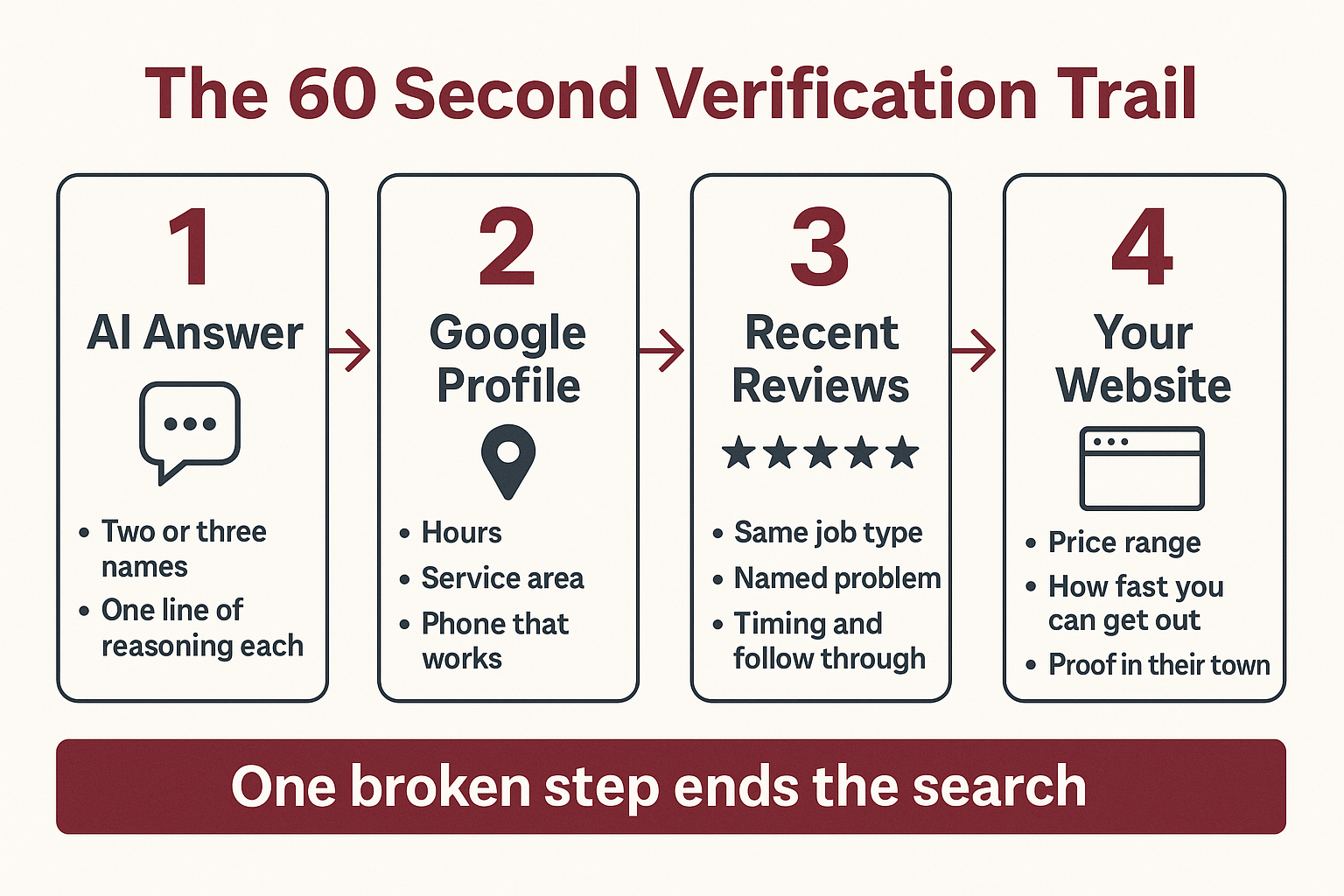
- They read the AI answer, usually two or three company names with a sentence of reasoning each
- They open a new tab and search your business name directly
- They land on your Google Business Profile and check hours and service area first
- They skim the most recent reviews looking for their exact problem
- They click through to your website to see if it says what the AI said it did
Four stops, maybe ninety seconds. A contractor can be strong at one stop and broken at another, and the broken one is the only one that matters.

Stop one and two: the profile and the directory trail nobody audits
The Google Business Profile is where the homeowner confirms you are real. Hours, service area, phone number, recent photos. Google’s own local results documentation states plainly that complete, accurate, and verified information makes a business more likely to appear in local results.
Industry research on AI visibility lines up with that. Businesses that got surfaced by AI tools had stronger data accuracy and more consistent trust signals across Google Maps, Yelp, Facebook, and their own websites. Companies with strong Google rankings but a weak presence everywhere else frequently lost AI visibility.
This is the part that bites contractors in Salinas who rank well in the local pack and assume that covers it. Meanwhile:
- An old suite number from an office you left in 2019 still sits on four directories
- A tracking number from a vendor two agencies ago still rings nowhere
- Your trade is listed as “contractor” on one site and “plumbing contractor” on another
- A duplicate profile from a franchise listing service is splitting your reviews
Matching business information across directories, filling in every profile field, and putting structured data on the site is the boring middle of AI Search Sync. It is also the part most vendors skip, because nobody can screenshot a corrected NAP record and put it in a monthly report. If you want the checklist version, I covered it in Strong on Google, Invisible in AI Answers.
The 60 Second Verification Trail
Here is the path a homeowner takes after an AI tool hands them your name, and what stops them at each step.
Stop three: star ratings pass the glance, review wording passes the check
A 4.9 average gets you past the first look. It does nothing for the second one, because at that point the homeowner is scanning for someone who had their exact problem.
Twenty reviews that say “great service” and “highly recommend” give a homeowner nothing to match against. They are standing in front of a water heater that quit on a Friday night. They want to read about a water heater that quit on a Friday night.
I pulled these from anonymized homeowner review language in the home service trades, and the detail level is the whole point. One customer wrote: “Our tankless hot water heater broke down on a Friday night. I called and they picked up immediately… They showed up exactly when they said they would, and even gave a courtesy call a half hour before.” Another described the job before it started in raw terms, saying the leaks were so bad water was dripping from the ceiling into the kitchen and dining room.
That review names the failure, the day of the week, the response time, and the courtesy call. A homeowner stops cold on that one.
Here is the second reason it matters. That same wording is what an AI system has to work with when it explains why it picked you over the other two names. Reviews that mention your trade, your town, and the specific job type feed the context the model is summarizing. I broke that down further in The Review Wording That Gets a Contractor Named in AI Answers.
What the Homeowner Checks and What Ends the Search
Each stop on the trail has one question behind it, and one specific thing that loses the call.
| Stop | What they are really asking | What ends it |
|---|---|---|
| Google Business Profile | Are they open right now and do they come to my town? | Blank service area, old address, hours that say closed |
| Reviews | Has anyone had my exact problem? | Page of five star reviews with no job details |
| Website | Does this match what the AI told me? | A different trade focus, or a service the AI mentioned that the site never names |
| Service area page | Do they really drive out here? | Four cloned paragraphs with the town name swapped in |
| Contact section | How fast can someone get here? | A form with no response time stated anywhere |
Stop four: the three questions your phone already answers forty times a month
Most verification is a homeowner hunting for answers to questions you already handle on the phone every week. The recurring ones are simple:
- What is this going to cost, even a range
- How fast can someone get out here
- Can I send photos first instead of committing to an on-site visit
That third one surprises contractors. In anonymized tree care call language, homeowners regularly ask whether they can send photos for a remote look before scheduling anything, along with insurance-driven calls about limbs hanging over a roof. Same pattern in other trades.
And almost none of those answers are published anywhere on the site. One plumbing operation saw its qualified-call rate roughly double month over month, from 31% to 61%, during a stretch when same-day availability and clear upfront pricing were the two things callers brought up most before booking.
The fix is transcription, not authorship. The answers already exist in your call log and in the form submissions where people type out their problem in their own words. Publishing them turns a private phone conversation into a page that satisfies a skeptical homeowner and the AI system summarizing the options at the same time.
If stating numbers makes you nervous, read Price Ranges on Your Website first. A range with the variables explained beats silence every time a homeowner is comparing three names.
Verification is geographic before it is anything else
This is where generic national marketing advice falls apart on the Central Coast. A homeowner in Carmel Valley looking at a company with a Salinas address wants one question answered: do you actually work out here?
A vague service area description reads as a no. So does a page that lists eleven towns in a row with no evidence behind any of them.
Research on AI answers found that query phrasing and whether a location gets named materially change how often a business appears. The same analysis flagged templated city pages, the same four paragraphs with the town swapped, as one of the patterns most likely to get filtered out rather than cited.
Run this test yourself. Have someone ask an AI tool the same question twice:
- Once naming Pacific Grove
- Once naming King City
See whether the answer changes, and whether you show up in both. If you only appear in one, you have a geography problem, not a rankings problem.
The fix is proof per area. Real jobs, real review mentions that name the town, real drive times, real photos of work in Marina or Hollister. For service area businesses with no storefront, how your profile is configured matters just as much, which I covered in Service Area or Storefront.
Frequently Asked Questions About AI Recommendations and Homeowner Verification
How long do I actually have before the homeowner moves on to the next name?
Treat it as about a minute. They are checking your profile, skimming reviews, and glancing at your site. If any of those three contradicts the others, they go back to the AI answer and click the second name.
My reviews are all five stars. Is that not enough?
It gets you past the glance test and nothing more. A homeowner with sewage backing up into the tub is scanning for a review that describes sewage backing up into a tub. Generic praise reads as nothing to them, and it gives an AI system nothing to quote when it explains why it recommended you.
Can an old directory listing with a dead phone number really cost me a job?
Yes, and it is one of the most common problems I find. Research on AI visibility showed businesses with consistent information across Google, Yelp, Facebook, and their own site were the ones getting surfaced. Conflicting records make you look unverifiable, and unverifiable businesses get skipped.
Do I need a separate page for every town I serve?
Only if you have something real to put on it. Cloned city pages with the town name swapped are a filtering target. One page with actual job photos, review quotes naming the area, and honest coverage notes does more than eight thin pages.
How do I find out if AI tools are naming me at all?
Ask them the way a homeowner would. Type the question a panicked customer would type, name your town, and see which companies come back. Then run it again with a different town in your coverage area and compare.
Want to know what Monterey County homeowners find when they check on you?
The verification trail is far easier to fix when someone is already listening to the calls. Core6 Clarity records and transcribes every inbound call on an active SEO or Google Ads campaign and turns it into a monthly plain-English report covering top caller questions, the objections that showed up in lost calls, and three prioritized action items. Phil Fisk takes a limited number of Central Coast contractor discovery calls himself, no account manager in between, from the Salinas office at (831) 789-9320, and Core6 Marketing has been working this market for more than 20 years with nothing outsourced overseas.