Direct Answer: A shared lead buys a contact record, not a booked job, and the same homeowner is usually sold to several contractors. Owned visibility keeps producing calls without a per-contact charge.
Read enough public complaints against the big lead aggregators and the same sentences keep showing up. Owners say they were receiving absolutely nothing for my money. That the leads were not legitimate or relevant. That the real problem was the consistently poor quality of the leads, and in a few cases that they got billed for jobs in trades they do not even perform.
I hear a version of that on the phone from contractors around Salinas, Marina, and Watsonville almost every month. Usually it comes with a story about cancellation terms that were harder to escape than expected, or a sales rep who promised exclusive work and delivered a shared blast.
That frustration is earned. But it helps to understand the mechanics behind it, because once you see what the money actually buys, the decision about shared contractor leads from Angi and HomeAdvisor versus owned visibility stops being emotional and starts being math.
What a Shared Lead Actually Buys You
In a shared lead model, you are not buying a job. You are buying a contact record: a name, a phone number, a ZIP code, and a short description of a problem.
That record gets sold to several contractors at the same time. So the homeowner in Seaside with a water heater problem may field four calls in twenty minutes, and the win usually goes to whoever dials first and quotes cheapest.
That structure creates three costs most owners only count one of:
- The charge itself, per contact, whether or not the person answers
- The time cost of calling fast enough to beat three competitors on the same record
- The margin cost of competing on price with strangers, since price is the only thing the homeowner can compare in that moment
None of that makes the channel automatically bad. A shared lead source can be profitable if your cost per contact is low enough and your close rate is high enough to cover it. The trouble is that most owners I talk to have never put those two numbers next to each other.
And the arithmetic is unforgiving. If you are paying for contacts, converting a small share of them, and racing to the bottom on price on the ones you do reach, the channel can look busy and still lose money every month.
Owned Visibility Buys an Asset Instead of a Transaction
Owned visibility means the channels that stay yours when you stop spending: your Google Business Profile, your website, your review history, and the content that answers what homeowners in your service area are searching for.
The difference is what happens next month. A contact record is consumed the day you buy it. A profile that ranks for plumbing work in Prunedale, or a service page that answers a roofing question people in Carmel Valley keep asking, keeps working without another charge attached to it.
That is also the part that compounds. Reviews build on reviews. Brand mentions build on brand mentions. One contractor client put it plainly in a review of our work, describing “a noticeable boost in lead quality” rather than just more traffic.
Owned does not mean free. You are trading a per-contact charge for a monthly investment in work that accumulates. But the ownership matters when a vendor relationship ends, and it matters a lot more when you consider who gets named in search results now. I wrote about the broader shift in what contractor marketing on the Central Coast looks like in 2026, and the short version is that the channels you own are the only ones feeding the systems that make recommendations.
Shared Leads vs Owned Visibility, Side by Side
Here is how the two models compare on the things that actually affect a contractor’s bank account.
| Factor | Shared lead purchase | Owned visibility |
|---|---|---|
| What you pay for | A contact record | Placement, content, and reputation |
| Exclusivity | Same homeowner sold to several contractors | The call comes to you alone |
| How the homeowner sees you | A stranger calling out of nowhere | A name they found and chose |
| Value next month | Zero, unless you buy again | Continues working and compounds |
| Price pressure | High, speed and low bid usually win | Lower, trust is already partly built |
| Who owns the asset | The platform | Your business |
| Feeds AI search answers | Rarely, the profile is not yours | Yes, through reviews, site content, and profile data |
The Trust Shortcut Matters More Than Lead Volume
Here is the pattern I keep seeing in home service call data. Referral calls convert faster than anything else, and in one tree care business’s records the callers said the referrer’s name alone was enough to skip the usual vetting questions.
No price shopping. No three estimates. The trust was already transferred before the phone rang.
Reviews, brand mentions, and a recognizable local name are the closest digital version of that head start. A shared lead gives you the opposite: the homeowner has no idea who you are when you call, so you start the conversation defending yourself instead of scoping the job.
That gap got wider in 2026. Consumer research shows the share of people using AI tools for local business recommendations jumped from 6% in 2025 to 45% in 2026, with ChatGPT and Google’s AI Mode leading.
And those answers are far more selective than the map pack:
- One study found AI local results surface roughly a third as many businesses as a traditional three pack
- Another found ChatGPT recommended only about 1.2% of the locations it studied, compared with nearly 36% appearing in Google’s three pack
A directory profile does not carry your name into that answer. Your own reviews, content, and profile data do, which is the whole reason we built AI Search Sync around owned channels. If you want the mechanics, I broke them down in the two things that separate contractors AI recommends from contractors it skips and in the review wording that gets a contractor named in AI answers.
The Measurement Swap
Most channel arguments end the moment you change what you count. This is the swap.
Track Booked Work, Not Lead Count
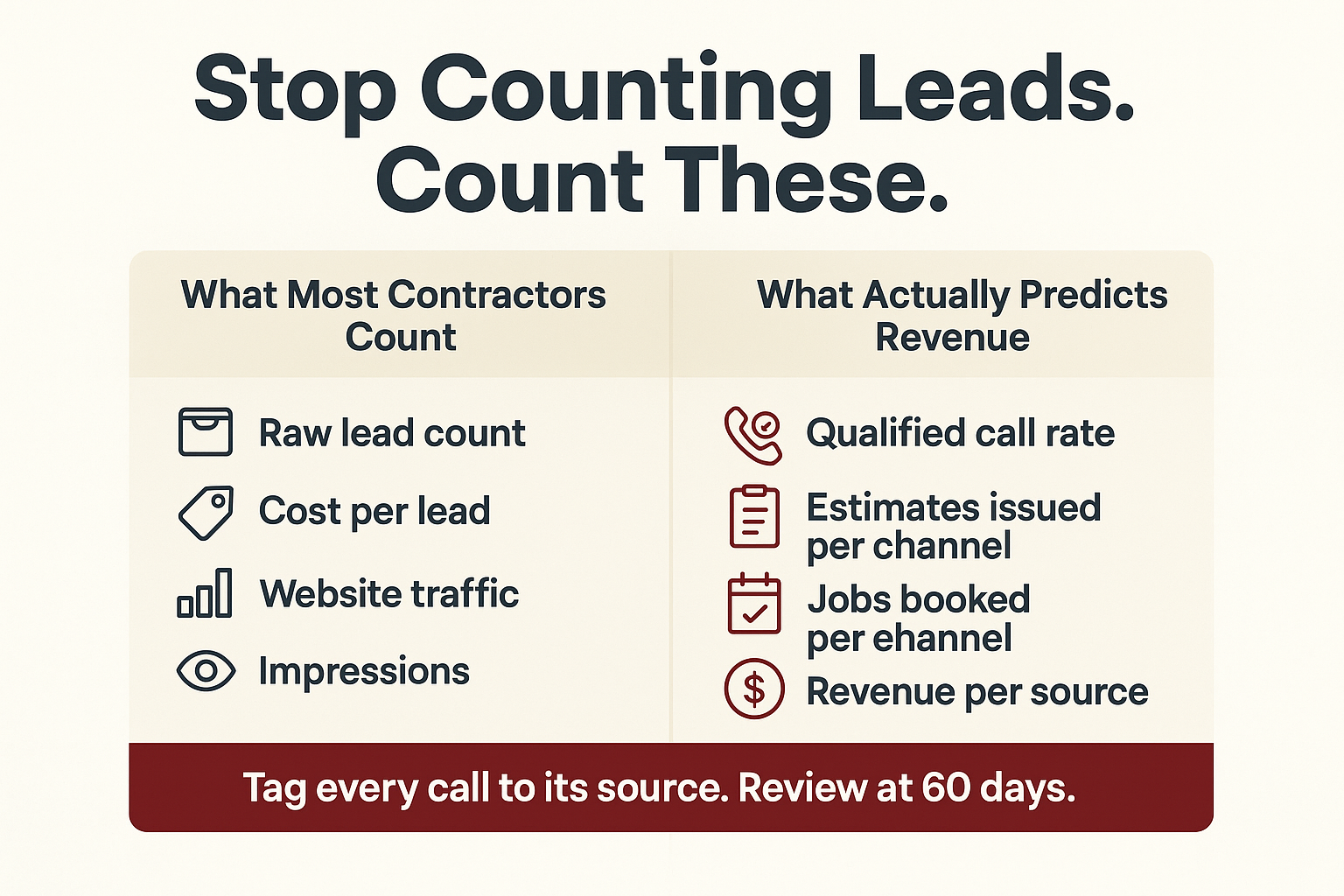
Lead count is the easiest number to report and the least useful number to act on. Swap it for three things you can tie to a bank deposit:
- Qualified call rate, meaning the share of calls that are real prospects in your service area for work you actually do
- Estimates issued per channel
- Jobs booked per channel, and the revenue attached to them
The only way that comparison is honest is if every call is tagged to its source. Recording and transcribing calls is how we judge whether a campaign is working, and it is also where the caller’s own words come from.
Call data gets specific fast. In one plumbing business’s records, the qualified call rate roughly doubled month over month, from 31% to 61%, during a stretch when same day availability and clear upfront pricing were what callers mentioned most before booking. That is a decision you can make in a month, not a guess you carry for a year.
And the cost of not measuring is real. A contractor featured in news coverage summed up his experience with unmeasured marketing as “four views per month” and “zero sales” after spending close to $20,000. Any owner should be able to spot that pattern inside 60 days.
I go deeper on why the per-lead number misleads people in cost per lead is the wrong number to judge marketing by.
Five Questions to Ask Any Lead Source or Agency
Treat this as your own diligence, whether you are talking to a platform rep, a local agency, or me.
- Will this produce booked work, or contact records? Ask them to describe the difference in their own words.
- How are calls and estimates tracked back to source? If the answer is a dashboard of impressions, you will not be able to compare channels.
- Do you know my trade and my service area? Pest pressure in the Salinas Valley and roofing demand on the Monterey Peninsula are not the same market.
- What happens when the leads are bad? Get the credit or refund policy in plain language before you sign anything.
- How long am I committed? Contract length, cancellation terms, and auto-renewal are where most of the public complaints start. The FTC’s guidance on online advertising and marketing is a reasonable reference point for what clear disclosure should look like.
If a vendor gets cagey on any of the five, that is your answer.
Frequently Asked Questions About Shared Leads and Owned Visibility
Are Angi and HomeAdvisor leads always a bad deal?
No. Shared leads can work for some contractors, usually ones with fast phone coverage and a high close rate on cold calls. The channel becomes a problem when nobody is tracking cost per contact against jobs actually booked, because that is the only comparison that tells you whether it pays.
How long does owned visibility take to produce calls?
We look for the first measurable ranking movement within about 30 days, but booked work builds over several months as reviews, content, and profile signals accumulate. It is slower at the start than buying contacts and considerably steadier after that.
Should I run both at the same time?
A lot of owners do, at least during the transition. Just tag the calls separately so you can see which channel is producing estimates and which one is producing noise. After 60 days of clean data the decision usually makes itself.
Why does a shared lead close at a lower rate than a call from Google?
Because of who started the conversation. Someone who searched, read your reviews, and dialed your number has already picked you. A shared lead has not picked anybody yet, and three competitors are calling the same person. You are starting from zero trust, and that shows up in both your close rate and your price.
Does my directory profile help me show up in AI answers?
Barely, if at all. The profile belongs to the platform, not to you, and AI tools tend to pull from your own reviews, site content, and business profile data. That is a big part of why the aggregator conversation in 2026 is really a visibility conversation.
Want to see what your own channel numbers say?
We work only with home service contractors in Monterey County and the surrounding Central Coast, month to month, with no 12 month contracts. Call tracking and transcription are part of how we judge whether a campaign is working, not an upsell on top of it. If you want a second set of eyes on your call and channel numbers, Phil Fisk will walk through them with you on a discovery call at (831) 789-9320 or https://calendly.com/core6-marketing/30min.