Direct Answer: AI tools verify a contractor by cross-checking listings across Yelp, Facebook, BBB, chambers and trade directories. Mismatched names, addresses or phone numbers make you unverifiable, so the model recommends someone else.
You show up in the map pack for your trade in Salinas. The phone rings on a regular basis. Then a homeowner in Marina types the same question into ChatGPT and gets three company names back, and none of them are yours.
That gap has become the single most common thing owners bring up with me right now. Their Google rankings are fine, but the AI answer skips them entirely.
Almost every time I go looking, the problem is not the website. It is the records about the business scattered across the rest of the internet, and the fix is boring, specific work that most contractors have never audited once.
Why Google Rankings and AI Visibility Are Not the Same Thing
Google ranks a listing. An AI model does something different. It tries to confirm that a business is real, active and locally relevant by cross-checking what several independent sources say about it.
Localogy’s write-up of SOCi’s 2026 report described the pattern plainly. Businesses with strong Google rankings but a weaker presence off Google lost ground in AI recommendations, while brands with more complete trust signals across platforms got pulled up.
Search Engine Land’s coverage of the same report landed in the same place. Companies that AI tools surfaced tended to have better data accuracy and more consistent signals across Google Maps, Yelp, Facebook and their own websites.
So think about it from the model’s side. If your Yelp page shows a Seaside address, your Facebook page shows an old cell number, and your website says something else again, the model has three versions of you and no way to pick one.
A competitor with one clean story across ten sources is easier to name with confidence. That is usually the whole difference. If you want the deeper version of how that verification works, I broke it down in what AI-powered local SEO actually checks before recommending a contractor.
The Audit List for a Central Coast Trade Business
Here is the list I actually work through for a contractor in Monterey County. It is not exotic, and that is the point.
- Yelp (still heavily referenced by AI tools, even by owners who ignore it)
- Facebook business page, including the About section
- Houzz, especially for remodelers, flooring and landscape work
- BBB listing
- Angi, whether or not you buy leads there
- Nextdoor business page
- Trade association directories for your specific trade
- Salinas Valley Chamber and Pajaro Valley Chamber member listings
- Supplier and manufacturer dealer locators
- Apple Maps and Bing Places, which almost nobody claims
The failure mode is almost never one big error. It is a suite number that exists on one listing and not another, a call tracking number set as the main line somewhere, and an old business name that never got retired.
Three small mismatches are enough to make a model hedge. And hedging looks like getting left out of the answer.
What Usually Breaks on Each Platform
This is the pattern I see over and over on contractor audits across Monterey County. Use it as a checklist, one platform at a time.
| Platform | What usually breaks | How to fix it |
|---|---|---|
| Yelp | Old address from a previous shop location | Claim the page, update address, request removal of any duplicate |
| Owner’s personal cell listed as the business line | Edit the About section, match the main line exactly | |
| BBB | Legal entity name instead of the trade name customers search | Ask BBB to align the display name with the public brand |
| Houzz | Service area set to one city only | Expand to the cities you actually cover and keep NAP identical |
| Angi | Auto-created profile the owner never claimed | Claim it, correct the data, or request removal if unused |
| Nextdoor | Old business name after a partner left | Rename the page and update the contact fields |
| Chamber listings | Phone number frozen from the year you joined | Email the chamber staff directly, they update these by hand |
| Dealer and supplier locators | PO box or mailbox address | Send the correct street address to your rep, these rarely self-update |
The Five-Step Citation Cleanup, In Order
Order matters here. Fixing the phone field before you settle on one correct version of your information just spreads the mistake faster.
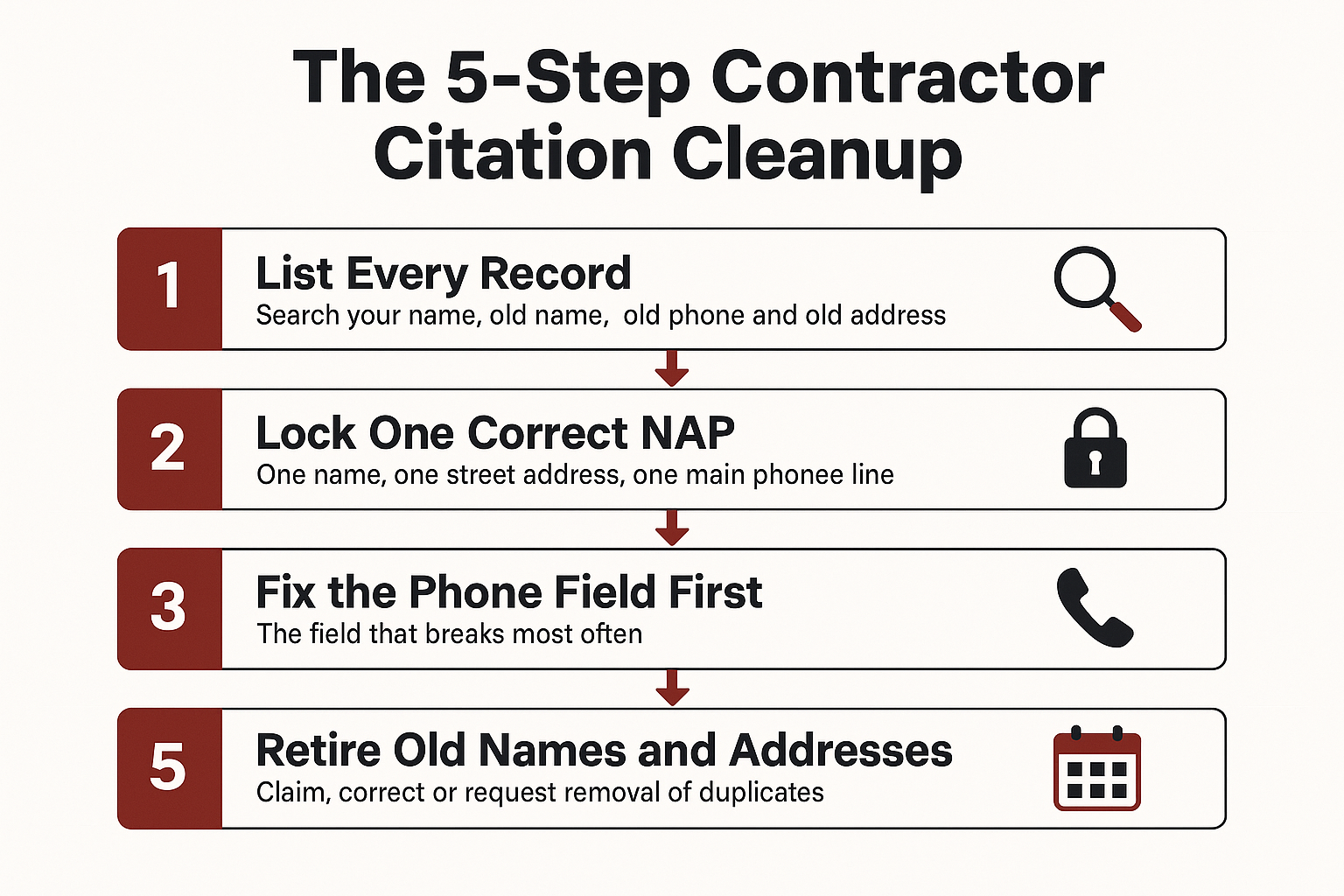
The Phone Number Is the Field That Breaks Most
If I only had one hour to spend on a contractor’s records, I would spend all of it on the phone number.
It breaks more than any other field because it changes more than any other field. Owners switch carriers, add an answering service, drop a personal cell into a directory late one night, or push a call tracking number into a listing that was never set up to hold one.
Call tracking is useful, and we use dedicated tracking numbers in our own work. But a tracking number belongs where the system accounts for it, not pasted in as the main line on a chamber listing that nobody will revisit for four years.
The stakes are simple when the job is urgent. Across home service businesses generally, homeowners describe problems in blunt terms, things like water coming through the ceiling or sewage backing up into the tub. Those people call the first number they find and move on to the next name if it dead-ends.
A disconnected number sitting on a well-indexed directory page does two kinds of damage. It loses the call, and it tells every model reading that page that your data is unreliable.
Central Coast Records Get Messy in Specific Ways
This market creates its own version of the problem. Three patterns come up again and again.
- The move. A company starts in Seaside, outgrows the yard, and relocates to Marina or north Salinas. The new address goes on the website and Google Business Profile. Yelp, Houzz and a handful of aggregator sites keep the old one for years.
- The mailbox. A lot of owner-operated trades run out of a truck and use a Salinas mailbox address with a suite or PMB number. Half the listings include the number, half drop it, and now you have two addresses.
- The name change. A partner leaves, the name changes, and the old name lives on across directories that were never touched again.
To find the stragglers, search your business name in quotes, then search your old phone number as a standalone search, then your old address. That last one surfaces records you forgot existed.
Most platforms have a claim flow that verifies by phone call or by an email at your domain. Budget an afternoon, not ten minutes, and keep a running sheet of what you fixed and where. The same discipline applies to your primary listing, which I covered in the Google Business Profile mistake costing contractors AI visibility.
Brand Mentions Count Too, But Only Real Ones
Directories are the floor, not the ceiling. What separates a business a model can verify from one it can only guess at is being mentioned in places that were never built for SEO.
That includes:
- Local news coverage and community publications
- Chamber member pages and event listings
- Supplier and manufacturer dealer pages
- Sponsorship pages for youth sports, school fundraisers and local events
- Trade association member rosters
These pages carry weight because a real organization put your name there for a real reason. Google’s own spam policies call out links and mentions created mainly to manipulate rankings, so the direction here is genuine local presence, not buying placements.
Reviews sit in the same bucket. The wording inside them tells a model what you do and where, which I get into in the review wording that gets a contractor named in AI answers.
Why This Is a Monthly Habit, Not a One-Time Project
Here is the part that frustrates owners. You clean everything up, and eighteen months later half of it is wrong again.
Data aggregators resell business records to each other. A directory refreshes from a stale feed and quietly overwrites the address you fixed. A platform redesigns its profile format and drops a field. That is normal drift, not carelessness on your part.
That is exactly why citation authority and NAP consistency is one of the pillars inside AI Search Sync rather than a task we tick off at launch. Monthly checking is the difference between a clean record and slow rot.
It does not have to be complicated for the owner. One client review of our work put it this way: “They made the whole process easy.” That is the goal on this kind of work, because no contractor wants to spend an evening arguing with a directory support form.
If you want to see how the pieces fit together across search and AI tools, the two things that separate contractors AI recommends from contractors it skips covers the bigger picture.
Frequently Asked Questions About Citations, NAP Consistency and AI Visibility
How long after fixing my listings will AI tools start naming me?
It depends on how often each platform gets crawled and how many records were wrong to begin with. In our own work we look for first measurable ranking movement within about 30 days, but citation cleanup tends to show up gradually as sources re-sync rather than all at once.
Should I put a call tracking number on my directory listings?
Keep your main business line consistent across directories. Tracking numbers belong in places where the setup accounts for them, like ad campaigns and specific landing pages, not dropped into a chamber listing or a dealer locator as the primary number.
Does using a mailbox address in Salinas hurt me?
It is not automatically a problem, but inconsistency is. Pick one exact format, suite number included or not, and use that identical string everywhere. Mixing formats across platforms is what creates the mismatch.
What if a directory will not remove an old listing?
Correct it instead of chasing removal. Update the old profile to the current name, address and phone so it points to the right business. An accurate duplicate does far less damage than a stale one.
Do I need to be on Angi or Yelp if I do not buy leads from them?
You do not need to spend money there, but you do want the profile claimed and accurate. AI tools read those pages whether you pay or not, and an unclaimed profile with the wrong phone number is working against you either way.
Want a clearer picture of what your records actually say?
Cleaning up citations for a Monterey County trade business means editing the same phone number and address across hundreds of records, and we do that work here on the Central Coast with nothing outsourced overseas. If you want to talk through what your own audit would turn up, Core6 keeps discovery calls open with Phil Fisk, or you can reach the office at (831) 789-9320.