Direct Answer: Calls give you the questions homeowners ask, forms give you the phrasing they type into search, and reviews give you the outcome language AI tools cite. Each feeds a different part of your SEO.
Most contractors I work with in Monterey County treat customer data as one pile. Calls, form submissions, and reviews all get lumped together under the same word: feedback.
That’s the mistake. Each of those three sources does a completely different job in search, and using them interchangeably is why so much contractor content still sounds like it came from a keyword tool.
I want to walk through what each source is actually good for, where the language from each one belongs on your site, and why the plumber in Salinas who reads his own contact form submissions has a real edge over the one paying for AI-written blog posts.
Calls Give You Questions, Not Search Terms
When a homeowner picks up the phone, they are usually in a hurry and mid-problem. What comes out of their mouth is a question or an objection, not a search query.
Across the contractor accounts we run on the Central Coast, the same handful of questions show up on calls month after month:
- How soon can somebody actually get out here?
- Do you charge for the estimate or the trip out?
- Do you handle the permit, or is that on me?
- Is that price the final number or does it change once you open it up?
- Do you work in my area, or is Carmel Valley too far out?
That language belongs in three places: your FAQ sections, your Google Business Profile posts, and the subheadings on your service pages. When you answer the question in the same words the caller used, you are matching the way people ask AI tools and voice search the same thing.
Call recordings and transcripts make this easy, because you stop guessing at what people ask. We build this into client accounts through Core6 Clarity, which records and transcribes every inbound call and turns the patterns into a monthly report. If you’d rather start manual, your call log holds more usable SEO material than your last ten blog posts, and a legal pad next to the phone for two weeks will prove it.

Form Submissions Are the Closest Thing to a Search Query
This is the distinction almost no agency bothers to explain, and it matters more than the call data.
A homeowner calling at 8 a.m. about a leak says something like “I’ve got water coming from under my sink and I need someone today.” That same problem, typed into a contact form at 11 p.m., comes out as “looking for a plumber in Salinas to fix a slow drain under the kitchen sink.”
The second version mirrors a search query almost word for word. People writing a form are not panicking and not talking to a human, so they describe the problem the same way they’d type it into Google.
Read a year of form submissions in one sitting and you’ll see the patterns:
- The trade word they use (“plumber,” not “drain specialist”)
- The city they name, and how often they name a neighborhood instead
- The specific fixture, room, or material involved
- Whether they say “repair,” “replace,” “install,” or “quote”
That phrasing belongs in your service page body copy, in your H2s, and in the opening line of every page. Not keyword tool output. Not competitor research.
If you’ve had a contact form running for two years and never read it as content, you are sitting on a rough draft of your best pages. The data your business already owns is usually the part nobody has opened.
Which Source Feeds Which Part of Your Site
Here’s the map I use when we build a content plan for a contractor account. Same three sources, three different destinations.
| Source | What It Captures | Where the Language Belongs |
|---|---|---|
| Phone calls | Questions and objections before booking | FAQ sections, Google Business Profile posts, service page subheadings |
| Form submissions | How the problem gets described in writing | Service page body copy, headings, page titles, blog topics |
| Reviews | Outcome language after the job is done | Trust signals, testimonials, and the AI citation layer |
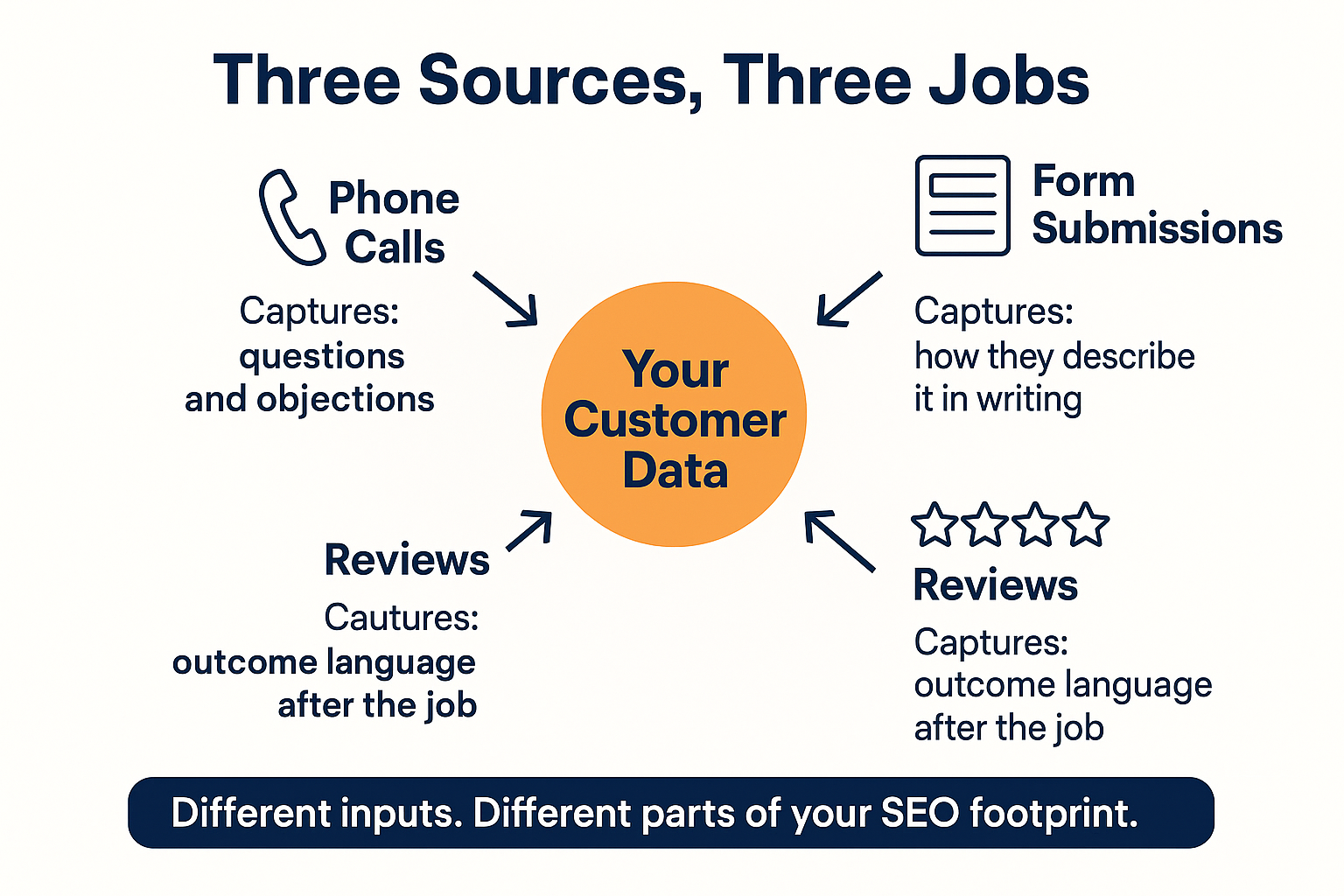
Three Sources, Three Jobs at a Glance
This is the whole idea in one view: one business, three data sources, three separate jobs in your search footprint.
Reviews Feed the Layer Most Contractors Ignore
Reviews are not just social proof anymore. They are a major input to how AI tools decide who to recommend.
When someone asks ChatGPT or Perplexity for a reliable HVAC company in Monterey, the system is not reading your website the way a human does. It’s pulling together the aggregated evidence about your business from across the web, and your reviews are a big piece of that pile.
Here’s where it gets practical. A review that says “great service, very professional” gives an AI system almost nothing to work with. A review that says the crew replaced a water heater same day in Seaside and it passed inspection the first try gives it three usable facts: the trade, the service area, and the outcome.
So contractors who understand this ask for reviews differently. Instead of “please leave us a review,” the request prompts for specifics:
- What work did we do?
- What city or neighborhood was the job in?
- What was the result you cared about?
Stay honest about it. You can ask for detail, but you can’t script the review or offer anything in exchange for a positive one, and the FTC’s rule on fake and manipulated reviews spells out where the line sits. Asking every customer for an honest, detailed review is fine. Steering only the happy ones is not.
This is the part of local SEO that AI Search Sync is built around, alongside Google Business Profile work, citation consistency, and on-page structure. What AI powered local search checks before recommending a contractor covers that check list in more detail.
Why Your Competitors Can’t Copy This
The reason most contractor content reads like filler is that it was written from keyword research instead of customer data. Any agency can run the same tool and get the same list of terms.
Nobody else has your calls, your form submissions, or your reviews. That’s the whole moat.
Content built from all three sources ends up sounding like real answers to real questions, because that’s exactly what it is. AI engines are more likely to cite that kind of page, because it clears the bar of adding something a homeowner couldn’t already read on a dozen identical sites. More competitors publishing more AI content doesn’t change the customer pool, and it doesn’t give them your job history.
One rule on the process, and it isn’t negotiable. Calls and form submissions get paraphrased and anonymized, always. No customer names, no addresses, no phone numbers, no details that identify a specific job.
Reviews are the only source you can quote word for word, and even then keep it to a first name and last initial. This isn’t a legal technicality to work around. It’s how you use real customer data without burning trust with the people who gave it to you.
Frequently Asked Questions About First Party Data Contractor Marketing
How many calls or forms do I need before there’s anything useful in there?
Less than you think. Thirty to fifty inbound calls is usually enough to see the same three or four questions repeating, and once a question shows up three times it belongs on your site. Form submissions can take a little longer since most contractors get fewer of them, but a year’s worth of forms is plenty.
Can I just record calls without telling people?
No. California is a two party consent state, so everyone on the call has to be notified that it’s being recorded. That’s handled with a short automated greeting at the start of the call, which is standard on any legitimate call tracking setup. Check with your own attorney if you want it confirmed for your situation.
What does call tracking usually run?
It varies a lot depending on how many tracking numbers you need, whether transcription and analysis are included, and call volume. Some setups are a modest monthly fee for numbers only, others run into the hundreds for recording plus reporting. Ours is bundled differently than most, so ask us directly rather than assuming a market rate applies.
How fast does this show up in rankings?
On our accounts we typically see the first measurable ranking movement inside 30 days once content and profile work go live. Reviews build slower because they depend on your job volume, but they compound. The contractor who asks for a detailed review after every job is in far better shape a year later than the one who asks twice a year.
Does this work for a one truck operation, or do I need a big call volume?
It works either way. A handyman in Marina taking eight calls a week still hears the same questions repeat, and honestly the smaller operations often have better data because the owner is the one answering the phone and remembers what people actually said.
Want a Second Set of Eyes on Your Own Customer Data?
If you’re running a home service business anywhere from Watsonville down to King City and you’ve got a year of calls, forms, and reviews sitting untouched, there’s probably a content plan hiding in it. Core6 Marketing works with contractors across Monterey County and the Central Coast, and we’re happy to look at what you already have and tell you what we’d do with it. You can reach us at (831) 789-9320 or book a 30 minute discovery call with Phil Fisk at https://calendly.com/core6-marketing/30min.