Direct Answer: Perplexity builds answers by crawling live web pages and citing them inline. To be named, a contractor needs authority across several cited sources, not just one strong Google profile.
A plumber in Salinas asked me last spring why he shows up fine on Google Maps but never gets named when someone asks an AI tool for a recommendation. Fair question. He had done the work on his Google profile, and it was paying off in the map pack.
The short version: Perplexity is not a smaller version of Google. It builds its answers a different way, from a different pool of sources, on a different schedule.
I want to walk through the actual architecture, because once you see how the citations work, the strategy stops feeling like guesswork. This is about how you get named, not just how you get ranked.
How Perplexity Builds an Answer, and Why Google Doesn’t Work That Way
Google returns a list. You type in “HVAC repair Marina CA” and Google hands you a map pack and ten blue links, then you decide.
Perplexity does the deciding. It runs a live web search, pulls in a handful of pages it judges relevant and trustworthy, writes a summary answer, and drops a numbered citation right next to each claim. Click the citation and you land on the exact page the sentence came from.
That is the piece most contractors miss. ChatGPT often answers from what it learned during training, so a business can get mentioned without any live page behind it. Perplexity is built around real-time retrieval plus inline sourcing, which means:
- Every business it names is tied to a page it just read
- Pages it cannot crawl cannot be cited
- A thin page it does crawl still loses to a clearer page from a competitor
- Being “well known” locally means nothing if nothing on the open web says so
So the goal is not to live in some knowledge base. The goal is to be on pages Perplexity crawls and treats as credible. That is a different job than winning the three-pack, and it is why I stopped treating AI visibility as a side effect of regular SEO.
Where Perplexity Pulls Local Contractor Data in Monterey County
For local service queries, Perplexity leans on a mix of sources rather than one dominant listing. In the results I have watched for Central Coast trades, the pattern is consistent:
- Yelp business pages and their review text
- Google Maps data, including categories and hours
- Angi and similar directory listings, even when the contractor never signed up for leads
- Local editorial coverage, like a Monterey County Weekly mention or a community news write-up
- Chamber and association directories, including the Salinas Valley Chamber and Pajaro Valley Chamber
- The contractor’s own site pages, when they answer a specific question clearly
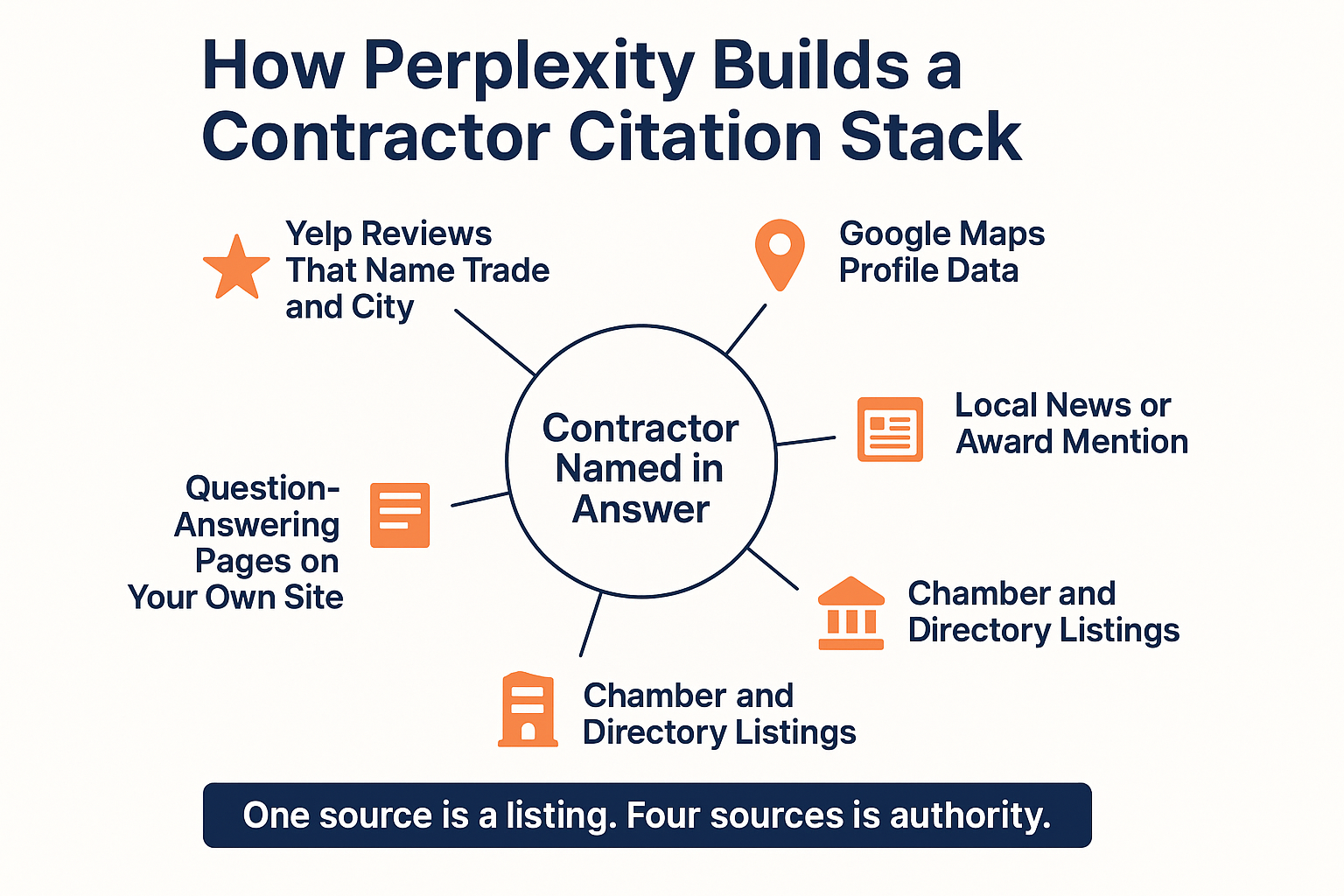
Here is the practical takeaway. A roofer in Santa Cruz County who is listed in a chamber directory, has thirty real Yelp reviews that mention roof types and cities, and got named in one local news piece is showing Perplexity the same story from four unrelated places.
That repetition is what reads as authority. One strong Google Business Profile is a single source, and a single source rarely carries an answer by itself. We build for that pattern inside AI Search Sync, because the Google Business Profile mistake costing contractors AI visibility is usually treating that profile as the whole plan.
Google vs. Perplexity: What Actually Differs
Same homeowner, same question, two very different machines behind the answer. This is the comparison I sketch out on discovery calls.
| Factor | Google Search | Perplexity |
|---|---|---|
| What you get back | A ranked list of links and a map pack | A written answer with inline citations |
| How the answer is built | Index plus ranking signals | Live retrieval, then summarized |
| Who picks the contractor | The homeowner, from the list | The tool, then the homeowner verifies |
| Source mix for local | Heavy on Google Business Profile | Yelp, Maps, directories, local news, your site |
| Refresh speed | Varies widely by page and site | Often re-crawls indexed domains within 24 to 72 hours |
| Winning content format | Longer, thorough service pages | Short, structured, one question answered |
The Citation Pattern Perplexity Rewards
Four independent sources telling the same story beat one strong listing. Here is what that stack looks like for a Monterey County contractor.
The 24 to 72 Hour Window Most Contractors Never Use
Perplexity processes its citation pool on a rolling basis. For domains it already knows, it often re-crawls new pages within 24 to 72 hours of publication.
Compare that to how long a new service page can take to settle into Google rankings. If your site is established, you can publish a clear answer page on a Tuesday and see it cited by the weekend.
But the format has to fit. Perplexity is stitching together a paragraph, so it favors content it can lift cleanly:
- A specific question as the heading, phrased the way a homeowner would say it
- A direct answer in the first two sentences, before any setup
- Short sections with real detail, not a 2,000 word essay
- Named cities and trades, so the local match is unmistakable
- Dates and specifics where they are honest, since vague pages get skipped
This is where our Voice of Customer work does the heavy lifting. The questions homeowners actually ask on the phone and in website form submissions become the headings, and the phrasing from reviews becomes the language in the answer. We are not guessing at search terms, we are publishing the questions we already know people ask. That is also why some contractor websites keep growing while others go flat.
Query Type Decides Whether You Get Named
Not every search behaves the same in Perplexity, and this trips people up.
For a fast “plumber near me” query, Perplexity tends to lean on map and directory data, and the answer looks a lot like a list. Your Google and Yelp presence carries most of the weight there.
For research-heavy queries, local businesses surface much faster. Those are the questions where a homeowner is comparing providers, hunting for a specialty, or trying to verify reviews across more than one site. Things like:
- “What should I look for in a licensed roofing contractor near Santa Cruz”
- “Who handles gopher control in the Salinas Valley”
- “How do I compare bids for a panel upgrade in Monterey”
- “Which landscapers in Watsonville do drought-tolerant design”
A generic company bio page has no chance of being cited for those. A page that actually answers the comparison question does.
Worth noting for the licensing angle: homeowners are told to verify contractors through the California Contractors State License Board, so pages that address licensing plainly tend to line up with what AI tools consider trustworthy context. If you want the mechanics of the selection side, we covered how Perplexity decides which contractor to recommend separately.
What I’d Fix First
If I had one week and a contractor in Seaside or Carmel Valley asked me where to start, it would go in this order.
One. Make sure your site is crawlable and your service area pages name real cities, not “the Monterey Bay Area and surrounding communities.”
Two. Get your name, address, and phone matching everywhere it appears, including chamber listings and old directory profiles you forgot about. Mismatched data gives a retrieval engine a reason to skip you.
Three. Ask for reviews that mention the job, the trade, and the city. A review that says “replaced our water heater in Prunedale” is worth more to an AI tool than five that say “great service.”
Four. Publish one question-answering page a week, pulled from questions you already get on the phone. Not filler. If you are not sure whether what you have now qualifies, there is a test for AI slop on contractor sites.
We typically see the first measurable ranking movement within 30 days on this kind of work, and Perplexity citations often show up sooner than Google position changes because of that faster re-crawl cycle.
Frequently Asked Questions About Perplexity Local Contractor Recommendations
Do I need to submit my business to Perplexity somehow?
No. There is no submission form or listing to claim. Perplexity pulls from pages it crawls on the open web, so the work is making sure those pages exist, load fast, and say something specific about your trade and service area.
Why does my competitor get named when I have more reviews?
Usually because they show up across more independent sources. Review count on one platform is a single signal. A contractor with fewer reviews but a chamber listing, a local news mention, and a clear answer page on their site gives Perplexity three or four places to confirm the same thing.
How fast can a new page show up in Perplexity results?
If your domain is already indexed and healthy, often within 24 to 72 hours. Brand new domains take considerably longer, because there is no crawl history to work from yet.
Is this different from what I should do for Google?
There is overlap, but the emphasis shifts. Google rewards depth and site authority over time. Perplexity rewards clear, current pages it can quote and cite right now, plus consistency across outside sources. Good work for one usually helps the other, though the content format for AI citation runs shorter and more direct.
Does any of this matter if most of my calls still come from Google?
It matters more each quarter. Most of our clients still get the bulk of calls from Google Search and Maps. But the homeowners doing serious comparison research before they call are increasingly starting in AI tools, and those tend to be the larger, better-qualified jobs.
Want to know where you stand in AI search?
We work with home service contractors across Monterey County, CA and the wider Central Coast, and every account is handled here in Salinas with nothing outsourced overseas. If you are curious whether Perplexity and the other AI tools are naming you or your competitors, a 30 minute discovery call with Phil Fisk is the easiest way to find out. You can reach the office at (831) 789-9320 or book a time at https://calendly.com/core6-marketing/30min.