
Direct Answer: A real AI content strategy uses AI for structure and speed, but pulls the actual subject matter from your calls, forms, and reviews, then has a local human verify every detail before it publishes.
Almost every contractor I talk to in Monterey County falls into one of two camps. Either an agency is posting blogs they have never read and could not defend to a customer, or there is no blog content at all and the owner feels behind.
Both camps have the same root problem. The content is not built around what the contractor actually knows or what their customers actually ask.
AI can help fix the speed problem. It cannot fix the knowledge problem. In this article I want to lay out what a working AI content strategy for contractors looks like in practice, what AI search systems actually pull and cite, and the monthly cycle I use with trade businesses from Salinas to Santa Cruz.
Why most contractor blogs never earn a single call
I have reviewed a lot of contractor sites on the Central Coast. The pattern is easy to spot once you know it.
The blog has 40 posts. Every one of them could belong to a plumber in Ohio, a roofer in Texas, or an HVAC company in Fresno. Nothing in the writing proves the business has ever worked a job here.
That kind of content fails for a plain reason: it has no information nobody else has. Search engines and AI answer tools are both trying to find the source that adds something, not the twelfth version of the same page.
Here is what generic content is missing:
- Local job detail. What actually goes wrong in homes near the Salinas River bottom, in older Pacific Grove cottages, or in coastal properties in Marina where salt air chews up equipment.
- Seasonal pattern. When the calls spike, and why. Fog season, first hard rain, ag dust, holiday water heater failures.
- Trade judgment. The call a 20-year tech makes on a job that a homeowner would never guess.
- Real numbers. Ranges, timelines, and conditions a homeowner could act on.
AI tools cannot invent any of that. They can only reshape what you give them. If you want a deeper breakdown of the damage generic content does, I covered it in how to tell if the content on your contractor site is hurting your rankings.

The four traits of content AI search actually cites
When ChatGPT, Perplexity, or Google’s AI answers recommend a contractor, they are pulling from pages that gave them something concrete to work with. Across the sites I watch, the content that gets picked up shares four traits.
- It is locally specific. Named towns, named neighborhoods, named conditions.
- It reflects real service experience. It reads like somebody who has been under the house.
- It answers a decision-stage question. Not “what is a heat pump,” but “should I repair or replace a 14-year-old unit in a Seaside rental.”
- It contains verifiable, actionable detail. Numbers, timelines, and conditions a homeowner can check.
Compare two blog topics. “5 reasons to maintain your HVAC system” checks zero boxes. “Why HVAC systems in older Salinas homes near the river tend to fail earlier than newer builds” checks all four.
Same trade. Same word count. Completely different outcome, because one has information and the other has filler.
Google has been direct about this too. Their guidance says the issue is not whether content was made with AI, it is whether the content is helpful, reliable, people-first content. AI answer tools apply the same test from a different angle. I broke down that mechanic in the two things that separate contractors AI recommends from contractors it skips.
Generic topic versus a topic that gets cited
Here is the same trade, rewritten four times. The right column is what an AI answer engine can actually quote back to a homeowner in Monterey County.
| Trade | Generic topic (skipped) | Locally grounded topic (cited) |
|---|---|---|
| HVAC | 5 reasons to maintain your system | Why coastal salt air shortens condenser life in Marina and Seaside homes |
| Plumbing | Common causes of clogged drains | What tree roots do to older clay sewer lines in Salinas neighborhoods |
| Roofing | How to choose a roofing material | What the first hard rain of the season exposes on Monterey Peninsula roofs |
| Landscaping | Tips for a healthy lawn | Watering schedules that hold up under Monterey County restrictions and summer fog |
| Pest control | How to prevent pests in your home | Why gopher pressure spikes near ag fields in the Salinas Valley each spring |
Using an AI tool is not the same as having an AI content system
This distinction is worth drawing plainly, because most of the confusion lives here.
Using a tool means opening ChatGPT, asking for a blog post about water heaters, and hitting publish. Anybody can do that in ten minutes, which is exactly the problem. Your competitor two towns over can produce the identical page just as fast.
Having a system means four things are defined and repeatable:
- Inputs. Where the subject matter comes from every single month.
- Review. Who checks it for accuracy and local detail before it goes live.
- Cadence. How often it publishes, without gaps.
- Tracking. What you measure to know whether it moved the phone.
A tool gives you output. A system gives you content that compounds, because month twelve builds on month one instead of repeating it.
An industry survey of contractors from ServiceTitan found 74% say efficiency is AI’s top value and 51% say marketing and sales is where they already see measurable impact. But 59% preferred AI built into software they already use, and 44% named integration complexity as the barrier.
That lines up with what I hear on calls. Contractors are not against AI in their marketing. They are against complexity and unclear return. More on that in where AI is actually worth it for a small trade business.
The monthly content cycle that actually fits a trade business
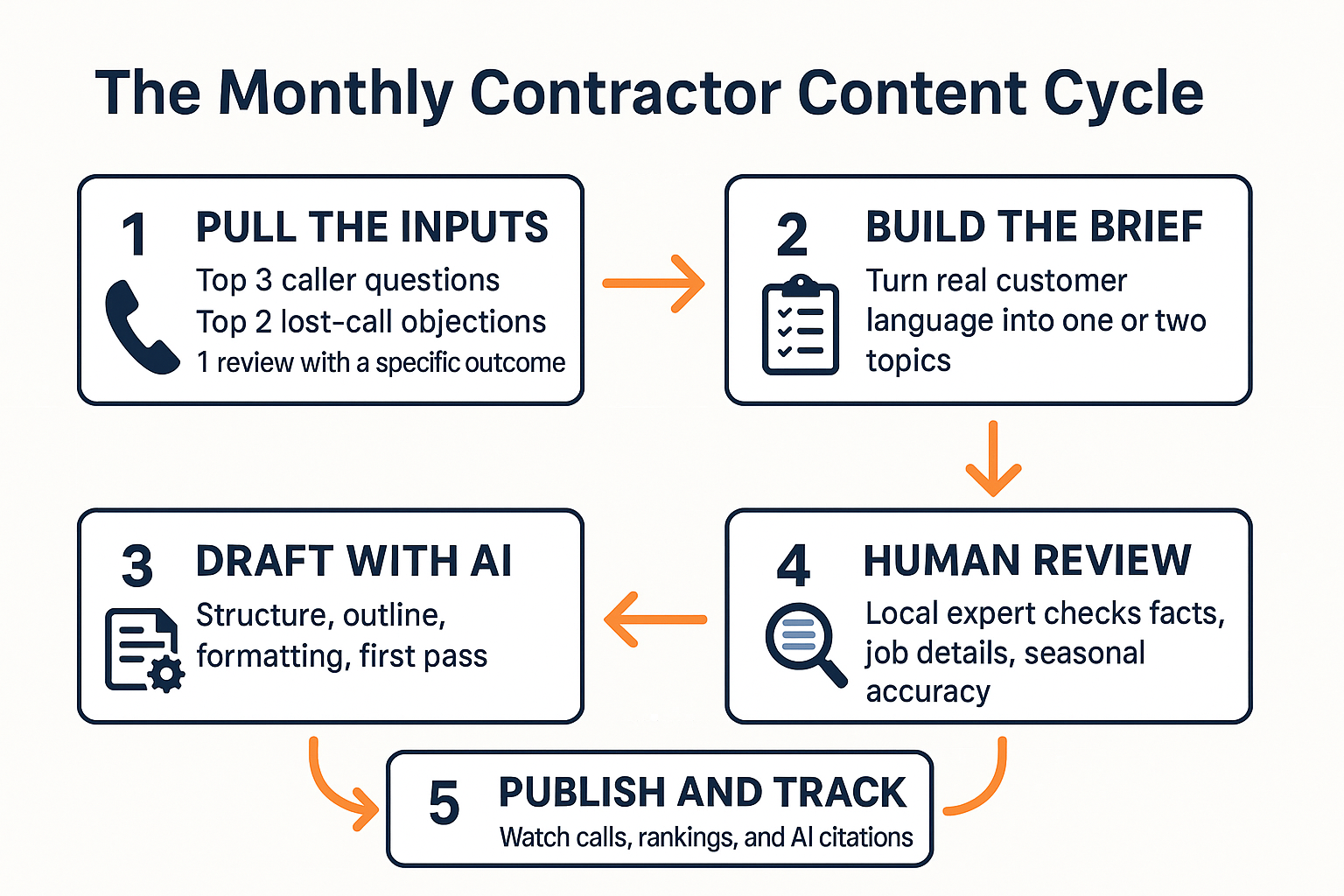
This is the loop I run. It takes less owner time than most contractors expect, and it produces material a content farm cannot copy.
Where the raw material comes from: your own customers
Every month, the inputs come from three first-party sources most contractors already own and ignore.
Inbound calls. The questions people ask before they book, and the objections that show up in calls that never closed. A tracking number with recording and transcription turns that into a list instead of a memory.
Website form submissions. How people describe the problem in their own writing. One caller might say “no hot water.” The form version is usually longer and closer to how they searched.
Reviews. These tell you which outcomes customers valued enough to write about, and the exact words they used. When several reviews mention showing up on time in a specific town, that is a content topic and a ranking signal at the same time.
I pull the top three caller questions, the top two objections from lost calls, and one review that describes a specific outcome. That becomes the brief for one or two pieces. Nothing gets written from a keyword list alone.
This is the Voice of Customer approach, and it is the reason the finished pages read like a real business wrote them. I went deeper on the review side in your customers already wrote your best SEO content and on the call side in your phone calls are the best SEO content you’re not using.
The human review step is not optional
AI drafts get details wrong in ways a homeowner will catch and a competitor will not correct for you.
I have seen drafts reference weather patterns that do not happen here, quote code requirements that do not apply in Monterey County, and describe equipment nobody installs on the Central Coast anymore.
The review step catches:
- Local accuracy. Does this reflect how homes and conditions actually work between Watsonville and King City.
- Trade accuracy. Would a licensed tech in this trade agree with every claim.
- Pricing safety. Are cost figures presented as ranges with context, not as promises.
- Voice. Does it sound like the owner, or like a machine.
Once that content is live and accurate, it feeds the visibility side. That is the role of AI Search Sync: getting the business profile, citations, on-page structure, and content all saying the same verifiable things so search engines and AI tools can confirm who you are and what you do. The content is the material. The sync work is the distribution.
Frequently Asked Questions About AI Content Strategy for Contractors
Will Google penalize me for using AI to write blog posts?
No. Google has said the issue is quality, not the tool. Thin, generic AI content gets ignored whether a human or a machine produced it. Content with real local detail and real service experience performs, again regardless of how the first draft was made.
How much time does this actually take me as the owner?
Less than most contractors assume. The heavy input is a short conversation each month about what customers are asking and what jobs came up. Usually 20 to 30 minutes. The pulling, drafting, review, and publishing happen on our side.
What does a content program like this typically cost on the Central Coast?
It varies a lot by volume and whether it is bundled with local SEO work. Monthly content programs for small trade businesses in this market can land anywhere from a few hundred dollars to a couple thousand, depending on how many pieces publish and what else is included. Ask for an exact quote rather than trusting a number on a page.
How fast does content start moving rankings?
We typically see first measurable ranking movement within 30 days on the profile and on-page work. Content compounds slower. Give it three to six months of consistent publishing before you judge it, because each piece keeps earning long after it goes live.
My agency posts blogs I have never read. Is that a problem?
Yes, and it is the most common thing I hear. If you cannot vouch for what is on your own site, a homeowner is going to find something inaccurate before you do. Read one post right now. If it could have been written about any city in the country, that is your answer.
Want a second opinion on the content sitting on your site?
If you are a contractor in Monterey County and you are not sure whether your blog is helping or just taking up space, a 30 minute call with Phil Fisk will tell you where you stand. We work with home service businesses from Salinas to Santa Cruz, and everything is done locally. You can reach Core6 Marketing at (831) 789-9320 or book time at https://core6.marketing/work-with-us/ when it suits your schedule.