Direct Answer: First party data is the call recordings, website form submissions, and reviews your business already collects. No platform owns it, and it tells you exactly what local homeowners are asking for.
Most contractors I talk to in Salinas and out on the Monterey Peninsula assume marketing data is something an agency hands them in a monthly PDF. Rankings, impressions, clicks. Numbers that go up and down and never explain why the phone rang.
Meanwhile, the most useful marketing information their business will ever own is already sitting in three places: their call log, their contact form inbox, and their reviews. It cost them nothing. And in almost every case, nobody has read it.
This is what first party data contractor marketing actually means. Not a tool you buy. Information your own customers already handed you, and what happens when you finally put it to work.
What First Party Data Means for a Home Service Contractor
Forget the term for a second. First party data is just the record of real people trying to hire you.
For a contractor in Monterey County, that comes down to three sources:
- Call recordings and transcripts. The questions people ask before they book, and the objections that show up right before they hang up.
- Website form submissions. How a homeowner describes their problem in their own writing, with no salesperson steering the conversation.
- Customer reviews. The outcomes people actually cared about, in the words they chose to praise the work.
What makes these three different from anything else in your marketing is ownership. No platform controls access to them. No algorithm update wipes them out. If Google changed the map pack tomorrow, your call transcripts from last quarter would still be sitting there, still telling you that half your callers in Marina and Seaside ask about financing before they ask about price.
Compare that to a lead you bought. The record belongs to the platform. You get a name and a phone number, and so do four other contractors. We wrote more about the three sources in The Three Places Your Best Marketing Data Already Lives, but the point worth sitting with here is simpler: one set of data is an asset you keep, and the other is a rental.

Why One Form Submission Beats Five Shared Leads
Several contractors have described this to me the same way. The homeowner who fills out the contact form on their site is a different animal from the lead that shows up from an aggregator.
The form submission means somebody looked them up, read their pages, saw their reviews, and decided they wanted that contractor. Not a list of five. They already picked you, and they usually explain the whole job in the message.
A purchased lead is the opposite. The homeowner asked a platform for options, the platform sold that contact to whoever was buying, and now the job goes to whichever crew calls back first.
Pricing on shared leads moves around a lot by trade and by season, but many contractors I have talked to on the Central Coast describe paying somewhere in the range of $25 to well over $100 per shared lead, with no guarantee the person even remembers filling out the form. Your own numbers will differ, and the only real way to know is to compare your close rate on aggregator leads against your close rate on form fills.
Here is the part most owners miss. Form submissions are not just leads. Read fifty of them together and you have a list of the exact phrases homeowners in Carmel Valley and Watsonville use to describe the problem you fix.
Your Own Lead Data vs. a Purchased Lead
The difference is not just cost per lead. It is what you still own six months later.
| What you get | Form submission on your own site | Shared lead from an aggregator |
|---|---|---|
| Who owns the record | You do, permanently | The platform does |
| How many contractors get it | One | Often three to five |
| Intent level | Homeowner chose you specifically | Homeowner asked for options |
| Detail included | Usually a full description of the job | Name, number, job category |
| Reusable as content | Yes, the wording becomes site content | No, you never see the full message |
| Long term asset value | Compounds every month | Ends when the lead goes cold |
The Real Problem Is Not Collecting It. It Is Reading It.
Almost every contractor I work with in Monterey County is already collecting this stuff. The gap is that nobody reads it as a group.
Here is what I see over and over:
- Call recordings sit in a dashboard nobody logs into after the first week.
- Form submissions land in an email inbox, get answered one at a time, and are never looked at side by side.
- Reviews get a polite thank you reply and are never mined for the phrases homeowners use to describe good work.
That third one stings the most. When a customer writes that your tech showed up in the rain on a Sunday and had their water heater running before dinner, they just handed you the most persuasive sentence on your entire website. Instead it sits on your Google profile, and your service page says “quality workmanship and customer satisfaction.”
The fix is not complicated. Once a month, pull the last thirty days of calls, forms, and new reviews. Write down the five questions that came up most, the two objections that killed deals, and any phrase a customer used that you would not have written yourself.
That is a content calendar. It writes itself out of your own business. I broke this down further in Your Customers Already Wrote Your Best SEO Content.
The Monthly Cycle That Turns Data Into Visibility
This is the loop we run on Voice of Customer data, and it repeats every month.
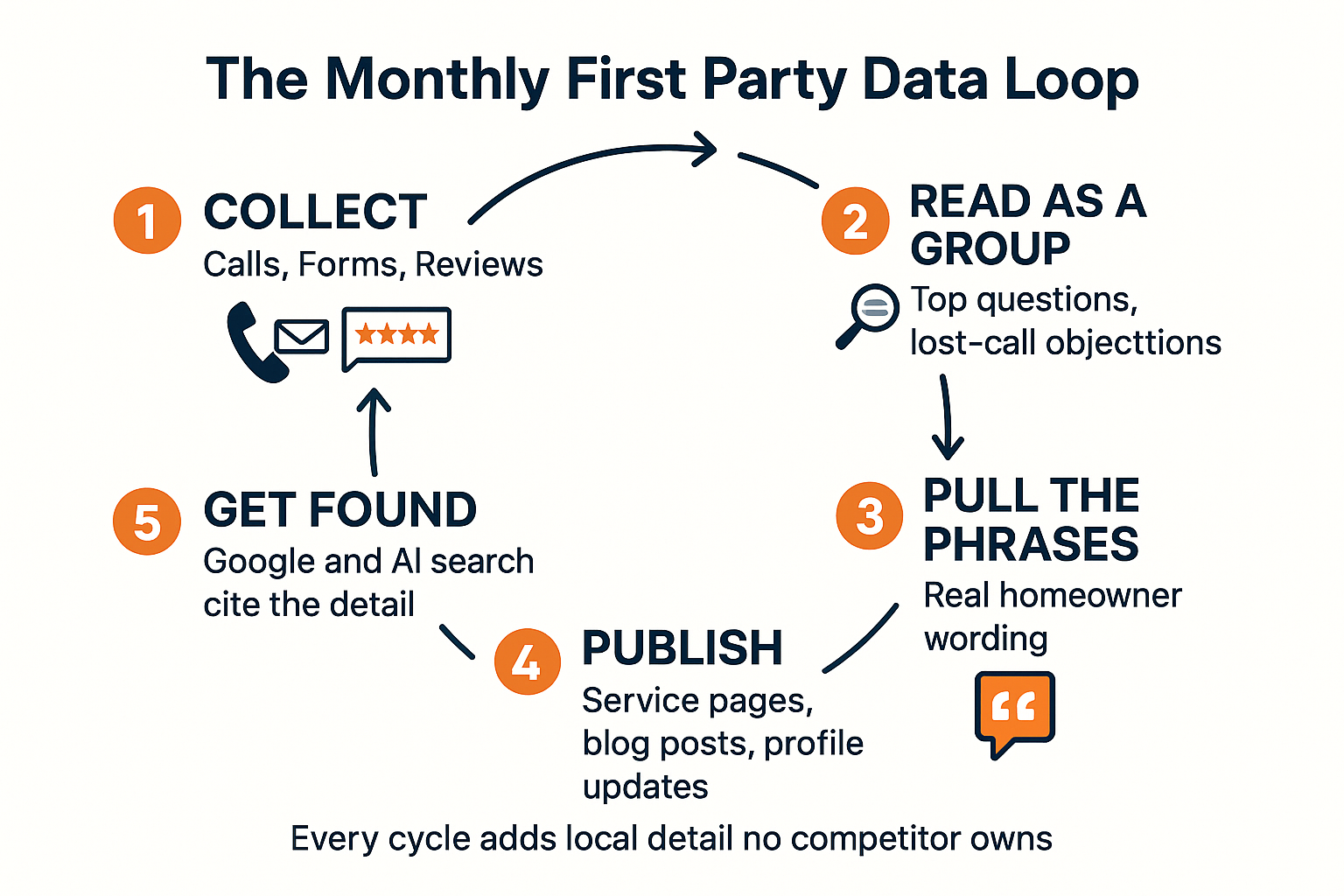
Why AI Search Pays Attention to Customer Language
This is the part that changed in the last two years. Tools like ChatGPT, Perplexity, and Google’s AI answers do not just match keywords. They pull specific, experiential detail and repeat it back to the person asking.
A generic service page gives them nothing to work with. “We provide professional roofing services in Monterey County” is a sentence a thousand other sites already have.
Now picture a page that reflects how a Seaside homeowner actually described their problem: the stain spreading on the hallway ceiling, the fog dripping off a flat section of roof, the tenant calling at 6am. Paraphrased into your content, that gives an AI system real substance to extract and cite.
Reviews carry weight here for the same reason, which is also why the Federal Trade Commission’s rule banning fake reviews matters more than most contractors realize. Genuine review language is a signal. Manufactured language is a liability.
This is exactly where our AI Search Sync approach connects to the customer data. Voice of Customer is what the content is made of. AI Search Sync is where that content shows up. If you want the mechanics of how these systems pick a contractor, Why Perplexity Pulls Live Data on Contractors covers it.
One Year In, the Gap Gets Hard to Close
Run this cycle monthly and something builds. Month one you have a handful of real questions answered on your site. Month six you have a library that names actual neighborhoods, actual job types, actual objections.
Month twelve, you own a body of content about your trade in your service area that no competitor can copy, because it came out of your customers, not a template.
The contractor down the road who spent that same year buying shared leads has nothing to show for it. Every dollar bought a phone number that went cold. There is no asset on the other side of it.
I have watched this play out with plumbers in Salinas and roofers up in Santa Cruz County. The first measurable ranking movement usually shows in about 30 days, but the real separation happens somewhere around month eight, when the content library starts answering questions before anyone picks up the phone.
Your own data is the only marketing input that gets more valuable the longer you use it.
Frequently Asked Questions About First Party Data for Contractors
I only get a few calls and forms a week. Is that enough data to matter?
Yes. Ten form submissions read side by side will show you a pattern you did not know existed. Small contractors often get cleaner signal than big ones because there is no call center diluting the language.
Do I need call tracking to do this?
You do not need it to start. You can keep a notepad by the phone and write down every question you get asked for two weeks. Recording and transcription make it far easier and catch the calls you missed, but the notepad version works if you are consistent about it.
Isn’t it a privacy problem to use what customers said?
Not when you handle it right. Calls and form submissions should always be paraphrased and stripped of names, addresses, and phone numbers. Reviews are public and can be quoted directly. We never publish a customer identifier out of a call or a form, period.
Can I just have AI write my service pages instead?
You can, and it will read like every other site in Monterey County. Generic AI text has no experiential detail in it, which is exactly what AI search systems are looking for. We covered what happens to those sites in our post on contractor sites stuffed with AI content.
How long does it take before this shows up in search?
Ranking movement often starts inside 30 days when the technical side is already in decent shape. The compounding effect, where your content library starts pulling in searches you never targeted, tends to show up later in the first year.
Want a second set of eyes on the data you already have?
If you run a home service business anywhere from King City up through Watsonville, you are already sitting on months of calls, form submissions, and reviews that nobody has read as a group. We spend time with Central Coast contractors walking through exactly what that data is saying and where it belongs on their site. If that is a conversation worth having, Phil keeps a few discovery calls open each week at https://calendly.com/core6-marketing/30min.