Direct Answer: Your recorded calls hold the exact phrases homeowners type into search. Pull the top questions and objections each month, then publish a page answering each one in that same language.
Most contractors I sit down with in Salinas have the same setup. A blog with ten or twelve posts nobody reads, and a phone that rings twenty to forty times a month with homeowners describing their problems in plain English.
The blog cost money. The calls were free. And the calls are the ones that hold the actual search phrases people use around Monterey County.
This is about the mechanics of using customer calls for SEO content: how spoken language maps to real search queries, how objections on lost calls point straight at missing pages, and how call patterns shift with our seasons here in ways you can plan content around.
Homeowners Search With the Same Words They Say Out Loud
Keyword tools hand you clean, tidy phrases. “HVAC repair Salinas.” “Roofing contractor Monterey.” Nobody talks that way, and increasingly nobody types that way either.
What I hear on recorded calls sounds more like this:
- “Why is my furnace clicking on and off?”
- “How much to replace a roof on a 1970s house out in Carmel Valley?”
- “Is it normal for the water pressure to drop when the washer runs?”
- “Do you guys even come out to King City?”
- “My neighbor got gophers taken care of, do you do the whole yard or just the tunnels?”
Those are search queries. Word for word. Voice search and AI tools trained people to type full sentences, so the gap between what a homeowner says on the phone and what they type into a search bar has basically closed.
A keyword tool will never show you “clicking on and off” because volume for that phrase looks tiny in isolation. But there are hundreds of variations of it, and a page written in that language catches the whole family of them. I covered the broader idea in why customer calls are the best SEO content most contractors ignore, but the mechanic here is simpler than people expect: transcribe, tally, publish.

What 30 Days of Call Review Actually Turns Up
I have never reviewed a month of contractor calls and found nothing. The pattern is remarkably consistent across trades.
A typical 30-day pull from an owner-operated shop with 1 to 20 employees surfaces:
- Three to five questions that repeat on nearly every call. Usually price range, timing, service area, and “how do I know if it needs repair or replacement.”
- Two recurring objections that show up right before someone gets off the phone without booking.
- A handful of phrases you would never write yourself. Homeowners in Watsonville describing a slab leak as “the floor feels warm in one spot,” for example.
- Wrong-fit calls that tell you which pages are attracting the wrong homeowner.
That last one matters more than people think. If half your calls are for jobs you do not take, your content is pulling in traffic that costs you time and rankings both.
Each repeated question is one page. Not a 2,000 word essay. A focused page that answers the question directly, in the caller’s words, with a local reference to Seaside, Marina, Prunedale, wherever the work actually happens. We handle the recording and monthly reporting side through Core6 Clarity for active campaigns, but a shop can run a rough version of this with a notebook.
Three Sources, Three Different Kinds of SEO Value
Calls are the loudest source, but they are not the only one. Each one gives you something the others cannot.
| Source | What it reveals | What it becomes |
|---|---|---|
| Inbound calls | Spoken questions and the objections that kill a booking | FAQ pages, service page sections, Google Business Profile Q&A |
| Website form submissions | Longer written descriptions of the problem, often with cost and timeline in the same sentence | Cost and process guides, comparison pages |
| Customer reviews | Which outcomes people valued, in praise language | Service page copy, case-style posts, GBP updates |
Lost Calls Are a Map of the Pages You Are Missing
This is the part contractors skip, and it is the most valuable data you have. Listen to the calls that did not book.
Here is a scenario I have seen versions of more than once. A homeowner on the Monterey Peninsula calls about replacing an aging system, gets a solid answer on scope, then asks whether the company offers financing. The person answering is not sure. The call ends politely and the job goes to a competitor whose service page had a financing section.
If 40% of your callers ask about payment before deciding, that is not a phone script problem. That is a missing page, and it is costing booked jobs, not just traffic.
High-ticket trades feel this hardest. Full HVAC replacement projects around Monterey County can vary widely, but many homeowners see quotes somewhere in the $6,000 to $15,000 range depending on system size, ductwork condition, and access. Roof replacements on older Carmel Valley and Pacific Grove homes commonly run five figures. Get an exact number from a licensed contractor, of course, but the point stands: at those amounts, an unanswered question does not become a follow-up call. It becomes a competitor’s job.
Common objections worth building pages around:
- Payment options and how estimates work
- Whether you actually serve their ZIP code
- How long they will wait for a crew
- What is covered if something goes wrong later
- Repair versus replace, with honest tradeoffs
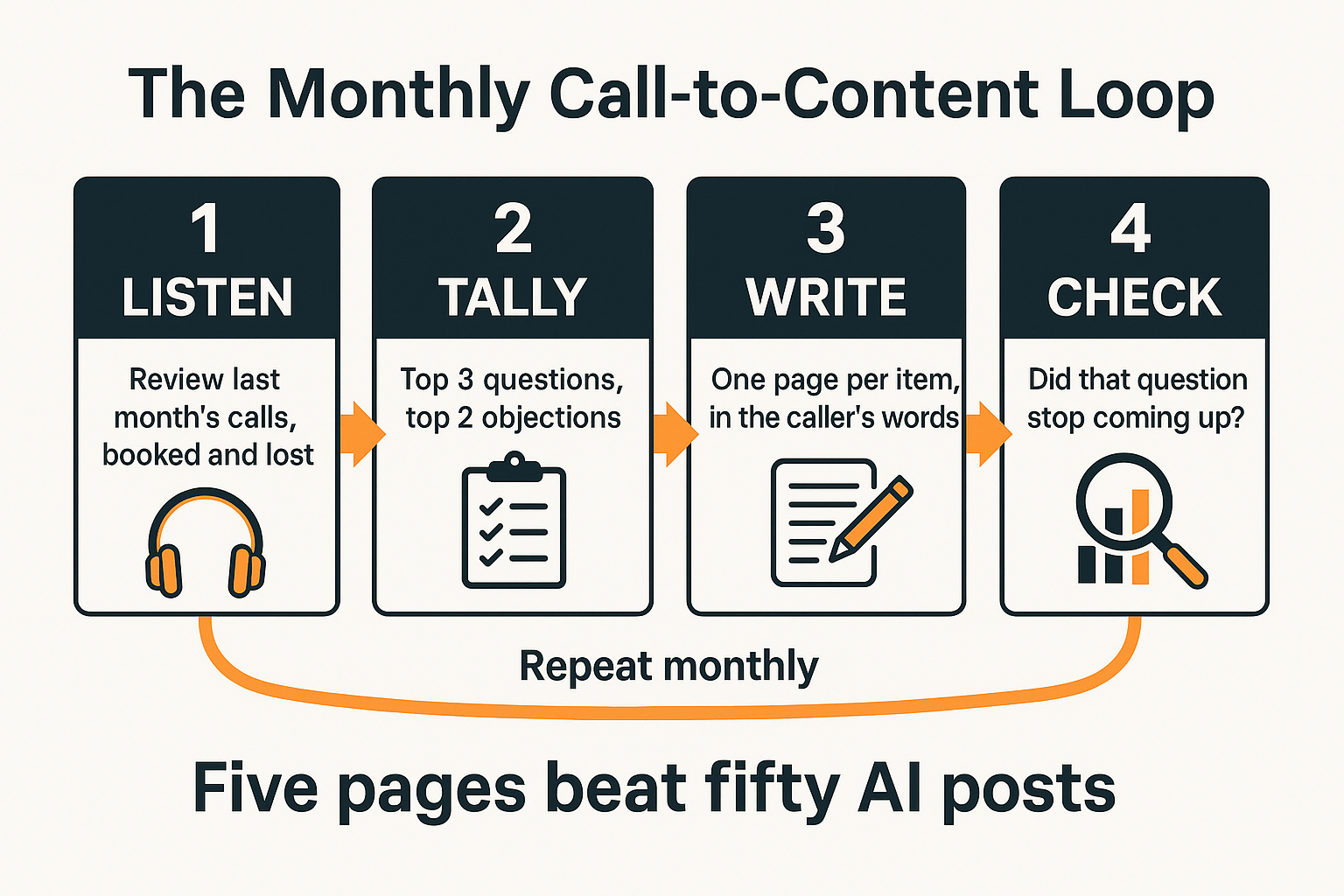
The Monthly Call-to-Content Loop
This is the whole process. Four steps, once a month, roughly two hours of your time.
Form Submissions Feed the Queries Where AI Answers Show Up
When homeowners type instead of talk, the phrasing gets longer and more specific. That is exactly the query shape AI answers are grabbing right now.
Whitespark’s Q2 2026 local search data found AI Overviews appearing in 97% of hybrid queries, meaning searches that mix a question with a place, like “average cost of HVAC replacement in Salinas.” Read your form submissions for a month and you will see that same structure over and over.
One form I reviewed described a problem in about four sentences, including the age of the house, the neighborhood, and a guess at budget. That single submission was a page outline.
Google’s own guidance on creating helpful, people-first content keeps pointing at the same thing: content written from real experience for real people. Customer language is the shortest path there, which is also why sites stuffed with generated filler keep running into trouble.
This is the connection between the two systems we run. Voice of Customer is what the content is made of. AI Search Sync is how that content gets found across Google, ChatGPT, Perplexity, and Gemini.
Reviews Tell You Which Outcome to Lead With
Reviews close the loop, because they describe results in the words homeowners use when they are relieved.
When a review says something along the lines of “they fixed a problem three other plumbers couldn’t diagnose,” that is a content asset sitting in plain sight. Somebody in Hollister with an intermittent leak nobody can find is searching in almost exactly those terms.
Use review language three ways:
- Service page headings. Lead with the outcome customers actually name, not the technical service label.
- FAQ answers. Their wording is clearer than yours will be.
- Google Business Profile posts. Short, specific, and it feeds review context back into local search.
Reviews that mention the trade, the city, and the job type do double duty. They read well to homeowners and they give AI tools the context they use when deciding which contractor to name. I go deeper on that in what AI-powered local SEO checks before recommending a contractor.
Our Seasons Change the Calls, So Plan Content Ahead of Them
Central Coast call volume is not flat, and the questions rotate on a schedule you can predict.
What I watch for:
- October through February: storm calls across Santa Cruz County and the Watsonville area. Roof leaks, drainage, downed limbs, standing water.
- Late spring: inland heat pushes AC and system replacement questions in Salinas, Gonzales, and King City while the Peninsula stays quiet.
- Summer: remodel and landscaping research season, long consideration cycles, lots of cost questions.
- Year-round on the coast: moisture, salt air, and pest pressure in Pacific Grove, Monterey, and Marina.
Here is the timing piece most contractors get wrong. A page about storm-related roof leaks published in December is already late. Search interest spikes in hours during a storm, and pages need weeks to settle into rankings.
So I pull last year’s call log by month, find the questions that surged, and publish that content 60 to 90 days ahead. We usually see first measurable ranking movement within about 30 days of publishing, which means an early fall build gives you room before the first real rain.
How to Start This Yourself, Without Buying Anything
You do not need software to begin. You need one hour a month and a willingness to hear the calls you lost.
A workable starting process:
- Pick a consistent day each month. First Monday works.
- Listen to or skim notes from 15 to 20 calls, including at least five that did not book.
- Write down every question in the caller’s own words. Do not clean it up.
- Mark the three that repeat most and the two objections that ended calls.
- Publish five short pages over the next month, one per item.
Five pages built this way will outperform fifty generated posts, every month, without exception in what I have seen across Monterey County. If you want the reasoning behind that, this piece on where automated content helps and where it backfires lays it out.
One caution on privacy. If you record calls in California, you need to notify the caller. Keep names, addresses, and phone numbers out of anything you publish. Paraphrase the question, never the person.
Frequently Asked Questions About Using Customer Calls for SEO Content
How many calls do I need before this is useful?
Fewer than you think. 15 to 20 calls is usually enough to see the top questions repeat. If you take 30 or more calls a month, patterns get obvious fast.
Do I have to record calls to do this?
No. A notepad by the phone works, as long as whoever answers writes down the actual words the caller used instead of summarizing. Recording just makes it accurate and lets you hear tone on the calls you lost, which is where the objections live.
Is it legal to record calls in California?
California requires all parties to consent, so you need a notification at the start of the call. Most tracking systems handle that automatically with a short announcement. Keep customer names and numbers out of any content you publish regardless.
Will writing in customer language hurt how professional my site looks?
It reads more credible, not less. A page titled around “why your furnace clicks on and off” tells a homeowner in Salinas you have heard the problem before. Clean grammar and plain wording can live together.
How long until content built from calls shows up in search?
We typically see first measurable movement within about 30 days of publishing, with steadier gains over three to six months. Pages targeting seasonal problems should go up 60 to 90 days before the season starts.
Want a Second Set of Ears on Your Call Log?
If you run a home service business anywhere from Santa Cruz down through Salinas and King City, your last 30 days of calls probably already contain your next five pages. Core6 Marketing works with contractors across Monterey County on exactly this kind of local visibility work, and Phil Fisk handles discovery calls himself at (831) 789-9320. Book a Discovery Call when you want to talk through what your own call log is telling you: https://calendly.com/core6-marketing/30min.