
Direct Answer: Electrician websites that generate calls answer three questions fast — can you fix my problem, do I trust you, and how do I reach you — and they’re built to do that on a phone screen first.
The search query ‘electrician website examples’ gets close to 1,000 impressions over a three-month window — but almost nobody actually clicks through. That tells me something real: homeowners and electrical contractors alike are searching for working examples, not marketing theory, and most of what they find doesn’t give them what they came for.
I’ve looked at a lot of contractor sites over the past 20 years working with home service businesses on the Central Coast. Most failing electrician websites look fine at first glance. There’s a logo, a phone number buried somewhere, a list of services, maybe a crew photo. What’s missing is a reason to call right now.
This article focuses on what the working examples actually share — the two or three things that separate a site that rings from one that just sits there. These observations hold true across trades, but I’m using electricians as the frame because that’s where the search behavior is, and because the stakes are high: electrical problems don’t wait.
The Three Questions Every Visitor Is Trying to Answer
When a homeowner in Seaside trips a breaker at 7 p.m. and searches for an electrician, they land on your site with three questions in their head:
- Can you fix my problem?
- Do I trust you?
- How do I reach you?
If any one of those takes more than a few seconds to answer, most visitors leave without making contact. They don’t call to ask — they just hit the back button and find the next result.
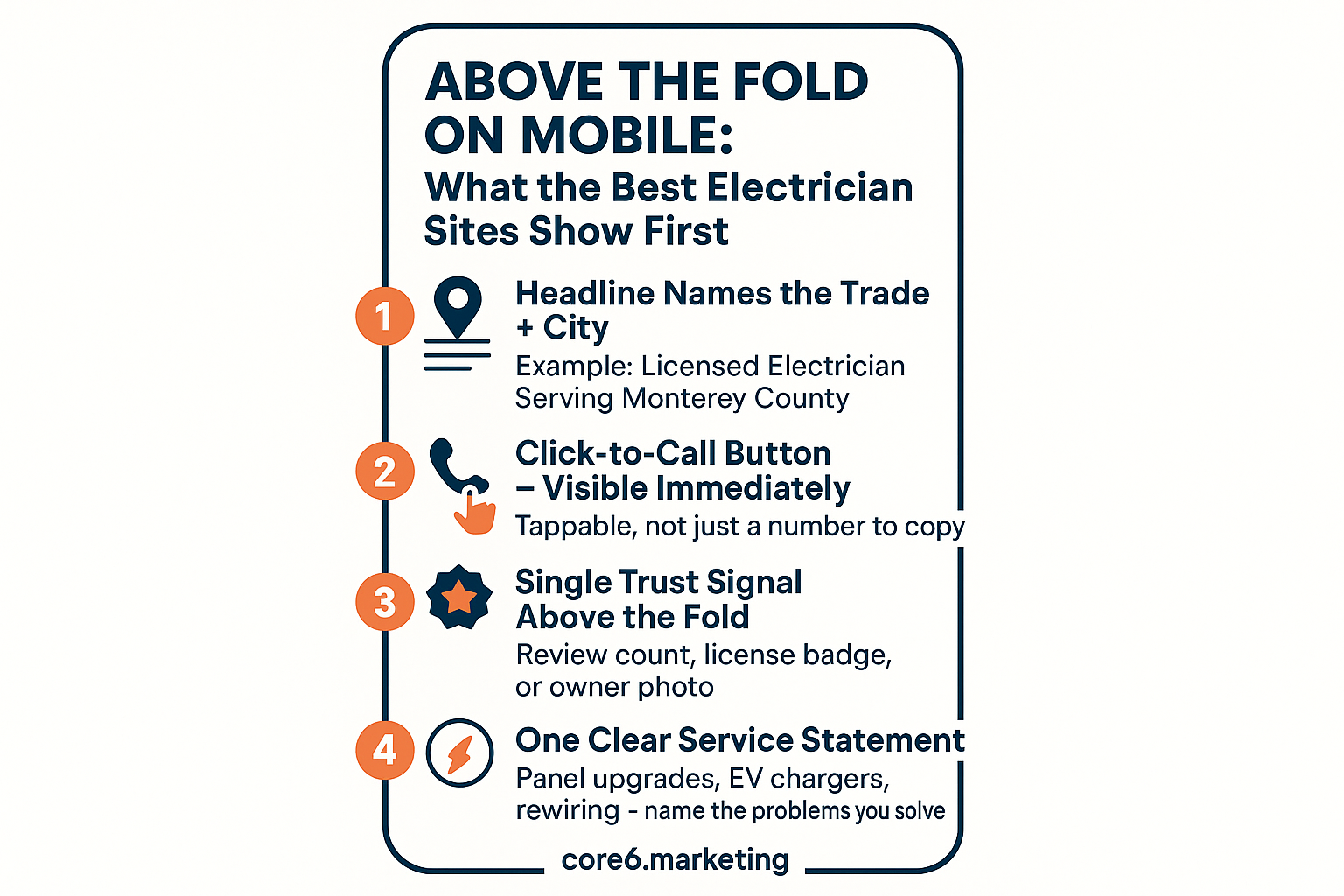
The sites that convert well answer all three questions above the fold — meaning before a visitor scrolls at all. The headline names the service and the area. There’s a visible phone number, ideally a click-to-call button on mobile. And there’s at least one trust signal — a review count, a license badge, a photo of the actual owner — that signals “this is a real local business.”
What I consistently see failing is the generic approach: a hero image of a stock electrician, a headline that says something like “Quality Electrical Services” with no location, and a phone number buried in the footer. That layout might look professional, but it answers none of those three questions quickly. And why contractor websites rank but don’t ring is almost always a layout and messaging problem, not a traffic problem.
Why Mobile-First Isn’t a Design Preference — It’s the Whole Game
More than 63% of organic search traffic now comes from mobile devices. A homeowner with a panel issue or a tripped breaker is almost never sitting at a desktop. They’re standing in their kitchen holding their phone.
If an electrician’s site requires zooming, scrolls sideways, or takes more than two to three seconds to load on a phone, a significant portion of those visitors are already calling the next result before the page even finishes loading. I’ve seen this pattern with contractors across Monterey County and it’s not close — slow and broken mobile experiences are one of the single biggest conversion killers in the trades.
The specific elements that matter most on mobile:
- A click-to-call button visible above the fold — not a number you have to tap and copy
- A headline that loads immediately and names the trade and city
- Images compressed enough to not stall the page load
- No horizontal scrolling, no tiny tap targets, no pop-ups that cover the screen
Page speed matters for search rankings too, not just user experience. Industry data consistently points to sites loading under two seconds ranking better and converting more than slower ones. A contractor in Salinas running a site on cheap shared hosting — or one that hasn’t been touched in two or three years — is losing organic position and first impressions at the same time.
This is also why the cheapest website option tends to cost the most jobs over time. The upfront savings disappear fast when the site is too slow to rank and too clunky to convert.
What a High-Converting Electrician Website Looks Like on Mobile
This breakdown shows the specific elements that appear above the fold on electrician websites that consistently generate calls — and what most contractor sites are missing in that same space.
How Trust Signals Actually Work on a Contractor Website
Most electricians list their license number and drop an “insured” badge in the footer and call it done. That’s not really a trust signal — that’s a compliance checkbox. Real trust signals change a visitor’s decision.
Here’s what I’ve seen actually move the needle:
Short video of the owner explaining their process. It doesn’t need production value. A 60-second phone video where the owner says who they are, what they do, and what a service call actually looks like does more work than a page full of badges. People hire people, especially for electrical work in their home.
Before-and-after photos with specific captions. A photo labeled “panel upgrade completed in Pacific Grove, 2024” tells a homeowner in Pacific Grove something useful — you’ve done this work nearby, recently. Generic stock photos of wiring panels don’t tell them anything.
Reviews that name neighborhoods. Reviews mentioning “fixed our panel in Seaside” or “came out same day in Marina” signal local relevance to both the homeowner and to search engines. Specificity is what makes a review believable. A contractor with 40 reviews that mention real Central Coast neighborhoods is more convincing than one with 200 generic five-star ratings.
This specificity point connects directly to how local search works. When Google or an AI-powered search engine like ChatGPT or Perplexity evaluates which electrician to surface for a query, the presence of location-specific content — in reviews, in service descriptions, in photo captions — matters. Our AI search visibility approach is built around exactly this kind of content signal, not just traditional ranking factors.
Trust Signals: What Works vs. What Contractors Think Works
Here’s a straightforward comparison of the trust elements that actually influence a visitor’s decision versus the ones most electrician sites lean on without much result.
| Trust Element | How Most Contractors Use It | What Actually Converts |
|---|---|---|
| License number | Listed in footer, small text | Visible near the headline with a brief explanation of what it means for the homeowner |
| Insurance badge | Footer icon, no context | Brief sentence explaining liability coverage and what that protects the homeowner from |
| Google reviews | Widget on homepage, generic | Reviews with neighborhood mentions pulled into service pages — specificity builds local credibility |
| Owner photo | Staff page nobody visits | Owner photo and first-person quote above the fold on the homepage |
| Video | Usually absent entirely | 60-second owner intro or job walkthrough — even shot on a phone — outperforms most written copy |
| Before/after photos | Generic or stock images | Real job photos with captions naming the city, the problem, and the outcome |
The Technical Condition of the Site Is Part of the First Impression
Most electricians don’t think of their site’s technical health as a marketing issue. But the condition of a site’s backend directly affects both its search rankings and what a homeowner sees when they land on it.
A site that loads slowly because it’s on cheap shared hosting isn’t just annoying — it’s actively losing rankings to faster competitors. A site that hasn’t been updated in two years may have broken plugins, expired SSL certificates, or outdated contact forms that silently fail. I’ve talked to contractors in Monterey and Salinas who had no idea their contact form had been broken for months.
The technical factors that matter most for an electrician’s site:
- Page load speed — under two seconds on mobile is the target
- SSL certificate — the padlock in the browser bar; missing or expired kills trust and hurts rankings
- Mobile responsiveness — the site renders correctly on every phone screen size
- Working contact forms — tested regularly, with confirmation emails that actually send
- Updated platform and plugins — outdated WordPress installs are a security and performance liability
None of this is glamorous. But it’s the foundation. A site that answers all three visitor questions clearly but loads in five seconds and has a broken form is still losing calls. For a deeper look at what makes an electrician’s website actually generate calls, these technical factors sit at the base of everything else.
Frequently Asked Questions About Electrician Websites
How much does it typically cost to build a website for an electrical contractor?
Costs vary considerably depending on the size of the site, who builds it, and what’s included. Based on what I see in the Monterey County market, a professionally built contractor website generally falls somewhere in a range that reflects the scope of work — a simple five-page site built by a local agency will look very different in price from a template-based DIY build, and both will be far apart from a larger custom project. The bigger question is what the site is built to do. A site built primarily to convert visitors into calls — with the technical performance, mobile layout, and trust signals this article describes — costs more upfront than a basic online brochure, but the math on what a single new electrical job is worth changes that calculation quickly. For an accurate picture of what a contractor site project actually involves and costs, it’s worth talking to someone who builds specifically for the trades.
Does my electrician website need to rank on Google, or is paid advertising enough?
Both can work, but they serve different timeframes. Google Ads can get an electrician’s phone ringing within days. Local SEO takes longer to build but produces traffic you’re not paying per click for. Most electrical contractors on the Central Coast who are consistently generating inbound calls are running both — ads for immediate volume and SEO for long-term organic position. If you want to understand how local SEO actually works for home service contractors, the mechanics are worth understanding before you invest.
Will AI search like ChatGPT affect how homeowners find my electrical business?
It already is, for some searches. When someone asks ChatGPT or Perplexity to suggest a licensed electrician in Monterey County, those platforms pull from the same signals that influence Google — reviews, citations, location-specific content, and how your Google Business Profile is maintained. The electricians showing up in those results aren’t doing anything exotic. They have consistent NAP information across directories, location-specific content on their site, and enough reviews with real detail that the AI has something to surface. Your HVAC Website Has One Job covers similar principles for another trade if you want to see how this applies across the board.
How many pages does an electrician’s website actually need?
More than most contractors think, but not for the reason you’d expect. A five-page site is fine as a starting point. But if you serve multiple cities — say, Salinas, Monterey, Marina, and Pacific Grove — having a single “Service Area” page that lists them all in a bullet list does almost nothing for local search. Separate pages for each key service and each primary city, even if they’re relatively short, give search engines more to work with and give homeowners in those areas something that feels specific to them.
What’s the biggest mistake electricians make with their website?
Building it to look good instead of building it to convert. A lot of contractor websites are designed with the owner’s pride in mind — the logo is front and center, there’s a long history section, the crew photos are carefully staged. But the homeowner who lands on that site at 8 p.m. with a failed circuit doesn’t care about any of that. They want to know if you serve their area, if you’re available, and how to call you in under ten seconds. Anything that slows down that path costs calls.
Want to Know What Your Electrician Website Is Actually Missing?
We work with home service contractors across Monterey County and the Central Coast, and we look at contractor websites every day. If yours isn’t generating consistent inbound calls, there’s usually a short list of fixable reasons why. You can book a no-pressure Discovery Call with Phil at https://core6.marketing/work-with-us/ to walk through what your site is doing — and what it isn’t.