Direct Answer: ChatGPT and other AI search tools pull from a different set of signals than Google. If your business isn’t structured around those signals, you won’t show up — even if your Google ranking is decent.
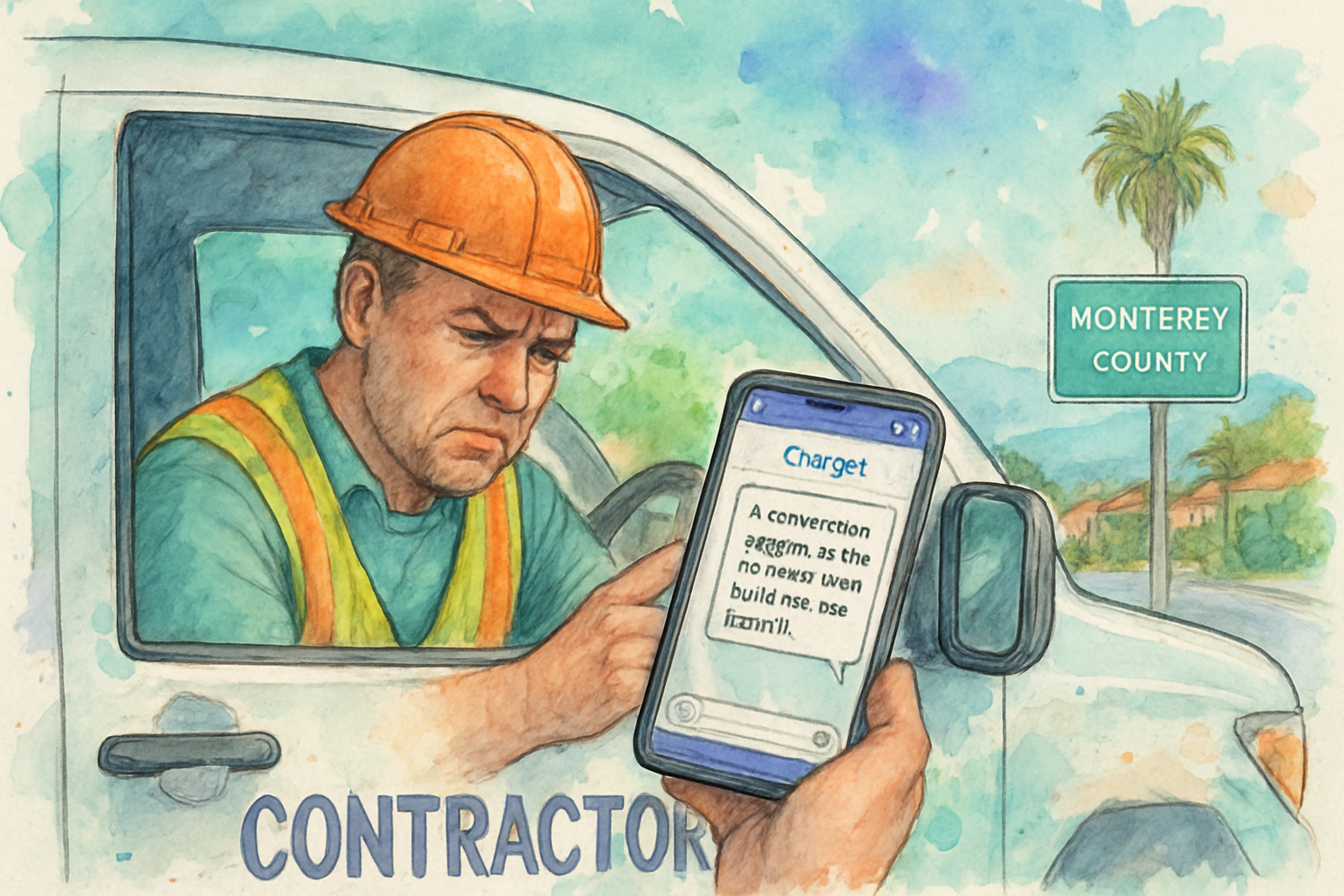
A roofing contractor in Salinas mentioned it at a chamber meeting last spring. He’d searched ‘best roofing contractor in Salinas’ in ChatGPT — and one of his competitors came up by name. He didn’t. His Google ranking was fine. His website had been up for years. But in ChatGPT, he was invisible.
This is happening right now across Monterey County. Plumbers in Seaside, HVAC companies in Carmel Valley, electricians in Marina — all competing in a search environment that most of them don’t know exists yet. And the contractors who figure this out early are going to own a serious advantage.
This article explains why AI search platforms like ChatGPT, Perplexity, and Google’s AI Overviews return the results they do — and what separates the businesses that show up from the ones that don’t.
AI Search Doesn’t Work Like Google — Here’s What It Actually Does
When someone types a question into Google, Google returns a list of links ranked by hundreds of factors. You click, you browse, you decide.
When someone asks ChatGPT ‘who’s the best HVAC company in Monterey County,’ something different happens. The AI doesn’t search in real time. It pulls from a large body of text it was trained on — and it tries to synthesize an answer. It’s pattern-matching across everything it’s absorbed: review platforms, directories, news sites, local publications, and yes, your website.
The businesses that get named are the ones whose information appears consistently, accurately, and repeatedly across all those sources. If your business name, address, and phone number appear correctly on Yelp, Angi, Houzz, your Google Business Profile, the Better Business Bureau, and a handful of local sites — that pattern gets picked up. If your information is scattered, outdated, or missing in key places, the AI has no pattern to recognize.
This is fundamentally different from trying to rank for a keyword. There’s no algorithm to reverse-engineer. The AI is just asking: ‘does this business have enough of a verifiable digital footprint that I can confidently mention it?’ If the answer is no, you don’t get mentioned.
For contractors on the Central Coast trying to improve their search ranking, this adds a new layer that goes well beyond traditional SEO tactics.
The Three Things That Determine Whether You Show Up in AI Results
After working with contractors across Monterey County and the Central Coast for over 20 years, the pattern is clear. Businesses that show up in AI-generated answers share three characteristics. Businesses that don’t, are usually missing at least two of them.
1. Citation consistency across 50+ directories
Every directory that lists your business is a data point. If your name is ‘ABC Plumbing’ on Google, ‘A.B.C. Plumbing & Drain’ on Yelp, and ‘ABC Plumbing Co.’ on Houzz — the AI sees three different businesses. Or it sees nothing it trusts enough to repeat.
The target is identical NAP (name, address, phone) across every platform where you appear. This means:
– Google Business Profile
– Yelp
– Angi (Angie’s List)
– Houzz
– HomeAdvisor
– Better Business Bureau
– Nextdoor
– Bing Places
– Apple Maps
– Local Chamber directories (the Salinas Valley Chamber and Pajaro Valley Chamber both have listings that carry real weight locally)
2. A website that clearly answers specific questions
AI platforms are looking for text that directly answers questions people ask. A website that says ‘We’re a family-owned plumbing company serving Monterey County’ is nearly useless to an AI. A page that says ‘We replace water heaters in Salinas, CA — most jobs are done same-day for $800 to $1,400 depending on unit size’ gives the AI something to work with.
Specific services, specific locations, specific answers. That’s what gets pulled.
3. Volume and recency of reviews — with owner responses
AI models weigh review activity heavily because it’s a strong signal of a real, active, trusted business. A contractor with 47 Google reviews averaging 4.8 stars who responds to every review looks very different to an AI than one with 12 reviews and no responses — even if the second contractor does better work.
If your Google reviews have gone quiet, that’s worth addressing. Missing reviews are more recoverable than most contractors think.
What AI Search Is Actually Looking For
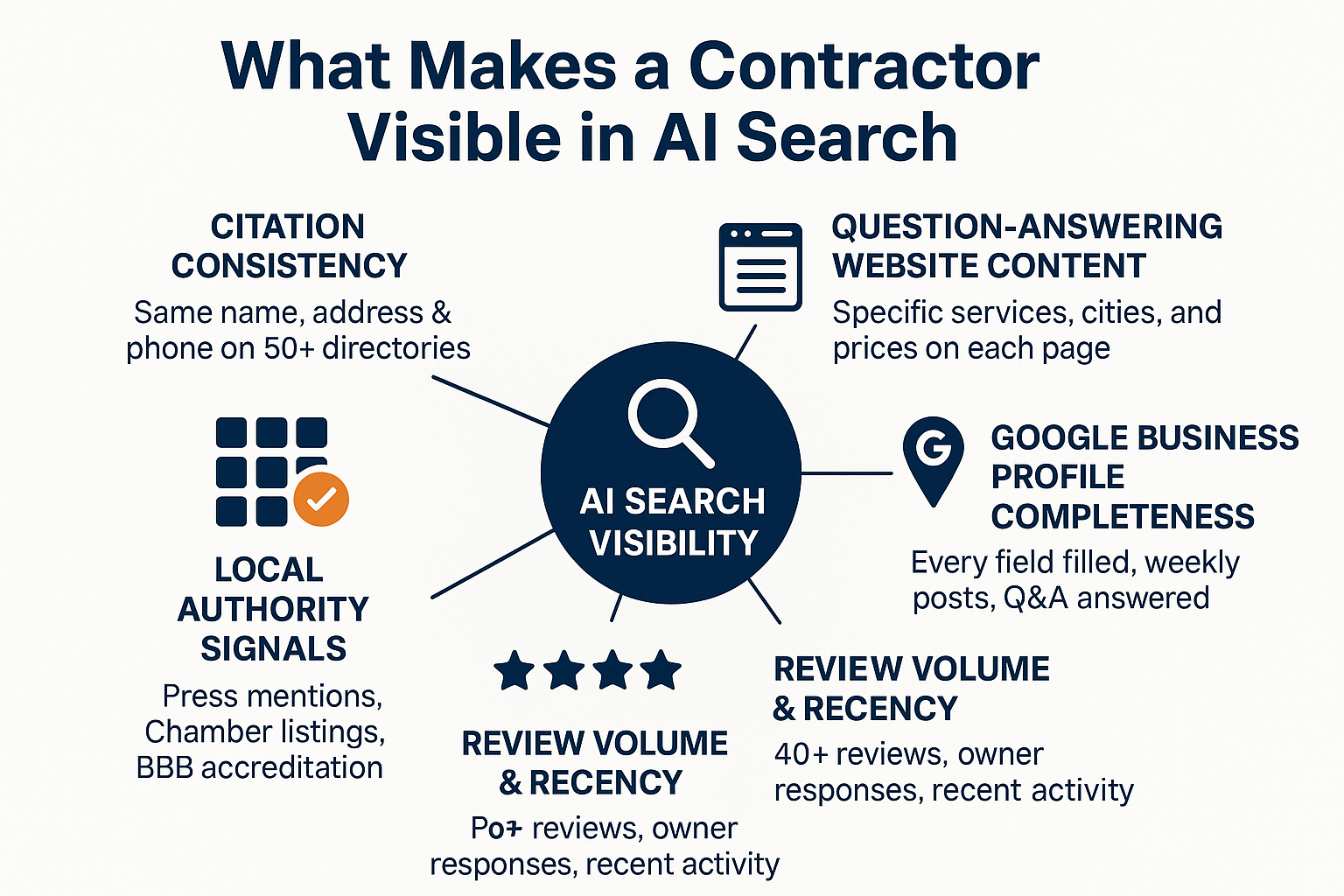
This breakdown shows the key signals that AI platforms like ChatGPT and Perplexity use when deciding whether to mention a local business in a generated answer.
Why Google Rankings Don’t Automatically Translate to AI Visibility
This is the part that surprises most contractors. You can rank on page one of Google for ‘plumber Monterey CA’ and still be completely invisible in ChatGPT. The two systems are measuring different things.
Google ranks pages based on technical factors: backlinks, site speed, structured data, keyword relevance, Core Web Vitals, and a long list of signals that SEOs spend careers tracking. It’s a live index of pages, re-crawled constantly.
ChatGPT, Perplexity, and Gemini are language models trained on a snapshot of the internet. They’re not re-crawling your site every week. They’re drawing on what they absorbed during training — and supplementing that with real-time web retrieval when enabled. But the weight of what they say still leans heavily on how well-documented your business is across the broader internet ecosystem, not just your own site.
That means a contractor who has ignored their Google Business Profile, let their Yelp listing go stale, and never built a single citation outside of their website is nearly invisible to AI — regardless of their Google ranking.
And a contractor who has a mediocre Google ranking but strong citation coverage, active reviews, and authoritative local directory listings may very well show up when someone asks ChatGPT for a recommendation in Salinas or Pacific Grove.
The difference between a contractor who has a website and one who actually gets found has always come down to how thoroughly the digital footprint is built — and AI search makes that even more true now.
Google SEO vs. AI Search Visibility: What’s Different
Here’s a side-by-side look at what each system responds to — so you can see where the gaps in your current setup likely are.
| Signal | Google SEO | AI Search (ChatGPT, Perplexity) |
|---|---|---|
| Citation consistency across directories | Important — affects local pack | Critical — primary trust signal |
| Website keyword optimization | High weight | Moderate — content depth matters more than keywords |
| Google Business Profile completeness | High weight for local pack | High weight — used as a primary source |
| Review volume and recency | High weight | High weight — signals active, trusted business |
| Backlinks from other sites | Very high weight | Low direct weight, but authority still matters |
| Specific Q&A content on website | Moderate — helps with featured snippets | High — AI pulls direct answers from page content |
| Local press or directory mentions | Moderate | High — reinforces business legitimacy |
| Page speed and technical SEO | High weight | Not directly measured |
What ‘AI Search Sync‘ Actually Means in Practice
When we talk about AI Search Sync — the methodology we use at Core6 — it’s not a buzzword for doing the same old SEO with a new label. It’s a specific approach to building the kind of digital footprint that AI platforms trust.
For a contractor in Monterey County, that means:
- Auditing and correcting every major citation — not just the top five directories, but 50 or more, including niche contractor directories and California-specific platforms
- Rewriting key website pages to answer the exact questions AI is trained to look for: ‘how much does a new HVAC system cost in Salinas,’ ‘who does same-day drain cleaning in Marina,’ ‘what’s the best roofing contractor in Carmel Valley’
- Google Business Profile optimization — categories, services, photos, weekly posts, Q&A responses, and attribute completion
- Review strategy — a repeatable process for generating consistent new reviews from real customers, so the review clock never goes quiet
- Local authority building — getting the business mentioned on local news sites, regional directories, and community platforms that AI models treat as credible sources
This is different from standard local SEO in one important way: traditional SEO is optimizing for an algorithm. AI Search Sync is optimizing for a language model’s confidence threshold. The question isn’t ‘does Google rank this page’ — it’s ‘does an AI have enough evidence to trust and mention this business by name.’
For contractors who have been relying on Angi or HomeAdvisor for leads and getting burned by shared, low-quality contacts, this kind of owned visibility is the long-term alternative. Your name in a ChatGPT answer is an exclusive mention — there’s no bidding war, no shared lead pool, and no per-call fee.
What You Can Do Right Now — Before Hiring Anyone
You don’t need an agency to take the first steps. Start here:
Step 1: Search your own business in ChatGPT and Perplexity
Open ChatGPT and type: ‘What are the best [your trade] companies in [your city], CA?’ See what comes back. If your name isn’t there and a competitor’s is, you now know the gap exists. That’s the starting point.
Step 2: Check your Google Business Profile for completeness
Log in and look at your profile like a stranger would. Is every service listed? Are your hours correct? Do you have at least 10 photos? Have you answered every question in the Q&A section? A half-filled profile sends weak signals.
Step 3: Google your business name and look at what the directories say
Search ‘[your business name]’ and check the first five directory listings that come up. Is your address the same on all of them? Is the phone number right? Is the category correct? Fix anything that’s inconsistent.
Step 4: Count your reviews and look at the last 90 days
If you haven’t gotten a new review in two months, the AI sees a stale business. That’s fixable — a simple follow-up text to your last 10 customers asking for an honest Google review can change that inside a week.
None of this is complicated. But it does take consistency. And contractors who treat their online presence the way they treat their equipment — with regular maintenance instead of emergency repairs — are the ones who end up owning the market.
Frequently Asked Questions About AI Search Visibility for Contractors
Does ChatGPT actually send leads to local contractors?
More than most contractors expect, and it’s growing fast. In Monterey County, a meaningful and increasing share of homeowners — particularly those 35 and younger — are starting their search for a contractor in ChatGPT or Perplexity instead of Google. They’re asking questions like ‘who’s a reliable plumber in Salinas’ and acting on what the AI says. If your name comes up, that’s a warm, pre-qualified referral. If it doesn’t, you’re not losing a lead — you never knew it existed.
If I rank well on Google, why wouldn’t I also show up in AI search?
Because they’re different systems measuring different things. Google ranks pages. AI models build confidence in businesses based on how well-documented they are across the entire web — not just how one website performs technically. A contractor can have a page-one Google ranking and zero presence in AI results if their citations are inconsistent and their non-Google footprint is thin.
How long does it take to start showing up in ChatGPT results?
Honestly, this is harder to predict than Google rankings because AI models update on different schedules. Citation cleanup and GBP optimization can start showing impact in 30 to 90 days as those updates propagate across directories that AI tools monitor. Some contractors see their name appear in AI responses within 60 days of a full citation audit. Others take longer, depending on how much cleanup is needed and how competitive the local market is.
Is this different from what SEO agencies have been doing for years?
Most traditional SEO is built around Google’s ranking algorithm — backlinks, on-page optimization, technical fixes. That still matters. But AI Search Sync goes further by specifically targeting the signals that language models weight: citation consistency, question-answering content, review momentum, and local authority signals from sources outside your own site. It’s an additional layer, not a replacement.
What if my competitor is already showing up in ChatGPT — am I too late?
No. AI search is still early enough that most contractors in Monterey County haven’t intentionally done anything to appear in it. Your competitor probably showed up because they happened to have strong citation coverage and an active Google Business Profile — not because they ran a deliberate AI search strategy. The gap is closable. Contractors who move on this in 2025 are still early.
Does this work for all trades, or just certain ones?
It works for any trade where homeowners search for a recommendation. Plumbers, HVAC companies, roofers, electricians, landscapers, general contractors, pest control — all of these show up in AI-generated recommendations when the business has a strong enough digital footprint. The trades that benefit most are the ones where trust matters and price shopping is secondary to confidence in who’s coming to your home.
Want to Know Where You Stand in AI Search Right Now?
We do a quick audit for contractors in Monterey County and across the Central Coast — checking your citation consistency, GBP completeness, review health, and whether you’re showing up in ChatGPT and Perplexity results for your trade and location. If you want to see what the AI actually says about your business, and what it would take to change it, you can book a 30-minute discovery call with Phil Fisk at https://calendly.com/core6-marketing/30min.