If you’re a contractor in Monterey County, you know the value of a solid first impression. You might have built your own website or paid for a cheap one a few years ago—but you’re wondering if it’s still good enough to bring in leads. That’s a smart question, because your website is often the first impression customers get. If it looks outdated or hard to use, people move on fast.
According to industry reports, 94% of first impressions come from website design, and 75% of users judge a company’s credibility based on the website. That means even if you're great at what you do, a weak site could be costing you jobs in Salinas or Santa Cruz. A lot of contractors assume “having a site” is enough. But many DIY websites load slowly, aren’t mobile-friendly, or lack trust signals like reviews, local project photos, or easy contact options. That creates doubt—and doubt kills calls.
This article provides a clear, actionable checklist detailing exactly what should a good contractor website have in 2026? to not just compete, but dominate the Monterey Bay market. It's time to focus on conversion-driven design. That means fast load speed, clear click-to-call buttons, local credibility (photos, badges, reviews), and mobile responsiveness. Your site needs to be built for Google and for real customers—especially as voice and mobile searches grow.
1. Mobile-First Responsive Design with Fast Load Times
In 2026, your website is, first and foremost, a mobile website. With more than two-thirds of all web traffic originating from smartphones, a mobile-first design is no longer a feature; it's the foundation of what should a good contractor website have in 2026. This approach involves designing the user experience for the smallest screen first and then scaling it up for tablets and desktops, ensuring a seamless experience for every visitor, no matter their device.
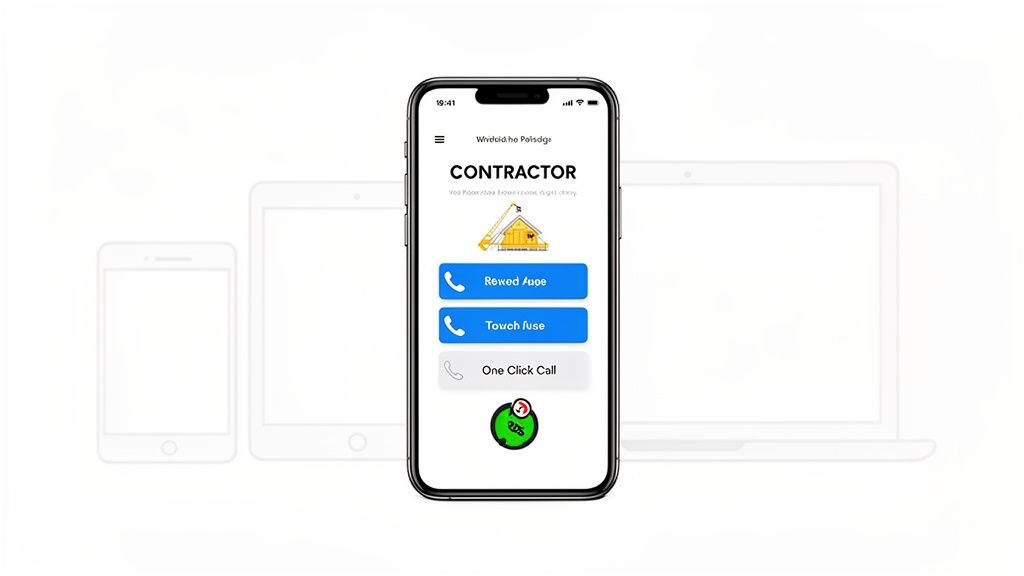
This matters immensely to potential customers in places like Salinas or Santa Cruz County. When a homeowner in Monterey has a burst pipe, they aren't firing up their desktop; they're grabbing their phone to find a plumber immediately. If your site is slow, clunky, or hard to navigate on their device, they will simply click back and call your competitor. Google knows this, which is why its mobile-first indexing prioritizes websites that perform well on mobile devices, directly impacting your local search visibility.
Why Speed is Non-Negotiable
A fast-loading site, one that appears in under two seconds, is critical. Slow speeds frustrate users and hurt your SEO rankings. Google’s Core Web Vitals are a set of metrics that measure user experience, and page speed is a primary component. A slow site signals a poor user experience, causing Google to rank it lower.
Actionable Implementation Tips
- Prioritize Prominent "Click-to-Call" Buttons: Make it incredibly easy for mobile users to contact you. Place a sticky "call now" button at the bottom of the screen that remains visible as they scroll.
- Implement Lazy Loading: This technique defers the loading of images and media until the user scrolls down to them. This dramatically improves the initial page load speed.
- Test on Real Devices: Browser emulators are helpful, but nothing beats testing your website on actual iPhones and Android devices to catch real-world usability issues.
- Compress Your Images: Use tools like TinyPNG or image compression plugins to reduce file sizes without sacrificing quality. This is one of the quickest ways to boost your site’s speed.
2. Local SEO Optimization with Schema Markup
Simply having a website isn't enough; search engines like Google need to understand what your business does, where you do it, and why customers should trust you. In 2026, Local SEO with Schema Markup is the critical technical element that answers these questions for them. This structured data is a type of code added to your site that acts as a translator, telling search engines that you're an HVAC contractor serving Salinas, not just a generic business page.
This behind-the-scenes optimization is what gets your business featured in the Google Map Pack and prized local search results. For a homeowner in Santa Cruz County experiencing an electrical issue, their "electrician near me" search is answered by businesses Google understands and trusts. Schema markup for your services, reviews, and service area provides that trust, making your site a primary candidate for top results. As search becomes more AI-driven, this explicit data becomes non-negotiable for local visibility.
Why Structured Data is Your Local Superpower
Schema markup helps search engines connect the dots. When you use Service schema, you're not just listing "water heater repair"; you're telling Google this is a specific service you offer in Monterey. When you use Review schema, you're verifying that the five-star rating on your site is legitimate. This clarity leads to rich snippets in search results, like star ratings and service prices, which significantly increase click-through rates.
Actionable Implementation Tips
- Implement Key Schema Types: Focus on
LocalBusiness,Service, andAggregateRatingschemas. These tell Google who you are, what you do, and how well you do it. - Ensure NAP Consistency: Your Name, Address, and Phone number (NAP) must be identical across your website footer, your Google Business Profile, and all local directories.
- Build Hyper-Local Service Pages: Create dedicated pages for each primary service in each major city you serve, like "Roofing in Gilroy" or "Plumbing in Hollister."
- Optimize Your Google Business Profile: Your GBP is a cornerstone of local SEO. Learn how to optimize your Google Business Profile for AI search to stay ahead of the curve.
- Integrate a Broader Strategy: Local SEO is a piece of a larger puzzle. Understanding emerging trends outlined in SEM best practices for 2026 will ensure your digital marketing efforts are comprehensive and future-proof.
3. Trust Signals and Social Proof Integration
When a homeowner in Salinas or anywhere in Monterey County needs a contractor, they are inviting a stranger into their home. This decision is built on trust, which is why social proof is one of the most critical elements a good contractor website should have in 2026. Trust signals are visual cues like reviews, ratings, certifications, and project photos that instantly build credibility and reduce a potential customer's hesitation.
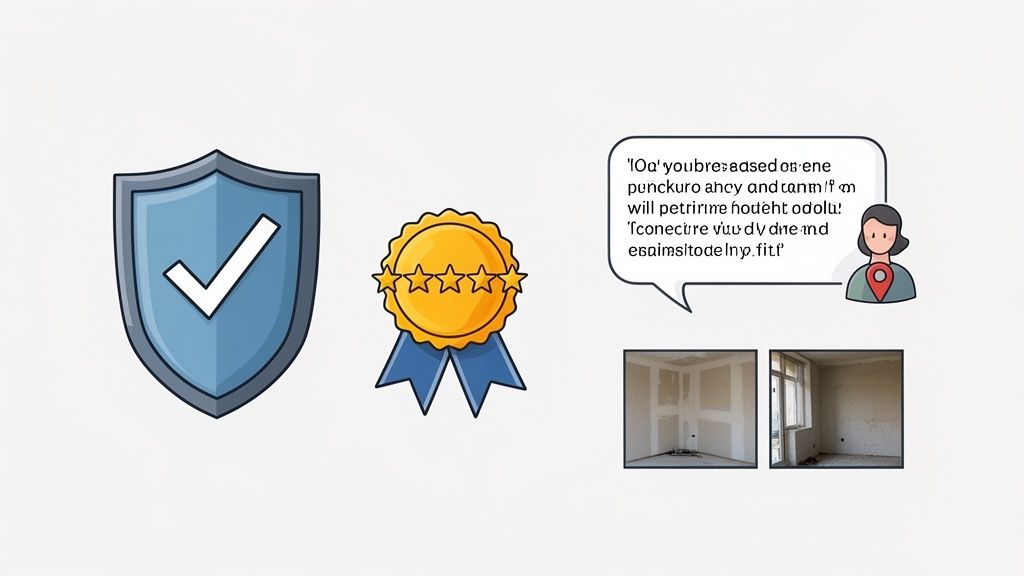
In 2026, these signals are more than just a few static testimonials. They are dynamic, authentic, and integrated directly into the user experience. Think of an electrician in Santa Cruz showcasing their 4.9-star Google rating right on their homepage or a Hollister roofer with an extensive before-and-after gallery of local projects. These elements provide powerful, third-party validation that you do quality work, making the decision to call you much easier. Without them, you are asking a visitor to take a leap of faith that your competitors are not.
Why It's Psychologically Critical
Trust signals directly address a customer’s biggest fear: making a bad hiring decision. Every positive review, license number, or industry badge acts as a piece of evidence that you are a reliable and professional choice. This psychological comfort is often the final nudge a visitor needs to convert from a browser into a paying customer. Effective online reputation management is no longer optional; it's a core conversion strategy.
Actionable Implementation Tips
- Place Ratings Above the Fold: Display your average star rating from Google, Yelp, or Angi prominently on your homepage, where visitors can't miss it.
- Showcase Local Testimonials: Feature reviews from customers in specific cities you serve, like Monterey or Watsonville. Include their name and the service provided to add authenticity.
- Create a Before-and-After Gallery: Visual proof is undeniable. Regularly update a gallery with high-quality photos of your recent work to showcase your skills.
- Systematize Review Requests: Use email or text automation to ask for a review after every completed job. The more recent your reviews, the more relevant they appear to new customers.
4. AI-Powered Chatbots and Instant Lead Capture
In 2026, waiting for a customer to fill out a contact form is a missed opportunity. Your website should engage visitors the moment they arrive, and AI-powered chatbots are the key. These intelligent systems act as a 24/7 virtual assistant, answering common questions, qualifying leads, and capturing contact details automatically. This feature bridges the critical gap between a casual website visit and a qualified sales conversation, ensuring you never miss a lead.
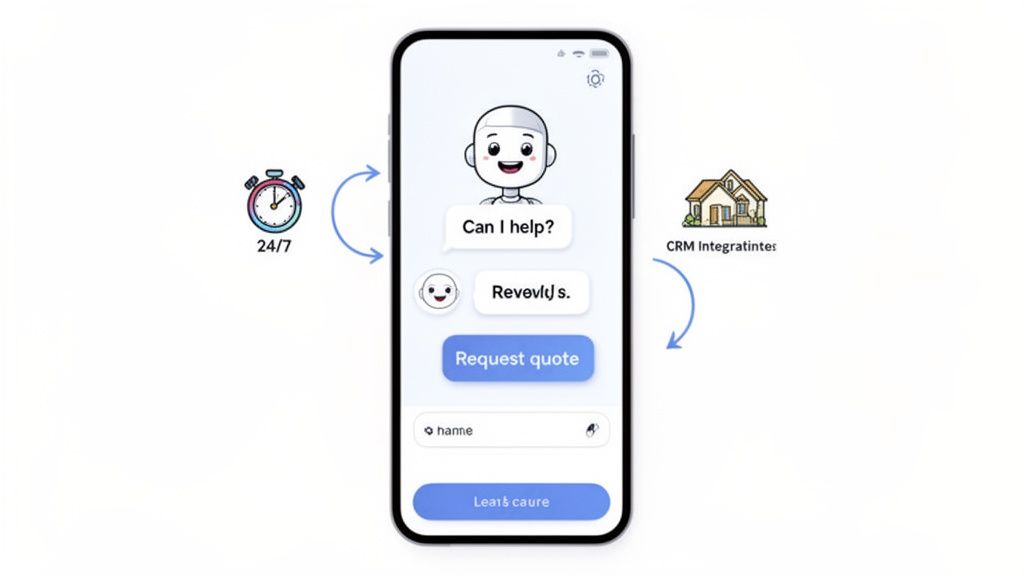
This is a game-changer for contractors in Santa Cruz County. Imagine a homeowner in Watsonville visiting your roofing site after a storm. The chatbot can instantly ask if it's storm damage, gather their address and photos, and pre-qualify them for an emergency inspection. This immediate, helpful interaction builds trust and captures the lead before they can even think about calling a competitor. For HVAC contractors in Salinas, a chatbot can handle high-volume seasonal requests, offering instant quotes for tune-ups or verifying service areas.
Why Instant Engagement Converts
A potential customer with an urgent problem wants answers now, not during business hours tomorrow. AI chatbots provide that instant gratification, making visitors feel heard and valued. By handling initial inquiries, they free up your team to focus on closing deals and completing jobs. Exploring a tool with an AI Chat feature can reveal how these systems provide instant responses and streamline lead capture. These tools are crucial for what should a good contractor website have in 2026.
Actionable Implementation Tips
- Train Your Bot: Feed your chatbot a list of your most frequently asked questions and answers, specific to services in the Monterey Bay Area.
- Create an Escalation Path: Ensure the chatbot can seamlessly transfer the conversation to a live human agent if the query is too complex or the user requests it.
- Integrate with Your Systems: Connect the chatbot directly to your CRM and scheduling software to automatically create new leads and book appointments without manual entry.
- Analyze and Refine: Regularly review chat transcripts to identify common pain points and improve the bot’s responses and conversational flow over time. You can learn more about how AI can help your trade business and find practical tips for implementation.
5. Service-Specific Landing Pages with Clear CTAs
A generic homepage that lists all your services isn't enough in 2026. Potential customers search for specific solutions, not general contractors. This is why service-specific landing pages are a core component of what a good contractor website should have in 2026. These are dedicated pages for each service you offer, like 'water heater repair' or 'commercial roof replacement', designed to capture highly targeted search traffic and convert visitors into leads.
This strategy works because it meets user intent directly. When a homeowner in Salinas searches for "emergency plumber," they want a page that speaks to that exact problem, not a homepage that also discusses kitchen remodels. A dedicated page allows you to align your headlines, content, and call-to-action (CTA) with the visitor's immediate need. This focus improves user experience and signals to Google that your page is a highly relevant result for that specific search query, boosting your local rankings.
Why Specificity Wins
A common mistake contractors make is bundling all their services onto one page. This dilutes your message and hurts your SEO. A dedicated landing page for "HVAC repair in Monterey County" can be optimized with specific keywords, testimonials from local clients who needed repairs, and a clear CTA like "Get Your AC Fixed Today." This targeted approach dramatically increases the chances of that page ranking for relevant searches and converting the visitor who lands on it.
Actionable Implementation Tips
- Problem-Centric Headlines: Instead of a generic "Our Services," use headlines that address the customer's pain point, like "Leaky Roof in Santa Cruz? We Offer 24/7 Emergency Repairs."
- Unique, Valuable Content: Avoid copying and pasting descriptions. Write unique content for each service page that details your process, the benefits, and answers common questions.
- Optimize for Local Modifiers: Ensure each service page title and its content includes local terms, such as "drain cleaning in Gilroy" or "electrical panel upgrade in Hollister."
- Place CTAs Strategically: Include a clear, benefit-driven CTA both above the fold (visible without scrolling) and at the bottom of the page to make it easy for users to take action.
6. Online Booking and Scheduling Integration
In 2026, convenience is king, and a crucial element of what should a good contractor website have in 2026 is frictionless online booking. This means integrating a scheduling system directly into your website, allowing potential customers to view your real-time availability and book a service appointment without ever needing to pick up the phone. This isn't just a nice feature; it's a powerful conversion tool that turns passive website visitors into scheduled, paying jobs.
Think about a homeowner in Gilroy whose AC unit fails during a heatwave. They don't want to play phone tag; they want to see who can come out now. If your website allows them to see an open slot for that afternoon and book it instantly, you’ve likely won the job. This immediacy meets modern customer expectations, which have been shaped by services like Calendly and on-demand apps. For contractors in Monterey County, this system streamlines your entire lead-to-job pipeline, reducing administrative workload and capturing high-intent customers at their moment of need.
Why Self-Service Scheduling Converts
Modern customers value autonomy and speed. Forcing them to call during business hours creates a barrier. An online booking system removes this friction, allowing them to schedule a roof inspection in Santa Cruz at 10 PM or book a plumbing estimate in Salinas before their morning commute. It puts the customer in control and shows that your business is modern, efficient, and respects their time.
Actionable Implementation Tips
- Show Real-Time Availability: Integrate your scheduling tool (like ServiceTitan or Housecall Pro) with your technicians' calendars to display genuinely open slots. This eliminates back-and-forth communication.
- Minimize Form Fields: Only ask for the absolute essentials to book the appointment: name, address, phone number, and a brief description of the issue. You can gather more details later.
- Enable SMS Confirmations: Send automated text messages to confirm the booking and send reminders. SMS has significantly higher open and engagement rates than email.
- Offer Multiple Service Options: Allow users to choose the type of service they need, such as "Emergency Repair," "Routine Maintenance," or "New Installation Quote," to help you prioritize and prepare.
7. Transparent Pricing and ROI-Focused Conversion Framework
In 2026, customers expect clarity, especially when it comes to cost. A vague "call for a quote" without any context can feel like a red flag. A transparent pricing and ROI-focused conversion framework builds immediate trust by clearly outlining service packages, potential costs, and the value you provide. It shifts the conversation from "how much does it cost?" to "what results will I get for my investment?"
This approach is crucial for what a good contractor website should have in 2026 because it addresses a customer's primary concern head-on. A homeowner in Salinas considering an HVAC upgrade wants to see clear maintenance plan pricing and a comparison showing how much they'll save on energy bills. Similarly, a business in Monterey County needs to quickly understand the cost-benefit of upgrading to LED lighting. By framing your services around ROI, you demonstrate that you understand their financial goals and are a partner in their success, not just a service provider.
Why Value Outweighs Price
When customers understand the long-term value, the initial price becomes less of an obstacle. Highlighting cost savings, efficiency gains, or increased property value helps justify the investment. This strategy positions you as a premium, value-driven contractor rather than a low-cost commodity, attracting better-quality leads who are focused on results.
Actionable Implementation Tips
- Create Service Tiers: Offer clear packages like "Basic," "Standard," and "Premium" with defined deliverables and prices. This caters to different budgets and decision-making styles.
- Use ROI-Focused Messaging: Instead of just listing features, emphasize outcomes. Use phrases like "Save up to 30% on your energy costs" or "Increase your home's value."
- Display Financing Options Prominently: If you offer payment plans or financing through partners, make it highly visible. This removes a significant barrier for larger projects.
- Build a Pricing FAQ: Proactively answer common questions like "Do you charge for estimates?" or "What's included in the price?" to build trust and reduce hesitation.
8. Paid Advertising and Advanced Analytics Integration
Having a great website is the first step, but actively driving qualified traffic to it is what fuels growth. By 2026, a top-tier contractor website must seamlessly integrate with paid advertising platforms like Google Ads and social media channels. This isn't just about running ads; it's about creating a data-driven system where every dollar spent is tracked, measured, and optimized for maximum return on investment (ROI). This integration is a critical part of what should a good contractor website have in 2026 for sustainable lead generation.
This strategic approach allows an HVAC contractor in Salinas to bid on "furnace repair near me" during a cold snap and know exactly how many calls those ads generated. Similarly, a roofing company in Santa Cruz County can run geo-targeted Facebook ads after a storm, directing homeowners to a specific landing page and tracking every form submission. Without advanced analytics, you're just guessing where your best leads come from; with it, you're making informed decisions that directly impact your bottom line.
Why Data is Your Most Valuable Asset
Advanced analytics tools like Google Analytics 4 (GA4) and heat mapping software give you a direct window into user behavior. You can see which pages visitors spend the most time on, where they click, and where they drop off. This data is invaluable for optimizing your ad campaigns and your website's conversion paths. If you see that paid traffic from Gilroy is converting at a higher rate than organic traffic, you know to double down on your ad spend in that area.
Actionable Implementation Tips
- Implement Comprehensive Conversion Tracking: Your website must track every important action, from phone calls and form fills to online bookings. This is foundational for measuring ad performance. You can learn more about setting up Google Ads conversion tracking on core6.marketing.
- Utilize Google Local Services Ads (LSAs): For most contractors, LSAs are a must. They appear at the very top of search results and build immediate trust with the "Google Guaranteed" badge.
- Align Ad Copy with Landing Pages: Ensure the promise you make in your ad is immediately fulfilled on the landing page. Mismatched messaging leads to high bounce rates and wasted ad spend.
- Leverage AI-Powered Bidding: Use Google’s Smart Bidding strategies to automatically optimize your bids for conversions or conversion value, letting the algorithm do the heavy lifting for you.
9. Video Content and Visual Storytelling
In 2026, text and static photos are no longer enough to build the trust needed for a home service decision. Video content is a powerful tool to communicate expertise, build an emotional connection, and showcase the quality of your work in a way that words alone cannot. Visual storytelling helps potential customers see the "before and after," meet your team virtually, and understand complex services, making it a critical part of what a good contractor website should have in 2026.
This is especially true for contractors across Monterey County. A homeowner in Salinas considering a major kitchen remodel wants to see your craftsmanship, not just read about it. A short video showcasing a recent project in Pacific Grove, complete with a testimonial from the happy client, is far more persuasive than a simple photo gallery. By showing your process, your team, and your results, you remove doubt and build the confidence a customer needs to make that call.
Why Visuals Convert Better
Video and high-quality images tell a story quickly and effectively. They demonstrate your professionalism and the real-world results you deliver. For services like roofing or HVAC installation, drone footage of a completed job provides a perspective that standard photography can't capture. Engagement metrics from video, such as watch time, also send positive signals to Google, which can boost your search rankings.
Actionable Implementation Tips
- Prioritize Authentic Testimonials: A video of a real customer in Santa Cruz praising your work is the most powerful marketing asset you can have. Keep it genuine and unscripted.
- Create Short Service Explainers: Use a 90-second video to explain the process of a common job, like replacing a water heater or upgrading an electrical panel. This educates the customer and positions you as the expert.
- Showcase Your Team: Introduce your technicians in short, friendly videos. This humanizes your business and builds trust before you even step on the property.
- Optimize and Embed Strategically: Host videos on a platform like YouTube for SEO benefits, then embed them on the relevant service pages of your site. Always include captions, as many users watch with the sound off.
10. AI-Powered Content Personalization and Dynamic Adaptation
By 2026, a static, one-size-fits-all website will feel outdated. The cutting edge of what should a good contractor website have in 2026 is the implementation of AI systems that dynamically adapt your site's content for each unique visitor. This technology analyzes user behavior, location, search terms, and even the time of day to present the most relevant messaging, offers, and calls-to-action in real-time.
Imagine a homeowner in Salinas searching for "emergency plumber after midnight." AI can instantly change your homepage headline to "24/7 Emergency Plumbing in Salinas – We're On Our Way!" and highlight your after-hours phone number. Contrast this with a visitor from Santa Cruz County who searched "new water heater installation." That visitor might see a banner promoting energy-efficient tankless water heaters and a CTA to schedule a free estimate. This level of personalization, powered by machine learning, dramatically increases engagement and conversion rates by speaking directly to a visitor's immediate needs.
Why Dynamic Content is a Game-Changer
Personalization builds a direct connection with potential customers, making them feel understood. It transforms your website from a passive digital brochure into an active, intelligent sales tool. By showing visitors the most relevant information first, you reduce friction, build trust, and guide them more effectively toward contacting you.
Actionable Implementation Tips
- Start with Geolocation: Begin by tailoring content to a visitor's location. A simple message like "Proudly Serving Monterey Since 1998" can significantly boost local credibility.
- Adapt to Visitor Intent: Use data from referring search terms to modify your headlines. If a user arrives from a "roof leak repair" search, your hero section should immediately address that specific service.
- Implement Weather-Triggered Messaging: Leverage a weather API to display timely messages. A roofing company's site could show a "Storm Damage Inspection" banner for visitors in an area that just experienced high winds.
- Ensure Privacy Compliance: Be transparent about data collection. Maintain a clear privacy policy that complies with regulations like the California Consumer Privacy Act (CCPA) to build user trust.
Top 10 Contractor Website Features Comparison — 2026
| Feature | ???? Implementation Complexity | ⚡ Resource Requirements | ???? Expected Outcomes | ???? Ideal Use Cases | ⭐ Key Advantages |
|---|---|---|---|---|---|
| Mobile-First Responsive Design with Fast Load Times | ???? Moderate — front-end dev + continuous testing | ⚡ Low–Medium — dev time, CDN, image/tooling | ???? Strong mobile SEO & conversions; lower bounce ⭐⭐⭐⭐ | ???? High mobile-traffic markets; emergency services | ⭐ Improves rankings, speed, mobile conversions |
| Local SEO Optimization with Schema Markup | ???? Low–Moderate — markup + citation management | ⚡ Low–Medium — SEO tools, directory listings | ???? Better local visibility, Map Pack placement ⭐⭐⭐⭐ | ???? Multi-location contractors; local search focus | ⭐ Rich snippets, higher local CTR and trust |
| Trust Signals and Social Proof Integration | ???? Low — content placement & review workflows | ⚡ Low–Medium — review tools, photo/video production | ???? Large conversion uplift; stronger purchase intent ⭐⭐⭐⭐⭐ | ???? In-home services; high-ticket jobs | ⭐ Builds credibility; reduces hesitation |
| AI-Powered Chatbots and Instant Lead Capture | ???? Moderate–High — AI training & CRM integration | ⚡ Medium–High — AI subscriptions, integrations | ???? 24/7 lead capture & qualification; faster responses ⭐⭐⭐⭐ | ???? After-hours traffic; emergency triage; high volume sites | ⭐ Immediate engagement; automated qualification |
| Service-Specific Landing Pages with Clear CTAs | ???? Moderate — page creation + SEO per service | ⚡ Medium — copy, images, SEO resources | ???? Improved service-keyword rankings & conversions ⭐⭐⭐⭐ | ???? Businesses with multiple services; PPC landing pages | ⭐ Focused messaging; higher conversion precision |
| Online Booking and Scheduling Integration | ???? High — real-time sync with ops & routing | ⚡ High — booking platform, integrations, support | ???? More booked jobs, fewer no-shows, operational efficiency ⭐⭐⭐⭐ | ???? High-volume scheduling; same-day/emergency services | ⭐ Frictionless booking; automated confirmations |
| Transparent Pricing & ROI-Focused Conversion Framework | ???? Low–Moderate — pricing strategy + content updates | ⚡ Low — content, calculators, design tweaks | ???? Better lead quality; increased trust and conversions ⭐⭐⭐ | ???? Price-sensitive markets; packaged services | ⭐ Reduces friction; pre-qualifies customers |
| Paid Advertising & Advanced Analytics Integration | ???? High — campaign setup, tracking, analysis | ⚡ High — ad spend, analytics tools, specialist time | ???? Immediate traffic & measurable ROI; optimization insights ⭐⭐⭐⭐ | ???? Quick lead generation; seasonal demand spikes | ⭐ Scalable leads; data-driven allocation |
| Video Content & Visual Storytelling | ???? Moderate — production, hosting, maintenance | ⚡ Medium — production costs, editing, hosting | ???? Higher engagement, trust, and SEO signals ⭐⭐⭐⭐ | ???? Demonstrative trades (roofing, plumbing), testimonials | ⭐ Emotional connection; longer time on site |
| AI-Powered Content Personalization & Dynamic Adaptation | ???? Very High — AI/ML infra, testing, privacy controls | ⚡ High — data, tooling, engineering expertise | ???? Higher personalized conversion rates; better LTV ⭐⭐⭐⭐ | ???? High-traffic, multi-service or multi-location sites | ⭐ Real-time relevance; adaptive conversion paths |
Build a Website That Works for Your Monterey Bay Business
If you’re in Salinas, Monterey, or anywhere on the Central Coast, and you’re wondering if your website is costing you leads, let’s take a look together. A slow, outdated, or confusing site isn't just a missed opportunity; it's an active liability that sends potential customers in places like Carmel-by-the-Sea and Santa Cruz straight to your competitors. A weak first impression creates doubt, and doubt kills calls before they ever happen.
Your website must function as a dynamic, intelligent, and hardworking member of your sales team. To recap the most critical takeaways:
- Speed and Accessibility are King: A visitor using their phone in Gilroy won't wait more than a few seconds for your site to load. Mobile-first design and optimized performance are the bedrock of user experience and Google rankings.
- Trust is Your Most Valuable Currency: Local project photos, authentic customer reviews, and transparent service pages are your digital handshake. Integrating these trust signals builds immediate credibility and confidence.
- Intelligence Drives Conversion: AI chatbots, online booking systems, and service-specific landing pages do more than just look modern. They capture leads, streamline operations, and provide the instant gratification that modern consumers expect.
- Data is Your Roadmap to Growth: Integrating advanced analytics isn't just for tech companies. Understanding how users find and interact with your site allows you to make informed decisions, optimize your ad spend, and generate a measurable return on your investment.
You don’t need a $10k redesign—but you do need a site that works. At Core6 Marketing, we build custom WordPress sites designed for leads, not just looks. We include high-speed hosting, mobile-first design, and optional drone/photo packages. Plus, we only work with one contractor per area, so your brand stands out—not someone else’s.
Is your current website generating the leads you need to grow? Contact us today for a free website analysis and see how a 2026-ready website can transform your business.
By Phil Fisk, CEO, Core6 Marketing
Phil Fisk is the founder of Core6 Marketing, a digital agency dedicated to helping local businesses in the Monterey Bay Area thrive online. With over a decade of experience in SEO, web design, and lead generation, Phil is passionate about delivering measurable results that drive real growth for his clients.
Core6 Marketing
1628 N. Main St #263, Salinas, CA 93906
831-789-9320
[email protected]
https://core6.marketing/