It’s the most common and costly frustration we hear from contractors: why do Google Ads fail for small contractors when they seem to work for everyone else? You pour your hard-earned money into a campaign, expecting your phone to ring. Instead, you get a shocking bill and a few junk leads. It’s a cycle that makes a lot of good business owners feel like they just can’t compete.
The truth is, winning with Google Ads isn't about outspending the big guys—it's about outsmarting them. Most contractors unknowingly waste their ad spend on the wrong clicks, and that’s exactly where their campaigns fall apart.
The Big Budget Myth In The Monterey Bay Area
We hear it all the time from contractors across Salinas and Santa Cruz County: "Is it even worth running Google Ads if I can’t outbid the big guys?" It’s a fair question. When you see large, multi-state companies plastered all over the top search results, it's easy to assume the game is rigged for those with the deepest pockets.
However, recent insights show that smart targeting—like using local keywords ('emergency plumber Monterey'), tightening your ad radius, and excluding low-value search terms—can dramatically cut cost-per-lead and still generate calls. The key is to stop thinking about "budget" and start thinking about "efficiency."

Where The Money Really Goes
Most contractors don't fail because they have a small budget. They fail because that small budget is spent inefficiently.
Think of it like a leaky pipe. It doesn’t matter how much water you pump through if most of it is escaping through holes before it ever reaches the tap. Your Google Ads account works the same way.
Before we dive deeper, let's look at the most common "leaks" we see draining contractors' budgets.
Top 5 Reasons Contractor Ad Campaigns Underperform
This table breaks down the most common mistakes local contractors make with Google Ads and the immediate impact on their budget and lead flow.
| Common Mistake | What It Looks Like in Your Campaign | The Financial Impact |
|---|---|---|
| Broad Keywords | Bidding on "plumber" instead of "emergency plumber Monterey." | Wasted clicks from people just browsing or doing research, not ready to hire. |
| Poor Geo-Targeting | Your ads show up in Gilroy when you only service Monterey County. | You pay for clicks from customers you can't even serve. |
| No Conversion Tracking | You don't know which ads or keywords are making your phone ring. | You keep funding what doesn't work while missing chances to invest in what does. |
| Ignoring Negative Keywords | Paying for clicks on searches like "plumber jobs" or "DIY plumbing." | Your budget gets eaten up by job-seekers and DIYers who will never become customers. |
| Sending Traffic to a Homepage | Ads link to your general homepage, not a specific service page. | Potential leads get confused or frustrated and leave without contacting you. |
These leaks might seem small, but they add up fast, draining hundreds or even thousands of dollars from your ad spend each month.
What this actually means is that success with Google Ads isn’t about budget—it’s about efficiency. Most contractors waste money on broad keywords and don’t track what’s converting.
The Power of A Smarter Strategy
Here’s the good news: as a local contractor, you have a powerful advantage. Unlike the national chains, you can be incredibly precise. A key actionable step is to focus only on 3–5 high-intent keywords and small service areas.
You can draw a tight circle around your exact service area, guaranteeing every dollar is spent reaching real, potential customers. And by tracking every single call and form submission, you get the hard data you need to cut waste and double down on what’s working. You must add negative keywords (e.g., “DIY” or “free”) to cut junk clicks from people who will never hire you.
This guide will show you how to plug those leaks. We’ll give you practical, local solutions to turn your Google Ads from a money pit into a reliable lead machine. If you're in Monterey, Salinas, or the Central Coast and tired of overspending on ads, Core6 can help you build a smarter, more affordable PPC strategy that actually drives leads.
By focusing on local SEO for home service contractors in Monterey, you can also build a powerful organic presence that supports your ads and reduces your long-term dependency on high ad spend.
How Unfocused Clicks Destroy Your Ad Budget
The number one killer of contractor ad campaigns isn't a bad ad or a weak offer—it's uncontrolled spending on the wrong clicks.
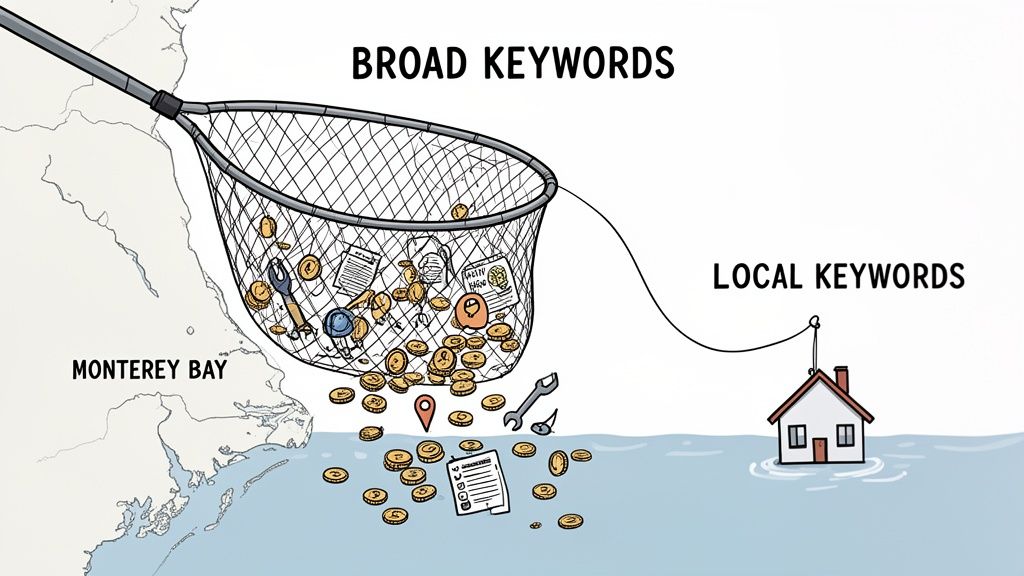
Think of it this way: you wouldn't cast a giant, expensive fishing net across the entire Monterey Bay just to catch one specific type of halibut. You'd catch something, sure, but you'd also waste a ton of time, fuel, and money on fish you can't even keep. That’s exactly what happens when you let Google Ads run wild with broad, unfocused keywords.
This is where so many campaigns go off the rails, and it's a primary reason why Google Ads fail for small contractors. You set a monthly budget expecting it to last, only to watch it vanish in a few days. The culprit? Clicks from people who were never going to hire you in the first place.
The Financial Reality of Broad Match Bidding
For contractors in high-demand trades like plumbing, HVAC, or roofing here in Monterey County, this nightmare is all too common. The problem starts with the sky-high Cost Per Click (CPC)—what you pay Google every single time someone clicks your ad. Fierce local competition drives these costs through the roof, crushing your budget long before you see any real leads.
Industry benchmarks show that ads for services like roofing can average $6 to $15 per click. Without an expert managing the campaign, it’s not uncommon for small operations to waste 70-80% of their entire ad spend on completely irrelevant traffic.
Let’s do the math. If you’re spending $10 per click, a $1,000 monthly budget only buys you 100 clicks. Even worse, the average Google Ads conversion rate for the construction industry is a dismal 1.9%. That means your $1,000 might only generate two actual leads. It’s a fast way to burn through cash with almost nothing to show for it.
What this actually means is that success with Google Ads isn’t about budget—it’s about efficiency. Most contractors waste money on broad keywords and don’t track what’s converting.
Who Is Really Clicking Your Ads?
When you bid on a generic term like "plumber," you're not just up against other local pros in Salinas. You're paying for clicks from all sorts of people who have zero intention of hiring you. Your budget gets eaten alive by:
- DIY Enthusiasts: Homeowners looking for "how-to" videos on fixing a leaky faucet themselves.
- Job Seekers: People searching for "plumber jobs" or "plumbing apprenticeships" in the area.
- Competitors: Other local contractors clicking your ads to check out your landing page (and costing you money while they do it).
- Users Outside Your Service Area: Someone in San Jose who sees your ad, clicks, and only then realizes you don't work in their city.
Every one of those clicks costs you money but delivers zero return on your investment. This is why a tightly focused approach is absolutely non-negotiable.
The Power of Negative Keywords
So, how do you stop the bleeding? The most effective tool in your arsenal is negative keywords. These are simply terms you tell Google not to show your ads for.
By building a solid list of negative keywords, you filter out all that junk traffic before they ever see your ad, let alone click it. Think of it as putting a "No Soliciting" sign on your digital storefront—it keeps the time-wasters away.
An effective negative keyword list is a core part of any successful campaign. We've put together a detailed guide to help you understand all about negative keywords and use them to protect your budget.
By zeroing in on just 3–5 high-intent keywords, setting a tight geographic service area, and aggressively adding negative keywords like "DIY," "jobs," or "free," you can slash those worthless clicks and make sure every dollar you spend is put in front of people actively looking to hire a pro.
The Landing Page Letdown Where Good Leads Vanish
Getting the click is only half the battle. This is where even perfectly targeted ads go to die, and it's a huge reason why Google Ads fail for small contractors. You’ve just paid good money for an interested homeowner in Watsonville to click your ad, but where you send them is what determines whether you get a lead or just a bill.
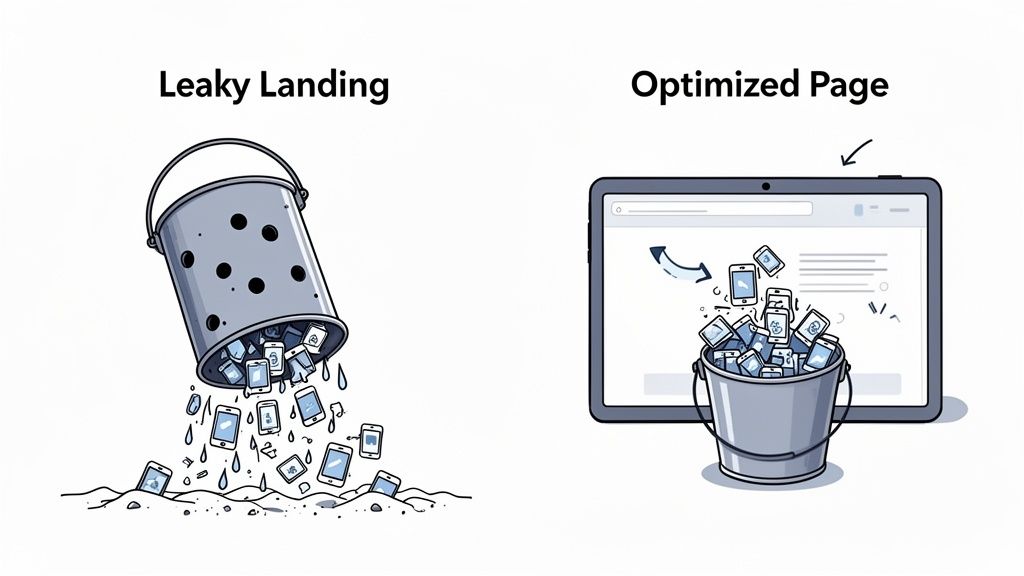
Think of your ad campaign like a plumbing system. The ad is the shiny new faucet, but your landing page is the pipe it's connected to. If that pipe is leaky, clogged, or leads nowhere, it doesn't matter how great the faucet is—no water (or in this case, leads) will come through.
Sending a potential customer to your generic homepage is a recipe for failure. You pay for every single click, and when that click leads to a confusing page, you’re basically paying for customers to get frustrated and leave.
The Critical Mismatch Between Ad and Page
The single biggest landing page mistake is a disconnect between the ad's promise and the page's content. If someone in San Benito County clicks an ad for "emergency HVAC repair," they need to land on a page that is only about that service. It should scream, "You're in the right place for immediate HVAC help!"
When you send them to your general homepage instead, you force them to hunt for the information they actually wanted. Most won't bother. They’ll just hit the back button and click on your competitor’s ad, and you just paid for it. This shatters trust instantly and is a primary driver of poor campaign performance.
The numbers don't lie. The construction industry's average Google Ads conversion rate is a shockingly low 1.9%. A huge reason for this is that when a user clicks an ad for a specific service but lands on a generic page, the bounce rate is astronomical. Now consider that over 60% of local searches happen on a phone; a slow-loading, non-optimized page just makes the problem that much worse.
Elements of a High-Converting Contractor Landing Page
A great landing page isn’t complicated. It’s a focused, simple tool designed to do one thing: turn a visitor into a lead. For contractors in Monterey County, this means building a page with a few non-negotiable parts.
Your landing page absolutely must have:
- A Clear, Bold Headline: The headline has to match your ad copy almost word-for-word. If the ad says "Affordable Roof Repair in Salinas," the headline better say the exact same thing.
- An Obvious Call-to-Action (CTA): Your phone number should be big, bold, and clickable right at the top. A simple "Request an Estimate" form should be right there, no scrolling required.
- Mobile-First Design: The page has to load fast and be incredibly easy to use on a smartphone. Buttons need to be big enough to tap, and forms should have as few fields as possible.
- Trust Signals: You need customer testimonials, photos of your actual work, and any local certifications or awards. This proves you’re a legitimate, trusted pro.
The goal of a landing page is to make the next step as easy and obvious as possible. Don't make potential customers think; guide them directly to the phone call or form submission.
By making sure your landing page is a direct continuation of your ad, you build a seamless path from interest to action. For more in-depth strategies, check out our guide on 7 actionable conversion optimization tips that can help turn more of your website visitors into paying customers. This simple alignment is one of the most powerful ways to fix a failing ad campaign and start getting the return on investment you deserve.
Why Flying Blind Without Conversion Tracking Fails
Running Google Ads without tracking your results is like trying to drive from Hollister to Pacific Grove with a blindfold on. Sure, you’re burning gas and moving forward, but you have no idea if you’re actually getting closer to the coast or about to drive straight into the ocean. This is, without a doubt, one of the biggest reasons why Google Ads fail for small contractors.
You can have the best ads and the slickest landing page, but if you don't know which clicks are turning into actual phone calls or job requests, you’re just gambling with your money.
You might think your ad for "HVAC repair in Salinas" is a home run because it gets tons of clicks. But what if all those clicks are from people looking for jobs, not service? Without the right data, you’re completely in the dark, forced to make decisions based on gut feelings instead of hard facts. You end up pausing campaigns that feel expensive but are secretly your best lead generators, while pouring money into others that are quietly bleeding your budget dry.
What Is a Conversion and Why Does It Matter?
In the world of Google Ads, a conversion is simply a valuable action a potential customer takes after clicking your ad. It’s the moment a click becomes a real business opportunity.
For most contractors here in Monterey County, there are really only two conversions that matter:
- A Phone Call: Someone clicks the phone number in your ad or on your website and calls your business.
- A Form Submission: A potential customer fills out your "Request a Quote" or "Contact Us" form.
That’s it. Clicks and impressions are nice vanity metrics, but they don’t pay the bills. Phone calls and form submissions are what lead to new jobs and revenue. Tracking them is non-negotiable.
Making Every Click Accountable
Setting up conversion tracking isn't just a geeky technical step; it’s what gives you total control over your ad budget. It connects a specific keyword, ad, and click to a tangible result for your business.
Imagine a homeowner in Santa Cruz searches for "emergency roof leak repair." They click your ad, call you from your landing page, and you book the job. With proper tracking, Google Ads records that entire chain of events.
This data is pure gold. It tells you, "The keyword ‘emergency roof leak repair’ in Santa Cruz County just generated a paying job. Let's spend more money there!" It also shows you which keywords are just attracting window shoppers, so you can cut them loose and stop wasting money.
Without this critical feedback loop, you’re flying blind. You have no way to separate your winning keywords from the ones just eating up your budget.
If you need a hand with this, our guide to setting up Google Ads conversion tracking walks you through the essentials of connecting your ad spend to real-world results. This single step can be the difference between a failing campaign and one that makes your phone ring consistently.
Alright, let's stop throwing money at ads that don't work and start building a lead-generation machine. We've seen all the ways Google Ads can fail, so now it’s time to flip the script.
Turning a struggling Google Ads account around isn't about some secret trick; it's about discipline and a smart strategy. This is your game plan for making every single ad dollar count.
A lot of contractors ask, “Can I even compete with the big guys and their massive budgets?” Absolutely. But you have to stop playing their game. Success isn't about outspending them—it's about being ruthlessly efficient. While your bigger competitors are casting a wide, expensive net, your advantage is precision.
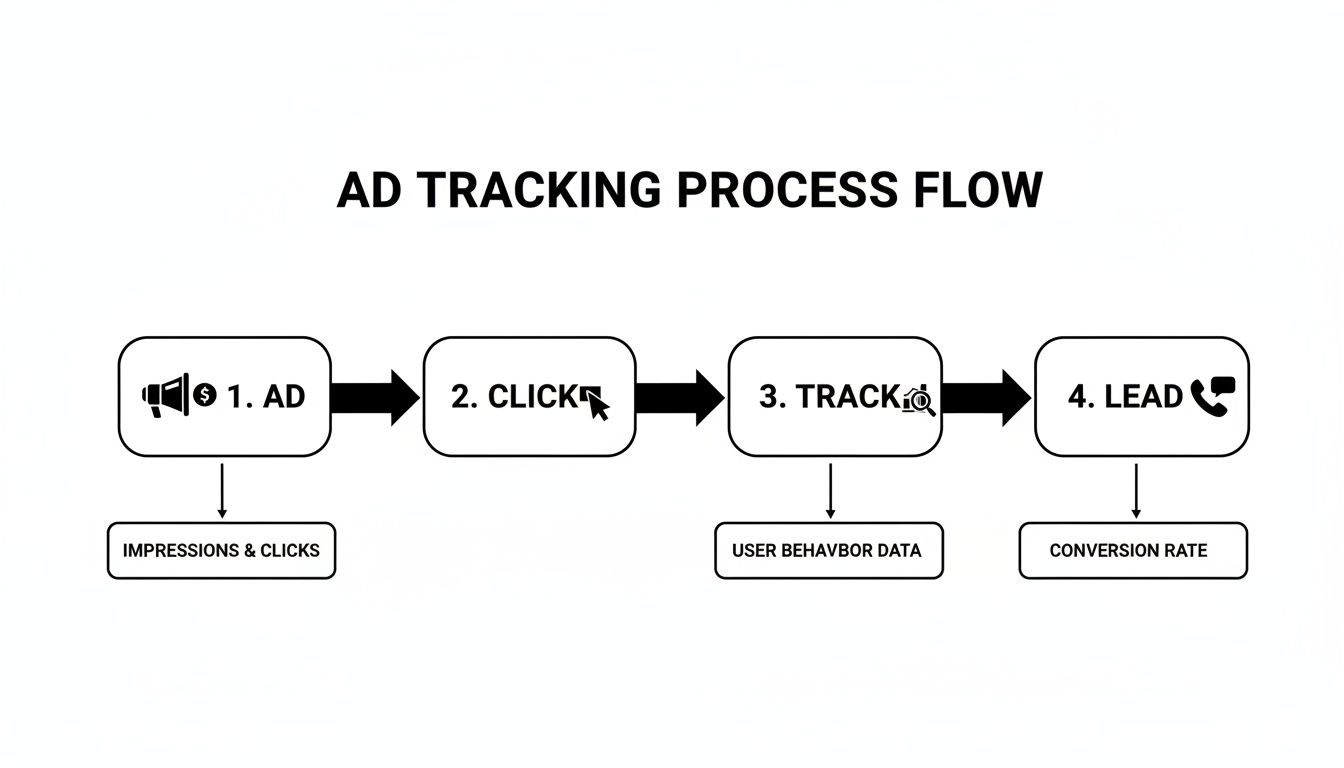
This simple flowchart shows you exactly what should happen when your tracking is dialed in, taking you from a simple ad view all the way to a paying customer.
.
- Informational Terms: cheap, affordable, reviews, comparison, what is
Get in the habit of checking your "Search Terms" report in Google Ads every week. You'll find new junk terms to add to your negative list. This simple weekly task can literally save you hundreds of dollars a month.
Step 3 Connect Your Ads to Your SEO
Finally, don't forget that Google Ads and Search Engine Optimization (SEO) are two sides of the same coin—they work best together. A strong organic presence on Google builds trust and authority, which can actually lower your ad costs over time. More importantly, it helps you become less dependent on constantly paying for clicks.
Think about it: when a potential customer in San Benito County sees your paid ad and your business listed organically on the first page, it's powerful social proof. It sends a clear signal that you're a legitimate, established local expert.
The content on your website, like local service pages and helpful blog posts, creates the foundation for both. We dive deeper into this approach in our guide to building a powerful PPC strategy for contractors. When paid and organic traffic support each other, you stop just buying leads and start building a real, sustainable growth engine for your business.
Should You DIY Your Ads or Hire a Local Pro?
This is the big question for many contractors in Carmel-by-the-Sea and Marina: handle Google Ads yourself or bring in a pro? The real answer comes down to your most valuable asset—your time. If you have the hours to learn the platform, build the campaigns, and then check in on them every single day, the DIY route can work for super simple, small-scale goals.
But let's be real, managing Google Ads effectively is a full-time job. It’s definitely not a "set it and forget it" kind of thing. The platform is complex, the competition is stiff, and Google is always changing the rules. A campaign that’s killing it one week can turn into a money pit the next if you’re not paying close attention. This constant babysitting is a huge reason why Google Ads fail for small contractors who are already stretched thin running their actual business.
When DIY Makes Sense
Going it alone might work out, but only under a few very specific conditions. If you have a tiny, clearly-defined service area and you’re only going after a handful of keywords, the learning curve won't be quite as steep.
You should only even consider DIY if you can commit to:
- Daily Monitoring: You have to be in there every day, checking your search terms, watching your budget, and looking at performance. No exceptions.
- Constant Learning: You’ve got to stay on top of Google's frequent algorithm updates and policy changes. It’s a lot.
- Limited Scope: Your campaign is small and focused, like targeting just one or two services in a specific town like Pacific Grove.
If you can't carve out at least an hour a day for this, you’ll probably end up spending more on wasted clicks than you would on professional management.
The Value of a Local Expert
Hiring a local agency in Monterey County isn't just another bill to pay; it's an investment in getting things done right and efficiently. A professional team already has advanced knowledge of bidding strategies, competitor analysis, and conversion optimization that would take anyone else years to learn from scratch. We know the local market inside and out—from the seasonal demand swings in Santa Cruz to the most profitable keywords in Salinas.
An agency's job is to generate a return on your ad spend that far exceeds their management fee. They handle the technical complexities so you can focus on what you do best—serving your customers.
The decision usually boils down to a simple calculation: what’s an hour of your time worth? If you burn five hours a week wrestling with ads and only getting so-so results, that's five hours you could have spent on a job site or closing new deals. Our deep dive into whether a small business needs a digital marketing consultant can help you weigh the pros and cons for your own situation.
It also helps to see how others approach client acquisition. For instance, looking at effective marketing strategies for professionals can offer some great insights you can apply to your own business. At the end of the day, the right partner frees you up to run your business while making sure your marketing dollars are working just as hard as you are.
A Few Common Questions We Hear from Contractors
We've walked through everything from budget-draining click mistakes to landing pages that just don't convert. Still, a few questions always pop up when we're talking with contractors around Monterey Bay. Here are some straight-up answers to help you get your ads on the right track.
Can I Really Compete with the Big Guys and Their Massive Budgets?
This is the number one concern we hear, and the answer is a hard yes. It’s not about outspending them; it’s about outsmarting them.
Success with Google Ads isn’t about who has the biggest wallet—it’s about who has the tightest strategy. The big national brands waste a shocking amount of money on broad keywords and sloppy targeting.
This is where you have the home-field advantage. You can get laser-focused on local terms like “emergency plumber in Monterey” or “Salinas kitchen remodeler.” By zeroing in on your actual service area and cutting out irrelevant search terms, you can slash your cost-per-lead and still get your phone to ring with quality jobs. Precision is your secret weapon.
How Do I Know If My Ads Are Actually Working?
If you’re not tracking conversions, you’re flying blind and burning cash. It’s that simple.
Conversion tracking is non-negotiable. You need to know which specific keyword and ad drove that phone call or that form submission. This isn't just data for the sake of data—it’s a roadmap. It tells you exactly where to double down on your investment and which campaigns to kill off, turning a marketing expense into a predictable lead-generating machine.
My Ads Are a Mess. What’s the Very First Thing I Should Fix?
If your campaigns are bleeding money, your first move is to fix your keywords and targeting. This is where most contractors go wrong, bidding on vague, expensive terms and showing ads to people miles outside their service area.
Here’s a simple, three-step fix you can do right now:
- Narrow your focus to just 3–5 high-intent keywords that scream "I'm ready to hire," like "Salinas HVAC repair," not just "HVAC."
- Build a strong negative keyword list. Add words like “DIY,” “free,” “jobs,” and “school” to stop paying for junk clicks from people who will never become customers.
- Shrink your geographic targeting down to only the zip codes you actually serve. No exceptions.
Fixing just those three things can completely turn around a failing campaign. When you combine these smarter ad strategies with a solid foundation of Monterey SEO for home service contractors, you start building a powerful, reliable system for attracting local leads.
By Phil Fisk, CEO, Core6 Marketing
Phil Fisk is the founder of Core6 Marketing, a digital marketing agency in Salinas, CA, dedicated to helping home service contractors grow their businesses. With over a decade of experience, he specializes in local SEO, Google Ads, and creating websites that generate leads.
Core6 Marketing
1628 N. Main St #263, Salinas, CA 93906
831-789-9320
[email protected]
https://core6.marketing/
If you're a contractor in Monterey, Salinas, or anywhere on the Central Coast and you're tired of throwing money at Google with nothing to show for it, let's talk. Core6 Marketing can help you build a smarter PPC strategy that actually drives leads without breaking the bank. Visit us at https://core6.marketing to book a free consultation.