For any plumber working in Monterey County, a powerful website is your single most valuable employee. It’s out there, 24/7, hustling for new business. A strategic website design for a plumber is what turns those late-night Google searches into actual service calls. Let's be honest, a generic, cookie-cutter template just won't cut it in competitive markets from Salinas to Santa Cruz. You need a site built from the ground up to convert local customers.
Your Digital Foundation for Local Plumbing Success
Think of your website as your digital storefront. When a homeowner in Pacific Grove has a burst pipe at 2 AM, or a restaurant in Gilroy needs urgent drain cleaning, what’s their first move? They grab their phone and start searching.
The real question is, will they find you? And if they do, will your website convince them in under ten seconds that you're the right pro to call?
This is where smart design goes way beyond just looking pretty. It’s about building an online experience that gives immediate answers, builds instant trust, and makes it incredibly simple to get in touch. Your site has to be engineered to meet the specific needs—and anxieties—of customers right here in the Monterey Bay Area.
Why a Generic Website Fails Local Plumbers
Using a one-size-fits-all template is like showing up to a major repiping job with only a single wrench. You're just not equipped for the task. These generic sites almost always lack the critical features needed to win over local customers who are stressed out and in a hurry.
A purpose-built website for a plumber in our area has to nail three core goals:
- Generate Qualified Leads: It needs to actively guide every visitor toward calling you or filling out a service request form. No dead ends.
- Establish Local Authority: It must prove you are a trusted, licensed, and reliable expert serving communities from Hollister to Watsonville.
- Provide a Flawless User Experience: It absolutely has to be fast, mobile-friendly, and dead simple to navigate, especially for someone dealing with an emergency.
A great plumber website isn't just a digital brochure; it's a lead-generation machine. It anticipates what a customer in crisis needs—a phone number, proof of expertise, and a quick solution—and delivers it without any friction.
The Rise of Specialized Plumbing Web Design
The plumbing industry has shifted hard into digital marketing, and that’s led to a new breed of design companies that focus only on the trades. For 2025, more than 20 firms have been singled out as top specialists dedicated to helping plumbers grow their business online. These agencies get our unique market, from how customers search for services to what lead generation tools actually work. They roll SEO, high-conversion features, and reputation management into one cohesive strategy.
This specialization is a big deal because it recognizes that a plumber's needs are completely different. You’re not selling a t-shirt; you’re selling a solution to an urgent, often stressful, problem. Your website has to reflect that with total clarity and confidence. The entire architecture, from your service pages to your contact forms, should be built with that specific customer mindset at its core.
If you want to see how a great website fits into the bigger picture, you might find our guide on digital marketing for plumbers helpful. It covers how all these pieces work together to fuel your growth.
Essential Elements of a High-Converting Plumber Website
To really connect with local homeowners and businesses, your website needs more than just a list of services. It needs specific, trust-building components designed to turn a visitor into a customer. Here’s a breakdown of the non-negotiable features every plumber's site should have to win jobs across the Monterey Bay.
| Feature | Why It's Crucial for a Monterey Bay Plumber | Example Implementation |
|---|---|---|
| Click-to-Call Phone Number | When a pipe bursts in Watsonville, people need a phone number, not a "learn more" button. Make it impossible to miss. | Place your number prominently in the header and footer, making it a clickable link on mobile devices. |
| Emergency Service Callouts | Highlights your availability for urgent jobs, which is a primary driver of plumbing searches. | Use bold banners or buttons like "24/7 Emergency Service" or "Need Help Now? Call Us!" |
| Geo-Targeted Service Pages | Shows Google (and customers) you're the go-to plumber for specific towns like Hollister or Pacific Grove. | Create dedicated pages for "Drain Cleaning in Salinas" or "Water Heater Repair in Monterey," with localized content. |
| Authentic Team Photos | Puts a real face to your business, building instant trust and showing you're a legitimate local company, not a faceless lead-gen site. | An "About Us" page featuring high-quality photos of you and your actual crew on the job or in uniform. |
| Customer Testimonials & Reviews | Provides social proof from neighbors. A glowing review from a homeowner in Santa Cruz is powerful for a potential client nearby. | Embed a feed of your latest Google or Yelp reviews directly on your homepage and service pages. |
| Visible Licensing & Certifications | Reassures customers that you are a qualified, professional, and insured expert, which is a major concern for homeowners. | Add a section in your footer or on your "About" page with your license number and any industry certification logos. |
These elements aren't just nice-to-haves; they are the foundational building blocks of a website that works. By including them, you directly address the questions and concerns of local customers, making it an easy decision for them to choose you over the competition.
Designing a Website That Builds Instant Trust
Let's be honest. When a pipe bursts in a Carmel-by-the-Sea home or a drain clogs up a Salinas restaurant, nobody is leisurely browsing for design inspiration. They're stressed, they're in a hurry, and they need one thing: a trustworthy professional who can fix their problem now.
Your website’s first job is to meet that panic with instant credibility.
A clean, professional, and uncluttered layout isn't just a nice-to-have; it's a deal-maker. Studies show that 94% of first impressions are design-related. If your site looks messy, old, or hard to navigate, potential customers will assume your work is, too. That’s the real secret to effective website design for a plumber—it’s not about winning awards, it's about projecting competence the second the page loads.
Your design needs to immediately answer a few silent but critical questions: Are you a real, local business? Are you licensed? Can you fix my problem? And most importantly, how fast can I reach you?
Make It Ridiculously Easy to Contact You
In a plumbing emergency, making someone hunt for a phone number is the fastest way to lose the job. Your contact info needs to be front and center, on every single page, no scrolling required.
Here's how to nail it:
- Header Visibility: Put your phone number in the top right corner of your website's header. Make it big, make it bold, and make it impossible to miss.
- Click-to-Call: On a smartphone, that number must be a clickable link. A frantic customer in Santa Cruz County needs to be able to tap their screen and call you directly. Zero friction.
- Footer Redundancy: Repeat your full contact details—phone, email, and primary service area—in the site's footer. It's a safety net that ensures the information is always accessible.
The goal is to make calling you the path of least resistance. When a potential customer is comparing three plumber websites on their phone, the one with the easiest-to-use "call" button often wins the job.
Weave in Trust Signals Everywhere
Beyond easy contact, your website needs to be covered in what we call trust signals. These are the little visual cues and bits of information that prove you're legit. They reassure anxious homeowners that you're a safe, professional choice.
Sprinkling these elements across your site builds immediate confidence and sets you apart from the fly-by-night competition.
- License and Insurance: Display your CSLB license number clearly, usually in the footer. A simple line like "Fully Licensed & Insured" removes a massive point of hesitation for customers.
- Certifications and Affiliations: Are you certified for tankless water heater installations? A member of the local Chamber of Commerce? Show off those logos. They act as third-party endorsements.
- Guarantees: A satisfaction guarantee or a warranty on your work is a powerful way to show you stand behind your quality. It tells customers you're not going to disappear if something goes wrong.
Structure Your Service Pages for Clarity (and SEO)
A generic "Our Services" page just doesn't cut it anymore. People search for solutions to specific problems, and your website needs to mirror their search. Creating dedicated pages for each core service is a must-do for both your customers and for Google.
Think about it from their perspective. Someone looking for a water heater replacement has a completely different set of questions than someone with a clogged drain. Your site navigation should guide them right where they need to go.
A good service page structure might look like this:
- Emergency Plumbing Repairs
- Drain Cleaning & Hydro Jetting
- Water Heater Installation & Repair
- Leak Detection & Pipe Repair
- Sewer Line Services
- Commercial Plumbing for Monterey Businesses
Each one of these pages should get specific, answer common questions, and have a clear call-to-action to schedule an appointment. This focused approach shows customers you understand their exact problem and have the expertise to solve it. For a deeper dive into how these elements come together, check out our complete guide on strategic web design for plumbers, which covers these topics in greater detail.
Content and Features That Generate Plumbing Leads
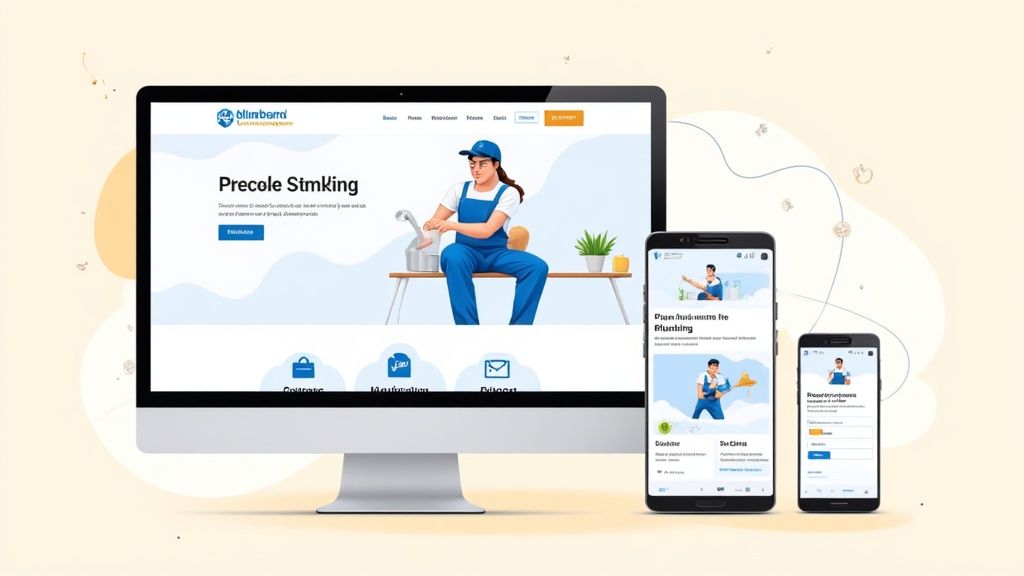
A great-looking website is a fantastic start, but it's only half the equation. To actually turn those website visitors into paying customers, your website design for a plumber needs content and features built for one purpose: conversion. It’s not enough to just list your phone number. Your site has to work as a complete sales tool that anticipates questions, builds immediate trust, and makes it incredibly easy for someone to hire you.
For a homeowner in Seaside dealing with a leak or a commercial property manager in Salinas facing a major backup, the words and images on your site are what close the deal. This is where you prove you get their problem and have the exact skills to fix it. It’s how you go from being just another name on Google to the only plumber they want to call.
Crafting High-Impact Service Pages
Your services are the heart of your business, so your website needs to reflect that. A single, generic "Services" page just won't cut it anymore. It’s a huge missed opportunity. What you really need are dedicated pages for each major service you offer, written specifically for customers in Monterey County.
Why bother? Because someone searching for "tankless water heater installation" has completely different concerns than someone with a clogged sewer line. Specific service pages let you speak directly to their problem.
Here’s what every single service page should have:
- A Clear Problem/Solution Focus: Start by describing the exact problem they're facing. For example, "Tired of running out of hot water halfway through a shower?" Then, immediately position your service as the perfect solution.
- A Peek into Your Process: Briefly explain what the job involves. You don't need a full technical manual, but showing you have a clear, professional process builds a ton of confidence.
- Local Context: This is key. Mention scenarios that people in our area understand. On a drain cleaning page, for instance, you could talk about issues common in older Pacific Grove homes or the unique plumbing demands of agricultural businesses near Gilroy.
- A Strong Call-to-Action (CTA): Don't make them guess what to do next. Every page needs a clear, unmissable button like "Request a Free Estimate" or "Schedule Your Drain Cleaning."
The Power of Social Proof and Visuals
Words will only take you so far. To build real, lasting trust, you have to show potential customers what you're capable of and let them hear from others who were happy with your work. This is where social proof becomes your most valuable asset.
A gallery of your work isn't just a nice-to-have; it's essential. High-quality photos of a clean repiping job or a perfectly installed new water heater provide tangible proof of your skills. It’s one thing to say you do great work, but it's far more powerful to show it.
Your portfolio and testimonials aren't just website add-ons; they are the foundation of your credibility. A glowing review from a neighbor in Hollister carries more weight than any marketing slogan you could ever come up with.
This brings me to my next point: a dedicated testimonials page. Featuring reviews from local customers creates an incredibly powerful connection. When a potential client sees that someone in their own town trusts you, it makes their decision to call you that much easier.
Frictionless Lead Capture: Your Secret Weapon
Okay, so you've convinced a visitor that you're the right plumber for the job. Now what? You have to make it ridiculously easy for them to contact you. Every extra click, every confusing form field, is another opportunity for them to leave and call your competitor.
Your calls-to-action (CTAs) are the signposts guiding them. They need to be direct, compelling, and impossible to miss.
- Use Action-Oriented Language: Forget passive phrases like "Contact Us." Use strong verbs that prompt action. "Get a Free Estimate," "Schedule Service Now," or "Request a Quote" are far more effective.
- Put Them Everywhere: Your CTAs should be in the website header, at the bottom of every single service page, and anywhere else it feels natural. Don't make people hunt for a way to give you their business.
The contact form itself should be short and sweet. Only ask for the absolute essentials: name, phone number, email, and a quick message about their problem. The more fields you add, the more people you'll lose. The goal is to start a conversation, not write their biography on the first contact.
Putting these content and feature strategies into practice is what separates a basic website from a lead-generating machine. For a deeper dive, you can learn more about our proven plumbing lead generation strategies that we use for contractors all over the Monterey Bay Area.
Optimizing Your Site for Local Monterey Bay SEO
A great-looking website is a fantastic start, but if potential customers in Monterey County can't find you when they're searching for a plumber, it isn't doing its job. This is where Search Engine Optimization (SEO), the process of making your website speak Google's language, comes into play. When someone desperately needs a plumber, you want your business to show up right at the top.
The goal is to be the first name a homeowner in Salinas or a business owner in Santa Cruz sees. This means your website design for a plumber can't just be about looks; it has to be about being visible when it matters most. It requires a focused approach that goes beyond generic keywords to target the exact terms your local customers are using.
This simple flow shows the core steps: keyword research, on-page optimization, and mobile testing.
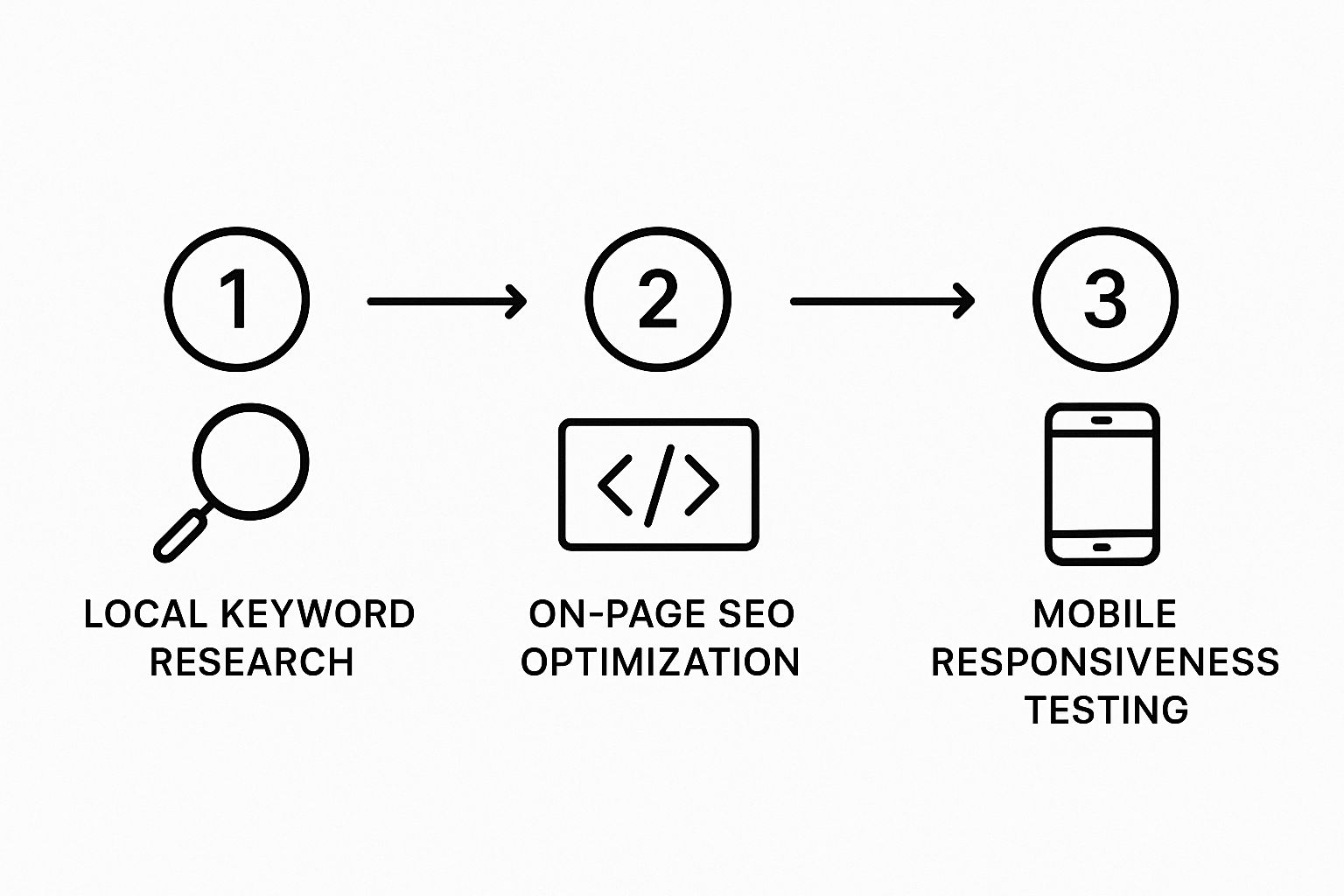
This isn't just a technical process. It starts with understanding what your customers need and ends with making sure they have a great experience on any device they use.
Speaking the Local Language with Keywords
The foundation of strong local SEO is using the right keywords. These are the phrases people are actually typing into Google when a pipe bursts or a drain clogs. A customer in Hollister isn’t just searching for a "plumber"; they're searching for an "emergency plumber Hollister" or "drain cleaning near me."
Your job is to find these specific terms and weave them naturally into your website.
- Service Pages: Instead of a single page for "drain cleaning," get specific with "drain cleaning in Santa Cruz County." This tells Google exactly where you work.
- Blog Posts: Write genuinely helpful articles that answer local questions, like "Common Plumbing Issues in Older Pacific Grove Homes."
- Image Alt-Text: When you upload a photo from a job, don't just call it "image123.jpg." Label it with descriptive, local text like "new water heater installation in Marina CA."
This hyper-local focus signals to search engines that you are the most relevant result for users in a specific area. That's how you get the click.
Key Takeaway: Local SEO isn't about tricking Google. It's about clearly and consistently telling search engines who you are, what you do, and—most importantly—where you do it.
Your Google Business Profile Is Non-Negotiable
If there's one tool you can't ignore, it's your Google Business Profile (formerly Google My Business). This is your digital storefront—the info box that appears in Google Maps and search results, showing your reviews, hours, phone number, and service area. For a plumber, an optimized profile is absolutely essential.
Making sure your Name, Address, and Phone number (NAP) are perfectly consistent across your website, your Google profile, and other online directories is critical. Any little inconsistency can confuse search engines and hurt your rankings. Think of it as your digital fingerprint; it needs to be identical everywhere.
Technical SEO That Drives Calls
Finally, a few technical factors can make or break your ability to rank well and convert visitors into customers. Site speed and mobile-friendliness are at the very top of that list. A slow-loading site will send potential customers straight to your competitors.
The data is undeniable. According to Google, mobile searches for phrases like 'plumbers near me' have skyrocketed. This proves your customers are on their phones, looking for immediate help. A fast, mobile-responsive site ensures you capture this traffic.
When that frantic customer in Watsonville finds you, they need a "click-to-call" button that works instantly, not a frustrating, slow-loading page. For a deeper dive into these strategies, explore our guide on local SEO for plumbers, which provides even more actionable tips for dominating your service area.
Turning Website Visitors Into Paying Customers
Getting a homeowner in Salinas to click on your website is a great start, but it doesn't pay the bills. The real goal is turning that initial click into a service call, and that's where Conversion Rate Optimization, or CRO, comes into play.
Think of it as the art and science of making your website more persuasive. It's about guiding more visitors to take the one action you want them to—whether that’s calling your number or filling out your "Get a Quote" form.
For a plumber, effective website design is all about creating a smooth, frictionless path from a homeowner's problem to your solution. When someone in Monterey County has a burst pipe, their patience is thin. Your website has to be a tool of reassurance and efficiency, not another source of frustration. Every single element, from the color of your "Schedule Now" button to the number of fields in your contact form, can either help or hurt your chances of landing that job.
It’s a game of inches where small, smart improvements lead to very real business growth.
The Psychology of a Powerful Call-to-Action
Your Call-to-Action (CTA) is the single most important instruction on your entire website. It’s the button or link telling visitors exactly what to do next. Let's be honest, phrases like "Contact Us" are passive and weak. You need clear, compelling commands that tap into the user's immediate need.
A plumber's CTAs should be direct and laser-focused on the solution. Try testing a few different variations to see what your local audience responds to best:
- Urgency-Driven: "Request Emergency Service Now"
- Value-Oriented: "Get Your Free, No-Obligation Estimate"
- Action-Focused: "Schedule Your Appointment Online"
Placement and design are just as critical as the words you use. Your main CTA should be impossible to miss. Put it "above the fold" (visible without scrolling) and repeat it as users navigate down the page. Use a contrasting color that pops against your site’s branding but doesn't look out of place. The goal is to make it the most obvious, inviting next step on the page.
Building a Seamless and Fast User Journey
Picture this: a potential customer in Santa Cruz is on their phone, quickly comparing three different plumber websites. Two of them take forever to load or have confusing menus. Yours, however, loads instantly and has a giant "Click to Call" button right at the top.
Who do you think gets the job?
A seamless user journey is all about removing obstacles. Here are the biggest culprits that send potential customers running to your competitors:
- Slow Load Times: Even a one-second delay can slash conversions. Your site absolutely must be optimized for speed, especially on mobile.
- Confusing Navigation: A visitor should be able to find your services, testimonials, and contact info in two clicks or less. No exceptions.
- Long, Complicated Forms: Only ask for what's essential. A customer with a flooded basement isn't going to fill out a ten-field questionnaire. Name, phone, and a brief description of the problem are all you need to get the ball rolling.
A great plumber website anticipates what a customer needs. It understands that someone in a panic values speed and simplicity above all else. When you optimize the user journey, you're not just improving your website; you're showing respect for your customer's time and their stressful situation.
The average website conversion rate for plumbers usually falls between 2% and 5%. Investing in professional design with clear CTAs, easy navigation, and blazing-fast load times is what pushes you into that top tier.
To make booking even easier, make sure your site is clearly displaying accepted payment methods. Showing this information upfront removes another point of friction and adds a layer of professionalism. When you continuously analyze user behavior and refine these elements, you transform your website from a simple online brochure into a powerful lead-generation engine that works for you 24/7.
Common Questions About Plumber Website Design
Putting your hard-earned money into a new website is a big decision, and it’s natural to have questions. For plumbing business owners I talk to across the Monterey Bay Area, the biggest concerns usually boil down to cost, timelines, and what happens after the site goes live. I get it. A website is a serious investment, and you need to know it’s going to work as hard as you do to bring in real, measurable business.
This isn’t just about getting a site that looks good; it's about building a digital asset that pulls in leads from Salinas to Santa Cruz. Let's tackle some of the most common questions we hear from local plumbers to give you the clarity you need.
How Much Does a Professional Plumber Website Cost?
This is almost always the first question, and the honest answer is: it depends. The cost of a website design for a plumber is tied directly to the scope of the project. A simple, clean brochure site with a handful of service pages will naturally cost less than a complex build with online booking, detailed project galleries, and other custom features.
Think of it like a plumbing job. Replacing a leaky faucet has a very different price tag than a full-home repipe. To give you a realistic idea, here are the main things that influence the final price:
- Custom vs. Template: A fully custom design, built from the ground up just for your brand, is a bigger investment than a site using a pre-made template. But custom sites almost always perform better because they’re designed specifically to meet your business goals and attract your ideal customer.
- Number of Pages: The more dedicated service and location pages you need (like "Drain Cleaning in Monterey" or "Water Heater Repair in Gilroy"), the more time is needed for design, writing, and optimization.
- Special Features: Need to integrate an online scheduling tool? A live chat function? An advanced portal for customer reviews? Each of these adds another layer of complexity and cost to the project.
The best way to look at your website is not as a cost, but as an investment in your lead-generation machine. A well-built site that brings in just a few extra high-value jobs a year can easily pay for itself and deliver a powerful return.
How Long Will It Take to Build My New Website?
I know you want to start seeing results as soon as possible. Typically, a new website build takes anywhere from four to twelve weeks. Just like the cost, the timeline depends on the site's size, complexity, and specific features.
A big part of that timeline also depends on you. Providing timely feedback on designs, sending over photos of your team and your work, and approving content are all crucial for keeping the project moving forward. If there are delays in getting us the information we need, the launch date can get pushed back. It’s a team effort.
What Kind of Ongoing Maintenance Is Required?
Getting your website live is just the starting line. A website is a living, breathing tool—not a "set it and forget it" brochure. To keep it secure, running smoothly, and ranking on Google, ongoing maintenance is absolutely essential. This is a critical piece of the puzzle for any plumber in Santa Cruz County or the surrounding areas.
Regular maintenance usually involves:
- Software Updates: Keeping your platform (like WordPress) and any plugins up-to-date is your first line of defense against security threats.
- Security Scans: We regularly scan for malware and other vulnerabilities to protect your site, your data, and your customers.
- Backups: Consistent backups mean that if anything ever does go wrong, your site can be restored quickly with minimal downtime.
- Performance Checks: We monitor your site's speed and fix anything that might be slowing it down, which is key for both user experience and SEO.
Understanding these key pieces helps you make a much more informed decision. For a complete look at the entire process, our guide on strategic web design for plumbers breaks it all down even further.
Ready to build a website that becomes your #1 source of local leads? The team at Core6 Marketing is here to answer all your questions and show you what a data-driven, conversion-focused website can do for your plumbing business.
Schedule Your Free, No-Obligation Consultation Today
By Phil Fisk, CEO, Core6 Marketing
Phil Fisk leads Core6 Marketing, a specialized digital agency in Salinas dedicated to helping home service contractors dominate their local markets. With a deep focus on data-driven strategies and measurable ROI, Phil's expertise lies in creating custom web solutions that generate qualified leads for businesses throughout the Monterey Bay Area.
Core6 Marketing
1628 N. Main St #263, Salinas, CA 93906
831-789-9320
[email protected]
https://core6.marketing/