
Why Most Roofing Websites Are Digital Ghost Towns
Ever wonder why your beautiful, brand-new website isn't bringing in calls? You're not alone. Many skilled roofing contractors find themselves with a digital presence that feels more like a ghost town than a bustling online office. The tough reality is that a good-looking website doesn’t automatically equal a lead-generating machine. The problem often hides in the details of the roofing website design itself.
The Outdated Playbook
A common pitfall is the "set it and forget it" mentality. A roofer might invest in a site that looks slick on day one but quickly becomes obsolete. Think about websites that are a nightmare to use on a phone, lack clear "Get a Free Estimate" buttons, or are filled with generic stock photos of smiling families instead of your actual crew and projects.
These are digital red flags for homeowners. They signal a business that isn't keeping up, which can plant a seed of doubt about the quality of your work. The goal is to build immediate trust, not create confusion.
Missing the Mark on Search Intent
Another critical mistake is creating content that misses what homeowners actually search for, especially when they're in a panic. Your website might be full of technical details about shingle types, but a homeowner with water dripping into their living room is frantically searching for "emergency roof repair near me."
It’s a startling fact that nearly 98% of roofing website content generates zero traffic, often because it fails to connect with these urgent, real-world needs. You can explore more data on why roofing content often underperforms.
Ultimately, a successful website must be built from the customer's perspective. If your roofing website design doesn't directly solve their problems and show them a clear path to a solution, they'll just click away to a competitor who does. To avoid these common mistakes, it's smart to study what goes into a pro roofing contractor website design from the very start.
Capturing Your Share of a Booming Market
The roofing industry is expanding quickly, yet a surprising number of contractors are still stuck in the past, leaving a lot of business on the table. While they're relying on old-school marketing, savvy roofers are using their websites to claim a serious piece of the action. The secret isn't just having a website; it's about building an online hub that matches how today's homeowners find and vet contractors. This means your roofing website design has to be more than a simple online business card.
For example, don't just say you offer "roof repair." Homeowners are searching for specific solutions. Are you an expert in installing energy-efficient cool roofs? Do you specialize in helping people with complex insurance claims after a major storm? These are high-value services people are actively looking for. A great website positions you as the authority for these needs, attracting higher-quality leads who are ready to hire.
The opportunity here is massive and growing. The U.S. roofing market is on track to hit $24.79 billion in 2025 and is expected to reach $33.44 billion by 2030. You can see more on these trends and explore roofing website design projections to understand just how big this is.
Developing a Winning Digital Game Plan
To grab a share of this growth, your first move is to scout the local competition. Take a hard look at their websites. What are they doing well, and more importantly, where are they falling short? Maybe their sites load slowly, are a pain to use on a phone, or offer zero useful information about handling storm damage. Every one of their weaknesses is an opportunity for you to shine. Your mission is to build a site that not only looks professional but also serves as a genuinely helpful resource for homeowners.
This kind of thinking is central to effective website design & SEO for home service contractors. To make it work, you need clear, realistic goals. Forget vague ambitions like "get more leads." Get specific. A much better goal would be, "increase online requests for hail damage inspections by 20% this quarter." This gives you a clear target, allowing you to build your website's pages and features with purpose, track your progress, and make smart tweaks to keep your business growing.
Designing for Homeowners Searching on Their Phones
Imagine this: a hailstorm just rolled through the neighborhood. A homeowner is standing in their driveway, phone in hand, looking for a local roofer right now. This isn't just casual window shopping; it's an urgent, high-stakes moment where a quick decision is about to be made.
If your mobile website is clunky or slow, you've just lost that lead. In fact, data shows 57% of users won't recommend a business if its mobile site is poorly designed. Your roofing website design needs to be built for these critical moments, not just as an afterthought. This means adopting a mobile-first approach, where you design for the smallest screen first and prioritize the features a stressed-out homeowner needs most.
Prioritizing for Mobile Urgency
When you're designing for a mobile user, put yourself in their shoes. What information is absolutely essential in that driveway scenario?
- Click-to-Call Buttons: Your phone number should be impossible to miss. Place a large, clickable button right in the header or a sticky footer so they can call you with a single tap. Don't make them search for it.
- Simple Navigation: A cluttered menu is a recipe for frustration. Use a clean "hamburger" menu with direct, easy-to-understand labels like "Emergency Repair," "Services," and "Contact."
- Fast-Loading Forms: Keep your "Request an Inspection" form short and sweet. Ask only for the essentials: name, phone, and address. Every extra field you add increases the chance they'll give up and call your competitor.
Designing for Real-World Conditions
A good mobile experience goes beyond just the layout. Think about the practicalities. That same homeowner might be dealing with a spotty cell signal or trying to tap buttons with wet thumbs during a downpour.
Your site needs to load lightning-fast, even on a weaker connection. Buttons and links should be large and spaced out, making them easy to tap accurately. An effective roofing website design anticipates the customer's real-world situation and makes it incredibly simple for them to connect with you for help.
To better understand how mobile performance directly impacts your ability to get leads, let's compare some key metrics between mobile and desktop users.
| Metric | Mobile Users | Desktop Users | Impact on Conversions |
|---|---|---|---|
| Average Time on Page | 1 minute, 15 seconds | 2 minutes, 45 seconds | Shorter mobile sessions mean your value proposition and contact info must be immediately visible. |
| Bounce Rate | ~60-70% | ~40-50% | A high mobile bounce rate often signals slow load times or a confusing layout, causing users to leave instantly. |
| Conversion Rate (Form Fill) | 1-2% | 3-4% | Simple, single-column forms with large fields are crucial to bridge this gap and make mobile conversions easier. |
| Primary User Intent | Urgent, task-oriented (e.g., "call now," "find address") | Research-focused (e.g., comparing services, reading blogs) | Mobile design must prioritize immediate actions like click-to-call, while desktop can support deeper content. |
The data is clear: mobile users are on a mission. They have less patience and are looking for quick solutions. By optimizing for speed, simplicity, and clear calls-to-action, you can turn those urgent mobile searches into paying customers.
Content That Connects With Stressed Homeowners
When a nasty storm rips through town or a mysterious leak appears on the ceiling, homeowners aren't casually browsing for roofers. They're stressed out and searching for someone they can trust—fast. Your website's content needs to meet them right in that moment of crisis. The purpose of your roofing website design isn't just to list your services; it's to offer immediate reassurance and a clear, simple solution.
Instead of filling your pages with jargon, speak directly to their worries. An "Emergency Storm Damage" page, for example, should cut straight to their biggest fears: How much will this cost? Will my insurance cover it? Can you stop the leak before it gets worse? Good content builds trust by proving you understand what they're going through. It’s no surprise that video is so powerful here; marketing data shows 86% of video marketers report it helps them get more leads by creating a much more personal connection.
From Emergency Repairs to Planned Replacements
Of course, not every visitor lands on your site in a panic. Plenty of homeowners are methodically planning a future roof replacement or just looking for routine maintenance. Your content needs to serve both types of customers effectively.
- For the Planner: This is your chance to shine as an expert. Write detailed blog posts and service pages that answer their long-term questions. Think about topics like, "Choosing the Best Shingles for Florida Weather" or "The ROI of a Metal Roof." This kind of content positions you as a thoughtful, knowledgeable professional.
- For the Panicked: You need a crystal-clear, highly visible "Emergency Services" section. Use straightforward language, bullet points explaining your immediate response process, and big, obvious call-to-action buttons like "Get Help Now."
Imagine your website has two main paths. One is an express lane for emergencies, providing quick contact info and instant peace of mind. The other is a scenic route for the planners, offering in-depth information that builds confidence over time. A fantastic way to do this is by creating a section dedicated to helping homeowners navigate insurance claims—a huge source of anxiety. By offering a simple guide or checklist, you become a helpful partner, not just another roofer trying to make a sale. This dual-focus approach is a key part of any successful roofing website design.
SEO That Actually Works for Roofing Contractors
Let's cut through the noise. The world of roofing SEO is crowded with agencies making big promises that drain your budget and deliver little in return. Real online success isn't about chasing every new digital trend or buying a generic "optimization" package. It's about a focused plan that connects your business with local homeowners who are right now looking for the services you provide.
Forget the complicated jargon. Effective SEO for roofers comes down to being the most helpful and trustworthy answer for someone searching in your specific service area. A solid roofing website design is your foundation, but what you build on top of it is what truly generates leads. It all starts by targeting the search terms your potential customers actually use—not just "roofing contractor," but high-intent phrases like "hail damage roof inspection Dallas" or "asphalt shingle replacement cost." These are the queries people type when they have a problem, and ranking for them puts you directly in their path.
Mastering Your Local Market
For any roofing contractor, good SEO goes beyond just keywords and dives deep into your local presence. A crucial first step is to learn about optimizing your Google Business Profile. This is how you show up prominently in local search results and get customers to your digital doorstep. Honestly, this part is non-negotiable for local success.
Next, you need to prove your expertise where it matters most: in your own backyard. Recent analysis shows the U.S. roofing market saw a 2.2% CAGR from 2020 to 2025, and much of that growth is tied to increased spending on digital marketing. To grab your share of this growing market, your SEO must be intensely local. This means creating service pages for the specific towns you operate in and collecting reviews from customers in those communities. You can find out more about how the roofing market is evolving and its link to online efforts. This targeted approach is what separates the contractors who thrive online from those who just get by. Our own guide on local SEO for roofing contractors offers more practical steps you can take today.
Converting Website Visitors Into Actual Appointments
Getting people to your website is only half the battle; it doesn't pay the bills. The real purpose of your roofing website design is to turn those clicks into scheduled inspections and, ultimately, signed contracts. This is the moment you convert a casual browser into a paying customer, and it all boils down to building trust and making it incredibly simple for them to take that next step.
Most successful contractors I've worked with understand the mindset of a homeowner with a roofing problem. They're often stressed, worried about costs, and searching for a clear, reliable solution. Your website needs to be that guide, confidently leading them to the answer without being aggressive or salesy. This means your contact forms should be short, your calls-to-action should be motivating, and your service pages need to tackle common worries head-on.
Building Trust and Easing Concerns
One of the quickest ways to build trust is by being upfront with information. For example, offering something like a detailed guide on skylight installation costs can directly address a major homeowner concern. This kind of transparency immediately establishes credibility and shows you have nothing to hide.
This infographic breaks down some key performance metrics for roofing websites, connecting the dots between technical performance and traffic growth.
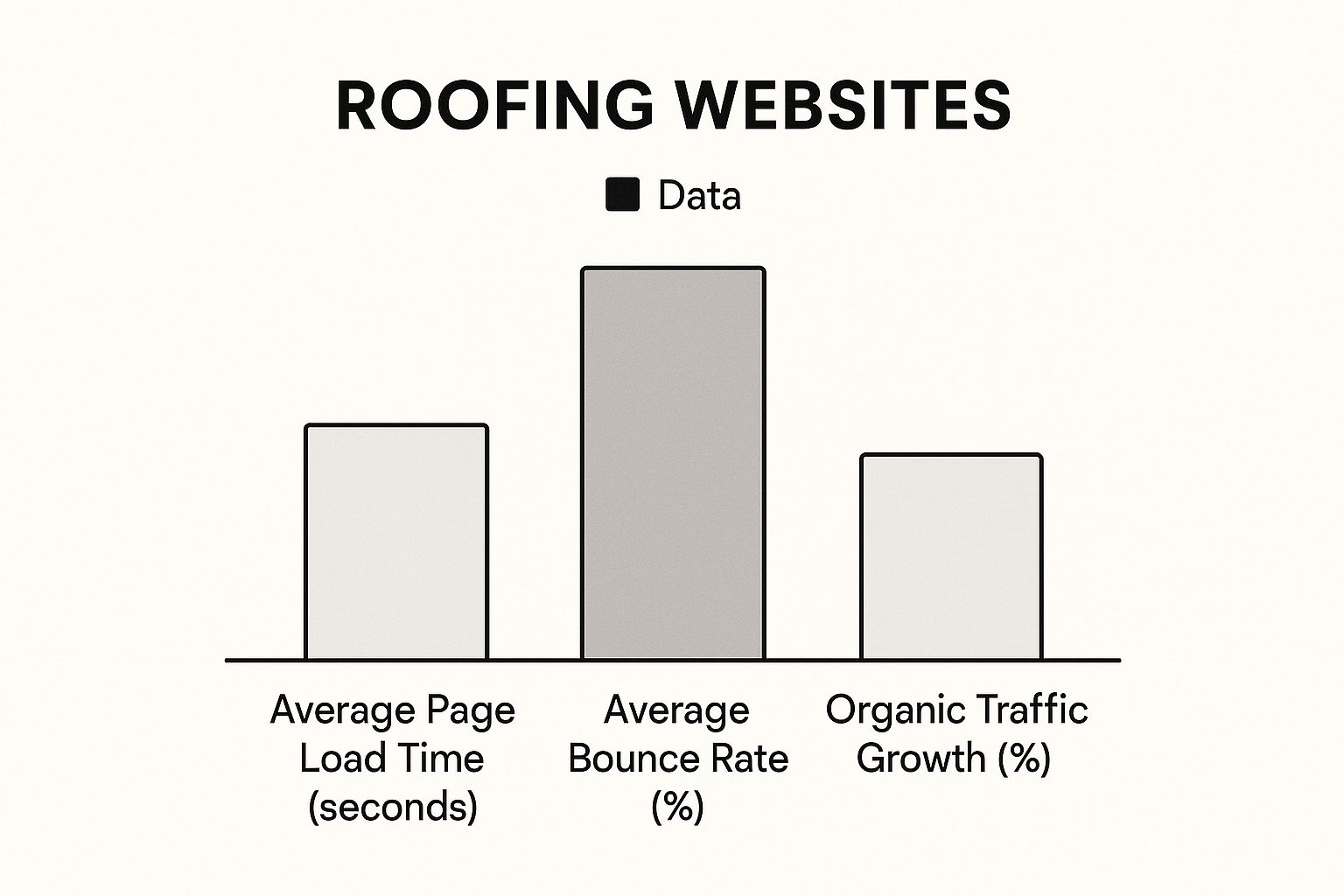
The data here is pretty clear: faster websites with lower bounce rates tend to get more organic traffic. It’s a great reminder that a solid user experience is crucial for both SEO and getting visitors to convert.
To help you decide which conversion elements to focus on, the table below compares the performance of common features on roofing contractor websites.
Website Conversion Elements Performance Comparison
Data showing the effectiveness of different conversion elements on roofing contractor websites
| Conversion Element | Average Conversion Rate | Implementation Difficulty | ROI Impact |
|---|---|---|---|
| "Get a Free Quote" Form | ~15-20% | Low | High |
| Click-to-Call Button | ~12-18% | Low | High |
| Live Chat Widget | ~10-15% | Medium | Medium-High |
| Project Gallery with CTAs | ~5-8% | Medium | Medium |
| Customer Testimonials Page | ~3-5% | Low | Medium |
| Financing Information Page | ~8-12% | Medium | High |
This data shows that simple, direct elements like "Get a Free Quote" forms and click-to-call buttons often deliver the highest conversion rates with the least effort. While a project gallery might not convert as directly, it plays a huge role in building the trust needed for a visitor to use those other features.
Beyond the technical aspects, social proof is your secret weapon. You absolutely must have authentic testimonials and reviews on your site. The numbers don't lie: 95% of consumers read reviews before making a purchase. Highlighting these prominently, along with industry certifications and galleries showing work similar to what a potential customer needs, proves you’re a reliable choice. If you want to explore this topic further, you can learn more about how online reviews impact home improvement businesses. By addressing potential objections and proudly displaying your reputation, your website will consistently turn visitors into booked appointments.
Launching and Improving Your Results Over Time
Getting your new roofing website live is a massive achievement, but it’s the starting line, not the finish line. The most successful roofing contractors treat their website as a dynamic tool that needs to evolve. The “set it and forget it” mindset is exactly why so many contractor sites fail to bring in a steady flow of leads long-term. Instead, you need a straightforward, consistent process for testing, measuring, and improving.
This cycle of ongoing improvement is what separates roofing businesses that thrive online from those that just exist. It’s all about making small, intelligent adjustments that build on each other over time, transforming your website into a powerful lead-generation machine.
Tracking What Truly Matters
First things first, you need to set up analytics that give you real insights, not just numbers to feel good about. Stop staring at your overall traffic and start focusing on how users behave on your most critical pages.
- Heatmaps: Tools like heatmaps are perfect for this. They create a visual map showing exactly where people are clicking—or trying to click—on your service pages. For instance, you might see a cluster of clicks on a photo of a specific shingle type. That’s a clear signal you should link that image to a page detailing your materials.
- Goal Tracking: Define what a "win" looks like on your site and track it. Monitor how many visitors fill out your "Free Inspection" form compared to how many hit the click-to-call button. This data tells you precisely which calls-to-action resonate with your audience. You might find that after a big storm, mobile visitors almost always prefer to call, which is your cue to make your phone number even more prominent during storm season.
Building a System for Growth
Lasting success online comes from a simple, repeatable system. Set aside just a few hours each month to look at your site’s performance and pick one or two small improvements to test. One month, you could try rewriting the headline on your hail damage page to create more urgency. The next, you might add a fresh customer testimonial to your homepage.
This methodical process of continuous improvement is the secret sauce for a high-performing website. By consistently gathering data and making informed tweaks, you ensure your roofing website design doesn’t just keep up with the market—it becomes a major driver of your business’s growth.
Your website is your most valuable digital asset. If you're ready to build a site that not only looks professional but is engineered to turn visitors into booked jobs, the team at Core6 Marketing can help. We build custom websites for contractors that are designed to rank and get results. Learn how we can transform your online presence today.