
Why Most HVAC Websites Fail (And What Actually Works)
Let's be honest: a huge number of HVAC websites are just expensive digital business cards. They might have a nice logo and a clean layout, but they do almost nothing to actually make the phone ring or get appointments on the calendar. The hard truth is that many contractors pay for a website without a clear strategy for turning it into a lead-generating machine. The result is a site that talks at potential customers instead of connecting with them when they need you most.
The main problem is a basic misunderstanding of what a customer is thinking. When a homeowner's air conditioner dies on a scorching July afternoon, they aren't admiring your font choices. They are stressed out and searching for a fast, trustworthy fix. A website that doesn't immediately address that urgency and build trust is going to be closed in seconds. This is why so many business owners say, "I have a website, but it never brings in any business."
The "Brochure Website" Trap
The "brochure website" is a classic mistake. It's a site that exists online but is functionally useless for bringing in new jobs. These sites usually have a few things in common that actively push away potential customers who are ready to hire someone.
So, what does this ineffective approach look like?
- Vague Service Descriptions: Simply listing "Heating and Cooling Services" doesn't cut it. A winning website design for hvac needs specific pages for AC repair, furnace installation, and emergency services that speak directly to a visitor's immediate problem.
- Hidden Contact Information: Making someone search for your phone number is a fatal flaw. Your number should be impossible to miss, especially on a phone.
- No Social Proof: A lack of real customer testimonials, reviews, or photos from actual jobs makes your business feel unproven and risky to a new customer.
- Focus on the "What," Not the "Why": These sites list what they do but fail to explain why a customer should choose them over five other local companies. They're missing a clear reason to be hired.
This issue is only getting more important as competition heats up. The HVAC market is set to grow significantly, with a 12.7% growth rate projected between 2024 and 2028. This boom means more customers are searching online, and a generic website just won't get noticed. To capture your piece of this growing market, your website has to be a fine-tuned tool for getting new clients. You can explore more data on this industry growth by reviewing these HVAC marketing statistics.
What a High-Performing HVAC Website Actually Does
So, what's the alternative? A great HVAC website acts like your best salesperson, working 24/7 to turn visitors into booked jobs. It moves the focus from just looking good to being strategic, prioritizing what truly matters to a homeowner in a jam. Instead of being a passive brochure, it’s an active tool built for one thing: generating profitable leads.
Effective sites do this by:
- Building Instant Trust: Showing off certifications, affiliations (like the BBB), and real photos of your team and trucks.
- Making Contact Effortless: Using big "Click-to-Call" buttons and simple "Request Service" forms that are easy to find and use.
- Solving Problems with Content: Answering common questions like "How much does a new AC unit cost?" or "Signs you need furnace repair" shows you're an authority.
- Showcasing Local Expertise: Clearly listing your specific service areas proves you're a real local contractor, not some faceless national company.
At the end of the day, the difference between a failing website and a successful one is a strategic focus on the customer's experience. By understanding their needs and anxieties, you can build a digital presence that not only looks professional but also consistently fills your schedule. For more specific ideas, our guide on website design and SEO for home service contractors offers more practical advice.
Building Trust Through Smart Design Choices
When a homeowner’s furnace gives out on the coldest night of the year, they’re not just browsing—they're stressed and searching for a reliable expert. Your website has only a few seconds to convince them you're the right person for the job. This isn't about flashy animations; it's about strategic design choices that communicate professionalism and turn a frantic visitor into a scheduled appointment.
Think of your website like your service vehicle. A messy, disorganized truck arriving at a job site immediately raises red flags. The same is true online. A cluttered, confusing website creates friction and makes a potential customer question your ability to handle their HVAC emergency. A clean, professional website design for hvac is the digital version of a clean truck and a uniformed technician—it sets a high standard before you even say hello.
Weaving Credibility into Your Visuals
Building trust online begins with being authentic. Stock photos of smiling families in perfectly air-conditioned homes are a thing of the past. Customers can spot a fake from a mile away. Instead, you need to provide genuine visual proof that you run a real, local, and skilled operation.
Here’s how you can do that effectively:
- Show Your Team: Feature high-quality photos of your actual technicians, office staff, and even yourself. Putting a face to the name makes your company more approachable and reduces the anxiety of letting a stranger into someone's home.
- Display Your Fleet: Photos of your clean, branded service trucks are powerful trust signals. They show you're an established business that invests in its equipment and professional image.
- Showcase Real Work: Before-and-after photos of installations or complex repairs are incredibly persuasive. They offer tangible proof of your skills and the quality of your work, moving beyond simple claims to show actual results.
These visuals work together to tell a story of a dependable company. This is a key part of managing your online reputation, which is just as important as the hands-on work you do. To get a better handle on this, you can check out our guide on reputation management for home services, which goes deeper into building a stellar online presence.
The Psychology of Trust Signals
Beyond genuine photos, certain design elements act as psychological shortcuts to build visitor confidence. When someone lands on your site, they are subconsciously scanning for signs that you are a legitimate and trustworthy business. Placing these “trust badges” in highly visible locations is critical.
To help you prioritize, here’s a breakdown of essential trust-building elements and how they stack up.
HVAC Website Trust Elements Comparison
Comparison of trust-building elements and their impact on conversion rates for HVAC websites
| Trust Element | Implementation Difficulty | Conversion Impact | Priority Level |
|---|---|---|---|
| Customer Testimonials | Low | High | Critical |
| Industry Certifications (NATE, etc.) | Low | High | Critical |
| BBB Accreditation Logo | Medium | Medium | High |
| "About Us" Story with Team Photos | Medium | High | High |
| Financing Partner Logos | Low | Medium | Medium |
These elements shouldn't just be tucked away in the footer. Instead, sprinkle customer testimonials throughout your service pages. Place certification logos near your call-to-action buttons. This strategic placement reinforces your credibility right when a customer is making a decision. The goal is to answer their unspoken questions—"Can I trust them?" and "Are they qualified?"—before they even have to ask.
This focus on user experience and trust is a central theme in modern web design. In fact, current website design for hvac trends show a major focus on user experience, search optimization, and communicating smart technology expertise. As more customers use search engines to find local contractors, a well-designed site becomes your most critical tool for acquiring new business. You can discover more insights about HVAC industry statistics to see just how important this is. By embedding these trust signals directly into your design, you create a smooth path from visitor to loyal customer.
Mobile-First Design That Captures Emergency Customers
Picture this: It's the hottest Saturday in July, the air conditioner has gone silent, and a homeowner is frantically Googling “emergency AC repair near me” on their phone. This isn’t a casual browse. It’s a desperate, high-stakes search for an immediate fix. With almost 60% of all web traffic now coming from mobile devices, you’re losing your most motivated customers if your site isn’t built for this exact moment. A clunky mobile website is a guaranteed way to lose a lead—more than half of users admit a bad mobile experience makes them less likely to even consider a company.
This is why a responsive website design for hvac is no longer just a feature; it's the core of your lead generation engine. Adopting a mobile-first design philosophy means you design the mobile version of your site before you even think about the desktop layout. This approach forces you to prioritize what a customer in distress needs most: your phone number, your service area, and quick proof that you can solve their problem right now.
Essentials for a Panic-Proof Mobile Experience
When someone is sweating in their own home, they don't have the patience for slow-loading pages or confusing menus. Your mobile site has to be quick, straightforward, and direct. The entire goal is to eliminate any and all friction between their crisis and your solution.
To land these high-value customers, your mobile site absolutely must have:
- A "Sticky" Header with a Click-to-Call Button: Your phone number should remain locked at the top of the screen as someone scrolls. Critically, this number must be a tappable link that instantly opens their phone's dialer. Don't make them copy and paste; one tap is all it should ever take.
- Lightning-Fast Page Speed: Every single second matters. A site that takes more than three seconds to load will be abandoned. This means you need to optimize your images, use clean code, and select a dependable hosting provider. A speedy site feels professional and reassures a stressed-out user that they've found a capable company.
- Thumb-Friendly Navigation: People use their thumbs to get around on their phones. All your buttons and links must be large enough to be easily tapped without hitting something else by mistake. Keep menus simple, focusing on core services like "AC Repair," "Furnace Repair," and "Emergency Service."
- Uncluttered Forms: If you include a "Request Service" form, make it incredibly simple for mobile users. Only ask for the absolute essentials: name, phone number, and a short note about the problem. A long, complicated form will be instantly ignored on a small screen.
Prioritizing Information for Mobile Users
On a desktop, you have plenty of room to share your company's story. On a mobile device, you have to cut right to the chase. The information a user sees "above the fold"—the content visible before they scroll—is the most important real estate on your site.
Here’s what every emergency customer must see the moment your page loads:
- Your Phone Number: Make it large, tappable, and impossible to miss.
- Your Primary Service: "24/7 Emergency HVAC Service."
- Key Trust Signals: A simple mention of "Licensed & Insured" or your 5-star Google rating.
By designing for your most urgent customer first, you naturally create an experience that serves everyone better. Whether someone is in a full-blown panic or just casually researching a system upgrade, a clean, fast, and easy-to-navigate mobile site makes you the obvious choice.
Local SEO Mastery for HVAC Contractors
A fantastic website is a great start, but if local customers can’t find it when their AC dies, it’s not doing its job. This is where local search engine optimization (SEO) becomes your most valuable player. When a homeowner frantically searches "AC repair near me," local SEO is what determines whether your business appears on that critical first page of Google or gets buried on page five. For HVAC contractors, success isn't just about being online—it's about owning the search results in your specific service areas.
A smart website design for hvac must be built with local SEO as a core component, not something tacked on later. This means you need to think like your customers. They aren't just searching for "HVAC services"; they're looking for "furnace repair in Dallas" or "emergency AC service in Plano." Your website has to prove to both people and search engines that you are the go-to expert for those exact locations.
Your Google Business Profile: The Digital Storefront
Long before a potential customer lands on your website, they'll probably see your Google Business Profile (GBP). Think of this free listing as your digital storefront—it’s often the first impression you make and a massive piece of the local SEO puzzle. A neglected profile can be a red flag, but a well-managed one builds instant trust.
To turn your GBP into a lead-generating asset, you need to go beyond the basics:
- Detail Your Services: Don’t just list "HVAC." Get specific. Add every service you offer, like "ductless mini-split installation," "thermostat repair," and "24-hour emergency heating service." This helps you show up for more detailed, high-intent searches.
- Show, Don't Just Tell, with Photos: Regularly upload high-quality photos. Post pictures of your team in uniform, your branded trucks on a job, and recent installations (with the customer's okay, of course). This authenticity makes customers feel more comfortable choosing you over a competitor.
- Answer Questions Before They're Asked: Use the Q&A section to your advantage. Think about common questions you get—"Do you offer financing?" or "What are your weekend hours?"—and answer them yourself. This lets you control the information and give people quick answers.
- Share Updates with Google Posts: Use Google Posts to announce special offers, share seasonal maintenance tips, or highlight company news. These posts act like mini-ads directly on your profile, catching the eye of anyone looking you up.
The chart below shows how strategic improvements, which often start with a click from your GBP to your website, can have a huge impact on performance.
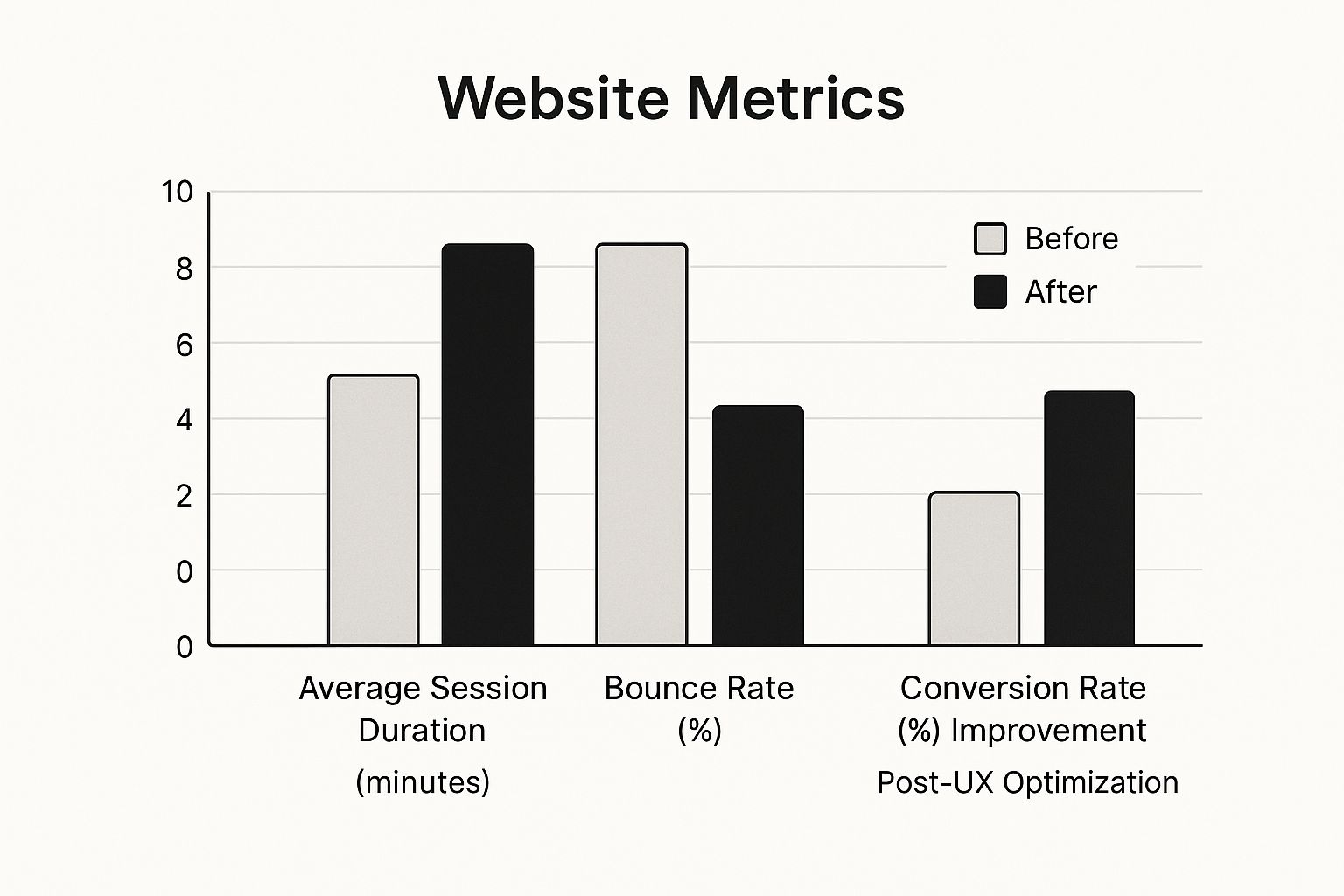
As you can see, a better user experience leads directly to more engaged visitors and a much higher chance they'll pick up the phone and call for service.
To measure your own progress, it helps to know what to track. Here are some key metrics and what you should be aiming for.
| Metric | Industry Average | Top Performer | Measurement Method |
|---|---|---|---|
| Organic Traffic Growth | 5-10% MoM | 15%+ MoM | Google Analytics (Acquisition > All Traffic > Channels) |
| Local Pack Rankings | Top 10 | Top 3 | Local SEO tools (e.g., BrightLocal) or manual search |
| GBP Clicks to Website | 20-30% of total clicks | 40%+ of total clicks | Google Business Profile Insights (Performance Report) |
| Conversion Rate (Form/Call) | 2-4% | 5-8% | Google Analytics (Goals/Conversions setup) |
These benchmarks give you a clear target. If your numbers are falling short, it’s a sign that your local SEO strategy needs attention.
Building Hyper-Local Authority
Beyond your Google Business Profile, Google wants to see consistent mentions of your business's name, address, and phone number (NAP) across the web. These online mentions are called citations, and they're essential for your local rankings. Consistency is everything—if your phone number on Yelp is different from the one on your website, it can confuse search engines and hurt your visibility.
To really build this local authority, create dedicated "service area" pages on your site. Don't just list the towns you work in. Make a unique page for each major city or neighborhood. On that page, talk about common HVAC problems specific to that area, mention a local landmark, and drop in a testimonial from a customer who lives there. This proves your deep connection to the community and sends strong signals to Google that you are a relevant local provider. For more ideas, you can explore our guide on 5 local SEO hacks for contractors that offers more hands-on tips. This focused, hyper-local approach is what separates the top-ranking contractors from everyone else.
Converting Browsers Into Paying Customers
A beautiful website that doesn’t make your phone ring or fill your schedule is just a costly digital business card. The real purpose of a great website design for hvac is to turn curious visitors into paying customers. This means every page should answer one simple question: what is the next logical step we want this person to take? Forgetting this is how businesses end up with pretty sites that generate zero leads.
Think about the customer's journey, from a frantic late-night Google search to a signed work order. They might land on your "AC Repair" page, but if the quote form is intimidating or they can’t quickly find information, they’ll just click the back button and be gone for good. Effective conversion is all about removing friction and building momentum toward a clear goal: getting them to contact you.
Crafting Calls-to-Action That Actually Work
A call-to-action (CTA) is your direct invitation to a potential customer, not just a button. The most common mistake I see contractors make is using weak, generic CTAs like "Learn More" or "Contact Us." These are passive and don't inspire action. A homeowner with a dead furnace needs a confident, solution-focused prompt.
For your CTAs to really work, they need to be:
- Action-Oriented and Specific: Instead of "Contact," try "Schedule Your AC Repair Now" or "Get a Free Furnace Quote." These phrases are direct, clear, and match what the customer is looking for.
- Visually Prominent: Use a bright, contrasting color for your CTA buttons. They should stand out from the rest of the page and be impossible to miss.
- Strategically Placed: A CTA should appear "above the fold" (visible before a user has to scroll) and be repeated after key information, like your testimonials or service details.
Here’s a real-world example: A contractor I know in Texas changed their main CTA from "Request an Estimate" to "Book Your Service Call Online." This single change boosted their online bookings by over 30%. The new wording felt more immediate and less like a drawn-out sales process, which was perfect for homeowners who needed a quick fix. It’s a great illustration of how small tweaks in language can produce big results.
Simplifying the Path to a Scheduled Job
Once a customer decides they want to reach out, the process has to be completely painless. People now expect the same level of convenience from their HVAC contractor as they get from ordering dinner online. If booking a service call is a chore, they’ll assume your actual service will be a hassle, too.
Try implementing these high-impact conversion tactics:
- Streamlined Forms: Keep your "Request a Quote" form short. You only need the essentials: Name, Phone Number, Email, and a short description of the problem. Asking for too much, like the exact model number of their unit, will make people hesitate and leave.
- Online Scheduling Integration: A real-time online scheduling tool is a game-changer. It lets a customer see your open time slots and book an appointment at 2 AM without ever having to call. This puts the control in their hands and satisfies the need for immediate action.
- Emergency Service Optimization: For your emergency service pages, the main CTA has to be a large, clickable phone number. You can have a simple "Emergency Request" form as a secondary option, but the primary focus must be on encouraging an immediate phone call.
The HVAC industry is growing fast, with the global market expected to reach nearly $383 billion by 2030. This growth is driven by the demand for smarter, more efficient systems. More customers are finding and hiring contractors online, making a frictionless conversion process more critical than ever. You can explore more about evolving HVAC industry trends to see how digital tools are changing the business.
By focusing on converting visitors into customers, you ensure your website design for hvac doesn't just look good—it actively grows your bottom line. To learn more, check out our insights on how SEO can transform your company.
Content That Positions You As The Local Expert
Potential customers aren't just searching for any HVAC contractor; they're looking for the smartest, most reliable one in town. They want to hire a local authority who genuinely understands their home, the local climate, and the specific issues they're facing. Your website's content is your single best tool for proving you are that expert. A great website design for hvac goes beyond a simple list of services and a contact form—it’s about educating your customers and building trust long before they ever pick up the phone.
The secret is to create content that directly answers the questions homeowners are already asking. Think about the phone calls you field every single day. What are the common problems and repeat questions? That's your content goldmine. When you build resources that address these real-world concerns, you not only attract more visitors but also establish your company as a helpful, knowledgeable leader. This approach turns your website from a sales brochure into a valuable community resource people will bookmark and even share with their neighbors.
Answering Questions with a Strategic FAQ
One of the most effective yet frequently overlooked pages on a contractor's site is a detailed Frequently Asked Questions (FAQ) section. This isn't just a spot to list your business hours. It's a prime opportunity to tackle common customer anxieties and technical questions head-on, showcasing your expertise and saving your team precious time on the phone. A thoughtfully crafted FAQ builds incredible trust.
Your FAQ page should dive into questions like:
- How often do I really need my HVAC system serviced?
- What are the signs my air conditioner needs to be replaced, not just repaired?
- Is a smart thermostat actually worth the investment for my home?
- What does a SEER rating mean, and why should it matter to me?
By providing clear, straightforward answers, you demonstrate transparency and a real commitment to customer education. This is especially vital for big-ticket items like system replacements, where homeowners are doing heavy research before making a final decision. Answering their questions upfront makes you the most helpful resource they find online.
Beyond Services: Creating Blog Content That Ranks
While your service pages are essential for converting customers who are ready to buy, your blog is what captures everyone else who is still in the research phase. Think of it as your engine for attracting a much wider audience through search engines. The most successful HVAC contractors plan their content around the seasons, mirroring the real-life needs of homeowners throughout the year.
Try building a content calendar that covers timely topics like:
- Fall: "How to Prepare Your Furnace for Winter" or "Is Your Heater Making Strange Noises? A Troubleshooting Guide."
- Winter: "Tips for Lowering Your Heating Bill During a Cold Snap" or "Why Is My Heat Pump Blowing Cold Air?"
- Spring: "Allergy-Proofing Your Home: The Importance of Clean Air Ducts" or "Getting Your AC Ready for the Summer Heat."
- Summer: "Common AC Problems and How to Spot Them Early" or "How to Choose the Right Size Air Conditioner for Your Home."
This kind of content does more than just fill your website with text. It establishes your authority on seasonal issues, helps you show up in search results for a wider variety of terms, and provides genuinely helpful advice that keeps your company top-of-mind. When a homeowner who learned from your "furnace prep" article later has a heating emergency, you’ll be the first company they call. It’s a long-term strategy that builds a loyal customer base.
Your Action Plan for Website Success
Knowing what makes an effective HVAC website is one thing, but actually building it is where the real work begins. It's time to move from theory to a practical roadmap. Whether you're building a new site from scratch or fixing an underperforming one, this plan will help you make smart decisions that lead to a real return on your investment. Success boils down to setting a realistic budget, picking the right partners, and knowing exactly what to measure.
Setting a Realistic Budget and Timeline
First, let's talk about money and time. A high-quality website design for hvac is an investment, not just an expense, but you have to be realistic about the costs. Going for the cheapest option often leaves you with a generic template site that fails to generate leads, wasting your money in the long run. A well-built, custom site can range from a few thousand dollars to well over $15,000, depending on its complexity, features like online scheduling, and the amount of custom content needed.
When mapping out your timeline, plan for at least 8 to 12 weeks from kickoff to launch. This gives everyone enough time for proper discovery, design, development, content creation, and testing. Rushing the process is a recipe for cutting corners on critical elements like local SEO and making sure the site works perfectly on mobile phones. A good web design partner will give you a detailed project plan so you know what to expect and when.
Choosing the Right Partner for the Job
Your choice of a web designer or agency is the single most important decision you'll make in this process. Don't just hire a generalist designer; you need a partner who gets the home service industry. They should know what makes a homeowner with a broken AC unit pick up the phone and call you.
When you're vetting potential partners, ask these critical questions:
- Can you show me examples of other HVAC or home service contractor websites you've built?
- How do you approach local SEO for a business with multiple service areas?
- What is your strategy for mobile-first design and capturing emergency service calls?
- How do you measure success? What key performance indicators (KPIs) do you track?
- What happens after the site launches? Do you offer ongoing maintenance and support?
A partner who can't answer these questions confidently with specific examples probably isn't the right fit. Remember, you’re not just buying a design; you’re investing in a lead generation strategy.
Tracking Performance and Optimizing for Growth
Once your new website is live, the work isn't over. You have to track its performance to understand what's working and where you can improve. This is where tools like Google Analytics become essential. You can't manage what you don't measure.
Here is a look at a typical Google Analytics dashboard, where you can monitor key metrics like user traffic, session duration, and goal completions.
This data tells a story about how visitors are interacting with your site. It helps you identify which pages are most engaging and which ones might be causing people to leave.
To start, focus on tracking these core metrics:
- Total Leads: This is the number of phone calls from the site and form submissions per month. It's your most important number.
- Conversion Rate: The percentage of visitors who become a lead. A good starting goal is 2-4%.
- Organic Traffic: How many visitors are finding you through search engines like Google? This shows the health of your SEO.
- Bounce Rate: The percentage of visitors who leave after viewing only one page. A high bounce rate can signal a problem with your page content or user experience.
By monitoring these numbers weekly, you can make data-driven decisions to continually refine your site. This process of ongoing improvement—testing new calls-to-action, adding fresh blog content, and updating service pages—is what separates a static digital brochure from a dynamic business-growth machine.
This entire process, from planning to ongoing optimization, is essential for building a website that does more than just exist—it delivers qualified leads directly to your business. If you’re ready to build a site that truly performs, the expert team at Core6 Marketing is here to help. We specialize in creating custom websites for contractors that are designed to dominate local search and drive measurable growth. Contact us today to get started.