
Let's be honest—seeing a negative review for your business feels like a gut punch. Whether it's a 1-star Yelp rating for your Gilroy cafe or a critical Google comment about your Santa Cruz shop, the impulse to ignore it or get defensive is strong. But mastering the art of responding to negative reviews is one of the most powerful moves a local business owner can make.
This guide will give you a clear, actionable framework for turning negative feedback into a public demonstration of your company's strength and commitment to customer service.
Why Responding to Negative Reviews Matters in the Monterey Bay
In our unique coastal economy—from the agricultural heart of Salinas to the tourist-driven shores of Monterey—your online reputation is your digital storefront. A negative review left unanswered doesn't just fade away. It lingers, shaping the perceptions of hundreds of potential customers who see it.
It’s a common misstep for busy owners across Monterey County to overlook criticism, but the cost of silence is steep. A thoughtful response, on the other hand, shows everyone watching that you are accountable and committed to quality.
The True Cost of Ignoring Feedback
The data doesn't lie: ignoring feedback is not a neutral act. On average, a single unanswered negative review can cost a business up to 30 potential customers. When you consider that approximately 75% of businesses don't respond to negative reviews, this creates a massive opportunity for local pros who do.
This is especially true for specialized fields where trust is everything. As we've detailed before, understanding how online reviews affect your home improvement contractor business is critical for tradespeople from Hollister to Santa Cruz who depend on referrals and a stellar reputation.
A professional response doesn't just address the original complaint; it sends a powerful message to every future prospect. You're showing them you're accountable, you care about quality, and you stand behind your work.
How Your Response Shapes Your Reputation
Your reaction to criticism speaks volumes. For a local business, every public interaction is a chance to either build or erode trust. What you choose to do—or not do—has a direct and immediate impact on your lead generation and digital visibility.
Here's a breakdown of how different actions play out in the real world.
| Your Action | Impact on Potential Customers | Impact on Your Monterey Bay Business |
|---|---|---|
| Ignoring the Review | Signals you don't care, driving them to competitors | Harms your brand, lowers local search visibility, and risks losing customers |
| Responding Defensively | Alienates the reviewer and onlookers who read the exchange | Appears unprofessional, invites more conflict, and damages public perception |
| Responding Professionally | Builds trust and shows you stand behind your service | Strengthens brand loyalty, improves public image, and can lead to the reviewer updating their rating |
The takeaway is clear: engaging thoughtfully isn't just about damage control. It's about turning a negative situation into a public display of your company's character.
The A.C.T. Framework: A Simple, Powerful System
Getting hit with criticism is never fun, but having a proven system takes the emotion and guesswork out of it. A simple, repeatable process is your best defense. We teach our clients the A.C.T. Framework because it’s a powerful method for turning a public complaint into a showcase of exceptional customer service.
The framework boils a professional response down to three core actions:
- Acknowledge what the customer is saying.
- Connect with them through genuine empathy.
- Take Action to solve the problem offline.
Think about how this plays out for a local business. A contractor in Watsonville gets a review complaining about a messy job site. Or a boutique in charming Carmel-by-the-Sea receives a complaint about a rude salesperson. The A.C.T. framework works perfectly for both.
This simple infographic breaks down the essential flow for managing your online feedback.
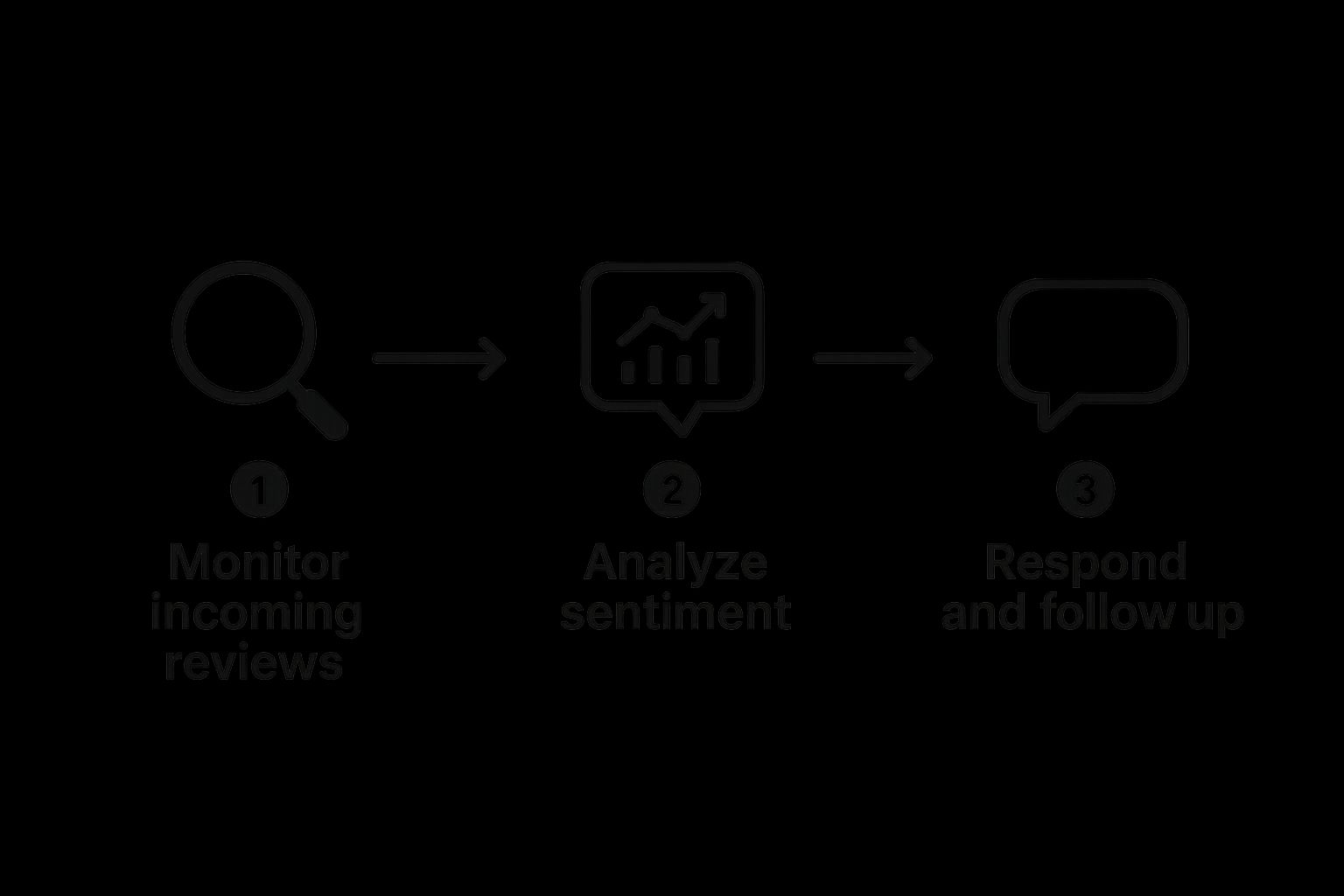
As the graphic shows, it all starts with proactive monitoring. From there, you can analyze the situation and deliver a strategic, helpful response that protects your reputation.
Step 1: Acknowledge and Validate
The first step, Acknowledge, is all about validating the customer's feelings. This is crucial: you aren't necessarily admitting fault. You are saying, "we hear you, and we’re sorry you had a bad experience." This one move can immediately de-escalate a tense situation.
For instance, a Salinas-based business could start with something as simple as, "Thank you for sharing your feedback. We're sorry to hear your visit didn't meet your expectations." That’s it. You've shown you're listening.
Step 2: Connect and Humanize
From there, you want to Connect with genuine empathy. This is where you remind the upset customer (and everyone else reading) that your business is run by real people in Monterey County. Drop the corporate-speak and use simple, direct language that shows you care.
A great way to connect is to briefly restate their specific problem. For example: "It sounds incredibly frustrating to have found debris left behind after our team finished the job." This proves you’ve actually read their review and understood their unique issue.
Step 3: Take Action and Resolve
The last step is to Take Action. This is where you provide a clear path to a solution while gracefully moving the conversation out of the public eye. Review platforms are for demonstrating accountability, not for hashing out details.
Offer a direct line to someone who can help. A powerful closing looks like this: “We want to make this right. Please call me directly at [Your Number] or email me at [Your Email] so we can resolve this for you.” This final step proves to every potential customer watching that you stand behind your work.
Nailing Your Tone, Timing, and Language
A great response is about more than just what you say—it’s how and when you say it. While our A.C.T. framework gives you the structure, the art is in the subtle communication that builds bridges. Mastering your tone, timing, and language is a non-negotiable part of responding to negative reviews effectively.
This is where many well-meaning business owners in Santa Cruz County can stumble. They might have the right solution, but if they deliver it too late or with a hint of defensiveness, it completely undermines their efforts. Your goal is to stay calm, professional, and consistently helpful.

Speed and Empathy Are Everything
When it comes to responding, timing is crucial. We live in an on-demand world, and customer expectations reflect that. A recent survey found that 34% of online shoppers expect a response to negative feedback within just 24 hours. Waiting longer sends a message that you don't care.
Once you jump in to respond, your choice of words will either de-escalate the situation or pour gasoline on the fire.
Key Takeaway: A simple language swap can completely change the tone. Instead of, “We are sorry, but the project was complex,” try, “We are sorry, and we recognize this was a complex project that required more communication from our end.” The first version dismisses their feelings; the second validates them.
This level of care is critical for any local business, but it's especially true for service-based industries where your entire brand is built on trust. You can dive deeper into managing your digital presence with our guide to reputation management for home services.
Fine-Tuning Your Language
The right words also depend on who you are. A high-end hotel in Pacific Grove will naturally have a different tone from a B2B agricultural tech firm in the Salinas Valley. Here are a few powerful phrases to keep in your back pocket:
- "We're sorry to hear your experience didn't meet your expectations." This validates their feeling and apologizes for the outcome without admitting universal fault.
- "Thank you for bringing this to our attention." This reframes their complaint as helpful feedback, not an attack.
- "We want to learn more so we can make this right." This shows you're committed to finding a solution and encourages an offline conversation.
By mastering these small but mighty nuances, you can turn a public complaint into a powerful demonstration of your company's integrity.
Turning Customer Feedback Into Business Intelligence
Every negative review feels personal, but what if you could change your perspective? Stop thinking of bad feedback as a fire to put out. Instead, look at it as a free consulting session that tells you exactly what needs fixing in your business.
This is the secret to moving from reactive damage control to proactive business strategy. The real power isn't in responding to a single unhappy customer. It's in spotting patterns. Is more than one person mentioning slow service at your Hollister restaurant on a Friday night? Has a recurring complaint about a specific product surfaced at your Marina storefront?
Did You Know? Monterey Bay is more than just a pretty coastline. Our region is a global hub for agricultural technology, or "AgTech," proving that innovation is in our local DNA. Smart business owners here apply that same innovative spirit to customer feedback.
From Complaints to Actionable Data
When you treat complaints like valuable data, you suddenly have a roadmap for improvement. A single negative review might just be one person's bad day. But when three or four reviews mention the same issue, you’ve uncovered a real problem that needs your attention.
It’s easier than you think to get started. Here’s a simple process:
- Track Everything: Create a simple spreadsheet. Log every piece of negative feedback, noting the date, platform (Google, Yelp), and the core issue.
- Categorize Complaints: Group similar issues together. You’ll quickly see categories form, like "Service Speed," "Product Quality," or "Staff Attitude."
- Look for Clusters: This is where the magic happens. Are complaints piling up on a specific day? Do they mention a particular employee or a certain service you offer?
By methodically tracking this feedback, a business in Santa Cruz County can stop guessing what’s wrong and start making data-informed decisions. This is how you turn customer sentiment into a genuine competitive edge and boost your ROI (Return on Investment). This process is fundamental to any smart reputation management for small business.
How to Handle and Report Illegitimate Reviews

While every legitimate complaint deserves a thoughtful response, not all negative reviews are genuine. Every so often, you'll get hit with feedback that is obviously spam, a fake review planted by a competitor, or something that violates the platform's rules.
Knowing how to deal with these is crucial for protecting your business from unfair attacks. This is especially true in competitive local markets, where a single bogus one-star review can do real damage to a Salinas business. Thankfully, platforms like Google and Yelp have specific policies that define what an illegitimate review is.
When to Flag a Review
So, when should you report a review? You have a strong case if the review falls into one of these categories:
- Spam or Fake Content: The review is a sales pitch, posted by a bot, or from someone who was never a customer.
- Off-Topic Rant: The feedback has nothing to do with an actual experience at your business.
- Prohibited Content: The review contains hate speech, harassment, threats, or private information.
- Conflict of Interest: The review was posted by a competitor or a disgruntled former employee.
When you flag a review, don't just click the button and hope for the best. Give the platform as much context as you can. Point to the exact policy the review violates. This dramatically increases your odds of getting it taken down.
While you're waiting for the platform to make a decision, it's still a good idea to post a calm, professional reply. In the meantime, the best defense is always a good offense. Focus on drowning out the noise by earning more positive feedback with our commercial and residential client review request scripts.
Ready to Take Control of Your Online Reputation?
Turning negative reviews into positive opportunities is a skill. It takes time, a clear strategy, and a consistent approach. But for busy small business owners in the Monterey Bay Area, finding that time can be the biggest challenge.
That’s where we come in. As an SEO agency in Salinas, we help local businesses manage their digital presence, improve their visibility, and turn their online reputation into a powerful tool for lead generation.
If you’re ready to stop worrying about negative feedback and start building a five-star reputation, we’re here to help.
Contact us today for a free consultation.
Phone: 831-789-9320
Email: [email protected]
By Phil Fisk, CEO, Core6 Marketing
Phil leads Core6 Marketing, a specialized agency helping home service contractors and other local businesses in Monterey, Santa Cruz, and San Benito counties generate leads and grow their businesses. With a focus on data-driven strategies like digital marketing for Santa Cruz retailers, he empowers local companies to enhance their digital visibility and achieve measurable results.
Core6 Marketing
1628 N. Main St #263, Salinas, CA 93906
831-789-9320
[email protected]
https://core6.marketing/