
Diving into Pay-Per-Click (PPC) advertising can feel like a gamble, but for contractors, it's one of the most direct ways to get in front of customers who need your help right now. The secret to winning with PPC for contractors in the Monterey Bay Area isn’t about the biggest budget—it’s about spending that budget intelligently. A successful campaign is built on razor-sharp local targeting, keywords that solve a problem, and ads that speak directly to homeowners in places like Salinas and Santa Cruz.
Your Blueprint for Profitable PPC for Contractors in Salinas
Forget the generic, one-size-fits-all advice. This is a real-world blueprint that shows you how a well-managed PPC budget transforms clicks into paying jobs. It’s designed to position your business as the go-to choice, whether you're serving the agricultural heart of San Benito County or the coastal communities of Monterey. We'll break down concepts like Cost-Per-Click (CPC) in plain English so you can feel confident in your decisions.
The goal here isn't just to get your name out there; it's to generate qualified leads that turn into profitable work. By the time you're done with this guide, you’ll have a clear path to building a campaign that delivers results you can actually measure.
Understanding the Investment and Return
Let's be clear: PPC is an investment, not just an expense. For most small to mid-sized contractors, a campaign might run anywhere from a few hundred to several thousand dollars a month. But here’s the exciting part—on average, businesses see a $2 return for every $1 spent on Google Ads, according to WordStream.
Despite that, a shocking 72% of companies admit they haven't even looked at their ad campaigns in over a month. That’s just leaving money on the table.
The Foundation for Local Success
A strong foundation is everything in construction, and it's just as true for PPC. For contractors working in our region, a successful campaign always boils down to these four critical pieces:
- Hyper-Local Targeting: Your ads should only show up for potential customers inside your actual service area. This means specifically targeting cities like Monterey, Gilroy, and Watsonville, not wasting ad spend on clicks from someone in another state.
- High-Intent Keywords: You want to capture the people who need you now. We focus on terms like "emergency plumber Santa Cruz" or "roof repair in Salinas" instead of wasting time on broad, research-phase keywords like "home improvement ideas."
- Compelling Ad Copy: Think of your ad as your digital first impression. It needs to say what you do, where you do it, and why a homeowner should trust you over the competition. Mentioning your local roots can build instant credibility.
- Optimized Landing Pages: When someone clicks your ad, the page they land on has to deliver on the ad's promise. It must be simple, direct, and have a crystal-clear call-to-action, like a big "Request a Free Estimate" button.
At its core, a strong PPC campaign for a local contractor acts like a digital beacon, signaling to nearby homeowners that you are the reliable, professional solution they’ve been searching for.
Core Components of a Successful Local PPC Campaign
To put it all together, here's a quick summary of the essential elements that form the foundation of a high-performing PPC campaign for contractors in the Monterey Bay Area.
| Component | Why It Matters for Contractors | Monterey Bay Area Example |
|---|---|---|
| Hyper-Local Targeting | Prevents wasted ad spend on clicks from outside your service area. | Targeting ads to specific zip codes in Salinas, Monterey, and Santa Cruz. |
| High-Intent Keywords | Captures customers who are ready to hire, not just browse. | Bidding on "leaky faucet repair Watsonville" instead of "plumbing." |
| Compelling Ad Copy | Builds trust and encourages clicks by speaking directly to the customer's needs. | "Local & Trusted Salinas Roofer. Free Estimates. Call Now!" |
| Optimized Landing Page | Makes it easy for potential customers to contact you and convert into a lead. | A simple page with a contact form, phone number, and project photos. |
Focusing on these core components turns PPC from a guessing game into a predictable system for growing your business.
As you build out your PPC blueprint, remember that it works best when combined with other digital marketing lead generation strategies. This structured approach is what separates the contractors who get consistent leads from those who just burn through their marketing budget.
Building a Keyword List That Attracts Local Jobs
Your keywords are the absolute bedrock of your entire Google Ads campaign. Getting this wrong is like building a house on a shaky foundation—no matter how great the rest of it is, the whole thing will eventually fall apart.
You'll just end up burning your budget on clicks from DIYers, people looking for jobs, or worse, homeowners who live miles outside your service area. A solid keyword list is the most critical first step in a successful PPC for contractors strategy.
We’re going to walk through how a real contractor here in Monterey County can build a keyword list that pulls in actual, paying jobs. The goal is to get your ad in front of a homeowner in Salinas with a burst pipe or a business owner in Santa Cruz who needs an urgent electrical repair. It’s all about nailing that local intent.
Targeting High-Intent "Money Keywords"
First, you need to understand the difference between a "research" keyword and a "money" keyword. A research keyword is something broad, like "kitchen remodel ideas." The person searching that is probably scrolling through Pinterest for inspiration, not pulling out their checkbook.
A money keyword, on the other hand, screams "I have a problem and I need it fixed now!" These are the search terms that lead directly to phone calls and filled-out contact forms. They almost always combine a specific service, a trigger word, and a location.
For our area, high-intent keywords would look something like this:
- Emergency plumber Salinas
- HVAC repair Santa Cruz
- Roof replacement Hollister
- Gilroy electrician for new wiring
- Carmel-by-the-Sea deck builder
Think like your customer. When their water heater dies, they aren't searching for "water heating technology." They're frantically typing "emergency water heater replacement near me" or "24/7 plumber in Monterey." Those are your money keywords.
Using Match Types to Control Your Audience
Google Ads gives you a powerful tool called match types to control exactly who sees your ad. Using them correctly is key to protecting your budget from wasteful clicks and improving your lead quality.
- Exact Match: You write this as
[keyword]. Your ad will only show for searches that are nearly identical to your keyword, like[plumber in seaside]. This gives you maximum control and usually brings in the highest-quality leads. - Phrase Match: You write this as
"keyword". Your ad can show for searches that include your keyword phrase in order, like"generator installation watsonville". This is perfect for capturing relevant searches with minor variations. - Broad Match: This is just the
keyworditself, with no symbols. We use this one very, very carefully. Google will show your ad for any search it thinks is related, which can burn through your budget on irrelevant clicks in a hurry.
For most local contractors, a smart mix of phrase match and exact match offers the best balance of reach and control. You’ll be visible for the right jobs without casting your net too wide.
The Power of Negative Keywords
This is the secret weapon of profitable PPC campaigns. Negative keywords are simply a list of terms you tell Google not to show your ads for. Building a strong negative keyword list is just as important as picking the keywords you want to target.
This list actively shields your budget from clicks you know are worthless. For any contractor, your starting list should immediately block terms like:
- free
- DIY
- how to
- jobs
- training
- school
- craigslist
- salary
A roofer in Salinas doesn't want to pay for a click from someone searching "roofing jobs Salinas," and a plumber in Monterey needs to avoid anyone looking up "how to fix a leaky faucet DIY." This isn't a set-it-and-forget-it task; you have to keep adding to this list to maintain a healthy return on your ad spend.
A focused keyword approach is just one piece of the puzzle. Once you get that click, your entire digital presence needs to work in concert to close the deal. To really maximize your reach, consider exploring a broader range of local business marketing strategies that will support your PPC efforts. And for more tips on improving your visibility right here in the Monterey Bay, check out our guide on 5 local SEO hacks for contractors.
Crafting Ad Copy That Gets Clicks in Monterey Bay
Think of your Google Ad as your digital handshake. It’s your one shot—in just a few seconds—to grab a potential customer's attention as they scan search results in Santa Cruz or Salinas. Your ad needs to do some serious heavy lifting. It has to build instant trust and convince a stressed-out homeowner that you're the right person to fix their problem, right now.
This is where great ad copy, written specifically for our local market, separates the contractors who get consistent calls from those who get ignored. It's not about using generic templates; it's about connecting with the very real anxieties of a homeowner in Monterey County.
When someone’s pipe bursts or their AC gives out, they aren't just searching for a service. They're searching for a fast, reliable, and local solution. Your ad is your first and best chance to prove you’re it.
Showcase What Makes You the Obvious Choice
Your Unique Selling Propositions (USPs)—the specific, powerful reasons a customer should call you instead of the other guys—are your trust signals. When you bake these into your headlines and descriptions, you can dramatically boost your click-through rates.
Here are a few USPs that work like a charm for local contractor ads:
- 24/7 Emergency Service: For plumbers, HVAC techs, and electricians, this is non-negotiable. It instantly solves a frantic homeowner’s biggest worry.
- Licensed, Bonded & Insured: This little phrase tells customers you’re a legitimate professional, which reduces their risk and sets you apart from fly-by-night operations.
- Serving the Monterey Bay Since 1998: Highlighting local longevity builds immediate trust. It shows you have deep roots and a reputation to protect in the community.
- Upfront, No-Hassle Pricing: Homeowners are terrified of hidden fees. Offering transparency right in your ad is a powerful motivator for them to make that first call.
A great ad answers the searcher's question before they even have to click. For someone in Gilroy, an ad that says "Gilroy's Trusted Electrician" feels far more relevant and reassuring than a generic one that could be from anywhere.
Your Call-to-Action Needs to Drive Action
The Call-to-Action (CTA) is arguably the most critical part of your ad. It’s the final instruction telling the user exactly what to do next. A weak or missing CTA is a recipe for lost leads. Your CTA has to be clear, direct, and push for action.
Try these strong, proven CTAs that work well for contractors:
- Get Your Free Estimate Today
- Call Now for a Quote
- Schedule Your Service Online
- Request a Consultation
See the pattern? Each one starts with a strong verb and creates a sense of immediacy. This simple tweak can make a massive difference in turning a casual searcher into a paying customer. The data backs this up, too. PPC traffic is known to convert up to 50% better than organic traffic, and a solid campaign can boost brand awareness by as much as 80%.
Ad Copy Examples: Before vs. After
Let's make this real. Imagine you're a plumber targeting Salinas.
Before (The Generic Ad):
- Headline: Plumber In Your Area
- Description: We fix leaks and drains. Call us for service.
This is bland. It’s forgettable. It does nothing to build trust or give the customer a reason to click on your ad.
After (The Optimized Local Ad):
- Headline: 24/7 Emergency Plumber in Salinas
- Description: Leaky pipe? Clogged drain? Licensed & Insured. Serving Salinas for 20+ Years. Get a Free Quote!
Now that's an ad. It hits a specific pain point (emergency), names the location (Salinas), packs in trust signals (Licensed & Insured, 20+ Years), and finishes with a powerful CTA (Get a Free Quote!). This kind of specific, value-packed copy is what gets you clicks and calls.
Great ad copy is just one piece of the puzzle. It works best when it's part of a cohesive digital marketing strategy. To learn more about building a strong local presence, check out our guide on local SEO for general contractors.
How to Set a Realistic PPC Budget and Bidding Strategy
“So, how much should I actually spend on this?”
It’s the first—and most important—question we hear from contractors all over the Monterey Bay Area. Diving into Pay-Per-Click (PPC) ads without a clear budget is like starting a major build without a blueprint. It gets expensive fast, and it’s almost guaranteed to go sideways.
Setting a realistic budget and a smart bidding strategy is the absolute core of successful PPC for contractors. This isn't about throwing more money at Google than your competitors; it's about out-thinking them. Let's break down how you can set a practical budget that actually lines up with your business goals, whether you’re serving clients from the quiet streets of Carmel-by-the-Sea to the bustling neighborhoods of Gilroy.
Starting Your Budget Calculation
There’s no magic number that works for every contractor. Your ideal budget comes down to your specific trade, how competitive your service area is, and what your growth goals look like. A fantastic place to start is to work backward from your revenue targets.
Let's imagine your goal is to land five new roofing jobs next month.
- If you know from experience that one out of every four qualified leads turns into a paying customer, you’ll need 20 leads.
- And if your ads typically convert 10% of clicks into leads, you’ll need 200 clicks.
- Finally, if the average Cost-Per-Click (CPC) for roofing keywords in your area is $5, your starting monthly budget should be $1,000 (200 clicks x $5/click).
This numbers-first approach takes all the guesswork out of it. You’re not just pulling a number from thin air; you’re building a budget based on the tangible results you want for your business right here in Monterey County.
Sample Monthly PPC Budget Scenarios for Local Contractors
To give you a clearer picture, we've put together some sample budget scenarios. This table breaks down what different budget tiers could look like for contractors in the tri-county area, helping you visualize the potential return at each level of investment.
| Trade (e.g., Plumber, Roofer) | Low Budget Tier ($500/mo) | Mid Budget Tier ($1500/mo) | High Budget Tier ($3000+/mo) |
|---|---|---|---|
| Plumber | Focus on hyper-local "emergency plumbing" keywords. Expect 5-8 qualified leads. | Broader reach for "drain cleaning," "water heater repair." Aiming for 15-25 leads. | Dominate local search for all plumbing services, including high-value jobs. Expect 40+ leads. |
| Roofer | Target specific terms like "roof repair Salinas." Expect 3-5 leads, mostly smaller jobs. | Bid on "roof replacement," "new roof installation." Aiming for 10-15 solid leads. | Compete for top commercial and residential roofing keywords across the region. Expect 25+ leads. |
| HVAC Contractor | Bid on "AC repair near me" during peak season. Expect 6-10 leads. | Cover "furnace installation," "HVAC maintenance." Aim for 18-30 leads per month. | Full-funnel approach targeting all HVAC terms, building brand recognition. Expect 50+ leads. |
| General Contractor | Niche focus on "kitchen remodel estimate." Expect 2-4 high-intent leads. | Target "bathroom remodel," "home addition" keywords. Aiming for 8-12 qualified project leads. | Aggressive bidding on all high-value remodeling terms. Aim to be the top choice. Expect 20+ leads. |
As you can see, even a modest budget can start generating calls, but scaling your investment directly impacts lead volume and the types of jobs you can attract. A well-managed higher budget doesn't just get you more clicks—it gets you in front of customers searching for bigger, more profitable projects.
Choosing the Right Bidding Strategy
Once you have a budget, you need to tell Google Ads how to spend it. This is where bidding strategies come in. Think of them as different sets of instructions you give Google to hit a specific goal.
For local contractors, these are the ones that matter most:
- Maximize Clicks: This strategy tells Google to get you the most clicks possible within your daily budget. It’s perfect for a brand-new campaign when you need to gather data fast and drive traffic to your website to see what resonates with users.
- Maximize Conversions: Once you have some conversion data flowing—we recommend at least 15-30 conversions a month—this is usually the way to go. You let Google’s algorithm do the heavy lifting to find users most likely to call you or fill out a form.
- Target Cost Per Acquisition (CPA): This is a more advanced version of Maximize Conversions. Here, you tell Google exactly how much you’re willing to pay for a lead—for example, setting a target CPA of $90. Google will then work to get you as many leads as possible at or below that cost.
Your choice here is critical. It needs to reflect your campaign’s maturity and your immediate business needs.
Understanding Your True Cost Per Lead
Looking beyond just what a click costs is essential. The number that truly matters is your Cost Per Acquisition (CPA), or Cost Per Lead. This tells you exactly what you’re spending to get one qualified phone call or form submission. One industry analysis found the average CPA for a contractor running PPC ads can be around $152.
Your landing page has a huge impact on this number. Check out this data:
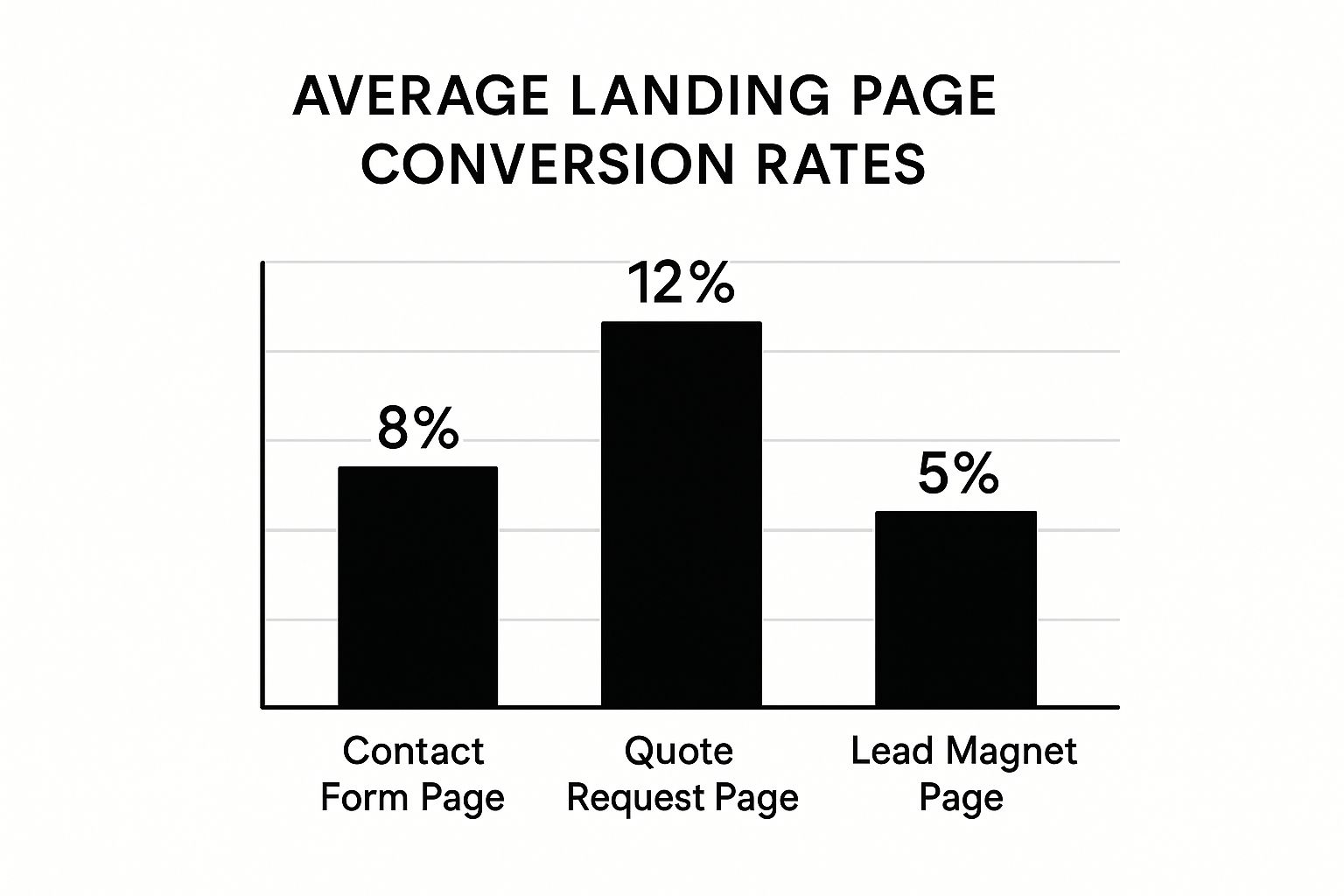
It’s no surprise that a straightforward 'Quote Request' page converts best. It gives a high-intent searcher exactly what they came for.
Ultimately, knowing your numbers is what separates a profitable campaign from a money pit. You have to track everything. This is where solid analytics and reporting play a massive role in your campaign’s success. When you know your CPA, you can make informed decisions and ensure every dollar you invest is pulling its weight.
Tracking Performance and Optimizing for Better ROI
Getting your PPC campaign live is the starting line, not the finish. The real magic of PPC for contractors happens after the launch. This is where you shift your ad spend from a simple expense into an intelligent, lead-generating machine that actually gets smarter and more profitable over time.
You have to be in your account, watching the data and making improvements. By digging into your Google Ads dashboard, you can turn raw data into insights that put more money in your pocket. It’s all about making small, consistent tweaks that lead to big wins across your service area.
Focusing on the Metrics That Actually Matter
When you first open up Google Ads, the amount of data can feel like you're drinking from a firehose. It's easy to get sidetracked by "vanity metrics"—numbers that look impressive but don't actually put jobs on the books. For a contractor in Monterey County, only a handful of key performance indicators (KPIs) really tell you if you're winning or losing.
Here are the essential KPIs you should be obsessed with:
- Click-Through Rate (CTR): This is just the percentage of people who see your ad and actually click it. A strong CTR tells you two things: your ad copy is hitting the mark, and you’re targeting the right keywords. In the home services world, the average CTR hovers around 2.44%. If you’re beating that, you’re doing something right.
- Cost Per Conversion (CPA): This is the big one. It’s the single most important number because it tells you exactly what you’re paying for each real lead—a phone call or a form submission. The goal is simple: get this number as low as you can without sacrificing the quality of the leads.
- Conversion Rate: This metric shows you what percentage of people who clicked your ad followed through and contacted you. For services like contracting, this number can be pretty high—often around 6-7%—because people searching for a contractor usually have an urgent need.
- Impression Share: Think of this as your piece of the pie. It tells you how often your ads were shown compared to all the times they could have been shown. If your impression share is low, it’s a red flag that your budget might be too small or your bids aren't aggressive enough.
A classic mistake is getting hung up on Cost-Per-Click (CPC). A cheap click is worthless if it doesn't lead to a phone call. I'd rather pay a bit more for a click that converts than pocket change for one that just bounces.
Practical Optimization Techniques for Better Results
Once you’re tracking the right numbers, you can start making smart, data-backed moves to improve them. This isn't a one-and-done task; it’s a constant cycle of testing and tweaking.
Refine Your Keywords with Search Term Reports
Your Search Term Report is a gold mine. Seriously. It shows you the exact phrases people typed into Google right before your ad appeared. You should be living in this report at least once a week.
Here’s what you’re looking for:
- Find New Negative Keywords: Did your "roof repair" ad show up when someone searched for "roofing jobs in Salinas"? Add "jobs" to your negative keyword list on the spot. Stop the bleeding.
- Discover New "Money" Keywords: You might stumble upon a super-specific, long-tail keyword that’s bringing in high-quality leads. Grab it and add it to your campaign as a phrase or exact match keyword so you can bid on it directly and own that search.
A/B Test Your Ad Copy
Never, ever assume your first ad is your best ad. You should always be running at least two ad variations against each other in every single ad group. Change just one thing at a time—try out a different headline, test a new call-to-action, or highlight a unique selling point.
Let the numbers pick the winner. Once an ad has enough impressions, pause the one that's underperforming and create a new challenger to go up against the champ. This constant process of small, incremental improvements is how you build an ad with an incredible Click-Through Rate. When you find ad copy that connects and builds trust, the positive effects ripple through your entire marketing funnel, which aligns perfectly with what we know about how online reviews affect your home improvement contractor business—every little detail matters.
Adjust Bids by Location
Not all neighborhoods are created equal. You might find that leads from Santa Cruz County are more profitable or convert more easily than leads from another town.
Inside Google Ads, you can use bid adjustments to tell Google you're willing to pay a little more to show your ads in those high-performing areas. It's a powerful way to make sure your budget is working as hard as possible, pushing your overall Return on Investment (ROI) even higher.
Your Top Contractor PPC Questions, Answered
If you're navigating the world of Pay-Per-Click advertising, you’ve probably got a lot of questions. We get it. Over the years, we've heard them all from hardworking contractors right here in the Monterey Bay Area. This isn't just theory for us; these are the real-world concerns we tackle every day for businesses trying to win more jobs locally.
To help you get some clarity, we’ve put together the most common questions we hear. From timelines and competition to costs and what "success" actually looks like, here are the straightforward answers you need to make smart decisions about using PPC for contractors.
How Long Does It Take to See Results from PPC?
This is usually the first thing everyone asks, and for a good reason—you're putting your hard-earned money on the line and you want to see it work. While PPC can get you in front of customers faster than almost any other marketing channel, it’s not an overnight switch. It’s better to think of it in phases.
- Weeks 1-2 (The Data Gathering Phase): As soon as your campaign goes live, Google’s algorithm starts learning. We begin collecting crucial data on which keywords are triggering your ads and what ad copy is getting clicks. You might see some initial traffic and maybe even a lead or two, but this period is all about gathering intel.
- Weeks 3-4 (The Initial Optimization Phase): With a couple of weeks of data under our belt, we can make our first strategic moves. This means adding negative keywords to stop wasting money on irrelevant clicks (like searches for "DIY" or "jobs"), pausing ads that aren't performing, and pushing more budget toward what's already working. You should start seeing a more consistent flow of qualified leads.
- Month 2 and Beyond (The Growth & Scaling Phase): By now, your campaign has real momentum. We have enough solid data to switch to more advanced bidding strategies like "Maximize Conversions" and can confidently scale up the budget. This is when you truly start to see a predictable and profitable return on your ad spend.
A little patience in that first month is crucial. A well-managed campaign in a market like Monterey County will build on itself, getting more efficient and effective over time.
Is My Market Too Competitive for PPC?
It's no secret that the contracting world is competitive, especially for high-demand services in places like Santa Cruz or Salinas. But "competitive" doesn't mean "impossible." In fact, if you see your competitors running ads, that’s usually a strong sign that PPC actually works in your market.
The secret isn’t to outspend everyone; it's to outsmart them. A smaller, local contractor can absolutely go toe-to-toe with bigger companies by being more strategic.
In the world of local PPC, precision beats power. A hyper-focused campaign targeting specific neighborhoods in Monterey with highly relevant ad copy will often outperform a big-budget, generic campaign every single time.
You win by niching down. Focus on specific services, target smaller geographic areas where you have a strong foothold, and write ad copy that speaks directly to local homeowners. Being the most relevant answer for "emergency plumber in Pacific Grove" is far more valuable than being a generic result for "plumber in California."
What's a Realistic Cost Per Lead for My Trade?
This number can swing pretty wildly based on your specific trade and location. A lead for a high-value job like a full roof replacement is naturally going to cost more than a lead for a quick drain cleaning. But we can look at industry data to get a solid baseline.
One analysis found that the average Cost Per Lead (CPL) for a contractor using PPC is around $152. It's critical to see this not as an expense, but as an investment. If a typical job brings in $2,000 in profit, paying $152 to acquire that job is a fantastic return. The key is to know your numbers: what is one lead truly worth to your business?
Should I Run Ads on My Own Company Name?
Yes, absolutely. This is called a "branded campaign," and it’s one of the most cost-effective moves you can make in PPC. Even if you already rank #1 organically when someone searches your business name, bidding on it gives you some major advantages:
- It’s a Defensive Play: This prevents a competitor from sneaking an ad above your organic listing when someone is looking specifically for you. You want to completely own that search results page.
- You Control the Message: Ads give you total control over what people see first. You can instantly promote a special offer or highlight a key service right at the top of the page.
- The Clicks are Cheap and Convert: Clicks from branded searches cost very little and convert at an incredibly high rate because the searcher is already looking for you.
Think of it as inexpensive insurance to protect your most valuable asset: your brand and reputation.
By Phil Fisk, CEO, Core6 Marketing
Phil Fisk is the founder and CEO of Core6 Marketing, a digital marketing agency based in Salinas, CA. With over a decade of experience, he specializes in helping local businesses in the Monterey Bay Area generate leads, increase their visibility, and achieve measurable ROI. He's passionate about leveraging technology to support our region's vibrant economy, from its ag-tech roots to its thriving small businesses.
Core6 Marketing
1628 N. Main St #263, Salinas, CA 93906
831-789-9320
[email protected]
Feeling more confident about PPC but still have a few questions? The best way to get answers tailored to your business is to talk with an expert. The team at Core6 Marketing is ready to help you build a profitable, lead-generating campaign from the ground up.
Schedule Your Free Consultation Today or give us a call at 831-789-9320.