
Picture this: a homeowner in Santa Cruz has a pipe burst. They’re not sitting at a computer typing. They’re yelling, "Hey Siri, find me a plumber open now!"
This is the new reality. Voice search isn’t some far-off trend. It’s the new battleground for local contractors, changing how customers in Monterey County find help when they need it most. For a plumber in Salinas or an electrician in Gilroy, being ready for these spoken questions is no longer optional.
Why Your Next Customer Is Talking, Not Typing
The big switch from keyboards to voice commands is changing how people find local services. Homeowners are now asking questions like “Who’s the best electrician near me open now?” instead of typing keywords into a search bar. This conversational shift favors businesses with clear answers and fast-loading mobile websites.
When someone speaks a search, it’s natural, it’s specific, and it usually means they have an immediate problem. They ask full questions, not just choppy keywords. Contractors who ignore this voice SEO trend risk being skipped by these common searches.
The Numbers Don't Lie
The data shows how important voice search has become for local contractors. According to recent industry reports, nearly 78% of mobile local searches convert within 24 hours. Voice searches, which are mostly mobile, are a huge part of this.
These aren't just website visits. They are high-value leads from people who are ready to hire you right away.
The infographic below shows how voice search leads directly to urgent phone calls.
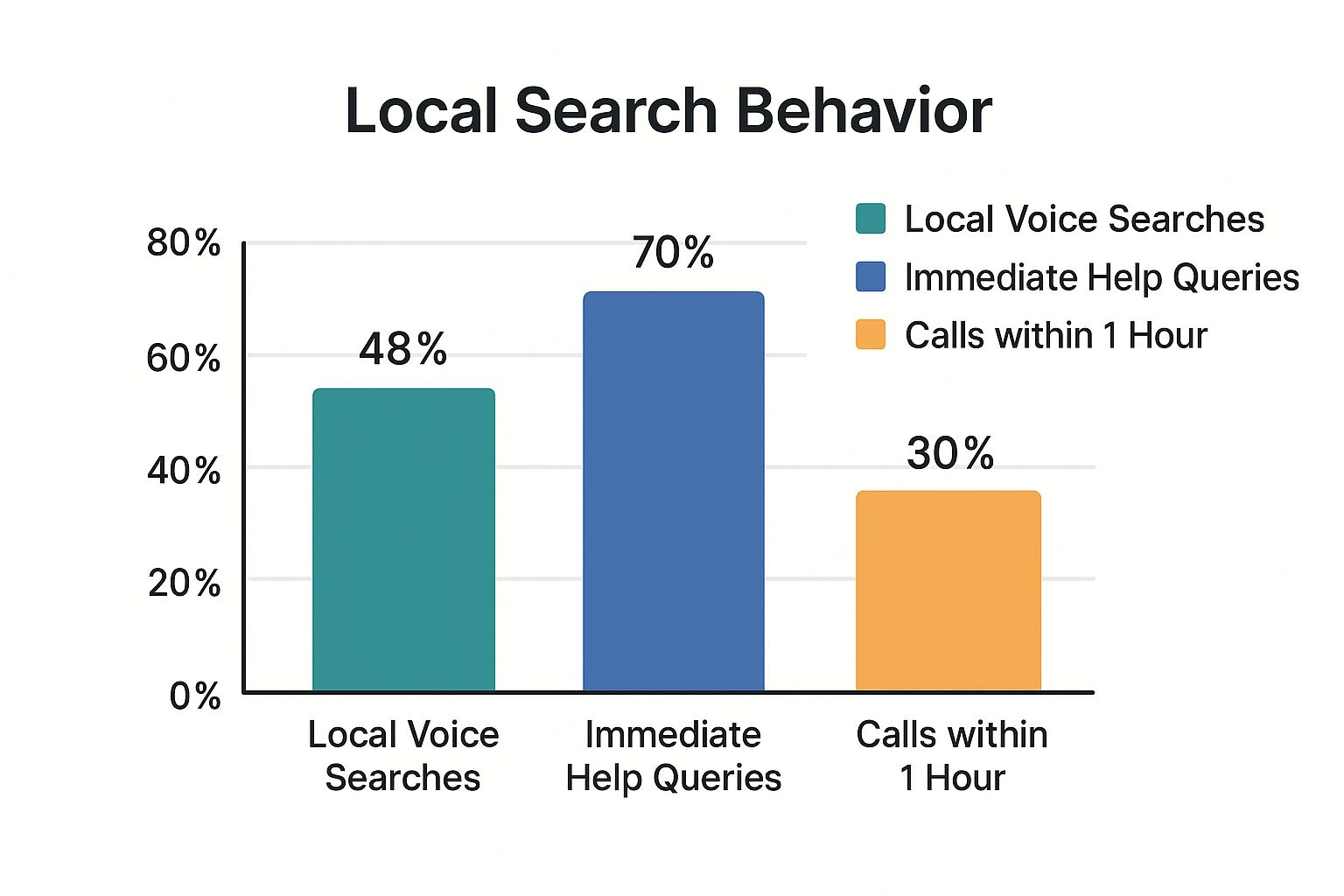
This data proves that many spoken searches come from nearby customers who need help now. For any contractor in our coastal economy, this is a massive opportunity to grab leads your competitors are missing.
The difference between how people type and how they speak is why a new approach is needed.
Typed vs. Spoken Searches: What’s the Difference?
| Search Element | Traditional Typed Search | Modern Voice Search |
|---|---|---|
| Query Style | Short, choppy keywords | Full, conversational questions |
| Example | "plumber near me" | "Who is the best emergency plumber near me?" |
| Customer Intent | Often research-focused | Immediate, action-oriented |
| Device Used | Desktop, laptop, or phone | Smart speaker, phone, car assistant |
This table makes it clear: you can’t just rely on old-school keyword tactics anymore. You have to optimize for real human questions. To learn more, our guide on local SEO for plumbers is a great place to start.
How Siri and Alexa Choose a Winner
When a homeowner in Monterey has a burst pipe and asks, "Hey Siri, find me a plumber," how does the assistant choose who gets the call? It’s not magic. It’s a decision driven by data.
Think of Siri or Alexa as a personal assistant. They need the most direct and trustworthy answer, right now. They scan for businesses that provide clean, structured, and reliable information to quickly solve the user’s problem.
The Digital Clues That Lead to Your Business
To become the go-to recommendation for voice search, you need to leave a clear trail of digital clues. Your goal is to make your business the obvious, most helpful answer.
Here are the key things voice assistants look for:
- Your Google Business Profile (GBP): This is the starting point for local voice search. An optimized GBP with accurate hours, a correct address, and good reviews tells Siri you are a real, active business in Monterey County.
- Consistent Local Info (NAP): Your Name, Address, and Phone number (NAP) must be identical everywhere online—from your website to Yelp. Inconsistencies create doubt, and a confused AI will just move on.
- Customer Reviews and Ratings: When a user asks for the "best" plumber, assistants look at star ratings and recent positive reviews. A steady stream of 4- and 5-star reviews is a powerful signal of quality.
Voice assistants are designed to deliver a single, confident answer. They prioritize businesses with the strongest and most consistent local signals, making a well-managed Google Business Profile essential for winning spoken searches.
The Secret Weapon: Schema Markup
Once you’ve nailed the basics, there's a powerful tool that acts like a "cheat sheet" for search engines: schema markup. Schema is a bit of code you add to your website that translates your content into a language AI can instantly understand.
Schema tells Google things like:
- "This is our official business name."
- "This is our 24/7 emergency service phone number."
- "This is a review from a customer in Hollister."
- "This is our service area, which includes all of San Benito County."
This structured data removes all the guesswork for the AI. A contractor in Salinas who uses schema is handing Siri a perfectly labeled folder, making their business much easier to recommend. For a deep dive, check out our guide on how to rank higher in Google Maps, which covers optimizations that also fuel voice search.
Winning the Voice Battle with AI Search Sync
Simply optimizing for traditional Google searches isn't enough anymore. When a homeowner in Salinas has a burst pipe and yells, “Hey Siri, find me a plumber,” old-school SEO tactics won't work. The game has changed.
Winning now means being the single best answer to a direct question, not just another link on a results page.
While other agencies are still writing blog posts for desktops, Core6 is preparing contractors to win “spoken” searches and appear in AI-generated recommendations. This is where our proprietary AI Search Sync system gives local contractors a serious advantage.
Beyond SEO to AI Search Sync
We built AI Search Sync for this new, answer-driven world of Siri, Alexa, and Google Assistant. It’s an approach made for how people search today.
Think of it like this:
- Traditional SEO is like putting a sign on your storefront. It helps people who are already on your street find you.
- AI Search Sync is like having a trusted local guide. Every time someone asks for a recommendation, our system makes sure that guide points them right to you.
This strategy gets your entire digital footprint ready to be understood and recommended by these powerful new gatekeepers.
How We Make You the Obvious Choice
Our AI Search Sync system prepares your business to be the most helpful and authoritative answer online. We structure your information so voice assistants and AI search can grab it and serve it up directly.
This involves a few key steps:
- Structuring for Answers: We organize your website content into clear, direct answers that a voice assistant can easily pull and repeat. This means building FAQ sections and service pages that address the conversational questions customers in Monterey County are asking.
- Entity Optimization: We establish your business as a recognized "entity"—a real-world business—in the eyes of search engines. This makes it easier for AI to connect your services to specific locations, like Hollister or Santa Cruz.
- Authority Signals: We boost the signals that prove your expertise, like customer reviews, local business listings, and schema markup. These are the credentials AI looks for when choosing the "best" contractor.
Our system is built on a simple idea: to win in the age of voice and AI, you can’t just be visible. You have to be the most credible and direct answer to a customer's spoken question.
This forward-thinking approach means that while other contractors are still trying to figure out how to show up, our clients are already getting recommended. Our guide on how to use AI for SEO is a great place to learn more.
Your Three-Step Voice Search Readiness Plan

Getting your business ready for voice search doesn't have to be complicated. Any local contractor can become more visible to customers asking Siri and Alexa for help by focusing on three practical areas. These smart, targeted tweaks will align your business with how real people in San Benito County are searching right now.
Let's break down the actionable steps to turn those spoken questions into paying customers.
Step 1: Add Q&A-Style Content
Voice searches are questions, not just keywords. People don’t say "plumber Pacific Grove cost." They ask, "How much does it cost to fix a leaky faucet in Pacific Grove?" Your website must provide direct answers.
The best way to do this is by adding an FAQ (Frequently Asked Questions) page.
Think about the top questions you get from customers every week. That's your goldmine.
- What are the signs I might have a hidden water leak?
- How often should I get my HVAC system serviced in our coastal climate?
- Is it cheaper to repair my water heater or replace it?
- Do you offer 24/7 emergency services in Salinas?
When you create content that answers these real questions, you’re feeding voice assistants the exact information they need. You can even use AI tools to help structure this content faster. Learn more in our guide on how to optimize service pages with ChatGPT for contractors.
Step 2: Ensure Your Website is Mobile-First and Fast
Most voice searches happen on a smartphone. This means your website's performance on a phone is critical.
If your site is slow or hard to read on a mobile device, Google knows it. The search engine will send that lead to a competitor with a better mobile experience. Voice-based searches increasingly favor AI results and featured snippets, which rely on fast, accessible content.
In the world of voice search, speed is trust. A website that loads instantly on a phone tells both the customer and the search engine that you are a serious professional ready to solve their problem.
Use free tools like Google's PageSpeed Insights to check your site's speed. A fast website is a powerful signal of professionalism that directly impacts whether you get the call.
Step 3: Master Your Local SEO Basics
Finally, make sure your basic local info is solid and consistent everywhere online. Voice assistants rely on local business directories to confirm who you are, where you are, and if you’re a trustworthy choice.
This comes down to two key things:
- Claim and Optimize Your Google Business Profile (GBP): This is the most important tool for local voice search. Fill it out completely with your correct business name, address, phone number, hours, and service areas (like Monterey County).
- Ensure NAP Consistency: Your Name, Address, and Phone number (NAP) must be identical across every online platform, from your website to Yelp. Even small differences can confuse search engines.
By focusing on these three steps, you'll make your business the clear, easy, and trustworthy choice for the next customer who says, "Hey Siri, find me a plumber." If you're wondering why home service pros in Monterey Bay are losing leads, a weak voice search strategy is often the culprit.
It’s Time to Make Your Business Voice-Ready
The way customers find a local plumber has changed for good. When someone in Monterey has a leaky pipe, they're asking their phone or smart speaker for help. Voice search is fast, local, and based on natural questions.
For any contractor in Salinas, Santa Cruz, or anywhere on the Central Coast, this isn't a future trend. It’s happening right now. Ignoring it is like letting a customer walk right past your shop and into your competitor's.
But this isn't a problem—it’s your biggest opportunity to get ahead.
Let’s Make Your Business the Go-To Answer
You don't have to figure this out alone. At Core6 Marketing, we help local contractors across Monterey County dominate this new playing field. We offer personalized strategies to make your website voice-search-friendly—and visible where your next customer is already asking.
Stop losing leads to competitors who have already adapted. It’s time to claim the business you’ve been missing.
Ready to make your business the first name people hear?
Get a free consultation today!
By Phil Fisk, CEO, Core6 Marketing
Phil Fisk is the founder of Core6 Marketing, a digital marketing agency dedicated to helping home service contractors in the Monterey Bay Area generate more leads and achieve measurable growth. With a focus on data-driven strategies and a deep understanding of the local market, Phil helps businesses thrive online.
Core6 Marketing
1628 N. Main St #263, Salinas, CA 93906
Phone: 831-789-9320
Email: [email protected]
Website: https://core6.marketing/