Direct Answer: Contractor sites that keep growing publish content sourced from real customer calls, form submissions, and reviews. Sites that go flat publish filler written to fill a calendar instead of answering real questions.
You have been posting to your blog for a year. Traffic is flat, the phone rings about the same as it always has, and you are starting to wonder if content is just something agencies sell to justify a monthly invoice.
I see this all over Monterey County. Two plumbers in Salinas, both publishing monthly, both spending real money. One picks up steady organic calls by month eight. The other is exactly where he started.
The difference is almost never writing talent. It is where the content came from. That is what a real content engine for local service businesses is, and it is the whole reason one site compounds while the other sits still.
A content engine for local service businesses is a sourcing method, not a writing style
When I audit a contractor site that has been growing on its own, the pattern is always the same. The pages answer questions actual homeowners asked, in the words those homeowners used, about situations they actually ran into.
That is not a tone. It is a sourcing decision. We pull from three first-party sources, and we treat all three as equal:
- Inbound calls, which show the questions and objections people raise before they book
- Website form submissions, which show how people describe the problem when they have to write it down
- Reviews, which show what customers valued after the job and the exact words they use to praise it
Here is why that matters for rankings. Real people do not search the way keyword tools suggest. A homeowner in Carmel Valley does not type “residential roofing services.” She types something closer to what she told our client on the phone, which was that her ceiling had a brown ring after the first real storm and she did not know if it was the roof or a pipe.
That phrasing is long-tail, local, and specific. It also happens to be the kind of language Google and AI answer engines match against. Your customers already wrote your best SEO content, and most contractors never look at it.

Content that goes flat usually answered the wrong question
Most contractor blogs I read were written to make the contractor feel like an expert. Very few were written to settle a homeowner’s uncertainty.
These are the posts I see over and over on Central Coast contractor sites, and they almost never earn organic traffic:
- Company history and “our story” posts
- Industry award and certification announcements
- General trade education, like how a heat pump works in theory
- Seasonal filler with no local detail, such as generic spring maintenance tips
- Rewrites of manufacturer marketing copy
Nobody in Prunedale is searching for the history of your company. They are searching because water is coming in somewhere, or the panel keeps tripping, or they got three bids that are $8,000 apart and cannot tell which one is honest.
That gap between what contractors want to write about and what homeowners are anxious about is the single biggest reason a blog stalls. If your last twelve posts read like a trade magazine, that is worth checking against how to tell if the content on your contractor site is hurting your rankings.
And if the posts were generated in bulk to fill a calendar, the problem compounds in the wrong direction. We have covered what happens to contractor websites stuffed with AI content, and it is not a slow decline. It is a site that never gets traction to begin with.
Your reviews are a content brief you already paid for
Reviews are the fastest evergreen content source a contractor has, and they are the one competitors cannot copy.
When a customer in Marina or Seaside writes a review, they rarely say “great service.” They describe the specific thing that happened: the crawlspace, the old panel the last guy would not touch, the fact that somebody actually showed up on a Saturday when the water heater let go.
Those descriptions contain search phrases no keyword tool would surface. I have pulled entire blog topics straight off a single five-star review because the customer named a job type, a neighborhood, and a worry all in one paragraph.
So read your reviews as a content brief, not just a reputation score. Here is the simple version of what I do:
- Pull your last 25 reviews into one document
- Highlight every job type, street, town, or landmark mentioned
- Highlight every phrase that describes a fear or a doubt
- Group the repeats, because repeats are search demand
- Turn the top five groups into your next five posts
One HVAC company on the Monterey Peninsula had four separate reviews mentioning salt air corrosion on coastal units. No agency keyword report had flagged it. That became one of their best performing pages.
The same works in reverse for calls. When a caller objects to something before booking, that objection belongs on a page, answered in plain language, before the next homeowner has to ask it.
Same trade, two content plans, twelve months later
This is the split I see most often when I compare two contractor sites in the same market. The trade is identical. The sourcing is not.
| Where the topic came from | Example post | Typical result after 12 months |
|---|---|---|
| Publishing calendar filler | Top 5 spring HVAC tips | Few impressions, no calls, no citations |
| A recorded caller question | Why your Salinas AC struggles after ag burn season | Ranks for phrases competitors never targeted |
| A five-star review | What coastal salt air does to condensers in Pacific Grove | Steady organic traffic, quoted in AI answers |
| A form submission | How to tell if a brown ceiling stain is roof or plumbing | Warmer callers who already trust you |
| Company news | We won a local business award | Almost no organic traffic |
How a customer-sourced content library compounds
One locally grounded post a month does not look like much in month two. By month twelve it covers the entire homeowner decision journey.
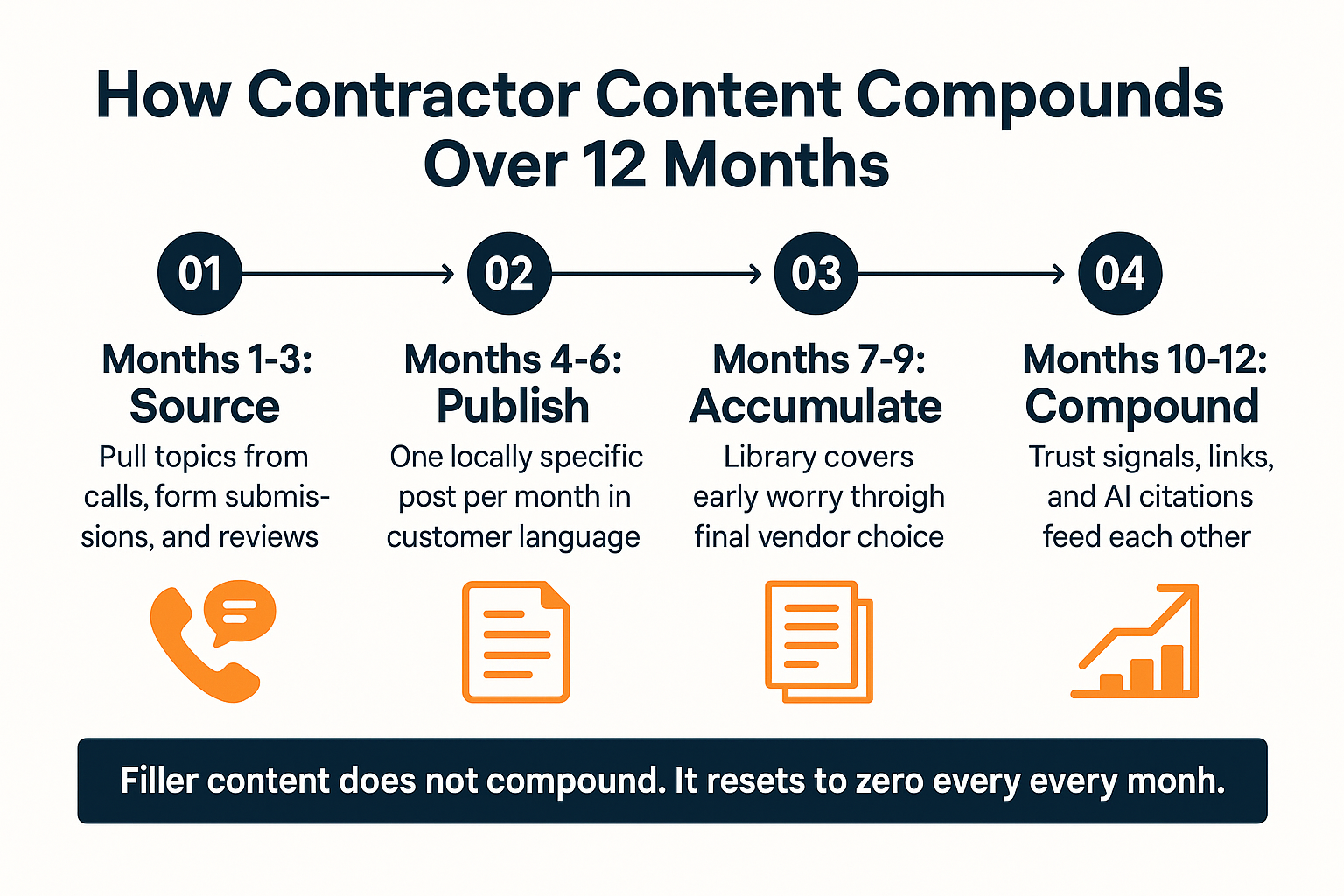
The compounding part is where the money actually is
A website rebuild is a one-time lift. It helps, and then it plateaus. A content library does something a rebuild cannot.
Twelve customer-sourced posts covers the whole homeowner journey, start to finish:
- “How do I know I even have a roofing problem?”
- “Is this a repair or a replacement?”
- “What does this kind of job usually run around here?”
- “How do I pick a roofer in Carmel Valley without getting burned?”
Each post earns its own small pile of trust signals, links, and mentions. Together they make the site the most complete answer in the market for a specific set of local questions, which is exactly what search engines and AI tools reward. Google’s own guidance on creating helpful, reliable, people-first content points at the same thing we see in the field.
There is a sales benefit too, and it is bigger than the traffic. A homeowner who reads three of your posts before calling is a decided lead. She is not price shopping five companies. She is calling you to schedule.
This is also how AI Search Sync earns visibility across ChatGPT, Perplexity, and Gemini. Those systems cite sources that answer specific questions with specific local detail. Generic content gives them nothing to quote. If you want the mechanics, see how local SEO actually works for home service contractors on the Central Coast and when AI Overviews name a contractor, what just happened.
On cost, content pricing across this market varies a lot depending on volume, research depth, and whether anyone is actually listening to your calls. What matters more than the number is whether you are paying for sourcing or just for words.
Frequently Asked Questions About Content That Actually Grows
How long before content starts producing calls?
We typically see the first measurable ranking movement within 30 days, but that is rankings, not revenue. Calls attributable to content usually start showing up somewhere in the four to eight month range, then build from there as the library fills out.
Is one post a month really enough?
For most owner-operated contractors on the Central Coast, yes. One post that came from a real caller question beats four that came from a topic generator. Volume without sourcing just gives you more pages nobody searches for.
Can I just have AI write these from my review list?
AI is useful for drafting and organizing once you have real source material in front of it. It is useless as the source itself, because it does not know what your callers in King City or Watsonville actually asked last month. Sourcing first, drafting second.
What if I only have a handful of reviews?
Then lead with calls and form submissions. Every contractor I work with is sitting on more usable customer language than they realize, and recorded calls fill the gap fast while review volume builds.
Do older posts need to be rewritten?
Some do. If a post is generic trade education with no local detail, updating it with real customer language and Monterey County specifics usually outperforms writing something brand new.
Want to know what your own customers are already telling you?
Most of the contractors I talk to in Monterey County have a year of usable content sitting in their call logs and review profiles and have never read either one for topics. If you want a second set of eyes on what your site is publishing and where the real material is hiding, we keep time open for discovery calls with Central Coast contractors at https://calendly.com/core6-marketing/30min. No pressure either way, and you will leave the call knowing what your customers have been asking.