Direct Answer: Your inbound calls and Google reviews contain the exact language your customers use to search for you. That language — turned into real content — outranks anything generic AI can produce.
Most contractors I talk to in Monterey County are either paying someone to write generic blog posts or just not publishing anything at all. Both approaches leave money on the table — because the best SEO content they’ll ever produce is already sitting in their call recordings, their form submissions, and their Google reviews.
I’m not being abstract here. Every time a homeowner in Salinas calls to ask whether their HVAC system can handle the marine layer humidity, or a Carmel Valley customer submits a form describing a slow drain that ‘smells like the ocean,’ that language is a data point. It tells you exactly how your market describes a problem — and that’s the raw material search engines actually reward.
Generic content is getting cheaper and faster to produce by the day. AI-assisted teams are publishing nearly 50% more content per month than those who don’t use AI tools. And most of it sounds identical. The contractors who pull ahead are the ones building content no competitor can replicate — because it comes from their own jobs, their own callers, and their own community.
What Your Phone Calls Are Actually Telling You
When a homeowner calls a roofing contractor in Pacific Grove, they’re usually not asking ‘do you offer roof repair services?’ They’re asking something like, ‘I’ve got a section over my garage that’s been leaking every time there’s heavy fog and I don’t know if it’s the flashing or the underlayment.’ That specificity — the fog, the location, the diagnostic uncertainty — is what makes content useful and what makes it rank.
I’ve seen this play out with contractors using call recordings to build their SEO content on the Central Coast. The questions that repeat across calls are the questions your market is also typing into Google and, increasingly, asking ChatGPT. A landscaper in Watsonville whose callers keep asking whether a grading project requires a Monterey County permit should have a direct answer to that on their website — not buried in a generic FAQ, but explained clearly on the relevant service page.
Those repeat questions are your content calendar. Not keyword research reports. Not trending topics. The three questions your phone answerer hears most often before someone agrees to a quote — those are your next three pieces of content. Build each one with real local context and a direct answer, and they’ll outperform anything your competitors are copying from a content template.
A few types of calls that almost always produce useful content angles:
– Diagnostic questions (‘how do I know if it’s X or Y?’)
– Permit and code questions specific to Monterey County or Santa Cruz County
– Timeline questions (‘how long does this take in the winter months here?’)
– Objections raised before booking (‘I got a lower quote from someone else — what’s the difference?’)

Why Reviews Are Becoming AI Citation Material
Google’s AI Overviews now surface what they call ‘Community Perspectives’ — actual reviewer language pulled directly into AI-generated answers. That’s a structural shift in how the search results page works, and most contractors haven’t processed what it means for them.
A five-star review that says ‘great job, fast service’ builds your star count. But it doesn’t build the evidence layer that AI systems use when deciding who to mention in a generated answer. Compare that to a review that reads: ‘They replaced the rotted fascia boards on our 1960s ranch house in Aptos — showed up on time, explained every step, and the crew cleaned up completely before they left.’ That review names a specific service, a location, a home type, and an outcome. It’s citation-ready.
I write about this connection between reviews and AI visibility in more depth in how ChatGPT decides which plumber or roofer to recommend, but the short version is this: the contractors who are coaching their customers to leave descriptive reviews — not just star ratings — are building a searchable evidence record with every job they complete.
Your Google Business Profile is one of the primary inputs AI systems read when forming an answer about local contractors. That profile is now functioning more like an AI feed than a static listing — and the reviews on it carry real weight in what gets surfaced.
A quick self-audit: pull your last 30 Google reviews and ask:
– How many name a specific service?
– How many include a city or neighborhood?
– How many describe the outcome in a way a new customer could understand?
The ones that hit all three are your AI-citation-ready reviews. The rest are helping your rating but not your reach.
Turning First-Party Data Into Content That Ranks
This breakdown shows the three sources contractors already have — and the specific content type each one produces best.
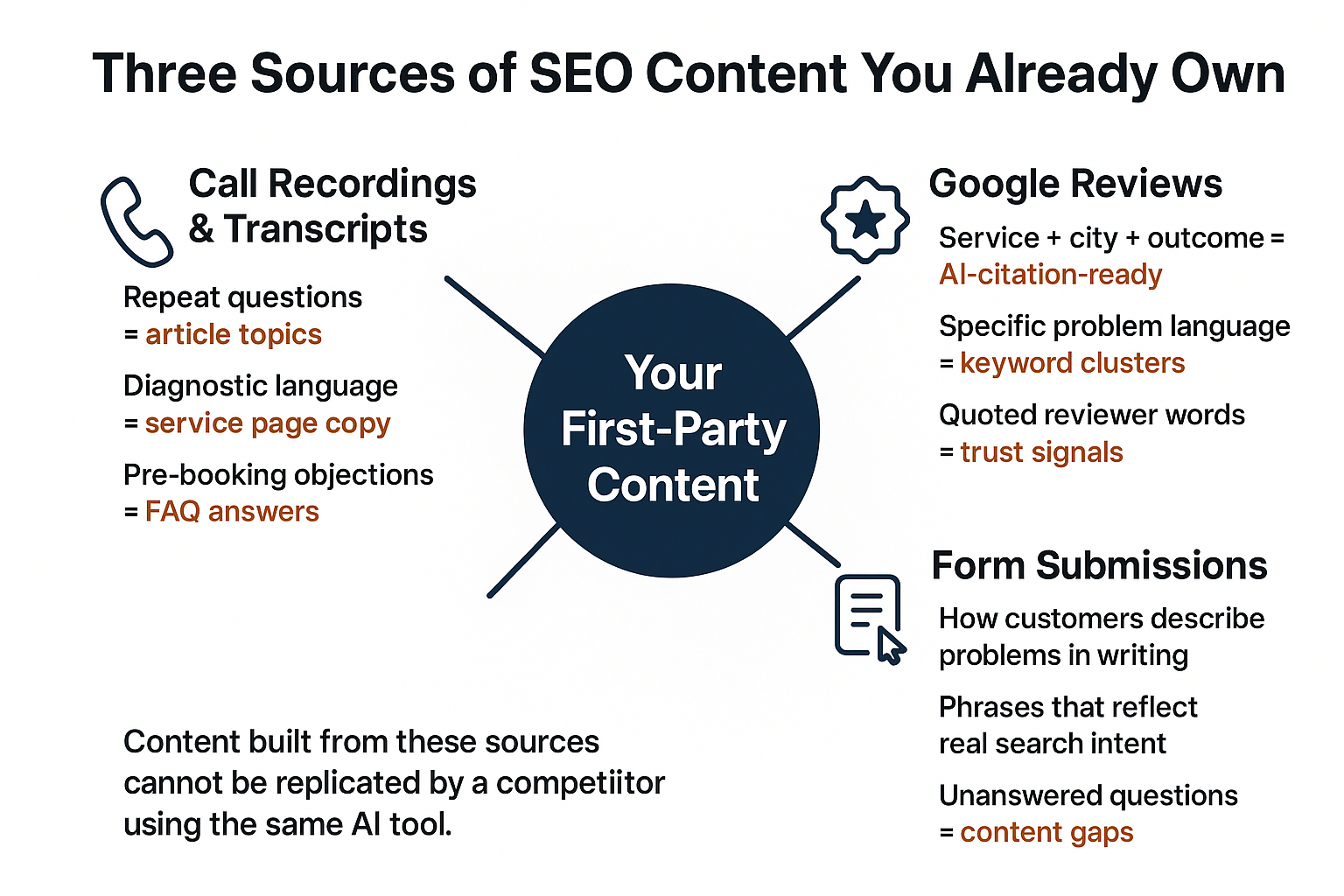
The Form Submission Angle Most Contractors Miss
Call recordings get the most attention in conversations about Voice of Customer content — and they deserve it. But form submissions carry a different kind of signal that I think is underrated.
When a homeowner fills out a contact form on your website, they’ve already decided to reach out. What they write in that message box is how they describe their problem in writing when they’re not talking to anyone. That’s as close as you’ll ever get to their actual search query.
One homeowner might write: ‘Looking for someone to fix a leak under my kitchen sink — the cabinet underneath is starting to smell and I’m worried about mold.’ Another might submit: ‘My outlets in the garage keep tripping since I started using a new air compressor — not sure if it’s the breaker or the wiring.’ Neither of those are invented. Both of them describe a search intent that deserves its own content answer — not a generic ‘we fix leaks’ or ‘we do electrical work’ landing page.
Form submissions are also the only first-party source that shows you what a customer writes when your competitor’s website didn’t answer their question well enough. They came to you because they still had a question. That question is a content opportunity.
If you’re building or updating a website, pages that actually generate calls share one trait: they answer the specific question the visitor arrived with. Form submission language is one of the best inputs for writing those answers — because it comes directly from people who were already close to booking.
Content Source Comparison: What Each One Produces Best
Each first-party source serves a different content function. Here’s how I think about mapping them to actual output.
| Source | Best Content Output | Why It Works |
|---|---|---|
| Call Recordings / Transcripts | Article topics, FAQ answers, service page subheadings | Surfaces the exact questions homeowners ask before they book — language no keyword tool generates |
| Google Reviews | AI-citation-ready quotes, location + service keyword clusters, trust copy | Reviewer language naming a service, city, and outcome is indexed by both Google and AI platforms |
| Form Submissions | Landing page copy, problem-framing headers, content gap identification | Shows how customers describe a problem in writing — closest available proxy for actual search intent |
| Job History / Field Notes | Local diagnostic content, seasonal guides, permit-specific posts | Documents patterns specific to Central Coast conditions — coastal humidity, soil type, code variations by county |
Why Generic Content Is Losing Ground — Fast
Google’s spam policies now explicitly flag content designed to produce volume without adding value for users. The guidance is direct: pages created primarily to manipulate rankings rather than serve a reader are a liability, not an asset.
And yet, most of the contractor content I see published on the Central Coast is exactly that — generic, templated posts about ‘the importance of regular HVAC maintenance’ or ‘5 signs you need a new roof.’ That content existed before AI tools made it fast to produce. Now that anyone can publish 50 posts a month for under $200, the volume advantage is gone. The only remaining advantage is specificity.
A post about HVAC maintenance in Monterey County that references how the salt air off the bay accelerates corrosion on condenser coils, or how the swing from cool coastal mornings to warm inland afternoons in Carmel Valley stresses systems differently than an inland California climate — that’s content no AI tool generates without your input. It reflects what you’ve seen on actual jobs.
This is exactly what AI Search Sync is built around: getting contractors visible across both traditional search and AI platforms by building content that carries the kind of specificity those platforms treat as authoritative. Generic content feeds the machine. Specific, first-party content beats it.
Frequently Asked Questions About Using Calls and Reviews as SEO Content
Do I need special software to get value from my call recordings?
Not necessarily. If you’re already using a call tracking system that transcribes recordings, you have what you need to start pulling questions and patterns from your calls. If you’re not transcribing calls yet, even listening back to your last 10 or 20 recordings and writing down the questions you hear most often gives you a usable content list. The point is the pattern, not the technology.
Can I quote my own reviews directly in my website content?
Yes — and this is one of the most underused moves in local SEO. Pulling specific, descriptive quotes from real Google reviews and featuring them on your service pages does two things: it gives visitors social proof in natural language, and it introduces the specific service-and-location keyword combinations that reviewers used. Just make sure the quotes you use are real and attributed accurately.
How is this different from just doing keyword research?
Keyword research tools show you what people search — but they can’t show you the exact phrasing a Salinas homeowner uses to describe a slab leak, or the specific question a Carmel Valley customer asks before they’ll commit to a quote. First-party content fills the gaps keyword tools can’t see. The two approaches work well together; they’re not competing methods.
What if my reviews are mostly short and generic — ‘great service, would recommend’?
That’s a coaching problem, not a lost cause. Most customers don’t leave detailed reviews because no one asked them to be specific. A simple follow-up message after a job — asking them to mention what the problem was, where the work was done, and how it turned out — shifts the pattern over time. It takes a few months, but the reviews you accumulate after making that change will be measurably more useful for both search and AI visibility.
Is this approach only useful for SEO, or does it help with other parts of my website?
It helps across the board. The language homeowners use on calls and in form submissions is also the language that should appear in your service page headers, your estimate request forms, your FAQs, and even your Google Business Profile description. When your website speaks the same way your customers think, it converts better — and ranks better. The connection between content quality and whether a site actually generates calls is direct.
Ready to Turn What You Already Have Into Content That Works?
If you’re a contractor in Monterey County, Salinas, Santa Cruz County, or anywhere on the Central Coast, the content you need to rank and get found by AI search already exists in your business — it’s just sitting unused. At Core6 Marketing, we help contractors identify those first-party signals and build them into a content strategy that’s specific to your market and your trade. If you want to talk through what that looks like for your business, you can book a no-pressure discovery call with Phil at https://calendly.com/core6-marketing/30min.