Direct Answer: Google Ads costs for contractors vary by trade and market, but California coastal markets typically run higher than national averages. What you spend matters far less than whether the campaign is built to generate calls — not just clicks.
Most contractors who ask about Google Ads want one thing: a straight answer on what it costs. Not a range so wide it’s useless, and not a sales pitch wrapped in case studies. A real number, with real context.
The honest answer is that cost varies — by trade, by how tight your service area is, and by whether your campaign is built to generate calls or just traffic. A plumber in Salinas is not paying the same per lead as a roofer in Santa Cruz County, and neither of them is paying what the national averages suggest.
This article breaks down what’s actually driving your costs, what the difference is between a campaign that pays for itself and one that bleeds budget, and where contractors in the Monterey Bay Area consistently leave money on the table.
What the Numbers Actually Look Like for Home Service Contractors
According to LocaliQ’s 2025 home services study — which analyzed over 3,200 U.S. search campaigns — national average cost per lead by trade breaks down roughly like this:
- HVAC: ~$45 per lead
- Plumbing: ~$52 per lead
- Roofing: ~$79 per lead
And 69% of advertisers saw cost per lead increase year-over-year. These are national figures. California coastal markets, including Monterey County, tend to run higher because of population density, housing values, and the number of contractors bidding on the same keywords.
That doesn’t mean Google Ads doesn’t work here — it means the margin for running a sloppy campaign is thinner. A roofing contractor in Carmel Valley paying $110 per lead on a campaign that converts at 2% is burning money. The same contractor with a tighter setup converting at 8-10% is printing it.
For a deeper look at how your website’s performance affects those conversion numbers, this breakdown on contractor websites that rank but don’t ring is worth reading before you spend a dollar on ads.
The Real Problem: Most Contractor Campaigns Are Built for Clicks, Not Calls
This is where most contractors get burned. They run Google Ads, spend a few hundred dollars, get clicks, and get almost no calls. They assume the platform doesn’t work — but the platform isn’t the problem.
A click to a slow-loading mobile site that buries the phone number converts at roughly 2–3% on a good day. That means out of every 100 people who clicked your ad, 97 left without contacting you. You paid for all 100.
A campaign built for call acquisition looks different:
- The landing page loads fast on mobile — under 3 seconds
- The phone number is visible above the fold without scrolling
- The ad copy matches exactly what the visitor was searching for
- Call extensions are active so users can call directly from the search result
- The campaign tracks which keywords actually generated calls, not just clicks
The difference between a traffic campaign and an acquisition campaign isn’t budget — it’s intent. One is optimized to show up. The other is optimized to make your phone ring.
If you want to understand why your website may be failing at conversion before your ads even run, this article on HVAC websites in Monterey County explains exactly what a low-converting page looks like in practice.

Google Ads vs. Local Services Ads: They’re Not the Same Thing
These two products get conflated constantly, and the confusion costs contractors real money.
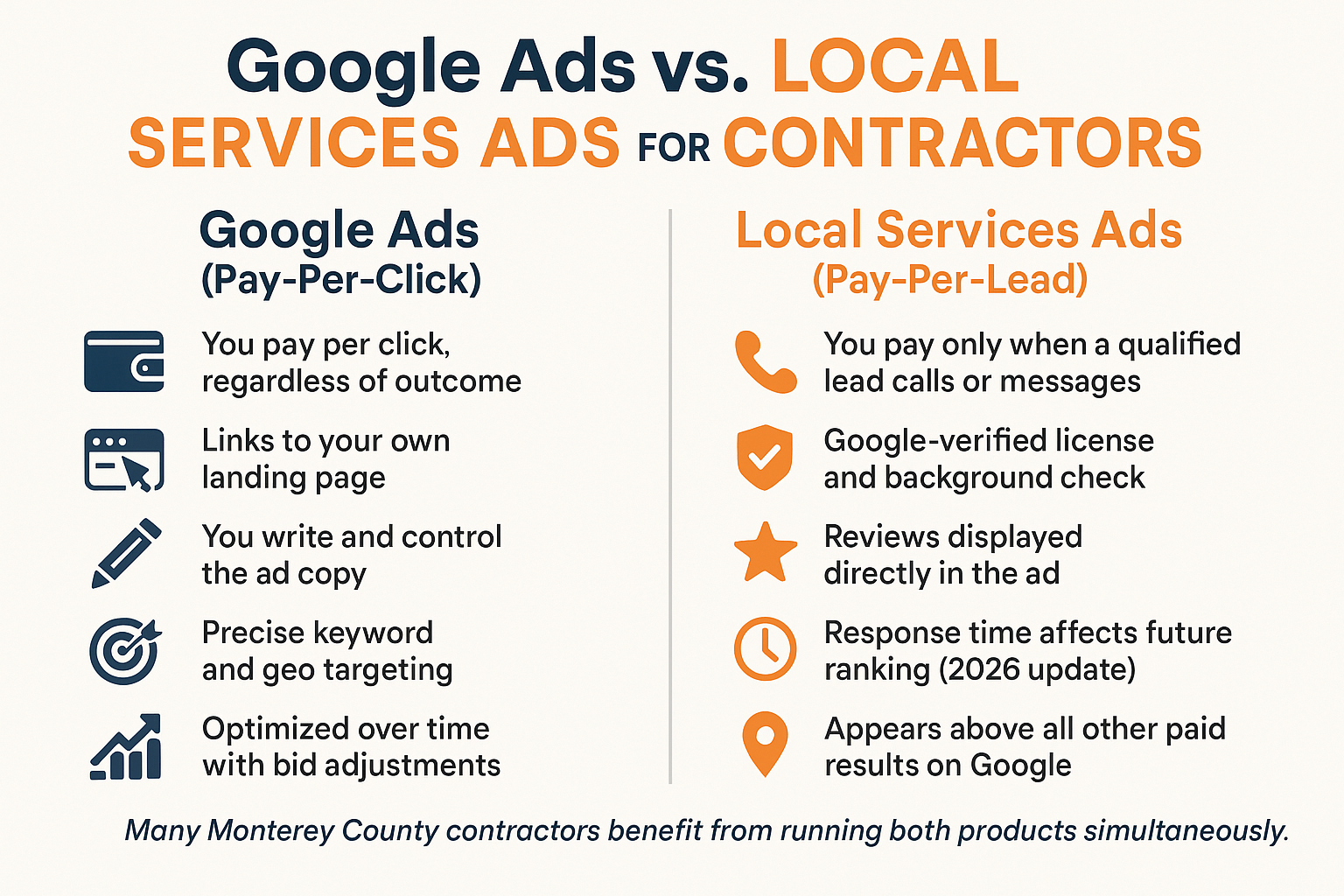
Traditional Google Ads are pay-per-click. You write the ad, set your bids, and pay every time someone clicks. You control the landing page, the message, and the targeting — which means you’re also responsible for what happens after the click.
Local Services Ads (LSAs) are pay-per-lead and now appear above traditional paid search results. Google verifies your license, shows your reviews, and charges you only when a qualified lead contacts you directly. In 2026, Google updated LSA ranking to factor in response time and call quality — meaning contractors who miss calls or respond slowly rank lower in future LSA placements. That’s not a small detail.
Many contractors on the Monterey Peninsula benefit from running both. LSAs capture the very top of the page with credibility signals (verified, reviewed, licensed). Traditional Google Ads give you precision control over messaging and landing page experience. They don’t compete — they stack.
For a broader view of how PPC campaign structure affects contractor lead quality, that article goes deep on the mechanics.
Google Ads vs. Local Services Ads: Key Differences at a Glance
Here’s a side-by-side comparison of how these two paid search products work — and where each one fits in a contractor’s marketing setup.
Where Central Coast Contractors Consistently Overspend
One of the most common budget leaks we see in contractor campaigns on the Central Coast comes down to service area targeting.
A Salinas plumber bidding on the keyword ‘plumber’ with broad geo-targeting ends up paying for clicks from Monterey, Pacific Grove, Marina, and sometimes further out. Those clicks rarely convert — either the homeowner finds someone geographically closer, or the mismatch between their location and your service area erodes the trust before you even speak.
Tighter geo-targeting almost always improves cost per lead, even when it reduces raw click volume. A campaign generating 40 clicks from people in your actual service area is worth far more than one generating 120 clicks from across Monterey County.
Other common places budget disappears:
- Broad match keywords that trigger ads for searches you’d never want to pay for (“plumbing school,” “plumber meme,” “plumber union jobs”)
- No negative keyword list — meaning you’re bidding on competitor searches, DIY searches, and job-seeker searches
- Running ads 24/7 when your team only answers calls during business hours — missed calls from LSAs can now hurt your future ranking
- No conversion tracking — so there’s no way to know which keywords are actually generating calls vs. burning budget
These aren’t edge cases. They’re the standard state of most Google Ads accounts that haven’t been actively managed.
What Drives Google Ads Cost for Contractors
These are the variables that move your cost per lead up or down — independent of what trade you’re in.
| Factor | What It Means | Impact on Cost Per Lead |
|---|---|---|
| Keyword match type | Broad match triggers more irrelevant clicks; exact match keeps spend tighter | High — can swing CPL significantly |
| Service area radius | Wider radius = more clicks from outside your actual territory | High — overspending is common here |
| Landing page speed | Slow mobile load = higher bounce rate = fewer calls per dollar spent | High — directly affects conversion rate |
| Phone answer rate | Missed calls waste ad spend and hurt LSA ranking (2026 update) | Medium-High — especially for LSAs |
| Ad schedule | Ads running when no one answers means paid clicks going to voicemail | Medium — depends on your team’s hours |
| Negative keyword list | Missing negatives means paying for job seekers, DIY searches, and competitors | Medium — builds up over time |
Why Set-It-and-Forget-It Google Ads Almost Never Works
Google Ads is not a platform you configure once and check monthly. The contractors who see consistent returns are running campaigns that get active attention — weekly at a minimum.
Here’s what that actually involves:
- Budget pacing: Making sure spend is distributed across the month, not front-loaded and exhausted by the 15th
- Keyword pruning: Reviewing search term reports and adding negatives to cut irrelevant traffic
- Bid adjustments: Pulling back on times or locations that are producing clicks but no calls
- Landing page monitoring: Watching conversion rates for drops that signal a page problem
- Call review: Listening to recorded calls to understand what’s actually happening when a lead comes in — are they converting, or are they falling off somewhere in the conversation?
One of the most consistent things contractors who have worked with us say is that they finally felt like someone was actually paying attention. Jake Robinson, who has been working with our team for years, noted that the team is “knowledgeable, responsive, and genuinely invested in helping us grow” and that they’ve seen “a significant increase in web traffic, stronger search rankings, and a noticeable boost in lead quality.”
That outcome doesn’t come from a campaign that’s on autopilot. It comes from someone watching the numbers and making decisions based on what the data is actually saying — not running the same settings month after month.
For a broader look at how local internet marketing for contractors fits together as a system, that guide covers how paid and organic channels interact.
Frequently Asked Questions About Google Ads for Contractors
How much should a contractor budget for Google Ads per month?
There’s no single right number, but in a competitive market like Monterey County, campaigns running below $500–$800/month often don’t generate enough data to optimize effectively. Based on national benchmarks for home services — and accounting for California coastal market conditions running higher than average — most contractors in trades like HVAC, plumbing, or roofing need a monthly ad spend that can sustain at least 20–30 clicks before meaningful conclusions can be drawn. The right number depends on your trade, your service area, and your target cost per job. An agency or consultant who understands your local market should be able to help you size a starting budget that isn’t guesswork.
What’s the difference between Google Ads and Local Services Ads?
Google Ads are pay-per-click — you pay every time someone clicks your ad, whether they call you or not. Local Services Ads are pay-per-lead and appear above traditional paid results. With LSAs, Google verifies your license and shows your reviews directly in the ad, and you’re only charged when a qualified lead contacts you. Since 2026, response time and call quality also affect your LSA ranking going forward. Many contractors benefit from running both.
Why did I spend money on Google Ads and get no calls?
Almost always, one of three things: the campaign was optimized for clicks rather than calls, the landing page was too slow or too hard to use on a phone, or the targeting was too broad and pulling in clicks from outside your real service area. A click from someone in Pacific Grove to a Salinas plumber’s website is rarely a call. Tightening up geo-targeting, fixing the landing page, and adding call extensions usually changes the picture significantly.
Do I need a special landing page, or can I just send people to my homepage?
Sending paid traffic to a general homepage is one of the most common campaign mistakes. A homepage serves multiple audiences and rarely has a single, clear call to action. A dedicated landing page — one that matches the exact service and location someone searched for, loads fast on mobile, and puts your phone number front and center — consistently converts at a higher rate. The cost of the click is the same either way. What changes is how many of those clicks turn into calls.
Is Google Ads worth it for a small contractor just starting out?
It depends on your situation. Google Ads can generate calls within days of launch — faster than SEO. But it requires a website that can actually convert visitors into calls, a budget that’s large enough to gather real data, and active management to keep from wasting spend. For contractors who are just getting started and don’t yet have a site built for conversion, fixing the website first usually produces better results dollar for dollar. For contractors with a solid site who need leads now while their organic rankings build, Google Ads can be a strong short-term bridge.
Want to Know What Google Ads Should Actually Cost for Your Trade and Territory?
We work exclusively with home service contractors on the Central Coast — from Salinas and Monterey down through King City and across to Santa Cruz County. If you want a straight look at what a well-built campaign would cost, what it should return, and whether your current setup has fixable problems, that conversation starts with a discovery call with Phil Fisk. Book a time at https://calendly.com/core6-marketing/30min — no pitch, just a real look at your numbers.