Direct Answer: AI can automate information and scheduling, but it cannot swing a hammer, pull a permit, or troubleshoot a Salinas slab leak at 7am. The trades are structurally resistant to AI displacement in ways most industries are not.
Every few months, a new headline says AI is coming for some profession. Lawyers, writers, accountants — the list keeps growing. If you’re running an HVAC company in Salinas or a roofing crew in Watsonville, you may have wondered if your trade is next.
The short answer is no — but not for the reasons most people assume. The trades aren’t safe because AI is bad at what it does. They’re safe because of what the work actually requires. And understanding that distinction has real, practical implications for how you run and market your business.
This article covers why home service contractors on the Central Coast sit in an unusually protected position, what specific characteristics make the trades resistant, and what that means for how customers are searching for you right now.
What Makes a Job Actually Hard to Automate
AI is genuinely good at processing language, recognizing patterns, and generating outputs based on existing data. That covers a wide range of desk jobs.
But physical trades require something different — real-time judgment in unpredictable, physical environments. A roofer in Carmel Valley isn’t following a script. They’re reading a 40-year-old roof deck, feeling for soft spots, deciding whether the OSB under the shingles has enough integrity to hold new material or needs to be pulled.
There are three core reasons why that kind of work resists automation:
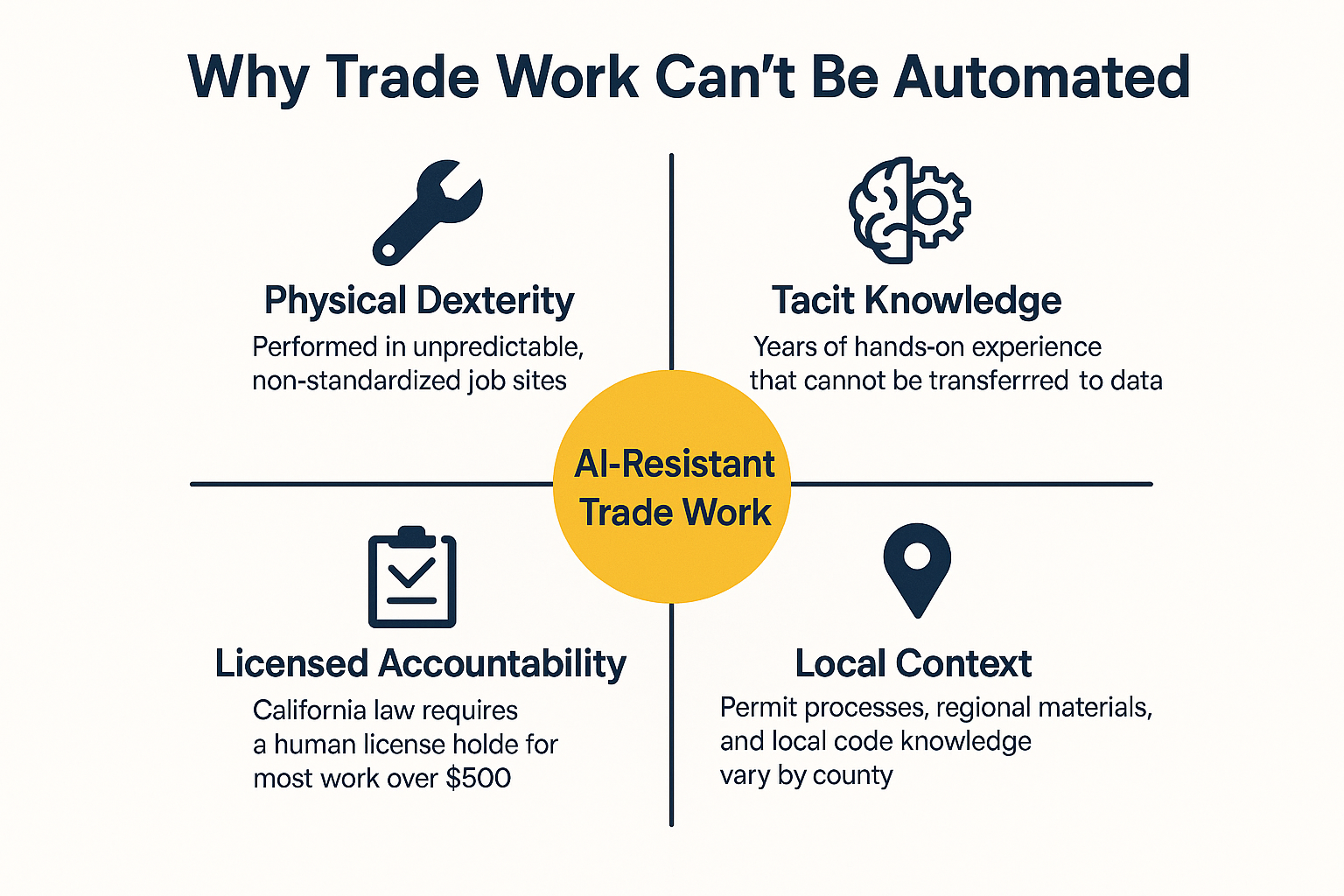
- Physical dexterity in variable environments. Every job site is different. No two attics, crawl spaces, or panel boxes are identical. AI systems that could theoretically operate a robot arm struggle enormously with the chaotic, non-standardized reality of existing homes.
- Tacit knowledge built over years. An experienced electrician in Monterey County knows from the smell of a panel, the color of insulation, or the age of a breaker box what the next problem is likely to be — before they open anything. That kind of knowledge doesn’t transfer to a training dataset.
- Licensing and liability accountability. California requires licensed contractors for most work over $500. The license, the bond, and the insurance all attach to a human being who takes legal responsibility for the outcome. AI doesn’t carry a CSLB license number.
This isn’t optimism. It’s the structural reality of the work. If you’re a plumber or roofer being found through AI search, customers still need a human to show up.
The Local Reality: Why Central Coast Contractors Have an Extra Layer of Protection
Monterey County isn’t San Jose. The housing stock here skews older — a significant portion of the homes in Salinas, Seaside, and Pacific Grove were built in the 1950s through the 1970s. That means knob-and-tube wiring, cast-iron drain lines, original roofing substrates, and HVAC systems that haven’t seen a service call in a decade.
Older homes create more complicated jobs. Complicated jobs require more experienced tradespeople. And experienced tradespeople operating in a specific local market — who know Monterey County’s permit process, the coastal fog’s effect on roofing materials, and which inspectors work which zones — are essentially irreplaceable by any automated system.
There’s also the labor pipeline problem. Trade school enrollment on the Central Coast hasn’t kept pace with aging contractor workforces. That creates a supply squeeze that works in your favor as an established operator. A homeowner in Carmel Valley who needs a licensed general contractor isn’t comparing you to an algorithm. They’re just trying to find someone qualified who will actually show up.
The real challenge isn’t AI replacing your trade. The challenge is making sure customers can find you when they start looking.
The 4 Traits That Make a Job AI-Resistant
These are the four characteristics that protect skilled trades from automation — and contractors on the Central Coast have all four.
What AI Is Actually Changing — and Why It Still Matters to You
Being AI-resistant doesn’t mean AI is irrelevant to your business. It just means the threat isn’t to your trade itself — it’s to how customers find you before they ever call.
AI-powered search tools like ChatGPT, Perplexity, and Google’s AI Overviews are changing where people go when they have a question. A homeowner in Marina who wakes up to a pipe leak used to Google “emergency plumber Marina CA” and scroll through results. Now they might ask ChatGPT the same question and get a direct answer — with a name attached.
If your business doesn’t show up in those AI answers, you’re invisible to a growing slice of your market. That’s not a distant future concern. Your competitor may already be showing up in ChatGPT while you’re not — and that gap is widening every month.
The businesses most likely to appear in AI-generated answers share a few specific traits:
- Consistent, accurate business information across Google, Yelp, Bing, and dozens of other directories
- A website with clear, specific service and location pages that AI tools can actually read and cite
- Google Business Profile activity — posts, reviews, Q&A — that signals an active, trusted local business
- Strong recent reviews from verified customers in specific cities
This is exactly what AI Search Sync is built to address. It’s not just about ranking on Google anymore — it’s about being the answer across every platform a potential customer might use to find a contractor.
AI’s Impact on Trades: What’s Changing vs. What Isn’t
Here’s a plain-language breakdown of where AI is actually relevant to your business and where it isn’t.
| Area of Your Business | AI’s Impact | What It Means for You |
|---|---|---|
| Performing the actual trade work | None — physical, licensed, judgment-based | Your job is safe. Focus on lead flow instead. |
| How customers search for you | Significant — AI tools are changing search behavior | Your visibility on ChatGPT, Perplexity, and Google AI Overviews matters now. |
| Customer reviews and reputation | Growing — AI tools cite reviews and trust signals | More recent, specific reviews = more AI visibility. |
| Your website’s ability to get found | High — AI reads and ranks site content | Thin or outdated sites get skipped by AI answers. |
| Scheduling and basic customer communication | Moderate — AI chatbots can handle intake | Optional tool; won’t replace a quality call with the owner. |
| Estimating and pricing | Low — too many job-site variables | AI tools can assist but can’t replace a physical walkthrough. |
The Practical Move: Use AI Where It Helps, Ignore It Where It Doesn’t
A lot of contractors are getting distracted by the wrong questions. “Will AI replace me?” is the wrong question. The right question is: “Am I easy to find when someone in Monterey County needs what I do?”
The trades that will grow over the next five years aren’t the ones that resist technology. They’re the ones that use technology selectively — to get found faster, answer the phone more consistently, and convert inquiries into booked jobs at a higher rate.
There are a few places where AI tools can genuinely help a contractor without any downside:
- Drafting follow-up emails to customers after estimates — takes 3 minutes instead of 20
- Generating job site checklists for recurring service types
- Summarizing customer reviews to identify patterns in what clients appreciate or complain about
- Writing basic service descriptions for your website pages, which you then review and edit for accuracy
What AI cannot do is build the local trust signals that make your business the answer when someone in Seaside asks their phone who to call for an HVAC tune-up. That still requires real content, real reviews, and a website that’s actually built to convert. A cheap or AI-built website might look fine on a screen but fail completely when it comes to getting found or turning visitors into calls.
Understanding how to improve your search ranking on Google as a contractor is still one of the highest-ROI activities you can invest in — because the phone call at the end of that chain is still a human conversation that wins or loses the job.
Frequently Asked Questions About AI and the Trades
Will AI ever be able to replace a licensed electrician or plumber?
Not in any practical near-term timeframe. Robotics capable of handling the physical complexity of existing residential work — cramped crawl spaces, corroded fittings, live panels — don’t exist at commercial scale, and the California Contractors State License Board requires a licensed human to hold legal accountability for the work. The barriers are legal and physical, not just technical.
Should I be worried about AI taking my customers before they even call me?
Yes — this is the real concern. AI search tools are already answering homeowner questions with specific business recommendations. If your business isn’t optimized to appear in those answers, you’re losing leads you never knew you had. It’s less about AI replacing your work and more about AI replacing the Google search that used to send customers your way.
What’s the difference between AI search and regular Google search?
Traditional Google search shows you a list of links and you click through. AI search tools like ChatGPT or Google’s AI Overviews generate a direct answer — often naming specific businesses — without the user ever clicking a search result. If you’re not in that answer, the homeowner may never see your name at all. We covered the specifics of this in detail for plumbers and roofers specifically — read the full breakdown here.
How do I make sure I show up in AI search results for Monterey County?
The foundation is the same as strong local SEO — accurate citations, an active Google Business Profile, recent reviews that mention specific services and cities, and a website with clear service and location pages. What’s different is that AI tools pull from a wider range of sources than just Google. AI Search Sync is specifically built to cover that broader footprint, including visibility on ChatGPT, Perplexity, and Gemini in addition to Google.
I’ve heard AI can build websites now. Should I just use one of those tools?
You can, but understand what you’re getting. AI website builders are fast and cheap. They are also not optimized for local search, not built with conversion in mind, and typically produce generic page structures that do nothing for your visibility in Monterey County. A site that doesn’t rank and doesn’t convert isn’t a marketing asset — it’s a liability. We wrote specifically about this for contractors considering tools like Lovable, Durable, and Wix.
Is this something I need to deal with now, or can I wait and see?
The contractors who show up first in AI search results right now are building an advantage that gets harder to close over time. Search visibility compounds. Waiting six months to address it means your competitor who started today has six months of momentum on you. The Monterey Bay Area market is small enough that being second often means being invisible.
Ready to Know Where You Actually Stand in Local Search?
If you’re a contractor on the Monterey Bay Area or Central Coast and you’re not sure whether your business is showing up where customers are actually looking — across Google, ChatGPT, and the other AI platforms gaining ground — Core6 Marketing offers a straightforward discovery call where we look at your current visibility and tell you honestly what’s working and what isn’t. Book a 30-minute call with Phil at https://calendly.com/core6-marketing/30min.