Direct Answer: Yes. When someone asks ChatGPT or Perplexity to recommend a plumber in Salinas, those tools pull from sources that are different from Google’s traditional search index — and most local contractors aren’t showing up in either place.
A homeowner in Marina has a water heater that stopped working on a Tuesday night. She doesn’t open Google and type ‘water heater repair near me.’ She opens her phone, taps ChatGPT, and types: ‘Who’s a reliable plumber near Marina, CA?’ That’s a real scenario happening right now across Monterey County — and it’s changing who gets the call.
For years, ranking on Google was the whole game. Get in the top three local results, get the call. But AI-powered search tools like ChatGPT, Perplexity, and Google’s own AI Overviews have added a second game running at the same time — and most local plumbers, roofers, and HVAC companies don’t even know they’re losing it.
This article breaks down how that shift actually works, what AI tools look at when they decide which contractor to mention, and what it means practically for a trade contractor trying to keep their phone ringing in Salinas, Monterey, or anywhere on the Central Coast.
What AI Search Actually Does When Someone Asks for a Contractor
Traditional Google search shows a list of blue links ranked by relevance and authority. The homeowner clicks, browses, and decides. AI search works differently — it reads that question, pulls information from multiple sources, and writes a response that names specific businesses or gives a direct recommendation.
When someone asks ChatGPT ‘Who are the best roofers in Salinas, CA,’ the tool isn’t checking Google Maps in real time. It’s drawing on data it was trained on — websites, review platforms, directory listings, editorial mentions — and synthesizing an answer. If your business isn’t represented well in those underlying sources, you don’t get mentioned. Period.
Google’s AI Overviews work slightly differently. They surface in regular Google results and pull from indexed web content, often bypassing the traditional local pack entirely. A roofing company in Pacific Grove that ranks #4 in standard results might get named in an AI Overview while the #1 ranked competitor doesn’t — because the AI is optimizing for a different kind of relevance.
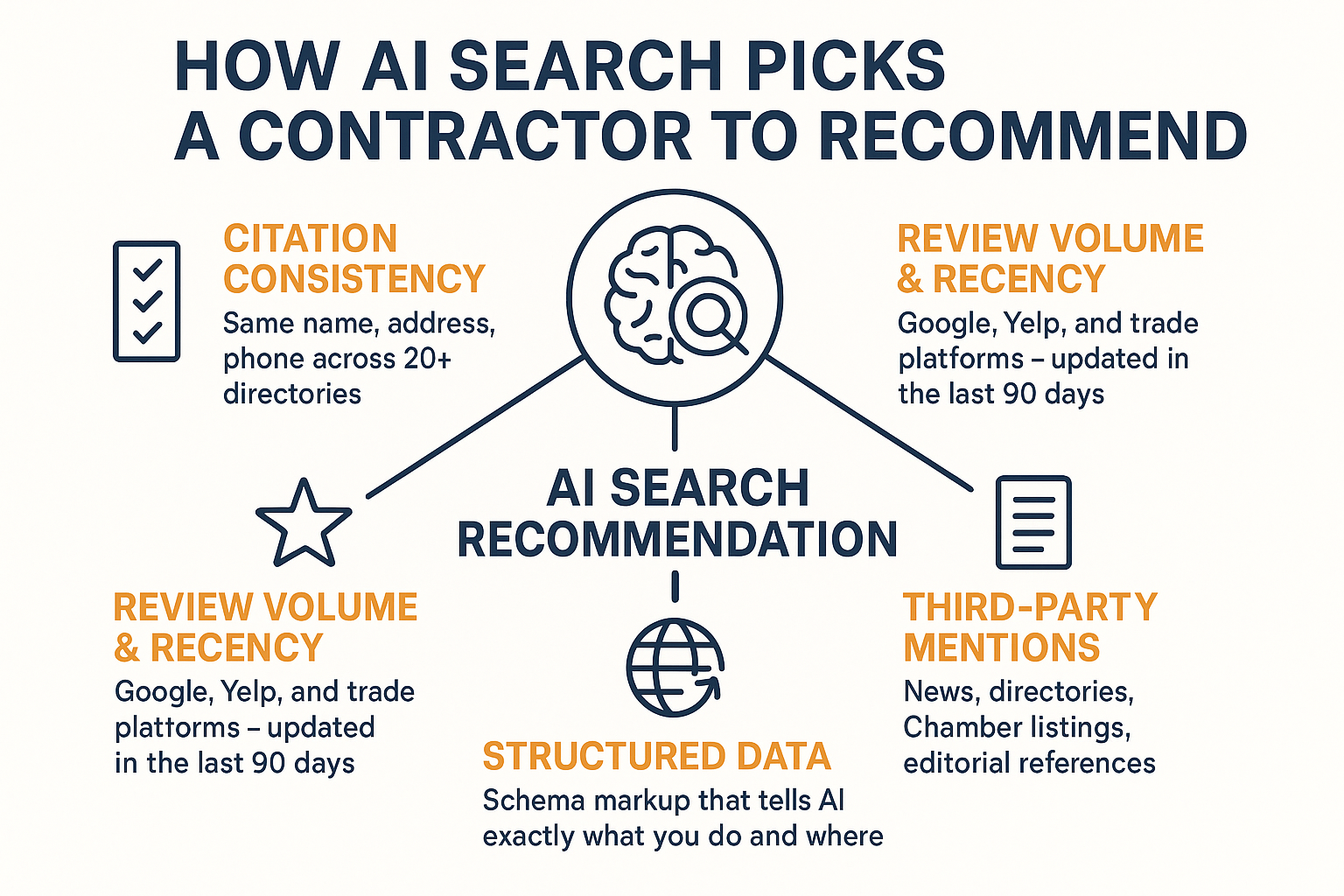
Here’s what signals these tools pay attention to:
- Authoritative mentions on third-party sites (not just your own website)
- Consistent business information across directories and citation sources
- Review volume and recency on Google, Yelp, and trade-specific platforms
- Clear, specific service descriptions on your website that match how people actually ask questions
- Structured data on your site that helps AI parse what you do and where you do it
If you want a deeper look at why a competitor might be showing up in ChatGPT while you’re not, this breakdown covers exactly that.

The Gap Most Monterey County Contractors Don’t Know They Have
Most home service contractors on the Central Coast have some Google presence. They’ve claimed their Google Business Profile, maybe collected 30 or 40 reviews over the years, and have a basic website. That was enough to compete in 2019.
But AI search tools are pulling from a much wider pool. Perplexity, for example, crawls the live web and cites its sources directly in the answer. If your website is thin — a homepage, a contact page, and maybe a services page that says ‘We do roofing’ — Perplexity doesn’t have much to work with. It’ll mention the competitor down the road who has detailed pages explaining their process, their service area, their pricing range, and answers to common customer questions.
The gap shows up in three specific places for most contractors in Salinas, Seaside, and Watsonville:
- Citation gaps — Your business is listed on Google but missing from Bing Places, Apple Maps, Yelp, HomeAdvisor (even if you don’t use it for leads), Angi, and industry directories. AI tools index all of these.
- Thin website content — Pages that describe services in three sentences instead of three paragraphs give AI tools nothing to quote or reference.
- No third-party mentions — No local news features, no Chamber of Commerce listings, no blog posts on other sites that name your business. AI gives weight to what others say about you, not just what you say about yourself.
We’ve written about how to improve your search ranking on Google before — and many of those same fundamentals feed AI visibility too. But AI has added new layers that standard SEO advice doesn’t fully address.
How AI Search Decides Which Contractor to Recommend
This infographic shows the five signals AI search tools weigh when generating a contractor recommendation — and where most local contractors fall short.
Does This Mean Google Doesn’t Matter Anymore?
No. Google still drives the majority of local contractor searches — somewhere around 60 to 70 percent of local service searches in markets like Monterey County still end with a Google Maps result or a traditional organic click. You don’t abandon that.
But the share going to AI tools is growing fast, and the demographics skew toward higher-value customers. Homeowners who are asking ChatGPT for contractor recommendations tend to be more deliberate buyers. They’re not just clicking the first result — they’re asking for a recommendation, reading the reasoning, and then making a decision. Those are often the $5,000 roofing jobs and $8,000 HVAC replacements, not the $200 service calls.
The practical answer for a contractor in Monterey County is to build visibility that works in both places at the same time. A lot of what improves your AI search visibility also improves your traditional Google rankings — deeper service pages, more reviews, consistent citations. They feed each other. The contractors who are going to struggle are the ones who optimize for neither and rely entirely on word of mouth or lead aggregators like Angi, which send shared leads to three or four competitors simultaneously.
For context on why local internet marketing as a whole matters for trades businesses, it’s worth understanding that AI search is an extension of the same ecosystem — not a replacement for it.
Traditional Google Search vs. AI Search: What Matters for Contractors
This table compares the key ranking factors between traditional Google local search and AI-powered search tools — so you can see where your current efforts carry over and where new work is needed.
| Ranking Factor | Traditional Google Local Search | AI Search (ChatGPT, Perplexity, Gemini) |
|---|---|---|
| Google Business Profile | High importance — primary local signal | Moderate — used but not the only source |
| Google Reviews | High importance — drives local pack ranking | High importance — review quantity and recency are cited |
| Website content depth | Moderate — helps organic rankings | High — AI needs text to quote and reference |
| Citation consistency | Moderate — supports local trust signals | High — inconsistent data causes AI to skip or omit your listing |
| Third-party mentions | Low to moderate — helpful but not required | High — AI weighs what others say about you heavily |
| Structured data / schema | Helpful — assists crawling and rich results | High — helps AI parse your service type and location accurately |
| Paid ads (Google Ads) | Drives top-of-page placement | No effect — AI results are organic only |
What a Plumber or Roofer Should Actually Do About It
There’s no shortcut here, but there is a clear sequence. Most contractors don’t need to start from scratch — they need to fill specific gaps that AI tools are penalizing them for silently.
Start with your citations. Run a free audit through BrightLocal or Whitespark and find everywhere your Name, Address, and Phone number (NAP) is listed incorrectly or missing entirely. A plumber in Salinas might have their correct info on Google but show an old address on Yelp and a missing phone number on Apple Maps. AI tools see that inconsistency and lower their confidence in your listing.
Then address your website content. Each core service should have its own page — not a bullet point on a general services list. A roofing contractor in Carmel Valley should have separate pages for roof replacement, roof repair, and gutter work — with each page explaining the process, typical cost range, and who it’s for. That’s what gives AI tools something to pull from when someone asks a specific question.
Finally, get more reviews on a regular cadence. Not a one-time push. AI tools weigh recency — 40 reviews from three years ago carries less weight than 40 reviews with 15 from the last 90 days. A simple follow-up text after every completed job asking for a Google review compounds quickly.
This is exactly what our AI Search Sync methodology addresses — building visibility across both traditional Google and AI-powered platforms at the same time, rather than treating them as separate problems.
Frequently Asked Questions About AI Search and Local Contractors
If I rank well on Google already, will I automatically show up in AI search results?
Not automatically. Traditional Google rankings and AI search visibility overlap in some areas — reviews and citations help both — but AI tools also weight factors that Google rankings don’t heavily reward, like third-party editorial mentions and structured data on your site. A contractor who ranks #1 in Google Maps in Monterey may still not get mentioned by ChatGPT if their website content is thin and their off-site presence is minimal.
How many people are actually using AI search to find local contractors right now?
It’s growing fast but still a minority of local searches — estimates put it somewhere between 10 and 20 percent of service-related searches in 2024, trending upward. That said, the contractors who get ahead of it now will have a real advantage by the time it becomes the norm. And in higher-income markets like the Monterey Peninsula, early-adopter customers are already using these tools regularly.
Does paying for Google Ads help me show up in AI search?
No. AI-generated answers are entirely organic. Your ad spend has zero influence on whether ChatGPT or Perplexity names your business in a response. Those are two separate systems.
What’s the fastest thing I can do to improve my AI search visibility?
Fix your citation consistency first — it’s the quickest gap to close and affects multiple platforms at once. After that, ask your last 10 to 15 customers for a Google review. Fresh reviews are a signal that both Google and AI tools respond to within 30 to 60 days. Those two actions alone move the needle faster than most things.
Is AI search going to replace Google Maps for finding local contractors?
Not in the near term. Google Maps and the local pack are deeply embedded in how people find service businesses. But AI tools are carving out their own share of that traffic — especially for research-stage queries like ‘who’s the best HVAC company in Salinas’ versus transactional queries like ‘HVAC repair near me.’ Both matter, and both need attention.
My website was built years ago and doesn’t have much content. Does that hurt me in AI search?
Yes, significantly. A thin website gives AI tools almost nothing to reference. If your site has a homepage and a contact form and not much else, an AI tool has no content to pull from when generating a recommendation. A well-structured service page with 300 to 500 words explaining what you do, where you do it, and what the process looks like is one of the most direct improvements you can make. We’ve covered why most contractor websites don’t generate calls in other articles — AI search makes that problem even more expensive to ignore.
Want to Know Where You Stand in AI Search Right Now?
We work with home service contractors across Monterey County — plumbers in Salinas, roofers on the Peninsula, HVAC companies in Seaside and Marina — and AI search visibility is now part of every local SEO conversation we have. If you want an honest read on whether your business is showing up where your customers are actually looking, Phil is available for a straightforward 30-minute discovery call. Book a time at https://calendly.com/core6-marketing/30min.