Direct Answer: No. AI cannot replace a plumber fixing a burst pipe, a roofer replacing damaged shingles, or an HVAC tech diagnosing a failing system. But AI is already changing how customers find those contractors — and that part matters.
Every few months a new headline says AI is coming for somebody’s job. And if you run a plumbing company in Salinas or a roofing operation in Seaside, you’ve probably heard the question from a family member or a customer: Is your job going away?
The short answer is no. But the longer answer is more useful — because while AI won’t swing a hammer or pull a permit, it is already changing where customers look when they need a contractor in Monterey County. And a lot of contractors are invisible to those new search behaviors.
This article breaks down what AI actually threatens, what it doesn’t, and what a Central Coast contractor should pay attention to right now — not in ten years.
What AI Can’t Do — and Will Never Do
Let’s start with the obvious. A language model cannot unclog your drain, rewire your panel, or replace a cracked tile on a Pacific Grove roof after a storm. Physical skilled trade work requires a licensed human being on-site. That’s not going anywhere.
California’s licensing structure reinforces this. Electrical, plumbing, HVAC, and general contracting work above certain thresholds requires a CSLB license — something no AI tool holds or will ever hold. In Monterey County, where inspections are required and code enforcement is active, unlicensed work creates real liability for homeowners. That keeps the demand for licensed contractors firmly in place.
What AI can do in the trades is pretty narrow:
- Generate a rough estimate template or proposal draft
- Answer a homeowner’s basic question about what a repair might involve
- Schedule appointments or follow up on leads via chatbot
- Help write a job description for a new hire
None of that replaces the person doing the work. What it does is reduce some of the administrative friction around the job — which, honestly, most busy contractors would welcome.
The Part That Does Change: How Customers Search for You
Here’s where contractors need to pay attention. AI is not replacing your trade — but it is replacing the search habits your customers have relied on for 20 years.
In 2023, most Monterey County homeowners Googled “HVAC repair Salinas” and clicked on the first two or three results. In 2024 and 2025, a growing percentage of those same homeowners are typing that question into ChatGPT, Perplexity, or Google’s AI Overview — and getting a direct answer with a contractor recommendation before they ever see a list of links.
If your business isn’t part of what those AI platforms are pulling from, you’re invisible to that search. Not buried on page two — actually invisible.
We’ve written about this in depth: Your Competitor Showed Up in ChatGPT — Here’s Why You Didn’t. The short version is that AI search platforms pull from Google Business Profile data, third-party citations, review volume, and structured content on your website. Contractors who’ve built a strong local SEO foundation show up. Contractors who haven’t, don’t.
This is not a future problem. If you have a competitor in Monterey, Carmel Valley, or Marina who started showing up in AI search results this year, they almost certainly have a stronger local footprint than you — better reviews, more consistent citations, and a website that actually signals what they do and where they do it.
The Real Threat Isn’t Robots — It’s Being Unfindable
When contractors worry about AI, they’re usually thinking about the wrong problem. A robot isn’t going to show up and do your job cheaper. But a competitor who invested in local visibility two years ago might already be collecting the calls you’re not getting.
In Monterey County, the average homeowner cost for a Google Ads click in trades like roofing or HVAC is $15 to $45 per click — and that’s pay-to-play. Organic and AI-driven visibility is earned through consistent effort over time, but it compounds. A contractor who ranks in Google’s local pack and gets pulled into AI search results is effectively getting double coverage on every relevant search.
The contractors getting hurt by AI-driven search changes are usually the ones who relied on word-of-mouth and never built a digital presence — or the ones who have a website that looks fine but isn’t actually doing anything for them.
Think about what happens when a first-time homeowner in Watsonville or King City needs a pest control company on a Sunday. They’re not calling a neighbor. They’re asking their phone. If your business doesn’t show up in that answer, you lost that job before you even knew it existed.
The fix isn’t complicated, but it does take real work:
- A complete, active Google Business Profile with recent reviews
- Consistent name, address, and phone number across 50+ directories
- A website with clear service pages for each trade and each city you serve
- Enough content authority that AI platforms cite you as a relevant local source
AI Search vs. Traditional Google Search: What’s Different for Contractors
This table shows how the two types of search work differently — and what they each require from a contractor’s online presence.
| Factor | Traditional Google Search | AI Search (ChatGPT, Perplexity, Gemini) |
|---|---|---|
| What triggers visibility | Keyword match + page authority | Entity recognition + citation patterns + review signals |
| Where results come from | Indexed web pages ranked by Google | Synthesized from multiple sources: GBP, directories, reviews, structured content |
| How a customer gets to you | Clicks a link in the results list | May get your name as a direct recommendation — or never see you |
| What you need to show up | On-page SEO, backlinks, GBP | All of the above, plus structured data, consistent NAP, high review velocity |
| Speed of impact | 3–6 months for new content | Can shift in 30–60 days with GBP + citation improvements |
| Cost to compete | $0 (earned) or $15–$45/click (paid) | $0 if earned visibility is built — no paid option exists yet |
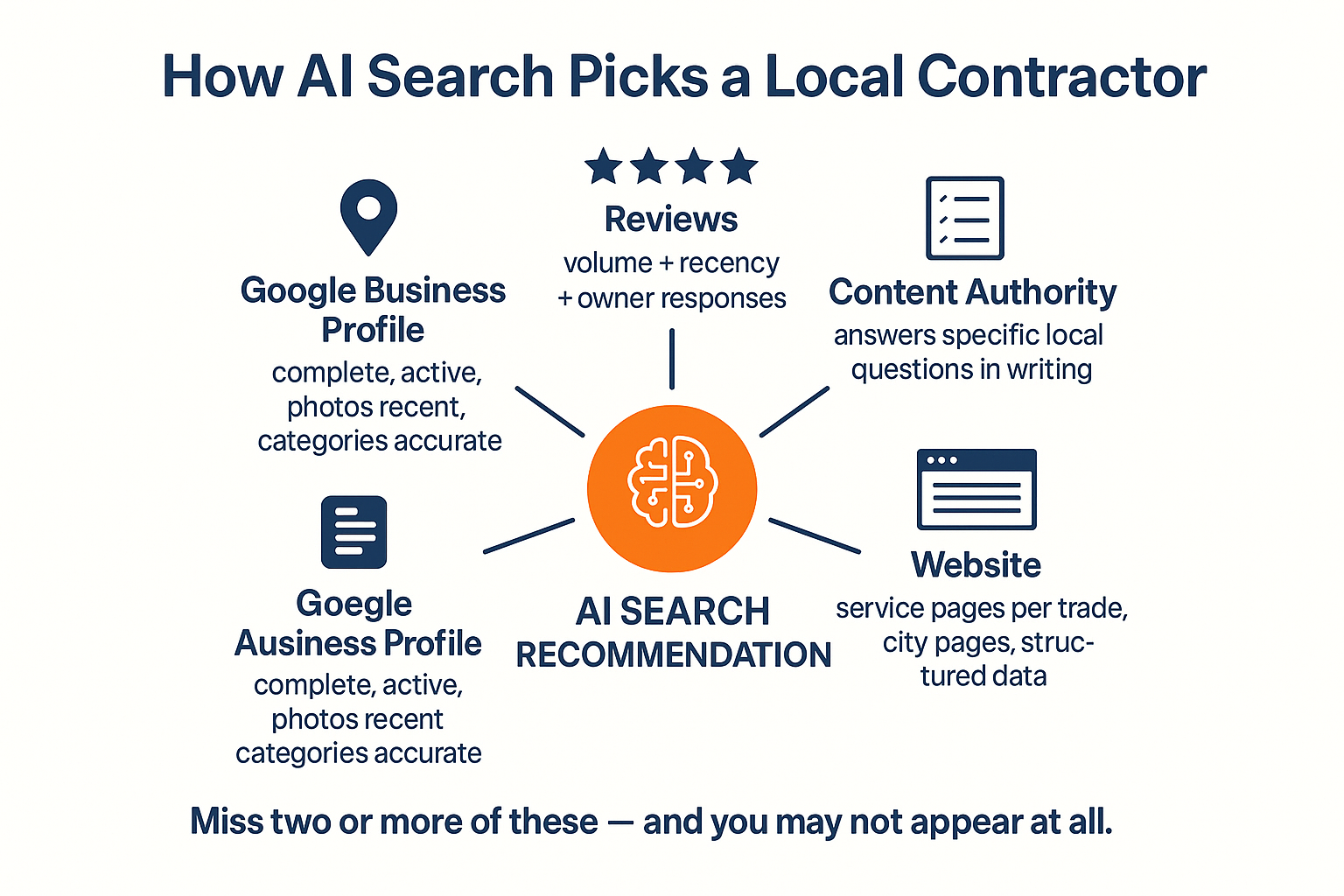
How AI Search Decides Which Contractor to Recommend
This shows the five main signals AI search platforms use when deciding which local contractor to surface in a recommendation — and what you can actually control.
What Electricians, Roofers, and HVAC Companies in Monterey County Should Actually Do
If you’re an owner-operator running a trades business on the Central Coast, the practical question is: what do you do with this information?
You don’t need to become a tech expert. But you do need to stop treating your digital presence as an afterthought.
Start with your Google Business Profile. If it hasn’t been updated in six months, if your photos are old, or if you’re sitting at fewer than 20 reviews, that’s your first problem. Reviews matter more now than they did three years ago — AI platforms weight them heavily.
Next, look at your website. Not whether it looks good — whether it actually shows up when locals search for your trade. A site with one generic page that says “We do electrical work in Monterey” is not a website that earns AI visibility. You need pages that speak to specific services in specific cities.
For HVAC companies on the Monterey Peninsula, for electricians in Salinas, for roofers in Santa Cruz County — the contractors who will win over the next three years are the ones who build this foundation now, not after their competitors have already locked up the rankings.
The cost of building this foundation varies. A legitimate local SEO engagement in this market runs $500 to $1,500 a month depending on scope and competition. A website built to convert — not just exist — typically runs $3,000 to $8,000 for a trades contractor. Those are real numbers, not guesses. You can read a full breakdown of what drives website cost here.
One More Thing: AI Tools That Actually Help Contractors Right Now
While AI search is disrupting visibility, there are AI tools showing up on the operational side of trades businesses that are worth knowing about. None of them replace skill — but some of them reduce wasted time.
Estimating software with AI features is the most practical example. Tools like Jobber, ServiceTitan, and Housecall Pro have added AI-assisted estimate generation and follow-up automation. For a two-person plumbing operation in Hollister, that can mean faster turnaround on quotes without hiring an office manager.
AI-powered call tracking and transcription is another area gaining traction. When you can read a transcript of every missed call and see which questions keep coming up, you can actually improve how your business responds — and train staff more efficiently. It also shows you which marketing sources are driving real calls versus dead clicks. That kind of intelligence changes how you spend your marketing budget.
AI drafting tools like ChatGPT can help a contractor owner write a project proposal, a follow-up email, or even a Google review request message — things that used to eat 30 minutes and now take five.
None of this is about replacing the person doing the work. It’s about removing the friction that slows down a busy owner-operator who’s doing four jobs a day and trying to run a business at the same time.
Frequently Asked Questions About AI and the Trades
Is AI going to take work away from plumbers and electricians in the next few years?
No — not the physical work. Diagnosing a failing circuit, replacing a water heater, or repairing a gas line requires a licensed human on-site. California’s CSLB licensing requirements don’t change because AI exists. What AI will affect is which contractors get called — because it’s changing how homeowners search. The contractor who isn’t findable in AI search loses calls they never knew they were competing for.
My business has been around for 15 years on word-of-mouth. Why do I need to worry about AI search?
Word-of-mouth built a lot of great businesses. But referrals have a ceiling — and they don’t help when a first-time homeowner in Seaside or Marina has no one to ask. Every year, a larger share of service calls starts with a phone or voice search, not a friend’s recommendation. If your business isn’t showing up there, you’re leaving a portion of your available market to someone else.
Can I get my business to show up in ChatGPT or Perplexity results?
Yes, but not by paying for an ad spot — there isn’t one. AI search platforms pull from your Google Business Profile, third-party directories, review platforms, and your website content. The more consistent and complete that information is, the more likely you are to get cited. This is the same foundation that drives traditional Google rankings — AI search just raises the bar on how thorough it needs to be.
What’s the fastest thing a contractor can do to improve their AI search visibility?
Update your Google Business Profile completely — services, hours, photos, and description. Then ask your last ten satisfied customers for a Google review. Those two steps cost nothing and can move the needle in 30 to 60 days. After that, the bigger gains come from a website overhaul and citation cleanup, which take more time but also last longer.
Do I need a separate strategy for AI search vs. regular Google SEO?
Not exactly. The foundation is the same — strong GBP, clean citations, a website with real content, and consistent reviews. What changes is the depth required. A website with thin service pages might rank okay in traditional Google but get ignored entirely by AI platforms that are looking for authoritative, specific, well-structured content. So the strategy is the same direction, just further down the road.
How do I know if my current website is actually helping me get found online?
Pull up Google and search your trade plus your city — for example, ‘plumber in Salinas’ or ‘roofing contractor Carmel Valley.’ If you’re not in the local map pack or the first page of results, your website isn’t doing the job. You can also check whether your site has individual pages for each service and each city you serve — most contractor sites don’t, and that’s a fixable problem.
Want to Know Where Your Business Actually Stands in AI Search?
Core6 Marketing works exclusively with home service contractors on the Monterey Bay Area and Central Coast — and we can show you exactly where your business shows up (and where it doesn’t) across Google, ChatGPT, and other AI search platforms. If you’re a contractor in Salinas, Monterey, Santa Cruz, or anywhere on the Central Coast and you want a straight answer about your current visibility, book a 30-minute discovery call with Phil Fisk at https://calendly.com/core6-marketing/30min.