Imagine a homeowner in Santa Cruz finds their water heater has burst. They grab their phone, search for a plumber, and click your ad. The page they see next decides if you get the job. That page—your landing page—is your digital handshake and your best salesperson, working 24/7 to turn clicks into customers.
In the competitive Monterey Bay market, a basic website isn't enough. You need a tool built to turn a visitor's urgent problem into a scheduled service call. This guide breaks down the best practices for landing page design, made for home service contractors in Monterey County, Santa Cruz County, and San Benito County. We’ll cover real-world tips that get more leads, whether you're an HVAC tech in Salinas or a roofer in Gilroy.
This is a practical playbook. It covers everything from strong headlines and trust signals to simple forms and local SEO. You will learn how to make your page great for mobile users, improve speed, and use testing to get better results. Let's build a landing page that works as hard as you do.
1. Nail Your Value Proposition Above the Fold
Before a visitor scrolls, they need to know three things right away: what you do, where you do it, and why you're the best choice. This "above the fold" content is the first thing they see. Making it clear is one of the most important best practices for landing page design, as it stops people from leaving your site.
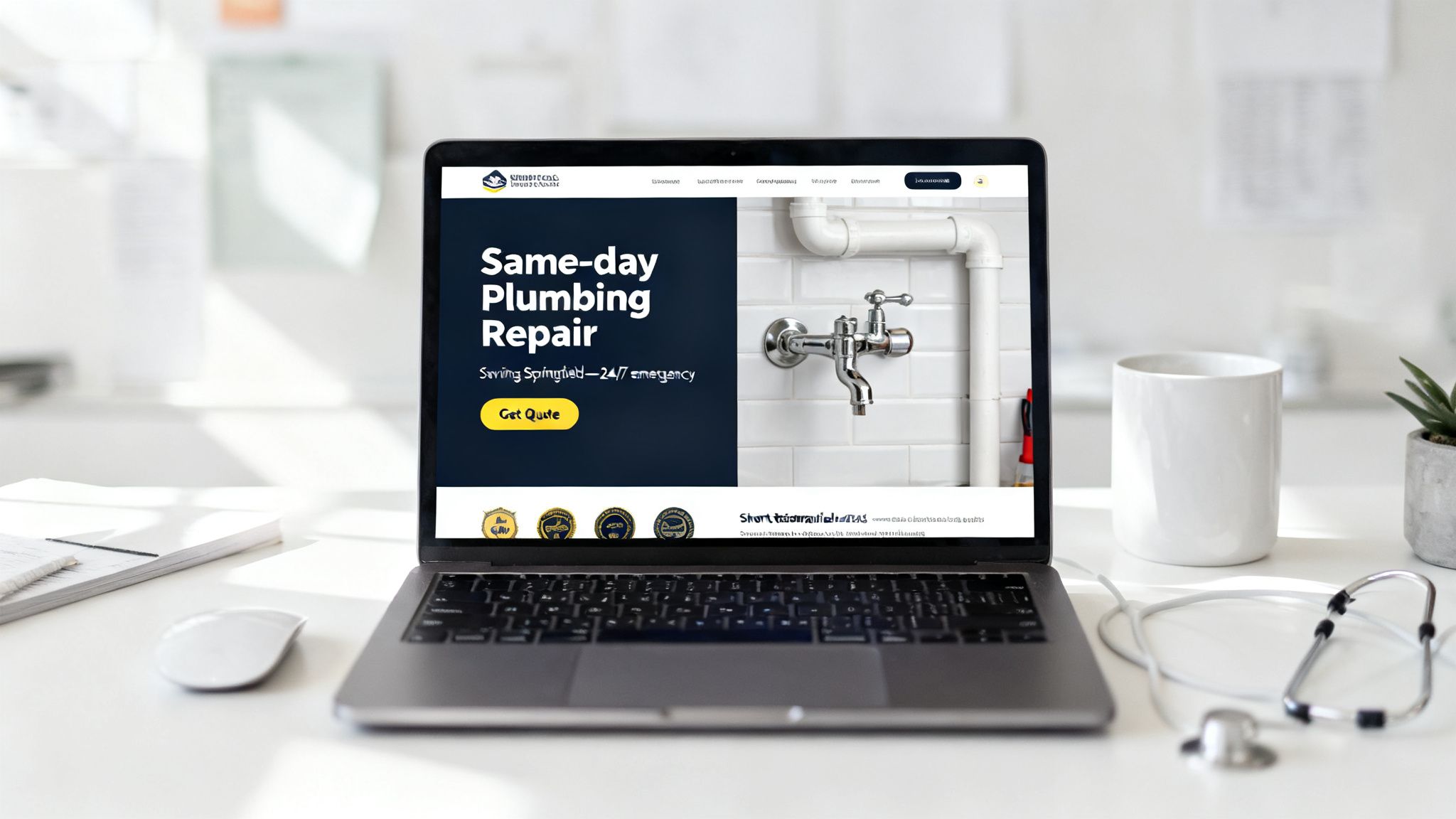
For a contractor in the Monterey Bay Area, this means being specific. Your message must connect with local homeowners who need help now. A weak headline won't work, but a strong, local one shows they've found the right pro.
How to Craft a Winning Value Proposition
A good value proposition uses a headline and sub-headline to send a clear message. It focuses on the customer's needs, not your company story.
- Headline Example: Same-Day Plumbing Repair for Salinas Valley
- Sub-headline Example: Licensed & Insured Plumbers Serving Monterey County. 24/7 Emergency Service Available.
This combination quickly explains the service (plumbing repair), location (Salinas, Monterey County), and benefits (same-day, licensed, 24/7).
Pro-Tip: Your landing page message must match your ad. If your Google Ad promises "Emergency HVAC in Santa Cruz," your landing page must say the same thing. This builds trust right away.
Actionable Implementation Checklist
- Lead with the solution: Focus on the problem you fix for the customer.
- Include local names: Always mention a city (like Gilroy) or county (like Santa Cruz County).
- Highlight urgent benefits: If you offer 24/7 service, make it easy to see.
- Use trust-building words: Add words like "guaranteed," "licensed," and "local expert."
- A/B Test your message: The benefit that works in Pacific Grove might be different from what works in Hollister. Test different headlines to see what converts best.
2. Mobile-First Responsive Design
Most homeowners search for services on their phones, so a mobile-first design is a must. This means you design your page for a smartphone first, then for bigger screens. For contractors in Monterey County, this is one of the most critical best practices for landing page design because many of your leads, especially for urgent jobs, will come from mobile users.
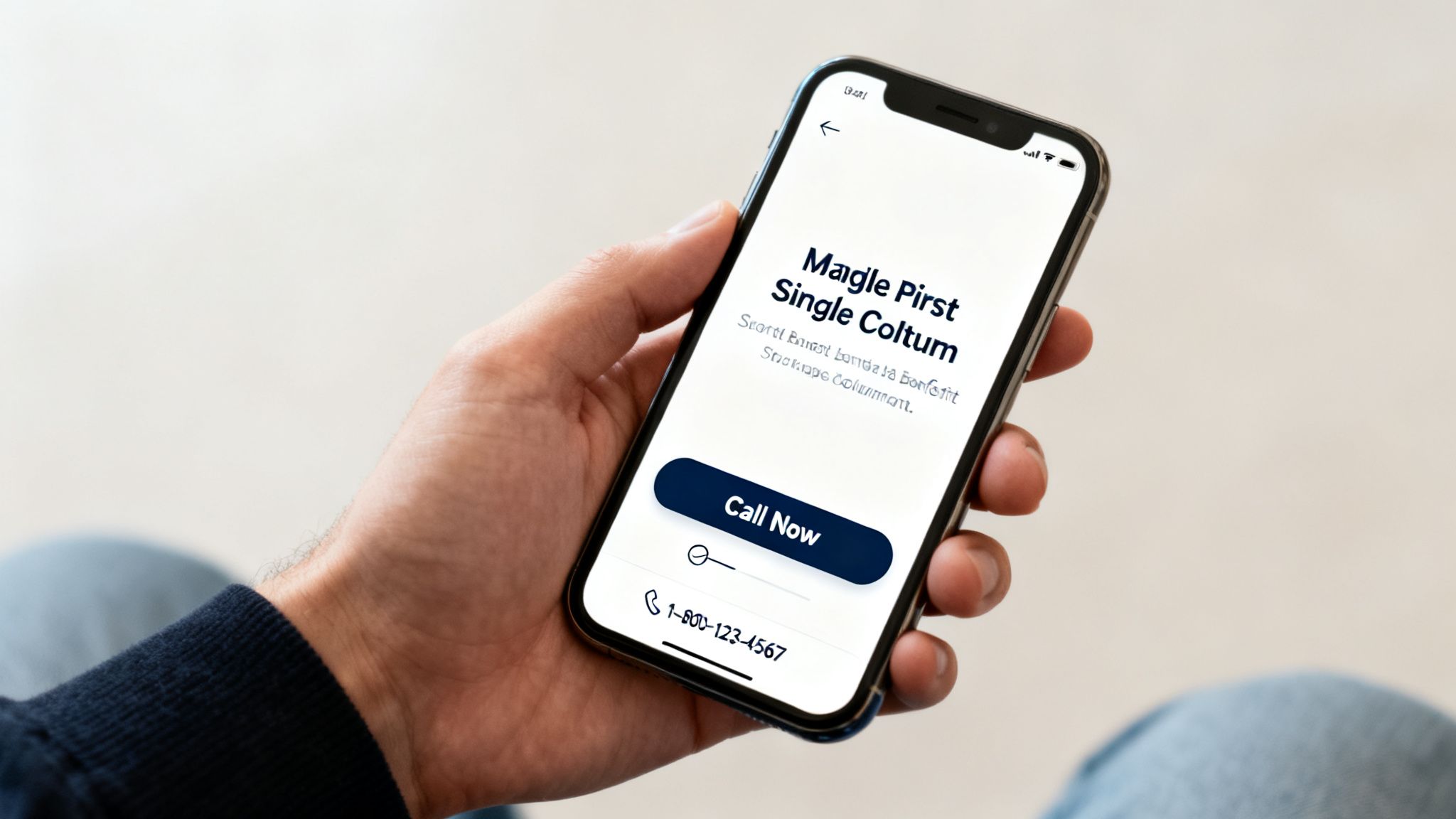
When a homeowner in Gilroy has a burst pipe, they grab their phone to find help fast. If your page is slow or hard to use on their device, you've lost that customer. A mobile-first design makes it easy for clients to contact you in an emergency.
How to Implement a Mobile-First Design
A true mobile-first design is fast and easy to use. It shows the most important info, like your phone number, without clutter.
- Prominent CTA: Your main Call-to-Action (CTA), like a "Call Now" button, must be easy to see and tap.
- Simplified Forms: On mobile, ask for only what you need. A name, phone number, and service type is often enough to get started.
This approach makes it simple for customers to take action. The goal is to connect them with your business as quickly as possible.
Pro-Tip: Test your landing page on real iPhones and Android phones, not just on your computer. Check button sizes, text readability, and load times on a cell connection.
Actionable Implementation Checklist
- Place CTAs above the fold: Make sure a click-to-call button is visible without scrolling.
- Use large, tappable buttons: Buttons should be easy to press with a thumb.
- Optimize font sizes: Use at least a 16px font size for body text so it's easy to read.
- Compress all images: Big image files are the top reason for slow mobile pages.
- Test page speed: Use Google’s PageSpeed Insights to check and improve your mobile speed.
3. Trust Signals and Social Proof
When someone from Salinas lands on your page, you have only a few seconds to show them you're a pro they can trust. Trust signals and social proof are the best ways to build this credibility. This is a vital best practice for landing page design, as it turns website visitors into real leads.
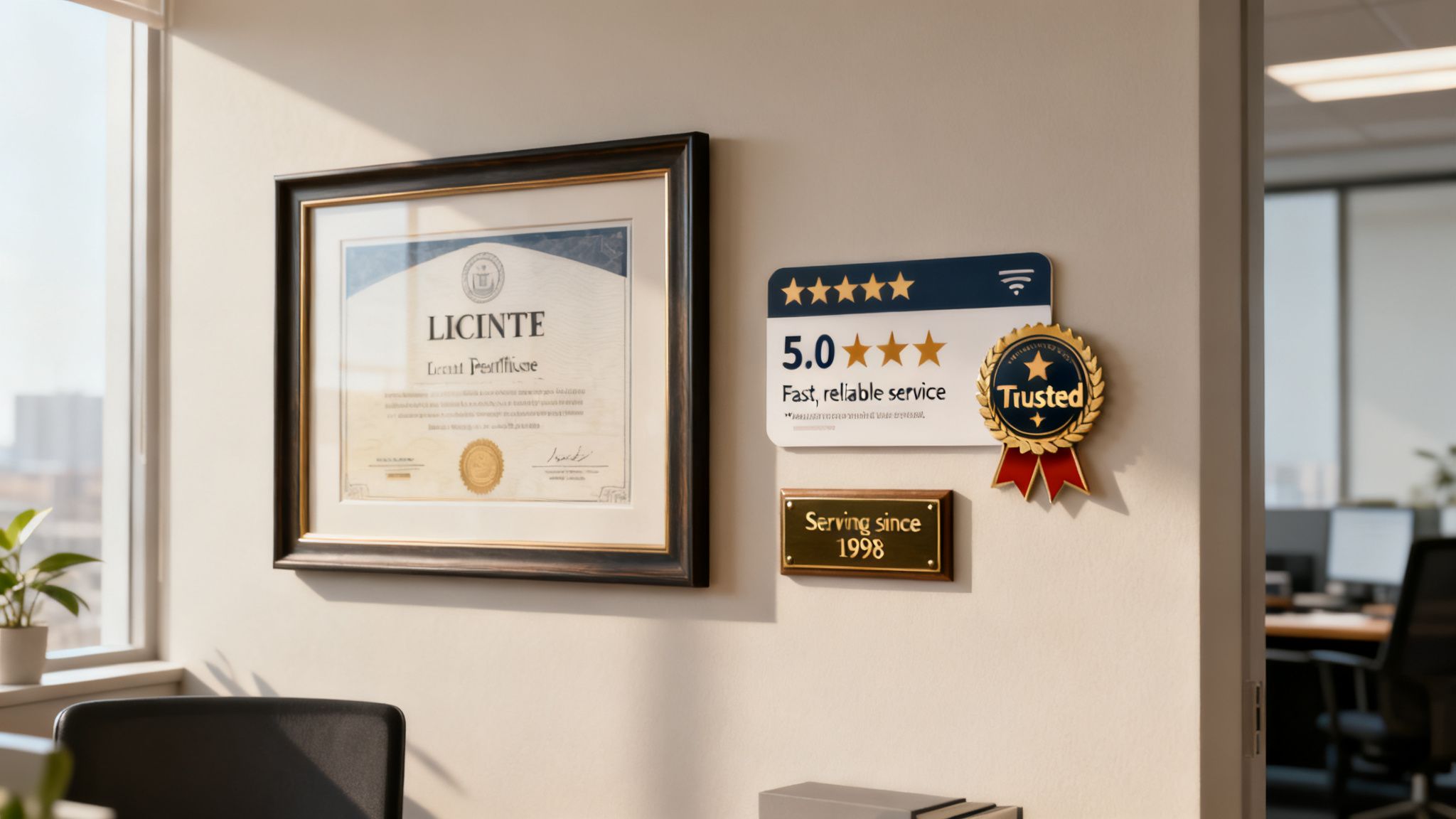
For a contractor serving Monterey County, you need to show why homeowners should choose you. This includes official licenses and certifications, plus real customer reviews. Without these, you're just another business. With them, you become a trusted local expert.
How to Build Instant Credibility
A strong trust strategy uses different kinds of proof. Official badges show you're qualified, while great reviews from neighbors in Hollister or Pacific Grove prove you deliver on your promises.
- Trust Signal Example: An HVAC contractor in Gilroy shows their EPA and NATE (North American Technician Excellence) certification badges near the top of the page.
- Social Proof Example: A roofing company shows a live feed of their 5-star Google reviews from clients across Santa Cruz County.
These elements work together to build the confidence a customer needs to call you.
Pro-Tip: Video testimonials are very powerful. A short video of a happy customer in Watsonville explaining how you fixed their leak is more convincing than a paragraph of text. Ask for permission to film a quick video on your phone after a job.
Actionable Implementation Checklist
- Display official licenses: Add your CSLB (Contractors State License Board) number where it's easy to see.
- Showcase certifications: Include logos from the BBB, local chambers, or partners.
- Embed real-time reviews: Use a tool to display your latest Google or Yelp reviews.
- Feature detailed testimonials: Include the customer's name and city (e.g., Carmel-by-the-Sea).
- Use specific numbers: Say "Over 500+ 5-Star Reviews" or "Serving the Community Since 1998."
- Highlight guarantees: A "100% Satisfaction Guarantee" can make customers feel more comfortable.
4. Focused Call-to-Action (CTA) Strategy
Your landing page has one main goal: to get a visitor to take a specific action. A focused Call-to-Action (CTA) is a key part of the best practices for landing page design because it guides the user to that goal. Without a clear CTA, even a great page won't turn visitors into customers.
For a roofer in Santa Cruz County, a visitor might be worried about a leak. They need a big, obvious button that says "Get Your Free Roof Inspection." A clear CTA makes it easy for homeowners from Watsonville to Santa Cruz to solve their problem with one click.
How to Build a Winning CTA Strategy
A strong CTA uses persuasive words, good placement, and a design that stands out. It should feel like the natural next step for the visitor.
- Primary CTA Example: Get Your Free Roof Inspection Today
- Reassurance Text Example: No-Obligation Estimate for Santa Cruz County Homeowners.
This combination uses an action word ("Get"), offers a clear benefit (free inspection), and reduces worry with reassurance text.
Pro-Tip: On mobile, your main CTA should be a "sticky" header or footer that stays on the screen as the user scrolls. For emergency services like a 24/7 plumber in Monterey County, this should be a large, clickable phone number.
Actionable Implementation Checklist
- Use action verbs: Start your CTA with words like "Get" or "Schedule" instead of "Submit."
- Choose contrasting colors: Make your buttons stand out. Bright orange or green often work well.
- Place CTAs at key points: Put buttons after your main message and customer testimonials.
- Limit your main CTAs: Don't confuse visitors. Stick to one main action per section.
- A/B Test your CTA text: See what converts better in the Hollister market: "Schedule Your Free Inspection" or "Request Your Free Quote."
5. Benefit-Driven Content and Messaging
People visit your landing page to find a solution to their problem, not to read a list of your services. One of the best practices for landing page design is to change your writing from features (what you do) to benefits (what the customer gets). A feature is "HVAC repair," but the benefit is "getting your AC running again fast."
For a contractor in Monterey County, this means connecting with a homeowner's worries. A family in Salinas with a burst pipe cares about getting fast, reliable service to prevent water damage. Highlighting the outcome of your work builds a stronger connection and gets them to act.
How to Craft Benefit-Driven Messaging
Good benefit-driven writing focuses on the positive result for the customer. It answers their question: "What's in it for me?"
- Feature: Kitchen Remodeling
- Benefit: A Beautiful New Kitchen That Increases Your Home Value
- Feature: Electrical Services
- Benefit: Licensed Electrical Work That Keeps Your Family Safe
This simple change in wording reframes the conversation. You're not just a service provider; you're a source of safety, comfort, and value.
Pro-Tip: Listen to your customers. When a homeowner in Santa Cruz calls, what words do they use to describe their problem? Use that same "customer language" on your landing page. It shows you understand them.
Actionable Implementation Checklist
- List top pain points: Write down the 3-5 biggest problems your customers have and create a benefit for each.
- Focus on the outcome: Instead of "We inspect your roof," say "Enjoy a leak-free home, guaranteed."
- Use benefits to address worries: Say things like "Upfront pricing, so you never get a surprise bill."
- Use specific numbers: A benefit like "$500 savings on your annual energy bill" is better than "lower energy bills."
- Tailor benefits by service: Emergency services should highlight speed, while remodeling should focus on quality and value.
6. Strategic Form Optimization
Your contact form is the final step for a visitor to become a new customer. The goal is to make it as easy as possible to fill out. Smart form design is one of the most important best practices for landing page design because a long, confusing form will make people leave.
For a contractor working in Santa Cruz County, a homeowner needing an emergency roof repair in Watsonville won't fill out ten fields. By asking for only the most important info, you make it much more likely they'll complete the form. The fewer barriers you have, the more leads you'll get.
How to Design High-Converting Forms
A great form feels like a quick chat, not an application. Ask for the minimum information you need to make contact.
- Simple 3-Field Example: Name, Phone Number, Service Type
- 1-Field Urgent Request Example: Just a phone number, with the text "We'll call you in 5 minutes for details."
- Dropdown Menu Example: Use a dropdown for "Service Type" with options like 'Emergency HVAC Repair' or 'New AC Installation.'
This approach respects the visitor's time and makes them more likely to click the final button.
Pro-Tip: The text on your submission button is important. Instead of "Submit," use something that shows value, like "Get My Free Quote" or "Schedule My Service Call." These work better because they tell the user what they get.
Actionable Implementation Checklist
- Make the phone number the main field: A phone call is often the fastest way to get a new job.
- Ask only for what you need: Start with Name and Phone. You can get the address and other details on the call.
- Add reassurance text: Include a line like "No obligation" or "We'll call you back within 5 minutes."
- Test form length: Try a 3-field form against a 5-field form to see which gets more leads from Gilroy to Pacific Grove.
- Track form abandonment: Use tools to see where people stop filling out your form. If many leave at the "Address" field, consider removing it.
7. Local SEO Integration and Location-Based Targeting
Your landing page needs to be found by local customers. This is why Local Search Engine Optimization (SEO) is a key part of the best practices for landing page design. By adding local information to your page, you tell Google that you are the best result for a homeowner in Santa Cruz County looking for your service.
When someone in Gilroy searches for "emergency roof repair," Google shows businesses that mention Gilroy. A generic page won't show up, but a page with local keywords and maps will. This helps you rank higher in local search and on Google Maps, bringing you customers who are ready to hire you. SEO agencies in Salinas can help local businesses dial this in.
How to Implement Winning Local SEO
Good local SEO means adding location details throughout your page, from headlines to code. This shows users and search engines that you are a dedicated local pro.
- Headline Example: Expert Electrical Services for Hollister Residents
- Sub-headline Example: Your Trusted, Licensed Electrician Serving All of San Benito County.
This immediately tells a local searcher they are in the right place, which builds trust and keeps them on your page.
Pro-Tip: Make sure your Name, Address, and Phone number (NAP) on your landing page exactly match your Google Business Profile. Any difference can hurt your local search rankings.
Actionable Implementation Checklist
- Use geo-specific headers: Include the city or county (e.g., "Pacific Grove," "Salinas") in your H1 and H2 titles.
- Create location-specific pages: If you serve cities like Monterey and Santa Cruz, create a unique landing page for each one.
- Optimize for local keywords: Target phrases like "digital marketing for Santa Cruz retailers" and "plumber near me."
- Embed a service area map: Show customers the areas you serve within Monterey County.
- Implement LocalBusiness schema: This is a type of code that helps Google understand your service area, hours, and contact info. A Landing Page SEO Checklist for Local Services can be a great guide for this.
8. Page Speed and Technical Performance
Online, speed is a must. One of the most important best practices for landing page design is making sure your page loads almost instantly. If a customer in Salinas clicks your ad for HVAC repair, a three-second delay is long enough for them to leave and call someone else.
For contractors in Monterey County, a slow website means lost money. Google also uses page speed to rank websites. A fast page gives users a better experience and helps you show up higher in local search results.
How to Optimize for Peak Performance
Making a page fast involves technical fixes that cut down load times. The goal is to get your main message to the user in under 2.5 seconds, especially on mobile.
- Image Compression: Large images are the main cause of slow pages. Use tools to make image files smaller before you upload them.
- Caching & CDN: Use browser caching and a Content Delivery Network (CDN). A CDN stores your site on servers closer to your visitors in the Santa Cruz County area so it loads faster.
Pro-Tip: Use Google's PageSpeed Insights tool to check your page speed. It gives you a free report with tips to improve. Aim for a score of 90 or higher.
Actionable Implementation Checklist
- Choose quality hosting: A good hosting provider is the foundation for a fast website.
- Compress all images: Use the WebP format for images when you can. It's smaller and still looks great.
- Minimize code: Combine and shrink CSS and JavaScript files to make your site faster.
- Enable lazy loading: This technique only loads images as a user scrolls down the page.
- Monitor Core Web Vitals: Check these speed scores in Google Search Console to see how your site is doing.
- Limit third-party scripts: Things like tracking codes or chat boxes can slow your site down. Only use what you really need.
9. Compelling Visual Design and Brand Consistency
Your website is your digital storefront. A messy or old-looking design suggests your work is the same. One of the most important best practices for landing page design is using great visuals and consistent branding to build trust and show your high standards.
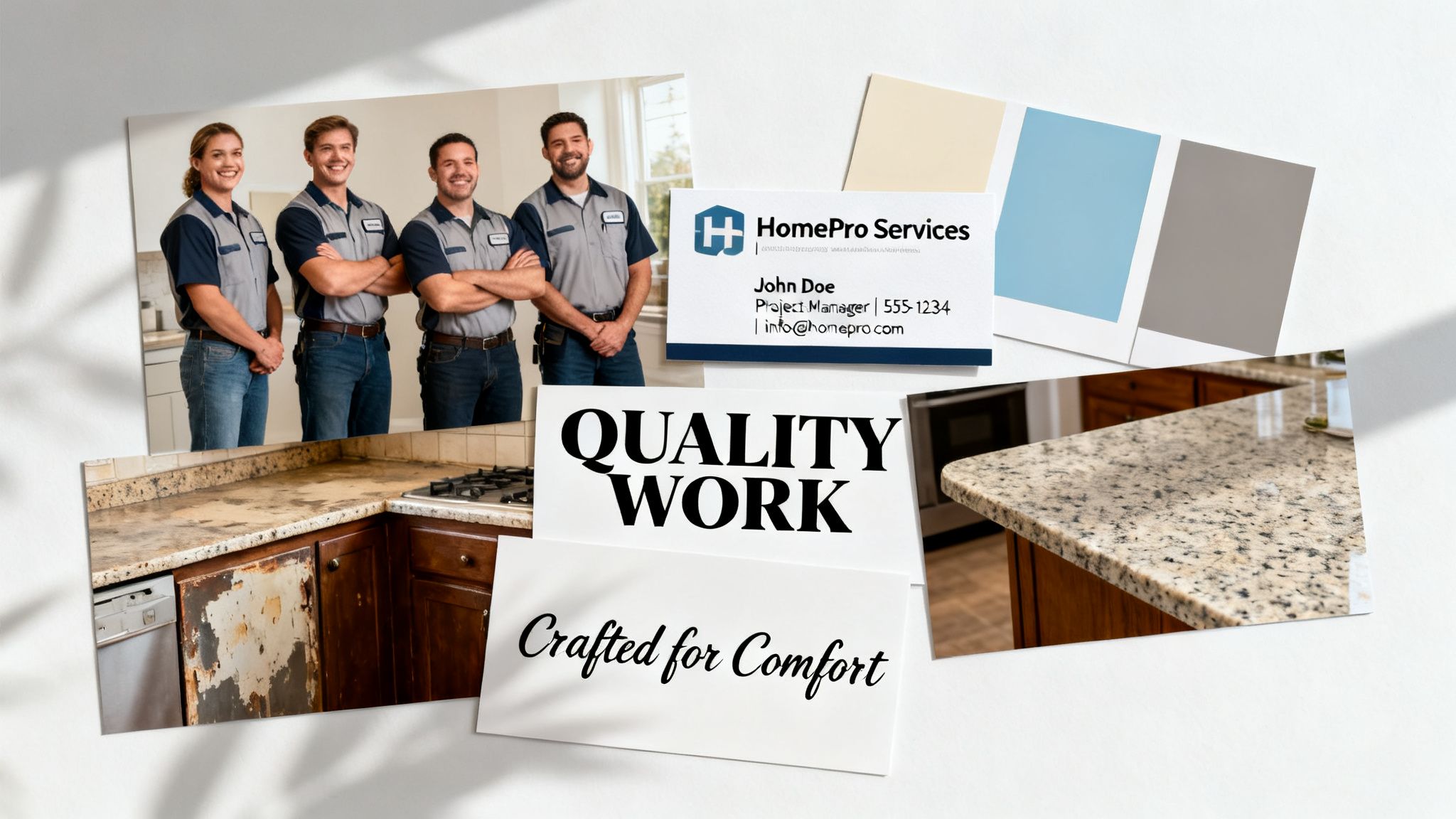
When a customer in Santa Cruz needs an electrician, they look for signs of a professional and reliable business. Good photos of your team, a consistent color scheme, and a clean layout show you are a serious business. Generic stock photos and messy branding can make them leave.
How to Build a Professional Visual Identity
A strong visual identity uses professional photos and a clear brand style. This means your logo, colors, and photos of your work all look unified and professional. It's about showing, not just telling, that you do quality work.
- Real Team Photos: Feature your actual technicians from Salinas, Gilroy, and other parts of Monterey County. It builds a local connection and shows you're a real business.
- High-Quality Project Galleries: A roofer should show clear photos of finished projects. A remodeling company needs professional before-and-after photos.
This shows visitors that the quality they see online is the quality they'll get. It's a great way to stand out from competitors who use generic or bad photos.
Pro-Tip: Your branding must be the same everywhere. The colors, logo, and fonts on your landing page should match your Google Business Profile, social media, and even your work vans. This builds brand recognition and trust.
Actionable Implementation Checklist
- Invest in professional photography: Don't use stock photos. Hire a local photographer to take pictures of your team and your best work.
- Create a simple brand guide: Decide on your main colors, fonts, and logo use.
- Showcase your work: Use high-quality before-and-after photos or short video testimonials.
- Optimize all images for the web: Make photo files smaller so your page loads quickly.
- Use whitespace: A clean, open design looks more professional and is easier to read.
- Ensure fonts are easy to read: Stick to clean fonts for your main text.
10. Conversion-Focused Testing and Optimization
Launching a landing page is only the first step. The best contractors in Monterey County know that you can't just "set it and forget it." The final best practice for landing page design is to always be testing and improving based on data. This way, you stop guessing what works and start knowing what turns visitors into customers.
This means creating different versions of your landing page and showing them to people to see which one works better. By looking at the data, you can make smart choices that get you more leads and lower your advertising costs. This gives you a big advantage over competitors in places like Santa Cruz and Watsonville.
How to Implement Systematic A/B Testing
A/B testing is the easiest way to start. You test one change at a time to see how it affects results. For example, does a red "Get a Quote" button work better than a green one? Does the headline "Emergency HVAC in Gilroy" convert better than "24/7 HVAC Repair for Gilroy Homes"?
- Test High-Impact Elements First: Start with your headline, main CTA button, contact form, and main image.
- One Change at a Time: To know what caused a change, only test one thing at a time.
- Example Test: Try a photo of your friendly team against a picture of a technician at work. The winner might surprise you.
Pro-Tip: Make sure you have enough visitors to get a good result. A test needs a certain number of visitors and conversions before you can be sure of the winner (usually a 95% confidence level).
Actionable Implementation Checklist
- Define your goal: Are you trying to get more phone calls, form fills, or appointments?
- Prioritize your pages: Start testing on your pages with the most visitors but the lowest conversion rates.
- Use the right tools: Tools like Google Optimize or Unbounce have built-in A/B testing.
- Run tests long enough: Let tests run for at least two weeks to get a clear picture.
- Document everything: Keep a record of every test, what you thought would happen, the results, and what you learned.
- Track your results: You must have conversion tracking set up to test properly. To learn more, read about what is conversion tracking.
Top 10 Landing Page Best Practices Comparison
| Item | ???? Implementation Complexity | ⚡ Resource Requirements | ⭐ Expected Outcomes | ???? Ideal Use Cases | ???? Key Advantages |
|---|---|---|---|---|---|
| Clear Value Proposition Above the Fold | Low–Medium — copy + layout and A/B testing | Low — copywriter, designer, basic testing | High — quickly reduces bounce; +40–50% conversion lift when optimized | Local/emergency landing pages; first-time visitors | Immediately qualifies visitors; improves local SEO and clarity |
| Mobile-First Responsive Design | Medium–High — device-specific design & testing | Medium — responsive dev, optimization tools, QA devices | High — better mobile conversions, improved rankings and calls | Mobile-heavy traffic; emergency services | Faster mobile UX; higher phone conversions; SEO gains |
| Trust Signals and Social Proof | Medium — review collection, verification, integration | Medium — customer outreach, multimedia assets, review tools | High — +25–35% conversion lift; reduces hesitation | High-ticket services; saturated local markets | Builds credibility; differentiates from unlicensed competitors |
| Focused Call-to-Action (CTA) Strategy | Low–Medium — placement, text, sticky elements, tests | Low — design, tracking, minor dev for sticky CTAs | High — +30–50% conversions; more phone calls | Emergency services; booking/quote-oriented pages | Reduces friction; guides user action; easy to measure |
| Benefit-Driven Content and Messaging | Medium — research-driven copywriting and testing | Low–Medium — copywriter, customer interviews, A/B tests | High — +20–40% conversions; better relevance and SEO | All contractors competing on price/quality/speed | Stronger emotional resonance; clearer value proposition |
| Strategic Form Optimization | Low–Medium — UX changes, progressive profiling | Low — form builder, CRM integration, tracking | Medium–High — +25–50% form completion; better lead quality | Lead capture pages; contractors without instant phone pickup | Higher completion rates; faster follow-up; reduced friction |
| Local SEO Integration & Location Targeting | Medium–High — multi-page strategy, schema, GBP work | Medium–High — content, citations, GBP upkeep, link building | High — improved local visibility and qualified leads | Multi-location businesses; competitive local markets | Better Maps/search rankings; lower paid acquisition costs |
| Page Speed & Technical Performance | High — Core Web Vitals, caching, code optimization | Medium–High — developer time, CDN/hosting, monitoring tools | High — lower bounce, better ranking; +5–10% conv. per sec saved | Mobile-first sites and organic traffic–driven pages | Faster UX, SEO benefits, reduced bandwidth/server costs |
| Compelling Visual Design & Brand Consistency | Medium — design system, photography, layout work | Medium–High — pro photography, design resources, brand guide | High — +25–35% conversion improvement; better lead quality | Remodeling/high-ticket services; premium brands | Increases trust and perceived quality; stronger brand recall |
| Conversion-Focused Testing & Optimization | High — experiment design, statistical rigor, iteration | Medium–High — testing tools, analyst time, sufficient traffic | High (compounded) — 20–40% gains over time with continuous tests | High-traffic landing pages; campaigns needing measurable lift | Data-driven decisions; reduces wasted spend; scalable learnings |
Turn Your Landing Page into a Lead-Generating Machine
You now have a complete plan for turning an average landing page into a powerful tool for getting leads. We've covered the real strategies that help home service contractors in the Monterey Bay Area win in their local markets. A great landing page is the result of using a proven plan and knowing what makes a local homeowner call you.
The path from a visitor to a lead is short, but it's easy to lose them. This is where mastering the best practices for landing page design gives you an edge. It's about making a great first impression with a clear message and building trust with reviews from people in Santa Cruz County. It's about making sure your site is fast on a phone for a customer in Gilroy with an emergency, and guiding them to a clear call-to-action.
Your Key Takeaways
Think of each practice as part of a system designed for one thing: getting you more business.
- Clarity and Trust are King: Your headline and reviews must answer two questions: "Am I in the right place?" and "Can I trust this company?" A plumber in Salinas can do this with a headline like "Trusted Salinas Plumbers for 24/7 Emergency Service" and recent Google reviews.
- The User Experience is Everything: A simple mobile design, fast page speed, and an easy-to-use form are essential. Every extra second a page takes to load, and every extra field on a form, can cost you a customer.
- Localization Builds Connection: Using local SEO, showing a service area map, and featuring photos of your team in local neighborhoods (like Carmel-by-the-Sea or Hollister) creates a bond. It shows customers you’re part of the Monterey County community.
Your Actionable Next Steps
Don't wait. The difference between a landing page that costs you money and one that makes you money is taking action.
- Conduct a Page Audit: Look at your most important landing page. Where is it weakest? Is your CTA clear? Is your page mobile-friendly?
- Prioritize High-Impact Fixes: You don't have to fix everything at once. Start with the easy wins. Changing a headline or simplifying your form can make a big difference quickly.
- Commit to Testing: Your data will tell you the truth. Use A/B testing on one thing at a time, like your CTA button color, and let your customers' actions guide you.
A well-designed landing page does more than just get leads. It builds your brand and creates a reliable way for your business to grow. It makes sure that when a homeowner in our area searches for your services, your business is the clear, professional, and trustworthy choice.
Ready to build a landing page that works as hard as you do? The team at Core6 Marketing helps home service contractors across Monterey, Santa Cruz, and San Benito counties create high-performance websites. Let us help you turn more local clicks into loyal customers.
By Phil Fisk, CEO, Core6 Marketing
Phil Fisk leads Core6 Marketing, a digital marketing agency in Salinas dedicated to helping local businesses in the Monterey Bay Area grow. With deep roots in our ag-tech community, Phil focuses on practical, results-driven strategies that deliver a measurable return on investment for small and mid-sized companies.
Core6 Marketing
1628 N. Main St #263, Salinas, CA 93906
831-789-9320
[email protected]
https://core6.marketing/