
If you're a contractor in Monterey County, you know the competition is fierce. Many think SEO means putting a few keywords like “plumber in Salinas” on their homepage and waiting for the calls to roll in. That strategy stopped working years ago, and understanding what contractors get wrong about SEO in 2026 is the key to getting ahead. With 97% of consumers in places like Santa Cruz searching online for local services, simply having a website is not enough. You must be easily found and immediately trusted.
Google’s algorithm increasingly emphasizes experience and trust signals, like fresh reviews and engaging local content. It knows when a site is stale, spammy, or trustworthy. A site that hasn't been updated, lacks fresh reviews, or isn't fast on a phone gets pushed down in search results, making you invisible to potential customers in Gilroy and Hollister.
SEO is a system, not a single task. It requires a fast, mobile-friendly site, regular updates, review activity, and locally relevant content that builds credibility over time. Start by auditing your site for mobile usability and local content depth. If you don't have individual service pages, local reviews, or geo-targeted blog posts, that’s where to begin. For more on this, check out our post on Monterey Bay website design for contractors, since design and SEO are tightly connected.
1. Misconception: Local SEO Means Just Getting Listed on Google My Business
For years, many contractors treated local SEO like a one-time checklist item: claim the Google My Business (GMB) profile, fill out the basic info, and wait for the phone to ring. While a strong GMB profile remains a cornerstone, treating it as the entire foundation is one of the most significant things contractors get wrong about SEO in 2026. This outdated "set it and forget it" approach ignores the complex, AI-driven ecosystem that now determines local search visibility.
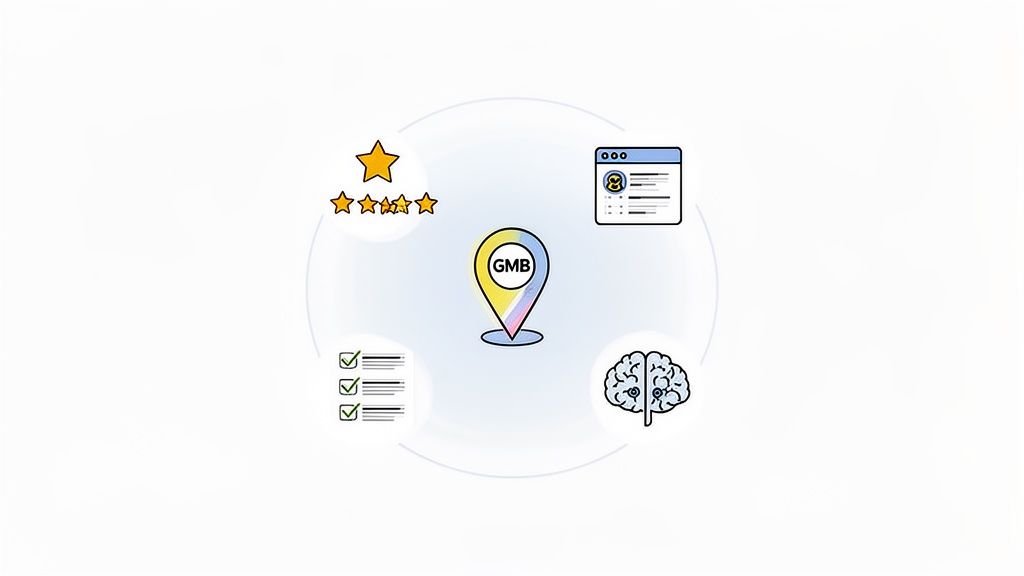
In 2026, search engines like Google use sophisticated AI to understand local intent with incredible precision. They no longer just match a keyword like "roofer in Salinas" to a GMB profile; they analyze a vast network of signals to determine which business is the most relevant, trustworthy, and authoritative for that specific user's need, right down to the neighborhood level.
Why GMB Alone Fails in 2026
Relying solely on your GMB profile means you are invisible across dozens of other critical digital touchpoints. An electrical contractor in Monterey with a perfectly optimized GMB might still lose out on high-value jobs to a competitor in Pacific Grove who has built dedicated landing pages for "rewiring historic homes in Carmel" or "EV charger installation in Seaside." These competitors are sending stronger, more specific signals to Google's AI, proving their expertise beyond a simple business category.
The financial impact is direct: you lose market share. When a homeowner in Santa Cruz County has an emergency, they search "24-hour plumber near me." The businesses that appear first are those with localized content, consistent citations across platforms like Yelp and Angi, and a high volume of recent, positive reviews that Google's AI can verify. A standalone GMB profile simply can't compete in this dynamic environment.
Actionable Steps to Move Beyond GMB
To truly dominate your local market, you must build a comprehensive digital presence that reinforces the authority of your GMB profile. For a comprehensive understanding of what it takes to dominate your local market beyond a basic Google My Business listing, delve into these 10 local SEO best practices.
- Build Hyper-Local Landing Pages: Create dedicated pages on your website for each primary city you serve. A page for "HVAC Repair in Hollister" should feature content specific to that area, including testimonials from local clients and mentioning common issues faced by San Benito County residents.
- Master Your Citation Consistency: Ensure your business name, address, and phone number (NAP) are identical across at least 50 online directories, from Yelp to the local chamber of commerce.
- Develop Neighborhood-Specific Content: Write blog posts or guides addressing unique local challenges. A Watsonville plumber could create content about "preventing pipe damage from agricultural runoff," demonstrating deep local expertise.
- Implement Local Schema Markup: Add structured data to your website's code to explicitly tell search engines your service areas, hours, and customer reviews. This makes it easier for AI to understand and rank your business correctly.
2. Misconception: Keywords Don't Matter Anymore—Just Write Good Content
A pervasive myth gaining traction among contractors is that keyword research is obsolete. The thinking goes that if you just create high-quality, "good content," search engines' advanced AI will figure it out and send customers your way. This is one of the most financially damaging things contractors get wrong about SEO in 2026. While AI has made search more conversational, keywords remain the fundamental language that connects a customer's specific problem to your exact solution.
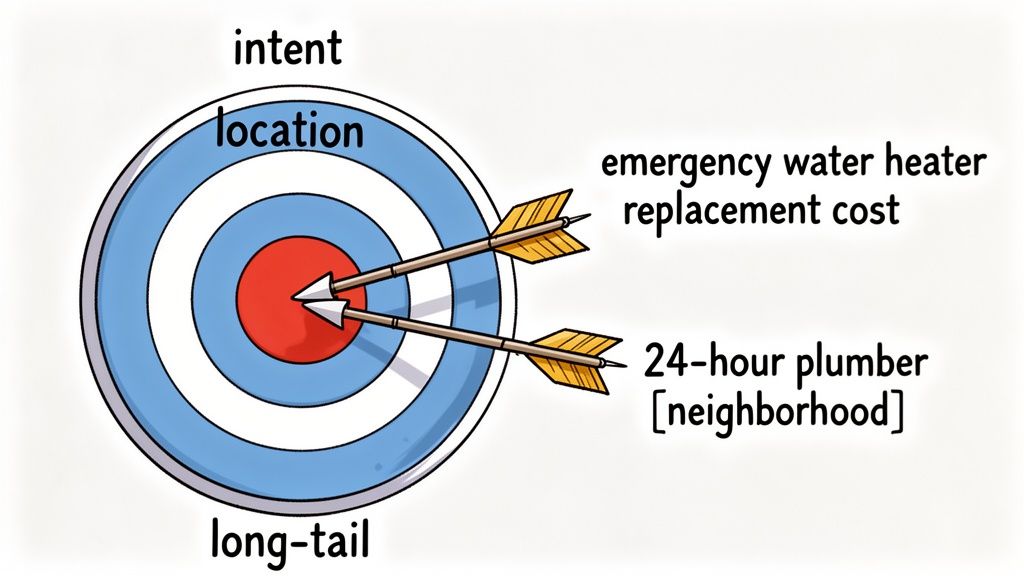
In 2026, the shift isn't away from keywords; it's toward a much smarter, intent-driven keyword strategy. Google's AI doesn't just see words; it understands the context and urgency behind them. Without a strategy, you create content that speaks to no one because it isn't aligned with how real customers in Monterey County actually search when they have an urgent need. This is a common mistake for contractors seeking an effective SEO agency in Salinas.
Why "Good Content" Alone Fails in 2026
Relying on generic "good content" without strategic keyword targeting makes your business invisible to high-intent customers. For instance, a roofer in Salinas might write a well-researched blog post about "The Benefits of Architectural Shingles." While informative, it completely misses the homeowner in Pacific Grove frantically searching "emergency roof leak repair near me" during a winter storm. Your competitor who built a page specifically targeting that high-intent, location-specific keyword will win the job every time.
The financial impact is immediate and severe: you lose out on the most profitable, urgent service calls. An HVAC contractor in Hollister creating general content about "air conditioning maintenance" is irrelevant to a family in San Benito County whose furnace breaks on a cold night. They are searching for "24-hour furnace repair in Hollister," not a general maintenance guide. Without targeting these specific, money-making keywords, your high-quality content never reaches the people ready to hire you right now.
Actionable Steps for Smarter Keyword Targeting
To capture ready-to-buy customers, you must build your content around the precise phrases they use. Understanding how to build topical authority around these keyword clusters is essential for signaling your expertise to search engines.
- Group Keywords by Customer Intent: Separate your keywords into distinct service categories: emergency repairs (
burst pipe fix Gilroy), installations (new HVAC system cost Santa Cruz), and maintenance (annual electrical panel inspection Monterey). - Target Long-Tail, High-Intent Keywords: Focus on longer, more specific phrases that indicate urgency. Instead of "plumber," target "why is my water heater making a popping noise Watsonville." These have lower search volume but much higher conversion rates.
- Build a Seasonal Content Calendar: Map your content to seasonal demands in the Monterey Bay area. Create content around "AC tune-up" in the spring, "furnace inspection" in the fall, and "sump pump repair" before the rainy season.
- Use Local Modifiers Everywhere: Ensure every service page and blog post includes local identifiers. Combine your service with cities and neighborhoods, like "electrician for historic homes in Carmel" or "drain cleaning in East Salinas."
3. Misconception: More Backlinks = Better Rankings Regardless of Quality
The old-school SEO playbook taught that more backlinks, the digital equivalent of a vote for your website, always led to better rankings. This belief has led many contractors down a wasteful path of chasing link quantity over quality. In 2026, believing that 100 low-authority links outweigh five high-authority ones is one of the costliest things contractors get wrong about SEO. This outdated strategy doesn't just fail; it actively harms your online reputation.
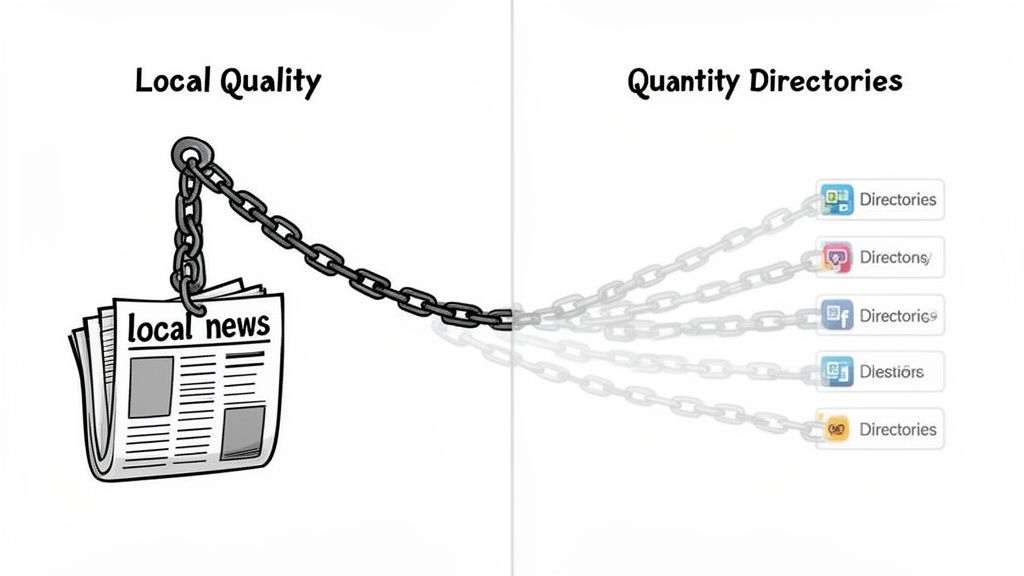
Today's search algorithms are far more sophisticated. Google's AI doesn't just count links; it analyzes their context, authority, and relevance. A single, powerful link from the Monterey County Herald discussing your company's sponsorship of a local charity event carries exponentially more weight than dozens of links from generic, spammy online directories. This is because the link from a trusted local source is a powerful signal of expertise and community trust.
Why Link Quantity Fails in 2026
Chasing link quantity often leads to acquiring links from irrelevant or toxic websites. This sends confusing signals to Google. For example, an HVAC contractor in Santa Cruz buying 100 cheap links from unrelated blogs may see a temporary bump, but Google's AI will quickly identify this unnatural pattern. The result can be an algorithmic devaluation or even a manual penalty, causing your website to plummet in search results and lose valuable leads overnight.
The financial loss is twofold. First, you waste money on ineffective link-building services. Second, and more importantly, you lose revenue when your rankings drop. A competitor in Watsonville who earns a single, high-quality backlink from the local Chamber of Commerce for their community involvement will see a sustained ranking boost and referral traffic, while your business becomes nearly invisible for critical search terms.
Actionable Steps for Quality Link Building
Shift your focus from buying links to earning them through genuine community engagement and strategic partnerships. Building real-world relationships is the foundation of a powerful, penalty-proof backlink profile.
- Sponsor Local Events: Get involved in community activities in places like Gilroy or Hollister. Sponsoring a youth sports team or a local festival often results in a valuable link from the organizer's website.
- Partner with Complementary Businesses: A roofer in Salinas could partner with a trusted gutter installation company. You can refer business to each other and link to one another's websites as a recommended local partner.
- Become a Local Expert: Offer to provide a quote or expert advice for a story by a local news outlet or a blogger in Carmel-by-the-Sea. These opportunities usually include a link back to your website in your author bio.
- Join Industry Associations: Ensure your business is listed in the member directories of relevant associations, like the local chapter of the National Electrical Contractors Association. These links signal industry authority.
- Monitor and Disavow: Regularly use a tool like Google Search Console to review who is linking to you. If you find spammy or toxic links you didn't ask for, use the disavow tool to tell Google to ignore them.
4. Misconception: SEO Takes Too Long; Just Use PPC for Immediate Results
Impatient for leads, many contractors funnel their entire marketing budget into Pay-Per-Click (PPC) ads, hoping for immediate phone calls. While PPC is a powerful tool for capturing instant demand, viewing it as a replacement for SEO is a critical, long-term strategic error. This "PPC-only" mindset creates a precarious, budget-dependent business model and is one of the most financially damaging things contractors get wrong about SEO in 2026.
In 2026, the digital landscape for home services is more competitive than ever. Relying only on paid ads is like renting your visibility; the moment you stop paying, your lead flow vanishes. SEO, on the other hand, is like building equity. It's an asset that compounds over time, generating a steady stream of high-quality, organic leads that act as a competitive moat and insulate your business from rising ad costs.
Why a PPC-Only Strategy Fails in 2026
The cost of PPC for home services has skyrocketed. An electrical contractor in Salinas might spend $3,000 per month on Google Ads for a modest return. A competitor in Santa Cruz County who invested in SEO 18 months prior now generates 40% of their leads organically. This allows them to reallocate that ad spend to enter new markets like San Benito County or hire more technicians, creating sustainable growth that the PPC-dependent business cannot match.
The financial impact is a constant, draining pressure on your profit margins. When a storm hits Watsonville, a roofer relying solely on PPC will see their ad costs spike due to intense competition. When their budget runs out, the leads stop cold. A competitor with a strong SEO foundation continues capturing high-intent organic traffic at a fraction of the cost, dominating the storm-related search results long after the "rented" ads have disappeared.
Actionable Steps to Integrate SEO and PPC
A truly dominant strategy uses PPC and SEO in tandem. PPC captures immediate demand while your long-term SEO asset appreciates in value. To understand the nuances of paid campaigns and avoid common pitfalls, explore our guide on why most Google Ads for contractors fail.
- Adopt a Hybrid Model: Use PPC for immediate leads in your primary service areas while simultaneously building your SEO foundation with a 12-to-24-month horizon.
- Leverage PPC Data for SEO: Analyze your best-performing PPC keywords and landing pages. This data is a goldmine, telling you exactly what content to create for your long-term SEO strategy.
- Track Conversion Rates Separately: Monitor your organic vs. paid conversion rates. You will likely find that organic leads, which are built on trust and authority, convert at a significantly higher rate.
- Strategically Shift Your Budget: As your organic rankings improve and start generating consistent leads, you can gradually reduce your reliance on PPC, dramatically improving your overall marketing ROI.
5. Misconception: Mobile Optimization Is Just Making Your Website 'Mobile Responsive'
For over a decade, the mantra has been "make your site mobile-responsive." As a result, many contractors believe that as long as their website resizes to fit a phone screen, their mobile SEO is handled. In 2026, this passive approach is a significant liability. True mobile optimization goes far beyond a flexible layout; it’s about delivering a superior, lightning-fast user experience that Google’s AI actively rewards.
Simply having a responsive website is no longer enough. The modern standard is a comprehensive mobile-first strategy that prioritizes performance, usability, and emerging search formats like voice. Confusing basic responsiveness with genuine optimization is one of the costliest things contractors get wrong about SEO in 2026, as it directly impacts both rankings and lead conversion.
Why 'Responsive' Alone Fails in 2026
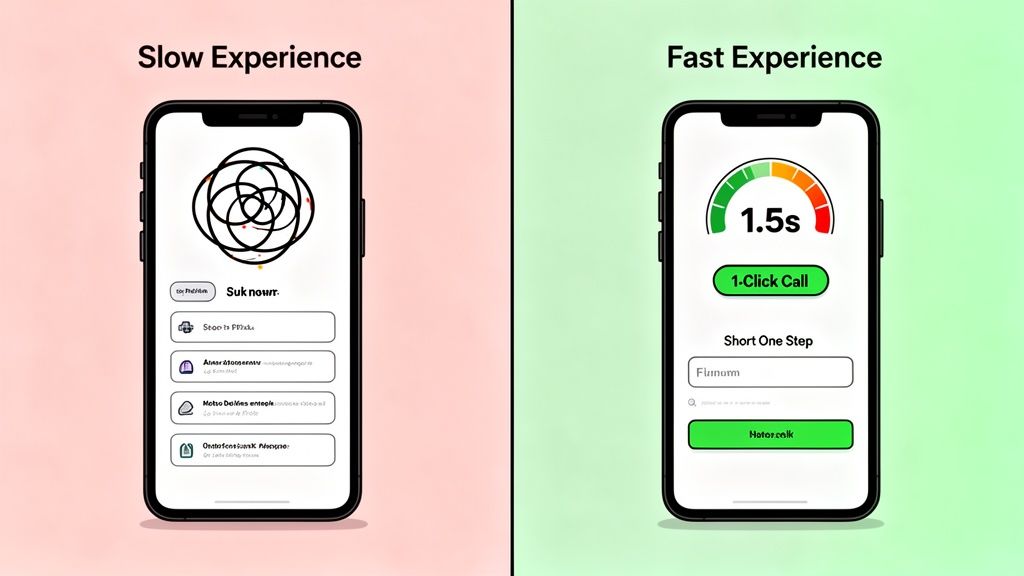
Google’s ranking algorithms now heavily weigh mobile-specific performance metrics known as Core Web Vitals. A responsive website for a plumbing contractor in Salinas that takes five seconds to load on a 4G network and buries its contact form behind three taps is technically "mobile-friendly," but it fails miserably on these performance tests. This poor experience sends negative signals to Google, suppressing your rankings.
The financial impact is immediate. Imagine a homeowner in Santa Cruz County experiencing a burst pipe. They perform a voice search on their phone: "emergency plumber near me." The search assistant will favor the company with a fast-loading site and structured data that provides a quick, direct answer. Your competitor in Watsonville, who has optimized for voice search and has a one-click-to-call button prominently displayed, will get that high-value emergency call. Your slower, less intuitive site is simply skipped over, losing you the most urgent and profitable jobs.
Actionable Steps to Move Beyond Responsive Design
To compete effectively, you must shift your focus from merely being responsive to being fully mobile-optimized. This means prioritizing speed and ease of use for customers on the go.
- Audit Your Mobile Performance: Use Google’s PageSpeed Insights to test your site on a simulated 4G connection. Your goal should be a performance score of 90 or higher.
- Prioritize Above-the-Fold Conversion: Place a "Click to Call" button and a simple quote request form at the very top of your mobile homepage. Don't make a potential customer in Hollister scroll and search for your phone number.
- Optimize for Voice Search: Create a dedicated FAQ page that answers common questions using conversational language (e.g., "How much does it cost to replace a water heater in Monterey County?"). This positions you to capture voice search queries.
- Compress and Streamline Assets: Use modern image formats like WebP, implement lazy loading for images, and minimize any code that blocks the page from loading quickly. Every millisecond counts.
6. Misconception: Technical SEO Is a One-Time Setup Task
Many contractors treat the technical health of their website like a one-off project. They hire a developer to build or "fix" the site, check the box, and assume the job is done for the next few years. This "set it and forget it" mindset is one of the most damaging things contractors get wrong about SEO in 2026. Technical SEO is not a one-time setup; it is continuous maintenance required to keep pace with evolving search engine AI, platform updates, and shifting competitor benchmarks.
A site that passed all technical checks in 2024 is almost certain to have performance issues today. Search engines now use advanced signals to evaluate site reputation, mobile usability, and security in real time. Ignoring the ongoing health of your site's foundation is like building a house in Santa Cruz County and never checking for termite damage; eventually, the structure will weaken and fail.
Why a "One-and-Done" Approach Fails in 2026
Neglecting continuous technical upkeep leads to the slow accumulation of "technical debt." This includes broken links from old service pages, outdated schema markup that no longer communicates effectively with search AI, and server slowdowns from poor hosting. Each small issue compounds, gradually eroding your site's ability to rank for valuable keywords.
For instance, a plumbing contractor in Salinas might have had a fast website in 2024. But by 2026, hosting degradation, a dozen new redirects from service page updates, and an expired SSL certificate can cause their Core Web Vitals score to plummet. They will lose rankings for "emergency plumber in Monterey County," not because their content is bad, but because their site now offers a poor, untrustworthy user experience that Google's algorithm actively penalizes. The financial cost is clear: fewer leads, lower conversion rates, and lost jobs to competitors who prioritize technical maintenance.
Actionable Steps for Continuous Technical Health
To stay competitive, you must treat technical SEO as a recurring business process, not a past expense. A deep dive into mastering technical SEO for home service contractors can provide a comprehensive roadmap for outranking your local competition.
- Implement Monthly Core Web Vitals Monitoring: Use Google Search Console to track your site’s speed and user experience scores. Set alerts to investigate any time your score drops below 75, as this directly impacts rankings.
- Conduct Quarterly Crawl Audits: Use a tool like Screaming Frog to crawl your website every three months. This process will identify crawl errors, broken links (404s), and duplicate content issues before they harm your SEO.
- Update Schema Markup Annually: Review and update your structured data at least once a year. This ensures you are using the latest schema.org standards to clearly communicate your services, service areas like Hollister, and business hours to search engines.
- Monitor Security and Hosting Performance: Regularly check that your SSL certificate is active and your hosting server response time is under 600ms. A slow or insecure site is a major red flag for both users and search algorithms.
7. Misconception: A Website Built on Cheap/Outdated Platforms (Wix, Weebly, Old WordPress) Can Rank as Well as Purpose-Built Sites
Many budget-conscious contractors select inexpensive website builders like Wix or Weebly, or let their old WordPress sites languish on cheap hosting, believing the platform itself doesn't significantly impact SEO. This is one of the most technically damaging things contractors get wrong about SEO in 2026. Your website's underlying technology is not just a container for content; it is a critical ranking factor that directly influences performance, security, and technical optimization.
In 2026, search engine AI evaluates a site's technical health with ruthless efficiency. It scrutinizes everything from server response times to code structure. Cheap builders and outdated platforms often fail these tests, creating an invisible ceiling that prevents you from outranking technically superior competitors, regardless of how good your on-page content might be.
Why Cheap and Outdated Platforms Fail in 2026
Relying on these platforms means you're fighting an uphill battle. An HVAC contractor in Hollister using an old WordPress site with unpatched plugins and slow hosting will see their rankings plummet when Google updates its Core Web Vitals standards. Meanwhile, a competitor in Gilroy on a modern, purpose-built site will maintain or even improve their visibility because their platform can adapt.
The financial impact is a slow bleed of lost opportunity. When a homeowner in Santa Cruz County needs an emergency roof repair, they click on the first few results. If your site takes more than three seconds to load or has security warnings, you lose that lead instantly. These platforms handicap your ability to control technical SEO, from managing header tags to implementing advanced schema markup, effectively telling Google your business is less professional and less reliable than the competition. A robust online presence, starting with a well-designed website, is critical for attracting and converting leads. For a deeper dive into crafting a web presence that truly supports your business, consider understanding how to build a powerful, purpose-built sales engine.
Actionable Steps to Build on a Strong Foundation
Your website is your digital storefront. To ensure it’s built to win, you must invest in the right technology and infrastructure.
- Prioritize Purpose-Built Platforms: When building a new site, choose a modern content management system (CMS) like WordPress on high-quality hosting. This gives you full technical control to optimize for speed, security, and advanced SEO tactics.
- Invest in Quality Hosting: Select a hosting provider that guarantees a server response time under 600ms, offers a 99.9% uptime guarantee, and provides proactive security management like firewalls and malware scanning.
- Plan a Strategic Migration: If you are currently on a restrictive builder or an old site, plan a migration. Carefully map out 301 redirects to preserve link equity, maintain your URL structures where possible, and test the new platform's Core Web Vitals to confirm a performance improvement before going live.
- Audit Technical Debt Annually: Treat your website like any other piece of critical business equipment. Once a year, audit it for outdated plugins, slow-loading scripts, and code bloat that accumulates over time.
8. Misconception: Reviews Don't Affect SEO Rankings; They Only Matter for Conversion
A common belief among contractors is that customer reviews serve one purpose: to convince a potential client to make the call. While strong reviews are undoubtedly powerful for conversion, thinking they don't impact search rankings is a critical mistake in 2026. This outdated view misses how Google's AI now deeply integrates reputation signals into its core ranking algorithm.
Google's E-E-A-T framework (Experience, Expertise, Authoritativeness, and Trustworthiness) is not just a guideline; it's a fundamental part of how it evaluates businesses. In 2026, fresh, positive reviews are one of the strongest signals of trustworthiness and real-world experience. A steady stream of positive feedback tells search engines that your business is active, reliable, and delivering quality service in the community, directly boosting your visibility.
Why a "Conversion-Only" View of Reviews Fails in 2026
Viewing reviews as just a final step in the customer journey means you are actively neglecting a powerful ranking factor. For example, consider two electrical contractors in Monterey County with nearly identical websites and services. The contractor with 150 recent 4.8-star reviews and a habit of responding within 24 hours will consistently outrank the competitor who has 30 older, 3.5-star reviews with unanswered negative feedback. Google’s AI interprets the first business as a more authoritative and trusted local entity.
The financial hit is significant. By ignoring review generation as an SEO strategy, you’re not just making it harder for customers to choose you; you’re making it harder for them to even find you. A roofer in Santa Cruz who implements a systematic review request program and gains ten new five-star reviews in a month sends a powerful signal of rising local authority, often leading to a measurable boost in map pack rankings and a higher call volume.
Actionable Steps to Integrate Reviews into Your SEO Strategy
Turn your reputation into a ranking asset by building a proactive review management system. To get a deeper look into this, you can learn more about the relationship between SEO and reputation management.
- Systematize Your Requests: Implement an automated email or text message system that sends a review request 3-5 days after a job in Hollister or Gilroy is completed. This timing captures the customer's peak satisfaction.
- Make It Frictionless: Provide direct links to your Google, Yelp, and Angi profiles in your requests. The fewer clicks required, the higher the completion rate.
- Respond to Every Review (Fast): Thank customers for positive feedback and address negative comments professionally within 24 hours. A thoughtful response to a bad review can demonstrate excellent customer service and mitigate its impact.
- Leverage Reviews on Your Website: Display a feed of your best reviews directly on your homepage and service pages. This builds on-site trust and can improve user engagement metrics, which are also SEO signals.
Conclusion: Stop Guessing and Start Growing
The digital landscape for contractors has evolved dramatically. Understanding what contractors get wrong about SEO in 2026 is the first step toward building a predictable pipeline of local jobs. Relying on outdated tactics like stuffing "plumber in Salinas" onto your homepage is a guaranteed way to fall behind your competitors in Monterey County. Modern SEO is a complete system, not just one task.
Google’s AI now focuses on trust and user experience. It rewards businesses that genuinely serve potential customers from Santa Cruz to Hollister. When a homeowner has a burst pipe at 2 AM, they search for a trustworthy, responsive, and highly-rated professional they can find instantly on their phone. Your SEO strategy must ensure you are that contractor. If you're unsure why your site isn’t ranking—or why traffic isn't turning into leads—reach out. We’ll explain what’s working, what’s not, and how to fix it without the jargon.
Your Path Forward: Key Takeaways
The biggest shift is from single tactics to an integrated strategy. Your website's technical health, mobile speed, content, and online reviews are all connected signals that Google uses to determine who ranks at the top.
Here’s a summary of the essential mindset shifts required for success:
- From "Keywords" to "Intent": Focus on creating helpful content that answers the specific questions your customers in places like Gilroy and Pacific Grove are asking.
- From "Backlinks" to "Authority": Prioritize earning high-quality, relevant links from local sources. Your reputation in the Monterey Bay Area matters more than anonymous links.
- From "Mobile-Responsive" to "Mobile-First": Your website must be designed for an exceptional mobile experience, including fast load times and click-to-call buttons.
- From "Set and Forget" to "Continuous Improvement": SEO is not a one-time project. It demands ongoing effort to maintain and grow your visibility.
Your immediate next step is to perform a quick audit. Pull up your website on your phone right now. Does it load in under three seconds? If not, you’ve identified your starting point for a stronger SEO foundation. The contractors who thrive in 2026 and beyond will be the ones who treat their online presence with the same professionalism they bring to every job site.
By Phil Fisk, CEO, Core6 Marketing
Phil Fisk is the founder and CEO of Core6 Marketing, a digital marketing agency based in Salinas, CA. With over 15 years of experience, Phil specializes in helping local home service contractors in the Monterey Bay Area generate more leads and grow their businesses through proven SEO and digital advertising strategies.
Core6 Marketing
1628 N. Main St #263, Salinas, CA 93906
831-789-9320
[email protected]
https://core6.marketing/