
A solid construction marketing strategy is your blueprint for landing great projects here in Monterey County. It’s how you go from waiting for word-of-mouth referrals to building a steady stream of good leads. The goal is to reach your best clients—whether they're planning custom homes in Carmel-by-the-Sea or leading commercial projects in Salinas—before your competition does.

Building Your Modern Marketing Blueprint
Let’s be honest: a good reputation alone isn’t enough to stand out in the Monterey Bay Area’s busy market. To grow your business the right way, you need a marketing plan. This plan is your roadmap to connect with the right clients and show them why your company is the best choice for their project.
The days of just relying on past clients and referrals are over. Digital marketing has changed the game for construction companies, creating new ways to get leads and win jobs. Today, the most successful local firms use a smart mix of SEO, helpful content, and social media to make sure they get seen.
Define Your Ideal Local Client
Before you spend any money on marketing, you need to know exactly who you’re trying to reach. A vague target like "anyone who needs construction" will waste your time and money. You need to focus on the specific clients that are most profitable for your business.
Are you looking for architects planning new buildings in Santa Cruz County? Or are your best jobs high-end kitchen remodels for homeowners in Pacific Grove? Answering this question makes every part of your marketing stronger.
Knowing your ideal customer is the most important first step. If you need a hand getting started, resources like a business growth Starter Pack can give you a solid foundation.
A winning construction marketing strategy is built on knowing your most profitable client. Once you understand their needs, goals, and where they spend time online, you can show up in the right place at the right time.
Set Clear, Measurable Goals
Once you know your ideal client, it's time to set clear goals. Your goals should be specific and measurable. Saying you want to "get more leads" is too vague—you can't track it, and you won't know if your marketing is working.
Instead, set solid targets that connect directly to your company's growth. For example:
- Increase qualified website leads by 20% in the next six months.
- Win three new commercial contracts in Salinas or Hollister by the end of the year.
- Rank on the first page of Google for "custom home builder Santa Cruz" within nine months.
These types of goals give your marketing a clear purpose and let you measure your return on investment (ROI). It turns marketing from an expense into a powerful tool for your company’s future. To learn more, our guide on https://core6.marketing/blog/7-steps-to-defining-your-target-market/ is a great resource. It’s all about building a system that delivers predictable results so your business can thrive in our unique coastal economy.
Using Digital Tools to Build a Better Contracting Business
Technology is no longer optional for contractors in Santa Cruz County; it’s the core of a modern construction marketing strategy. To get ahead and stay there, local firms need to use digital tools that make everything from managing leads to talking with clients smoother and more effective.
This is about more than just getting rid of spreadsheets. The right technology gives you a real competitive edge, helping you manage new jobs, keep clients updated, and prove your skills in new ways.
From First Call to Final Invoice: Your CRM is Your Command Center
A Customer Relationship Management (CRM) platform is like a digital command center for your sales and marketing. A CRM is a tool that helps you manage customer data. Think of it as one central place to track every conversation with a potential client, from their first email in Watsonville to the final signed contract.
With a good CRM, nothing gets missed. It helps a local contractor like you:
- Keep all your leads organized, whether they came from your website, a phone call, or a referral.
- Set up automatic follow-up emails so you always stay top-of-mind.
- See your entire sales pipeline at a glance, so you know where your best jobs are coming from.
Using a CRM gives you a clear view of your customer's journey and shows you what’s working.
Keeping Clients Happy with Project Management Software
Great communication is what turns a one-time project into a string of future referrals. Project management software made for contractors, like CoConstruct or Buildertrend, gives you, your team, and your clients a single, clear place to work from.
These platforms let you share daily progress photos, updates, and budget information. Imagine a client in Carmel-by-the-Sea logging in to see the latest pictures of their custom home build—it builds amazing trust and cuts down on "just checking in" phone calls. That level of transparency is a powerful marketing tool.
The chart below shows where most modern construction firms are putting their marketing dollars. You'll see a heavy focus on digital channels, which is where these tools really shine.
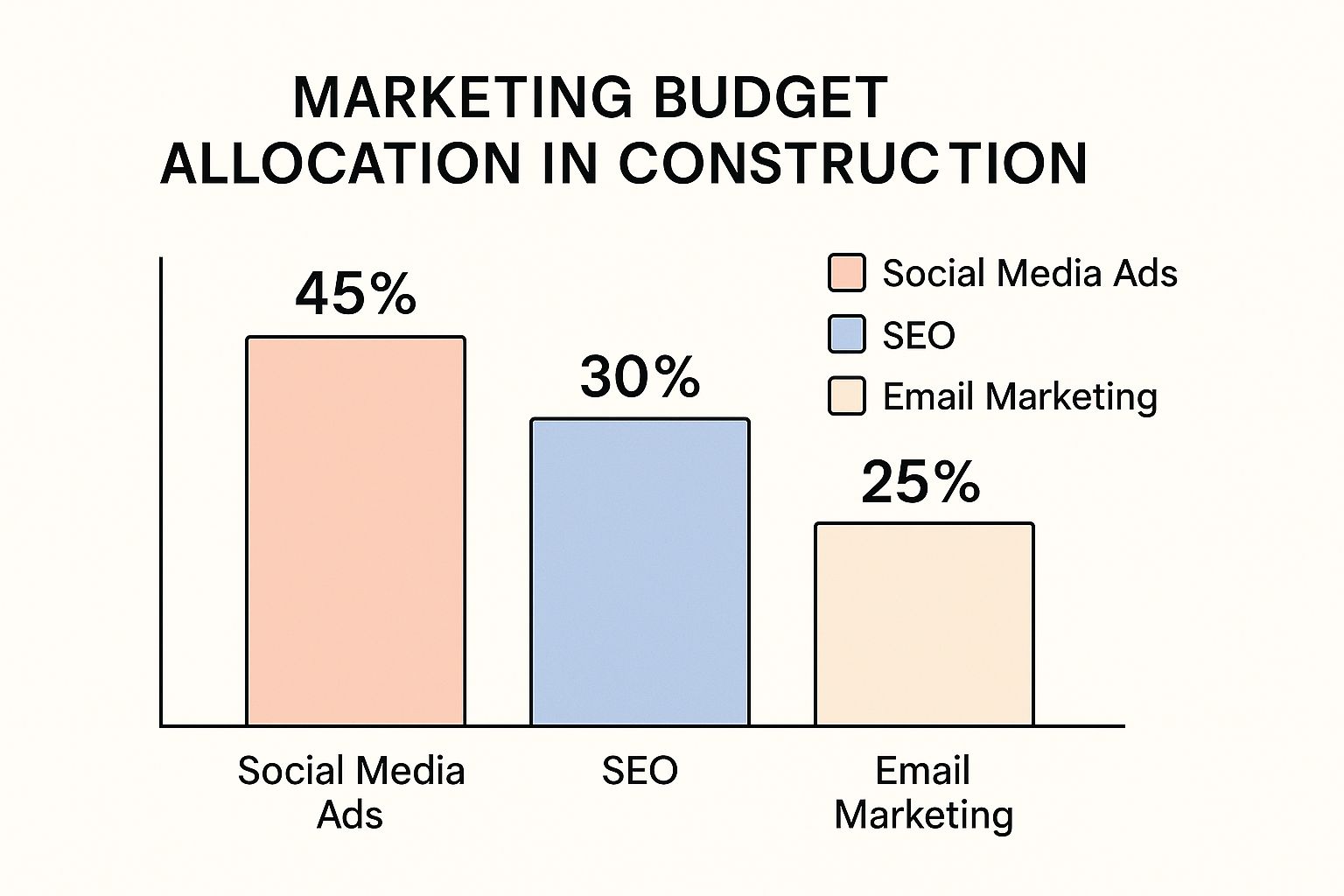
This data makes it clear: contractors are investing heavily in digital ads and online visibility to land new clients.
Use Your Tech to Showcase Your Expertise
The tools you use can also be powerful marketing assets. For example, if you use Building Information Modeling (BIM) to create detailed 3D models before starting a job, you should show them to potential clients. It immediately shows a level of skill and care that makes you stand out.
The construction industry is adopting these tools quickly. A recent Deloitte report found that construction companies increased their use of digital tools by 20% in just one year. You can read the full research about digital adoption findings to see how things like BIM and AI are changing the industry.
Even using AI to improve your website's search ranking can give you a big advantage. If you're curious, you can learn how to use AI for SEO in our detailed guide. When you use modern technology in your work, you send a strong message: your firm is efficient, modern, and dedicated to quality. That's a story every client wants to hear.
Essential Tech for Your Construction Marketing Toolkit
To make it even clearer, here’s a breakdown of the key technologies every Monterey Bay contractor should consider. Think of this as your starter pack for building a more efficient and profitable business.
| Technology | Marketing Function | Monterey Bay Example |
|---|---|---|
| CRM (e.g., Jobber, HubSpot) | Lead & Client Management | Tracking a new custom home lead in Salinas from initial inquiry to project completion, with automated follow-ups. |
| Project Management (e.g., Buildertrend) | Client Communication & Trust | Sharing daily progress photos and budget updates with a client for their kitchen remodel project in Monterey. |
| 3D Modeling (e.g., BIM Software) | Showcasing Advanced Capabilities | Presenting a 3D walkthrough of a proposed ADU to a potential client to help them visualize the final space. |
| Local SEO Tools (e.g., Google Business Profile) | Local Visibility & Lead Generation | Optimizing your profile with project photos and reviews to appear in top search results for "contractors in Santa Cruz." |
| Email Marketing (e.g., Mailchimp) | Nurturing Leads & Referrals | Sending a monthly newsletter to past clients in the Monterey Bay with home maintenance tips and showcasing recent projects. |
By using these tools, you're not just organizing your business—you're marketing it by creating better client experiences and showing your professionalism at every step.
Crafting Your Message to Showcase Local Expertise
A great marketing strategy starts with a message that connects with local clients. Here in the Monterey Bay Area, your expertise isn't just about what you can build—it's about where you build it. Your marketing should prove that you understand the unique challenges of projects in Hollister, Carmel, and everywhere in between.
This is your chance to go beyond a simple list of services and tell a real story. Show potential clients you’re a local partner who understands our area. You know how the coastal fog affects materials, the different permitting rules in each city, and the building styles that make our communities special.

Build a Powerful Online Portfolio
Think of your website's project gallery as your online showroom. It’s often the first place a potential client goes to check out your work. Generic stock photos are a waste of space; you need high-quality pictures and videos of your actual projects right here in San Benito County and the surrounding areas.
What kind of visual story are you telling?
- Before-and-After Photos: These are perfect for remodelers. Showing a dramatic kitchen remodel in Gilroy or a bathroom update in Seaside gives clients clear proof of your skills.
- Drone Footage: For new homes or large projects, aerial shots capture the full scope of your work. Imagine showing off a beautiful custom home you built overlooking the coast.
- Video Walkthroughs: A short video tour of a finished project makes a potential client feel like they’re right there, seeing the quality of your work up close.
Your portfolio should attract the kinds of jobs you want more of. If you’re targeting high-end homes, fill your gallery with your best work from Carmel-by-the-Sea and Pacific Grove.
Leverage Authentic Client Testimonials
Nothing builds trust faster than a good review. A positive review from a happy client is ten times more powerful than anything you can say about your own company. In fact, studies show that around 90% of people read online reviews before hiring a business.
Make asking for testimonials a normal part of finishing a project. Don't just settle for a star rating. Ask clients to be specific about their experience.
A great testimonial isn't just, "They did a good job." It tells a story: "They finished our Santa Cruz remodel on time and on budget, and their crew was professional and respectful of our home every single day."
Put these stories everywhere—on your website, your Google Business Profile, and your social media pages. If you can get video testimonials, even better. They add a personal touch that's hard to ignore.
Establish Yourself as a Local Authority
Content marketing is your secret weapon for proving you're the local expert. This means creating helpful content that answers the questions your ideal clients are already asking Google. When you regularly publish useful information, you position your company as the go-to authority in the region.
This isn’t just about writing random blog posts. It's a key part of your construction marketing strategy that builds trust over time.
Here are a few topic ideas perfect for our area:
- For Santa Cruz: "Key Things to Know for Seismic Retrofitting in Older Santa Cruz Homes"
- For Carmel-by-the-Sea: "Choosing Coastal-Friendly Building Materials for Your Carmel Remodel"
- For Hollister: "How to Navigate San Benito County Permitting for New Farm Buildings"
Writing about topics like these shows you have a deep, practical understanding of our local area. It proves you're not just a builder, but a knowledgeable guide for any Monterey Bay project. If you want to learn more, check out the power of blogging to transform your business on our site.
When you combine a stunning portfolio, real client stories, and expert content, you create a marketing message that stands out. You stop selling construction services and start selling confidence, trust, and unmatched local knowledge.
Getting Found Online with Local SEO
Having a beautiful website is a great start, but it won't help if clients can't find it. For any local contractor, appearing online when someone searches for your services is the most important part of your construction marketing strategy.
This is where local Search Engine Optimization (SEO) comes in. SEO is the process of improving your website to increase its visibility in search engines. It’s what helps you show up when a homeowner in Gilroy or a developer in Salinas is looking for a qualified contractor.
Local SEO is all about making your business more visible in local search results on Google. When someone types "remodeling contractor near me" or "commercial builder Monterey County," you want your company to be one of the first names they see. This is about attracting great leads from right here in our community.
Your Google Business Profile is Your Digital Handshake
Think of your Google Business Profile (GBP) as your modern-day Yellow Pages ad, but much more powerful—and completely free. It’s the business listing that appears in Google Maps and local search results. Since 46% of all Google searches are for local information, this is a huge opportunity.
Optimizing your GBP is a must-do.
Here’s what that means:
- Complete Every Single Section: Fill out every field, including your service areas, hours, and a detailed business description with important keywords.
- Upload High-Quality Photos: Regularly add pictures of your finished projects, your team on the job, and your company trucks. Show off that recent build in Pacific Grove or a commercial job you just finished.
- Encourage and Respond to Reviews: Good reviews are a huge trust signal for both Google and customers. Ask happy clients for a review and always respond to every single one, good or bad.
Your GBP is often the first impression a potential client has of your business. A strong profile with great reviews can be the reason they decide to call you.
The Power of Local Keywords and Consistent Information
To rank well in local search, you have to use the words your customers use. This means targeting "long-tail" keywords that include specific locations. Instead of just "general contractor," try using terms like "custom home builder in Santa Cruz" or "kitchen remodeling contractor for Monterey County." These phrases attract clients who are ready to hire.
Just as important is your NAP (Name, Address, Phone Number) information. This info must be exactly the same everywhere it appears online, from your website to your GBP and directories like Yelp.
If your business name, address, or phone number are different across websites, it can confuse search engines and hurt your local rankings. Think of your NAP as your digital fingerprint—it needs to be identical everywhere to build trust with Google.
This consistency proves to Google that your business is real and located where you say it is. It’s a simple but very important step for climbing the local search rankings.
Putting It All Together for Local Dominance
Getting found online takes time and consistent effort. It requires a mix of a well-built website, creating content for specific locations, and building a strong local reputation through reviews. By focusing on your Google Business Profile and local keywords, you can turn your website from a simple brochure into a powerful lead-generation tool.
The goal is to become the clear choice for anyone searching for construction services in the Monterey Bay Area. A dedicated approach to local SEO ensures that when they’re ready to build, you’re the first contractor they find. To learn more about this topic, check out our complete guide on local SEO for contractors.
Measuring Your Success and Driving Growth
You wouldn't build a custom home in Santa Cruz without a blueprint and regular check-ins. Your marketing should be treated the same way. A construction marketing strategy is only a success if you can measure it, improve it, and see the results over time. This is how you stop guessing and start knowing what works, ensuring every dollar you spend brings a good return.
This data-first approach gives you the confidence to do more of what works and stop wasting money on what doesn't. It's how you win more high-value projects across the tri-county area—by making smart decisions based on real numbers.

Defining Your Key Performance Indicators
Before you can measure success, you have to decide what success looks like for your business. These measures are your Key Performance Indicators (KPIs). KPIs are the specific numbers you track to see how your marketing is doing.
For most contractors here in Monterey County, the most important KPIs are:
- Website Traffic: How many people visit your website each month? A steady increase is a good sign that your SEO and content are working.
- Lead Conversion Rate: Of all the visitors to your site, what percentage fills out a contact form or calls you? This shows how well your site turns visitors into potential clients.
- Cost Per Lead (CPL): How much do you have to spend on marketing to get one person to contact you? Knowing this helps you find the most cost-effective marketing channels.
- Customer Acquisition Cost (CAC): Taking it a step further, how much does it cost to turn a lead into a paying customer? This is the ultimate measure of your marketing and sales effectiveness.
Tracking these numbers gives you a clear picture of what’s happening. You might find that your blog posts are bringing in lots of traffic from Seaside, but your paid ads in Marina are converting leads at a much higher rate. That’s the kind of information that helps you make smarter budget decisions.
Using the Right Tools to Track Performance
You don't need expensive software to get started. A couple of free, powerful tools can give you all the data you need.
The most important tool is Google Analytics. It’s completely free and tells you a lot about your website visitors. You can see where your traffic comes from, which pages are most popular, and which cities, like Salinas or Gilroy, are sending you the most visitors.
Understanding where your best leads come from is marketing gold. When you can trace a signed contract back to a specific blog post or a Google search, you've found the secret to repeatable success.
Another key tool is Google Search Console. This free platform shows you exactly what search terms people are using to find your website. It’s a direct look into what your potential customers need, allowing you to adjust your SEO strategy to match.
Calculating Your Return on Investment
At the end of the day, your marketing needs to answer one question: "Are we making more money than we're spending?" This is your Return on Investment (ROI). The formula is simple, but the insight it provides is powerful. Knowing your ROI gives you the confidence to keep investing in your marketing.
For a detailed walkthrough, you can learn how to calculate marketing ROI in our step-by-step guide. A positive ROI proves that your marketing isn't just an expense—it's a profit center. This is the data that changes your mindset from "spending money on ads" to "investing in predictable business growth."
Driving Future Growth with Data
Your data tells a story about what your customers want. By studying these numbers, you can continuously improve your construction marketing strategy. Did a project you featured from Carmel-by-the-Sea get a lot of attention on social media? That's a sign to show more of that type of work. Is a blog post about building ADUs driving a lot of leads? It’s probably time to create more content on that topic.
This cycle of measuring, learning, and adjusting is what separates growing contractors from those who are just getting by. Using digital tools and data isn't just about being more efficient; it's directly connected to your bottom line.
To grow your operations along with your marketing wins, you might need to invest in your business. Looking into options like construction equipment financing can help you get the tools you need for bigger jobs. By letting data guide your decisions, you build a marketing engine that fuels steady growth for years to come.
Your Construction Marketing Questions Answered
Even the best plan can lead to questions. The same is true when putting your construction marketing strategy to work. Here, we answer the common questions we hear from contractors all over the Monterey Bay Area, from Salinas to Santa Cruz.
Think of this as your go-to FAQ, based on our conversations with local builders, remodelers, and specialty contractors. Let's get you some clear, simple answers.
How Much Should a Construction Company in Salinas Spend on Marketing?
There’s no single magic number, but a good rule of thumb for an established company is to budget 5-10% of your total revenue for marketing.
If you’re a newer business trying to build a name for yourself in Monterey County, or you're pushing for fast growth, aiming for 10% is a smart move. On the other hand, a well-known company with a steady flow of referrals can likely stay closer to 5%.
The most important part isn’t the exact amount—it’s tracking your spending and results.
Don't just spend money on marketing; invest it. Put your first dollars into high-impact basics like a professional website and an optimized Google Business Profile. Once you see a return, you can reinvest those profits into other areas like local ads or content.
This changes marketing from an expense into a reliable engine for growth. You start measuring what you spend against the good leads and profitable jobs it brings in.
What Is the Most Important Part of a Construction Marketing Strategy?
If I had to pick just one thing, it would be the powerful combination of a professional website and a Google Business Profile. In today's market, these two are the foundation for everything else you do.
Here’s how they work together:
- Your Google Business Profile is how local customers in places like Santa Cruz and Hollister find you when they search for "remodeler near me" on their phone.
- Your website is your 24/7 online showroom. This is where potential clients go to see your best work, read reviews, and decide that you’re the right choice for the job.
They are completely connected. A potential client finds you on Google Maps, sees your 5-star reviews, and clicks straight to your website to see your portfolio. If either of those pieces is weak, the whole system can fall apart.
Do I Really Need Social Media for My Construction Business?
Yes, but you do not need to be on every platform. For most contractors, a visual-first platform like Facebook or Instagram will give you the most value. These sites are great for the construction industry because they let your work speak for itself.
Social media is the perfect place to:
- Showcase amazing "before and after" photos of your projects.
- Post short video testimonials from happy clients.
- Share behind-the-scenes videos of your team at work.
It's less about getting direct leads and more about building trust and staying on people's minds. Think of it as a living portfolio that constantly shows off your quality and professionalism.
The key is to pick the platform where your ideal clients spend their time. An SEO agency in Salinas would tell a high-end remodeler in Carmel-by-the-Sea to use Instagram to attract luxury projects with stunning photos. A commercial contractor, however, might get more value from LinkedIn by connecting with local developers and business owners. Go where your customers are.
At Core6 Marketing, we build strategies that get local contractors found and hired. If you're ready to stop guessing and start growing with a marketing plan that delivers real, measurable results, we're here to help.
Let's build your blueprint for success. Schedule a free, no-obligation consultation today!
By Phil Fisk, CEO, Core6 Marketing
Phil Fisk is the founder of Core6 Marketing, a digital marketing agency dedicated to helping home service contractors in the Monterey Bay Area grow their businesses. With years of experience and a passion for data-driven results, Phil specializes in creating practical marketing strategies that generate qualified leads and deliver a clear return on investment.
Core6 Marketing
1628 N. Main St #263, Salinas, CA 93906
831-789-9320
[email protected]
https://core6.marketing/